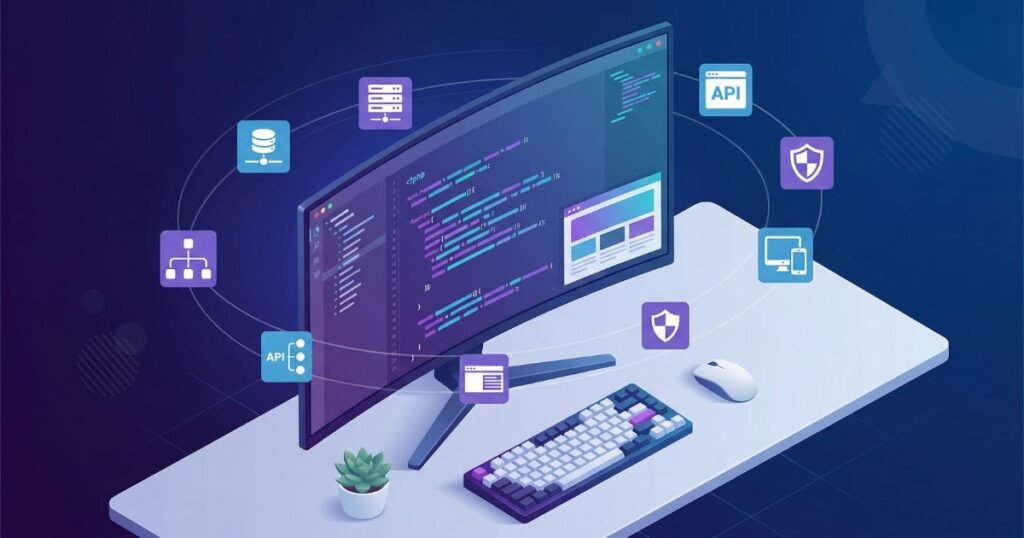
PHP has been one of the most enduring and widely used server-side programming languages since its creation in the mid-1990s. While the broader technology landscape has shifted dramatically over the past three decades, PHP has evolved alongside it, continuously improving its performance, security, and developer experience. A significant part of PHP’s continued relevance comes from the robust ecosystem of frameworks built around it.
A PHP framework provides a structured foundation for building web applications. Instead of writing every component from scratch, developers use frameworks to access pre-built modules for routing, database management, authentication, caching, session handling, and dozens of other common tasks. This dramatically speeds up development, reduces the chance of errors, and encourages best practices in code organization.
Choosing among the best php frameworks for web development is not a trivial decision. Each framework has its own philosophy, its own strengths, and its own ideal use cases. Some are designed for large-scale enterprise applications. Others are built for speed and simplicity. Some prioritize flexibility and allow developers to make most decisions themselves, while others follow strict conventions that guide the development process from start to finish.
This article provides a thorough and detailed guide to the best php frameworks 2026 has to offer. It covers the most popular and battle-tested options, explains their core features, compares their strengths and weaknesses, and helps developers, freelancers, agency owners, and startup founders make an informed decision about which framework to use for their next project.
Whether the goal is to build a small business website, launch an e-commerce platform, develop a content management system, or create a scalable SaaS application, this guide will clarify which framework best fits each scenario.
Why Use a PHP Framework
Writing a web application in raw PHP without a framework is entirely possible, but it introduces significant challenges as the project grows in complexity. Without a structured foundation, codebases become difficult to maintain, scale, and secure. Frameworks solve these problems by providing organized architecture and reusable components.
The most important reason to use a framework is productivity. Frameworks eliminate the need to write boilerplate code for tasks that every web application requires. Authentication systems, form validation, database abstraction layers, template engines, and error handling are all included out of the box in most modern PHP frameworks. This means developers can focus their time and energy on building the unique features that differentiate their application.
Security is another critical factor. PHP frameworks implement security best practices by default. They protect against common vulnerabilities such as SQL injection, cross-site scripting, cross-site request forgery, and session hijacking. Building these protections manually requires deep security expertise, and even experienced developers can make mistakes. A well-maintained framework handles these concerns systematically.
Code organization is a third major benefit. Most PHP frameworks follow the Model-View-Controller pattern, commonly known as MVC. This pattern separates the application into three distinct layers: the model handles data and business logic, the view handles presentation and user interface, and the controller handles incoming requests and coordinates between the model and the view. MVC php frameworks for beginners provide a clear structure that makes it easier to learn, understand, and collaborate on complex projects.
Maintainability improves significantly when a framework is used. When multiple developers work on the same project, having a shared set of conventions and patterns reduces confusion and makes it easier for new team members to get up to speed. The best php mvc frameworks for seo also ensure that applications produce clean, crawlable output that search engines can index effectively.
Community support is the final major advantage. Popular PHP frameworks have large, active communities that contribute plugins, packages, tutorials, and documentation. When a developer encounters a problem, there is almost always someone in the community who has already solved it.
How to Choose the Right PHP Framework
Before examining individual frameworks, it is worth understanding the criteria that should guide the selection process. How to choose php framework for web app depends on several factors that vary from project to project and from developer to developer.
Project size and complexity play a central role. A simple portfolio website or a small business landing page does not need the same framework as a large-scale enterprise resource planning system. Lightweight php frameworks for startups and small projects offer simplicity and speed, while full-featured frameworks provide the tools needed for complex, data-heavy applications.
Performance requirements matter significantly. Some frameworks add overhead that can slow down request processing, while others are optimized for maximum speed. Php framework performance benchmarks vary widely across frameworks, and choosing one that matches the performance needs of the project can prevent bottlenecks as traffic grows.
The learning curve is an important consideration, especially for teams with junior developers or for solo developers who need to get productive quickly. Php frameworks with low learning curve allow developers to start building real applications within days rather than weeks. More complex frameworks offer greater power and flexibility but require a larger upfront investment in learning.
Security requirements should be evaluated carefully. Projects that handle sensitive data, financial transactions, or personal information need frameworks with strong security foundations. Php framework security best practices include input validation, output escaping, parameterized queries, secure session management, and built-in protection against common attack vectors.
Scalability is critical for projects that expect to grow. Php frameworks for scalable web apps should support caching, queue management, database optimization, and horizontal scaling. Choosing a framework that can handle growth from the beginning avoids the costly and disruptive process of migrating to a different framework later.
Community size, documentation quality, available packages, and long-term maintenance are also essential factors. A framework with a small community and infrequent updates may become a liability over time, while a framework with strong community backing provides ongoing security patches, new features, and a wealth of shared knowledge.
The php framework selection for developers ultimately comes down to balancing all of these factors against the specific requirements of the project at hand.
1. Laravel
Laravel is the most popular PHP framework in the world, and it continues to hold that position in 2026 with a wide margin. Created by Taylor Otwell, Laravel is designed to make web development enjoyable, expressive, and productive.
The laravel php framework benefits are numerous and well-documented. At its core, Laravel provides an elegant syntax that is easy to read and write. The framework includes Eloquent ORM for database management, which allows developers to interact with databases using intuitive, expressive PHP code rather than raw SQL queries. Eloquent supports relationships, eager loading, query scoping, and database migrations, all of which simplify complex data operations.
Laravel’s routing system is clean and flexible. Routes can be defined using simple closures, controller methods, or resource controllers that automatically map to standard CRUD operations. The framework also supports route model binding, middleware, route groups, and API resource routes, which provide fine-grained control over how requests are handled.
Blade is Laravel’s templating engine, and it strikes an excellent balance between simplicity and power. Blade templates support template inheritance, sections, components, slots, and directives, making it easy to build reusable and maintainable view layers.
Authentication and authorization are built into Laravel out of the box. The framework provides starter kits like Laravel Breeze and Laravel Jetstream that include login, registration, email verification, password reset, and two-factor authentication. The authorization system supports gates and policies that allow developers to define fine-grained access control rules.
Laravel’s ecosystem is one of its greatest strengths. Laravel Forge automates server provisioning and deployment. Laravel Vapor enables serverless deployment on AWS. Laravel Nova provides an administration panel. Laravel Cashier handles subscription billing. Laravel Scout adds full-text search capabilities. Laravel Echo enables real-time event broadcasting. This rich ecosystem means that developers rarely need to look outside the Laravel world for tools and services.
For php frameworks for ecommerce development, Laravel is an excellent choice. Packages like Bagisto and Aimeos provide full-featured e-commerce solutions built on Laravel, and the framework’s flexibility makes it easy to build custom shopping experiences tailored to specific business needs.
Laravel is also one of the best php framework for cms development. Laravel-based CMS platforms like Statamic and October CMS offer modern, developer-friendly alternatives to traditional content management systems. These platforms leverage Laravel’s architecture to provide clean, extensible, and performant content management experiences.
The framework follows the MVC pattern strictly, and its documentation is among the best in the PHP ecosystem. Every feature is explained clearly with practical examples, which makes Laravel accessible to developers of all skill levels. It is one of the php frameworks with low learning curve relative to the power and flexibility it provides.
2. Symfony
Symfony is a professional-grade PHP framework designed for building complex, enterprise-level web applications. Developed by SensioLabs, Symfony has been a cornerstone of the PHP ecosystem since its initial release and continues to be one of the most respected and widely used frameworks in 2026.
The symfony php framework features include a modular component architecture that sets it apart from most other frameworks. Symfony is built from dozens of decoupled components, each of which can be used independently outside of the full framework. This means developers can use Symfony’s HTTP foundation component, its routing component, its console component, or its event dispatcher in any PHP project, even if they are not using the full Symfony framework.
This modularity has had a profound impact on the PHP ecosystem. Laravel itself uses many Symfony components under the hood, as do Drupal, phpBB, and many other PHP projects. Symfony components are the foundation upon which much of the modern PHP world is built.
Symfony follows the convention-over-configuration approach for common tasks while providing extensive configuration options for developers who need to customize behavior. The framework uses YAML, XML, PHP, and annotation-based configuration, giving developers the flexibility to choose the format they prefer.
Doctrine ORM is the standard database abstraction layer used with Symfony. Doctrine is a powerful and feature-rich ORM that supports complex relationships, custom query builders, database migrations, and advanced caching strategies. It is well-suited for applications with complex data models and sophisticated query requirements.
Twig is Symfony’s templating engine. Twig templates are secure by default because they automatically escape output to prevent cross-site scripting attacks. The template syntax is clean and intuitive, and Twig supports template inheritance, macros, filters, and custom extensions.
For php framework security best practices, Symfony is arguably the strongest option available. The framework includes a comprehensive security component that handles authentication, authorization, access control, CSRF protection, and password hashing. The security system is highly configurable and supports advanced features like voters, firewalls, and guard authenticators.
Symfony is one of the best choices for php frameworks for scalable web apps. Its architecture is designed to handle high traffic, complex business logic, and long-term maintenance requirements. Large organizations and government institutions frequently choose Symfony for their most critical applications because of its stability, security, and long-term support guarantees.
The framework’s LTS releases receive bug fixes for three years and security fixes for four years, which provides the kind of stability that enterprise clients demand. This commitment to long-term support is a significant advantage for projects that need to remain in production for many years.
Symfony’s learning curve is steeper than Laravel’s, but the investment is rewarded with a framework that is extraordinarily powerful, flexible, and well-architected. Developers who master Symfony gain a deep understanding of software architecture principles that transfer to any language or framework.
3. CodeIgniter
CodeIgniter is a lightweight and straightforward PHP framework that has been helping developers build web applications quickly and efficiently for many years. It is known for its small footprint, excellent performance, and minimal configuration requirements.
The codeigniter php web framework is an ideal choice for developers who want to get a project up and running without spending significant time on setup and configuration. The framework has a nearly zero-configuration setup process. After downloading and extracting the files, developers can begin writing application code almost immediately.
CodeIgniter’s documentation is clear, comprehensive, and well-organized. Every feature is explained with practical examples, and the framework’s relatively small API surface means there is less to learn compared to larger frameworks like Symfony or Laravel. This makes CodeIgniter one of the mvc php frameworks for beginners who want to understand the MVC pattern without being overwhelmed by complexity.
Performance is one of CodeIgniter’s greatest strengths. The framework has a small core with minimal overhead, which means it processes requests quickly and uses server resources efficiently. Php framework performance benchmarks consistently show CodeIgniter among the fastest full-featured PHP frameworks available.
CodeIgniter supports a wide range of databases including MySQL, PostgreSQL, SQLite, MSSQL, and Oracle. Its query builder provides a clean interface for constructing database queries without writing raw SQL, while still allowing raw queries when needed for complex operations.
The framework includes built-in support for form validation, session management, file uploading, email sending, pagination, and caching. These features cover the essential needs of most web applications without requiring additional packages or dependencies.
For php frameworks for small business websites, CodeIgniter is an outstanding choice. Its simplicity, speed, and low resource requirements make it well-suited for projects that need to be built quickly, hosted affordably, and maintained without a large development team.
CodeIgniter has evolved significantly with its version four release, which brought modern features like namespacing, autoloading, and improved database and routing systems. While it remains lighter than Laravel or Symfony, it has adopted many modern PHP practices that keep it relevant and competitive.
4. CakePHP
CakePHP is one of the original PHP MVC frameworks, and it continues to be a reliable and productive choice for web development in 2026. The framework follows a convention-over-configuration philosophy, which means it provides sensible defaults for most decisions and allows developers to start building features immediately.
A cakephp web development tutorial typically begins with the framework’s bake command-line tool, which can generate models, controllers, views, and even complete CRUD interfaces from a database schema. This scaffolding capability makes CakePHP one of the fastest frameworks for prototyping and building data-driven applications.
CakePHP’s ORM is powerful and easy to use. It supports table associations including belongsTo, hasMany, hasOne, and belongsToMany relationships. The query builder provides a fluent interface for constructing complex queries, and the ORM includes built-in support for validation, callbacks, and behaviors that can be attached to models to add reusable functionality.
The framework includes a built-in authentication and authorization system, form helper, pagination, caching, and internationalization support. Security features are comprehensive and include CSRF protection, SQL injection prevention, and XSS filtering.
CakePHP follows strict naming conventions that automatically map database tables to models, models to controllers, and controllers to views. While this convention-driven approach requires developers to follow specific naming rules, it eliminates a significant amount of configuration and boilerplate code.
For developers working on php frameworks for ecommerce development, CakePHP provides a solid foundation for building custom e-commerce solutions. Its rapid scaffolding capabilities make it easy to build product catalogs, shopping carts, order management systems, and customer dashboards.
CakePHP’s community is smaller than Laravel’s or Symfony’s, but it is active and supportive. The framework has a plugin ecosystem that extends its functionality with additional features like search, queue processing, and social authentication.
5. Yii Framework
Yii, which stands for “Yes It Is,” is a high-performance PHP framework designed for building modern web applications. The yii php framework guide reveals a framework that balances performance, security, and developer productivity in a cohesive package.
Yii is built from the ground up for performance. It uses lazy loading extensively, which means components are only initialized when they are actually needed. This approach minimizes memory usage and reduces request processing time. The framework also includes built-in support for caching at multiple levels including data caching, fragment caching, page caching, and HTTP caching.
The framework includes Gii, a powerful code generation tool that provides a web-based interface for generating models, controllers, CRUD operations, forms, and modules. Gii speeds up development significantly by automating the creation of boilerplate code while still producing clean, well-structured output that can be customized and extended.
Yii’s ActiveRecord implementation provides an intuitive and efficient way to interact with databases. It supports relational queries, eager and lazy loading, schema caching, and database migration. The query builder supports complex joins, subqueries, and union operations.
Security is a core priority in Yii. The framework provides built-in protection against SQL injection, cross-site scripting, cross-site request forgery, and cookie tampering. Its authentication and authorization components support role-based access control, which makes it easy to implement complex permission systems.
For php frameworks for scalable web apps, Yii is a strong contender. Its performance characteristics and caching capabilities make it well-suited for applications that need to handle high traffic volumes. The framework also supports RESTful API development out of the box, which is essential for modern web architectures that separate the front end from the back end.
Yii’s documentation is comprehensive, and the framework has an active community that contributes extensions, tutorials, and forum support. It is particularly popular in the development communities of Eastern Europe and Asia, where it is used for a wide range of projects from small websites to large-scale enterprise applications.
6. Phalcon
Phalcon is unlike any other PHP framework on this list because it is delivered as a C extension rather than as PHP code. This unique architecture gives Phalcon extraordinary performance advantages that are difficult for any traditional PHP framework to match.
The phalcon framework performance is its defining characteristic. Because Phalcon’s core components are compiled C code that runs directly in memory, the framework adds virtually no overhead to request processing. In php framework performance benchmarks, Phalcon consistently outperforms every other full-featured PHP framework by significant margins.
Despite being implemented as a C extension, Phalcon exposes a fully PHP-based API. Developers write their application code in standard PHP, using Phalcon’s classes and methods just as they would with any other framework. The difference is that the underlying framework code executes much faster than interpreted PHP code.
Phalcon includes all the features expected of a modern PHP framework. It provides an ORM with support for relationships, transactions, and virtual foreign keys. It includes a template engine called Volt that compiles to plain PHP. It offers a routing component, a dependency injection container, a caching layer, an event management system, and comprehensive security tools.
The framework supports both full MVC applications and micro applications, making it suitable for projects of varying sizes. For developers building lightweight APIs or microservices, Phalcon’s micro application approach provides a minimal, high-performance foundation.
The trade-off with Phalcon is that it requires installing a PHP extension on the server, which can be more complex than simply uploading PHP files. Some shared hosting environments do not support custom PHP extensions, which limits Phalcon’s deployment options. However, for developers who have control over their server environment, Phalcon offers unmatched performance.
For top lightweight php frameworks list entries, Phalcon deserves special recognition. It is technically a full-featured framework in terms of capabilities, but its execution model means it consumes minimal resources compared to frameworks that are interpreted at runtime.
7. Slim Framework
Slim is a PHP micro-framework designed for building simple yet powerful web applications and APIs. It provides only the essential tools needed to handle HTTP requests and responses, route them to the appropriate handlers, and return output to the client.
The slim micro php framework tips for effective use center around understanding its philosophy. Slim is not trying to be a full-stack framework. It does not include an ORM, a template engine, or an authentication system out of the box. Instead, it provides a lean, fast, and flexible foundation that developers can extend with the specific components they need.
This minimalist approach makes Slim ideal for building RESTful APIs, microservices, and small web applications. When a project does not need the full feature set of a framework like Laravel or Symfony, using Slim avoids unnecessary complexity and overhead.
Slim supports PSR-7 HTTP message interfaces and PSR-15 middleware, which means it integrates well with a wide range of third-party packages from the PHP ecosystem. Developers can add database abstraction with Eloquent or Doctrine, templating with Twig or Plates, and authentication with any compatible library.
The framework’s middleware architecture is clean and powerful. Each request passes through a series of middleware layers that can perform tasks like logging, authentication, content negotiation, and rate limiting before reaching the route handler. This pipeline approach keeps application code organized and promotes single-responsibility design.
For lightweight php frameworks for startups, Slim is an excellent choice when the project involves building an API backend or a small web service. Its minimal footprint means fast execution and low resource usage, which translates to lower hosting costs and faster response times.
Slim is also a valuable learning tool for developers who want to understand how HTTP frameworks work at a fundamental level. Because Slim does not hide complexity behind layers of abstraction, developers gain a clear understanding of how requests are received, processed, and responded to.
8. FuelPHP
FuelPHP is a community-driven PHP framework that introduced several innovative concepts when it was first released. The fuelphp hmvc tutorial resources available online demonstrate one of the framework’s most distinctive features: its support for the Hierarchical Model-View-Controller pattern.
HMVC extends the traditional MVC pattern by allowing MVC triads to be nested within each other. This means that a controller can call other controllers internally, which promotes modular design and code reuse. Complex pages that display content from multiple independent sources can be composed from separate HMVC modules, each with its own model, view, and controller.
FuelPHP includes a full-featured ORM, a template parser, authentication and authorization components, form validation, and a caching system. The framework also provides a command-line tool called Oil that handles code generation, database migrations, and interactive debugging.
Security features in FuelPHP include input and output filtering, CSRF protection, query parameterization, and encryption utilities. The framework enforces security practices by default, which reduces the risk of common vulnerabilities.
FuelPHP’s community is smaller than those of the top-tier frameworks, and its development pace has slowed in recent years. However, for developers who are already familiar with FuelPHP or who specifically need HMVC architecture, the framework remains a functional and capable option.
PHP Framework Comparison Guide
A php development frameworks comparison guide helps developers see the differences between frameworks at a glance. Understanding the php framework pros and cons of each option is essential for making the right choice.
Laravel offers the best overall developer experience, the largest community, and the richest ecosystem. It is the safest choice for most projects and the best starting point for developers who are new to PHP frameworks. Its trade-off is that it adds more overhead than lighter alternatives, which can affect performance in extremely high-traffic scenarios.
Symfony provides the most robust and well-architected foundation for enterprise applications. It is the best choice for complex, long-lived projects that require strict code quality standards and long-term support. Its trade-off is a steeper learning curve and more verbose configuration compared to Laravel.
CodeIgniter offers the best balance of simplicity and functionality. It is the best choice for small to medium projects that need to be built quickly and hosted affordably. Its trade-off is a smaller ecosystem and fewer built-in features compared to Laravel or Symfony.
CakePHP provides excellent rapid development capabilities through its convention-driven approach and code generation tools. It is the best choice for data-heavy applications that benefit from automatic scaffolding. Its trade-off is that its strict conventions can feel restrictive for developers who prefer more flexibility.
Yii delivers strong performance and comprehensive features in a cohesive package. It is the best choice for performance-sensitive applications that also need a rich feature set. Its trade-off is a smaller English-language community compared to Laravel or Symfony.
Phalcon provides unmatched performance among PHP frameworks. It is the best choice for applications where response time and throughput are critical priorities. Its trade-off is the requirement to install a C extension, which adds complexity to deployment and limits hosting options.
Slim provides the most focused and lightweight foundation for APIs and small applications. It is the best choice for microservices and projects that need minimal overhead. Its trade-off is that it requires developers to assemble their own stack of components for features that other frameworks include by default.
This best php frameworks comparison shows that there is no single best framework for every situation. The right choice depends on the specific requirements, constraints, and priorities of each project.
PHP Framework Trends in 2026
The php framework trends 2026 landscape reflects several broader shifts in the web development industry.
Performance optimization continues to be a major focus. PHP 8.3 and 8.4 have introduced significant performance improvements at the language level, and frameworks are taking advantage of these improvements through JIT compilation, preloading, and fiber-based asynchronous execution. Phalcon framework performance has always set the standard in this area, but other frameworks are closing the gap through optimization and caching strategies.
API-first development is becoming the dominant architectural pattern. Modern applications increasingly separate the front end from the back end, with the PHP framework serving as an API backend that communicates with a JavaScript front end built in React, Vue, or similar technologies. Laravel, Symfony, Yii, and Slim all provide excellent support for building RESTful and GraphQL APIs.
Developer experience is receiving more attention than ever. Frameworks are investing in better documentation, more intuitive configuration, improved error messages, and developer tools that make the development process smoother and more enjoyable. Laravel continues to lead in this area, but other frameworks are learning from its example.
Security awareness is increasing across the ecosystem. Php framework security best practices are being built more deeply into frameworks, with automatic security headers, content security policies, rate limiting, and vulnerability scanning becoming standard features rather than optional add-ons.
Containerization and cloud-native deployment are influencing framework design. Frameworks are being optimized for deployment in Docker containers, Kubernetes clusters, and serverless environments. Laravel Vapor, for example, enables fully serverless deployment on AWS Lambda, which represents a significant shift in how PHP applications can be hosted and scaled.
Choosing a Framework Based on Project Type
Different types of projects call for different frameworks. The following recommendations are based on the strengths and characteristics of each framework.
For small business websites and simple web applications, CodeIgniter and Slim are the most practical choices. Php frameworks for small business websites should be easy to set up, affordable to host, and simple to maintain. Both CodeIgniter and Slim meet these criteria while providing enough functionality to build professional, functional websites.
For e-commerce platforms and online stores, Laravel and Symfony are the strongest options. Php frameworks for ecommerce development need to handle complex product catalogs, shopping carts, payment processing, inventory management, and order fulfillment. Laravel’s ecosystem includes dedicated e-commerce packages, while Symfony’s architecture provides the flexibility and scalability needed for large-scale retail operations.
For content management systems and publishing platforms, Laravel is the leading choice. The best php framework for cms development should support flexible content modeling, user roles and permissions, media management, and SEO-friendly URL structures. Laravel’s ecosystem includes multiple CMS platforms that leverage its architecture to provide modern content management experiences. Best php mvc frameworks for seo also typically produce clean URL structures and properly structured HTML output that search engines can crawl and index effectively.
For high-performance APIs and microservices, Phalcon and Slim are the top choices. When every millisecond of response time matters, these frameworks provide the fastest execution with the least overhead.
For enterprise applications and large-scale systems, Symfony is the clear leader. Its component architecture, long-term support model, and enterprise-friendly design make it the most appropriate choice for mission-critical applications that will be maintained for many years.
For rapid prototyping and minimum viable products, Laravel and CakePHP enable the fastest development cycles. The best programming language for startups that use PHP will almost certainly involve one of these two frameworks because of their ability to turn ideas into working software quickly.
Getting Started with PHP Frameworks
For developers who are new to PHP frameworks, the best approach is to start with one framework and learn it thoroughly before exploring others. Trying to learn multiple frameworks simultaneously leads to confusion and shallow understanding.
Laravel is the recommended starting point for most developers. Its documentation is excellent, its community is the largest, and the abundance of tutorials, courses, and books makes it easy to find help at every stage of the learning process. It is one of the beginner friendly programming languages ecosystems that offers the most support for newcomers.
After gaining proficiency in one framework, developers can expand their knowledge by trying a different framework for their next project. Understanding the similarities and differences between frameworks deepens one’s understanding of web development principles and makes it easier to adapt to new tools and technologies.
Contributing to open-source framework projects is another excellent way to learn. Reading framework source code, submitting bug fixes, and participating in community discussions provide insights that go far beyond what tutorials and documentation can offer.
Conclusion
The best php frameworks for web development in 2026 offer a rich variety of options for every type of project and every level of developer experience. Laravel leads the pack with its unmatched ecosystem and developer experience. Symfony provides the most robust foundation for enterprise applications. CodeIgniter delivers simplicity and performance for smaller projects. CakePHP enables rapid development through conventions and code generation. Yii balances features with performance. Phalcon offers unrivaled speed through its C extension architecture. Slim provides a focused foundation for APIs and microservices. FuelPHP brings HMVC architecture to the PHP world.
PHP framework selection for developers should be guided by project requirements, team capabilities, performance needs, and long-term maintenance considerations. There is no universally best framework, but there is almost certainly a best framework for any given project.
The PHP framework ecosystem continues to evolve, innovate, and improve. Developers who invest time in learning one or more of these frameworks position themselves to build professional, secure, and scalable web applications that meet the demands of modern users and businesses.
Frequently Asked Questions
Which PHP framework is best for beginners in 2026?
Laravel is generally considered the best PHP framework for beginners because of its clear documentation, intuitive syntax, and large community. CodeIgniter is also an excellent beginner choice due to its minimal configuration requirements and straightforward approach. Both frameworks allow new developers to start building functional applications quickly without being overwhelmed by complexity.
Is Laravel better than Symfony?
Laravel and Symfony serve different purposes and excel in different contexts. Laravel is better for rapid development, smaller to mid-sized projects, and teams that value developer experience and productivity. Symfony is better for large-scale enterprise applications that require strict architecture, long-term support, and extensive customization. Many experienced developers learn both and use them for different types of projects.
Which PHP framework has the best performance?
Phalcon has the best raw performance among PHP frameworks because it is delivered as a compiled C extension rather than interpreted PHP code. Among traditional PHP frameworks, CodeIgniter and Slim are the fastest because of their small footprints and minimal overhead. Laravel and Symfony are slower in raw benchmarks but offer caching and optimization features that can bring production performance to acceptable levels for most applications.
Can I use PHP frameworks for e-commerce development?
Yes, PHP frameworks are widely used for e-commerce development. Laravel has dedicated e-commerce packages like Bagisto and Aimeos that provide complete online store functionality. Symfony powers parts of major e-commerce platforms. CakePHP and Yii are also used for custom e-commerce solutions. The choice depends on the scale and complexity of the online store being built.
What is the difference between a micro framework and a full-stack framework?
A micro framework like Slim provides only the essential components for handling HTTP requests, routing, and middleware. It does not include an ORM, template engine, or authentication system by default. A full-stack framework like Laravel or Symfony includes a comprehensive set of tools and components that cover virtually every aspect of web application development. Micro frameworks offer simplicity and flexibility, while full-stack frameworks offer convenience and completeness.
Are PHP frameworks still relevant in 2026?
PHP frameworks are absolutely still relevant in 2026. PHP powers a significant portion of the web, and frameworks like Laravel and Symfony continue to grow in popularity and capability. Modern PHP has excellent performance characteristics, strong type system improvements, and active community development. PHP frameworks remain a practical, efficient, and well-supported choice for building web applications of all sizes.