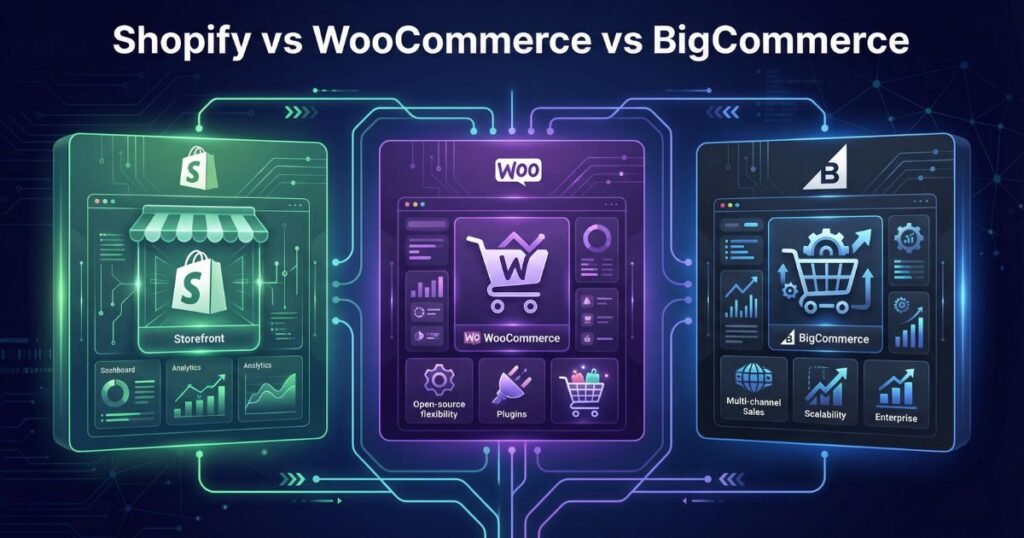
Selecting the right ecommerce platform is one of the most important decisions any online business owner will ever make. That decision becomes even harder when the top three options, Shopify, WooCommerce, and BigCommerce, all bring impressive capabilities to the table. This comprehensive shopify vs woocommerce vs bigcommerce comparison walks you through every detail, complete with side-by-side comparison tables, package breakdowns, pricing analysis, and honest pros and cons so you can make a confident choice.
Millions of online stores run on these three platforms, and each one serves a different type of merchant. Some prioritize simplicity, others prioritize flexibility, and still others prioritize built-in power. The purpose of this article is not to declare a single winner but to help you determine which is better shopify woocommerce or bigcommerce based on your unique business needs, budget, technical skills, and growth goals.
Whether you are a first-time seller, a growing startup, or an established brand reevaluating its tech stack, this shopify vs woocommerce vs bigcommerce review 2026 will serve as your definitive guide.
Quick Snapshot Comparison Table
Before getting into the deep analysis, here is a high-level overview that summarizes the core differences across all three platforms at a glance. This table gives you a quick reference point for the entire shopify vs woocommerce vs bigcommerce features comparison that follows.
| Feature | Shopify | WooCommerce | BigCommerce |
|---|---|---|---|
| Platform Type | Hosted SaaS | Self-Hosted (WordPress Plugin) | Hosted SaaS |
| Free Plan Available | No (Free Trial Only) | Yes (Free Plugin) | No (Free Trial Only) |
| Starting Paid Price | $39/month | $0 (Plugin) + Hosting Costs | $39/month |
| Transaction Fees | Yes (if not using Shopify Payments) | No Platform Fees | No Platform Fees |
| Ease of Use | Very Easy | Moderate to Advanced | Moderate |
| SEO Capabilities | Good | Excellent | Very Good |
| Customization | Moderate | Unlimited | Good |
| Built-in Features | Moderate | Basic (Extensible) | Extensive |
| Hosting Included | Yes | No | Yes |
| Security Managed | Yes | No (User Responsibility) | Yes |
| Best For | Beginners and Dropshippers | Developers and Content Marketers | Growing and Mid-Market Brands |
This table alone answers many common questions, but the real value lies in the detailed breakdowns that follow.
A Brief Overview of Each Platform
Before jumping into the detailed comparisons, it is important to understand the fundamental philosophy behind each platform.
Shopify is a fully hosted, all-in-one ecommerce solution that launched in 2006. It is engineered to make building and running an online store as effortless as possible. Shopify handles hosting, security, updates, and provides a visual store builder alongside thousands of apps in its marketplace. It is consistently rated as the best ecommerce solution for beginners 2026 because it removes virtually all technical barriers.
WooCommerce is an open-source ecommerce plugin built for WordPress. Released in 2011, it has grown into the most widely installed ecommerce solution in the world. Because it runs on WordPress, WooCommerce offers unmatched flexibility and customization. However, it requires users to arrange their own hosting, manage their own security, and handle technical maintenance independently.
BigCommerce is a hosted SaaS ecommerce platform founded in 2009. It positions itself as the feature-rich platform built for growth, providing many advanced selling tools right out of the box without third-party app dependencies. BigCommerce serves businesses of all sizes but has earned a strong reputation among mid-market and enterprise-level merchants.
Understanding these foundational differences is the first step in any meaningful ecommerce platform comparison for small businesses and larger organizations.
Shopify vs WooCommerce vs BigCommerce Pricing Comparison
Cost is often the deciding factor, especially for new business owners. The shopify vs woocommerce vs bigcommerce pricing comparison below reveals exactly what you can expect to pay on each platform, including free and paid options.
Shopify Pricing Packages
| Plan | Monthly Price | Transaction Fee (Third-Party Gateway) | Staff Accounts |
|---|---|---|---|
| Starter | $5/month | 5% | 1 |
| Basic | $39/month | 2% | 2 |
| Shopify | $105/month | 1% | 5 |
| Advanced | $399/month | 0.5% | 15 |
| Shopify Plus (Enterprise) | From $2,300/month | Custom | Unlimited |
Shopify does not offer a permanent free plan. It provides a free trial period, typically three days, followed by promotional pricing for the first few months. Transaction fees are waived when using Shopify Payments, the platform’s built-in payment processor. Premium themes range from one hundred to four hundred dollars as a one-time purchase, and apps from the Shopify App Store can add anywhere from five to two hundred dollars per month each.
WooCommerce Pricing Breakdown
| Component | Cost | Required or Optional |
|---|---|---|
| WooCommerce Plugin | Free | Required |
| Web Hosting | $3 – $50+/month | Required |
| Domain Name | $10 – $15/year | Required |
| SSL Certificate | Free – $100/year | Required |
| Premium Theme | $0 – $200 (one-time) | Optional |
| Premium Extensions | $0 – $300+/year each | Optional |
| Managed WordPress Hosting | $25 – $200+/month | Optional (Recommended) |
WooCommerce is the only platform in this comparison that offers a genuinely free core product. The plugin itself costs nothing to download and install. However, the total cost of ownership depends entirely on your hosting choice, theme, and the extensions you need. A bare-bones WooCommerce store can operate for as little as ten to twenty dollars per month, while a professional setup with managed hosting and premium extensions can reach two hundred to five hundred dollars per month or more.
BigCommerce Pricing Packages
| Plan | Monthly Price | Transaction Fees | Annual Sales Threshold |
|---|---|---|---|
| Standard | $39/month | None | Up to $50K |
| Plus | $105/month | None | Up to $180K |
| Pro | $399/month | None | Up to $400K |
| Enterprise | Custom Pricing | None | Custom |
BigCommerce does not offer a free plan but provides a fifteen-day free trial. One standout advantage is that BigCommerce charges zero transaction fees on any plan, regardless of the payment gateway used. However, BigCommerce does enforce annual sales thresholds, meaning you may be required to upgrade your plan once your revenue exceeds certain limits.
Pricing Comparison Summary Table
| Pricing Factor | Shopify | WooCommerce | BigCommerce |
|---|---|---|---|
| Free Plan Available | No | Yes (Plugin Only) | No |
| Free Trial | Yes (3 Days) | Not Applicable | Yes (15 Days) |
| Lowest Monthly Cost | $5/month (Starter) | ~$3/month (Basic Hosting) | $39/month |
| Mid-Tier Cost | $105/month | ~$50 – $150/month | $105/month |
| Enterprise Cost | From $2,300/month | Varies by Infrastructure | Custom |
| Transaction Fees | 0.5% – 5% (Third-Party) | None | None |
| Hidden Costs | App Fees, Theme Costs | Hosting, Plugins, Security | Plan Upgrades at Thresholds |
When conducting an affordable ecommerce platforms comparison, WooCommerce appears cheapest at the surface level. However, the total cost of ownership can climb quickly when factoring in quality hosting, premium plugins, and developer costs. Shopify offers predictable monthly pricing, while BigCommerce delivers excellent value by including many features that Shopify charges extra for through apps.
Shopify vs WooCommerce vs BigCommerce Features Comparison
Features determine what your store can do and how effectively it serves your customers. This shopify vs woocommerce vs bigcommerce features comparison uses a detailed table to show exactly what comes built in versus what requires add-ons.
| Feature | Shopify | WooCommerce | BigCommerce |
|---|---|---|---|
| Drag-and-Drop Builder | Yes | Via Page Builder Plugins | Limited |
| Product Management | Yes | Yes | Yes |
| Inventory Management | Yes | Yes (Basic) | Yes (Advanced) |
| Abandoned Cart Recovery | Yes (Basic Plan+) | Via Extension (Paid) | Yes (All Plans) |
| Multi-Channel Selling | Yes (Via Apps) | Via Extensions | Yes (Built-In) |
| Gift Cards | Yes | Via Extension | Yes |
| Discount Codes | Yes | Yes | Yes |
| Product Reviews | Via App | Via Extension | Yes (Built-In) |
| Customer Segmentation | Limited | Via Extension | Yes (Built-In) |
| Real-Time Shipping Quotes | Via App | Via Extension | Yes (Built-In) |
| Multi-Currency Support | Yes (Shopify Payments) | Via Extension | Yes (Built-In) |
| Blog | Yes (Basic) | Yes (Advanced – WordPress) | Yes (Basic) |
| App/Extension Marketplace | 8,000+ Apps | 59,000+ Plugins | 1,000+ Apps |
Shopify provides a comprehensive set of tools for building and managing an online store. Its app marketplace contains thousands of third-party tools that extend functionality, but relying on multiple paid apps can significantly increase monthly costs. Many essential features like advanced reporting, abandoned cart recovery, and gift cards are either locked behind higher-tier plans or require paid apps.
WooCommerce starts with fundamental ecommerce capabilities and relies on extensions to expand. The WordPress plugin ecosystem is the largest in the world, giving WooCommerce virtually unlimited extensibility. Advanced features like subscription billing, product bundles, and booking systems require premium extensions, but the variety of available solutions is unmatched.
BigCommerce stands out for its robust built-in feature set. Without purchasing any additional apps, BigCommerce includes advanced product filtering, customer groups and segmentation, multi-currency support, built-in product reviews, real-time shipping rate calculations, and extensive faceted search. This makes BigCommerce particularly appealing for businesses that want powerful features without recurring app costs.
For those seeking the best ecommerce tools for online store owners, each platform has genuine merits. Shopify wins for ecosystem breadth and simplicity, WooCommerce wins for unlimited extensibility, and BigCommerce wins for built-in feature depth and value.
Shopify vs WooCommerce vs BigCommerce Ease of Use
The shopify vs woocommerce vs bigcommerce ease of use comparison is especially important for people who lack technical skills or who want to get their store running quickly.
| Ease of Use Factor | Shopify | WooCommerce | BigCommerce |
|---|---|---|---|
| Setup Time | 30 Minutes – 1 Hour | 2 – 8 Hours | 1 – 2 Hours |
| Learning Curve | Low | High | Moderate |
| Coding Required | No | Sometimes | No |
| Drag-and-Drop Editor | Yes | Via Plugin | Limited |
| Onboarding Assistance | Yes (Guided Setup) | No (Community Support) | Yes (Guided Setup) |
| Customer Support | 24/7 Live Chat, Email, Phone | Community Forums, Host Support | 24/7 Live Chat, Email, Phone |
Shopify is widely regarded as the easiest ecommerce platform available. Setting up a store takes less than an hour, and the interface is intuitive and well-organized. Everything from adding products to configuring shipping rules to launching marketing campaigns happens through a clean, user-friendly dashboard. Shopify is the platform most frequently recommended for the shopify vs woocommerce vs bigcommerce for beginners question because it eliminates virtually all technical complexity.
WooCommerce has a steeper learning curve. Because it runs on WordPress, you need to understand the basics of WordPress site management, including installing plugins, managing themes, configuring settings, and handling updates. Someone with prior WordPress experience will find WooCommerce natural and powerful. A complete beginner, however, may feel overwhelmed by the initial setup process and ongoing management responsibilities.
BigCommerce falls between Shopify and WooCommerce in usability. Its dashboard is well-designed and relatively straightforward, but the sheer number of built-in features and configuration options can feel complex to first-time users. The platform provides helpful onboarding guides and thorough documentation, and most users become comfortable within a few days of active use.
Shopify vs WooCommerce vs BigCommerce SEO Comparison
Search engine optimization is vital for driving organic traffic. The shopify vs woocommerce vs bigcommerce seo comparison reveals meaningful differences in how each platform handles search visibility and ranking potential.
| SEO Feature | Shopify | WooCommerce | BigCommerce |
|---|---|---|---|
| Custom Page Titles | Yes | Yes | Yes |
| Custom Meta Descriptions | Yes | Yes | Yes |
| Custom URL Slugs | Partial (Forced Prefixes) | Full Control | Full Control |
| XML Sitemap | Auto-Generated | Via Plugin | Auto-Generated |
| Robots.txt Editing | Limited | Full Control | Limited |
| Schema Markup | Basic (Auto) | Full Control (Via Plugin) | Built-In Microdata |
| 301 Redirects | Manual | Via Plugin or .htaccess | Built-In Tool |
| Blog for Content Marketing | Basic | Advanced (WordPress) | Basic |
| Page Speed Control | Limited (Managed Hosting) | Full Control | Limited (Managed Hosting) |
| SEO Plugin Availability | Via Apps | Yoast, Rank Math, etc. | Limited |
WooCommerce is generally considered the strongest platform for SEO. Because it runs on WordPress, it benefits from the extensive SEO capabilities of the WordPress ecosystem, including powerful plugins like Yoast SEO and Rank Math. WooCommerce gives you full control over URL structures, meta data, schema markup, XML sitemaps, robots.txt files, and page speed optimization. For businesses where shopify vs woocommerce vs bigcommerce for seo ranking is a top priority, WooCommerce provides the most granular control.
Shopify has significantly improved its SEO capabilities over the years. It now supports customizable meta titles and descriptions, automatic sitemap generation, canonical tags, and structured data. However, Shopify still has notable limitations. Its URL structure includes mandatory prefixes like /collections/ and /products/, and full robots.txt customization is restricted. These are minor issues for most stores but can frustrate advanced SEO practitioners.
BigCommerce provides a solid SEO foundation with customizable URLs without forced prefixes, automatic sitemaps, built-in 301 redirect management, optimized page titles and meta descriptions, and microdata for rich snippets. BigCommerce often ranks between WooCommerce and Shopify in SEO flexibility, offering more URL control than Shopify but less overall customization than WooCommerce.
Shopify vs WooCommerce vs BigCommerce Performance Comparison
Website speed and uptime directly affect user experience, conversion rates, and search engine rankings. The shopify vs woocommerce vs bigcommerce performance comparison below highlights how each platform delivers in real-world conditions.
| Performance Factor | Shopify | WooCommerce | BigCommerce |
|---|---|---|---|
| Average Page Load Time | 1.3 – 2.5 seconds | 1.0 – 5.0+ seconds (Varies) | 1.2 – 2.5 seconds |
| Uptime Guarantee | 99.99% | Depends on Host | 99.99% |
| CDN Included | Yes (Global) | Depends on Host | Yes (Global) |
| Automatic Scaling | Yes | No (Manual) | Yes |
| Caching | Managed | Manual Configuration | Managed |
| Performance Optimization | Automatic | Manual (Plugins Required) | Automatic |
Shopify delivers consistently fast performance because it operates as a fully managed, cloud-hosted platform. Shopify uses a global content delivery network to serve pages quickly to visitors around the world and guarantees 99.99 percent uptime. Store owners never need to worry about server optimization, caching configurations, or database performance tuning.
WooCommerce performance varies dramatically based on the hosting provider, server configuration, theme quality, and number of active plugins. A WooCommerce store on cheap shared hosting with ten poorly coded plugins will perform significantly worse than the same store on a high-quality managed WordPress host with optimized caching and a lightweight theme. WooCommerce can deliver exceptional performance, but achieving it requires deliberate effort, technical knowledge, and often a higher hosting budget.
BigCommerce runs on managed cloud infrastructure built on Google Cloud Platform with global CDN capabilities and a guaranteed uptime of 99.99 percent. Performance is consistently strong across all plans, and store owners never need to manage server-level settings. BigCommerce has invested heavily in platform speed, and most stores load quickly without any additional optimization work.
Shopify vs WooCommerce vs BigCommerce Hosting Comparison
The shopify vs woocommerce vs bigcommerce hosting comparison highlights one of the most fundamental architectural differences between these three platforms.
| Hosting Factor | Shopify | WooCommerce | BigCommerce |
|---|---|---|---|
| Hosting Included | Yes | No | Yes |
| Hosting Type | Managed Cloud | Self-Arranged | Managed Cloud (Google Cloud) |
| Server Management Required | No | Yes | No |
| Bandwidth Limits | Unlimited | Depends on Host | Unlimited |
| Storage Limits | Unlimited | Depends on Host | Unlimited |
| Automatic Backups | Yes | Depends on Host | Yes |
| Server Location Control | No | Yes | No |
Shopify includes hosting as part of every plan. You never need to purchase, configure, or manage a web server. Shopify handles server maintenance, software updates, and security patches completely. This all-inclusive approach is a major reason why Shopify appeals to non-technical store owners and remains a top recommendation in any ecommerce software comparison for startups.
WooCommerce does not include hosting. You must choose a web hosting provider, install WordPress, and then install the WooCommerce plugin. Popular hosting choices include SiteGround, Bluehost, Cloudways, and Kinsta. The hosting provider you select has a direct impact on your store’s speed, security, and reliability. Managed WordPress hosting services tend to deliver better performance and support but come at a higher price than basic shared hosting.
BigCommerce includes hosting in all its plans, similar to Shopify. The platform operates on Google Cloud Platform infrastructure, providing fast load times, automatic scaling, and enterprise-grade reliability. Store owners never need to think about hosting, as BigCommerce handles everything behind the scenes.
Shopify vs WooCommerce vs BigCommerce Security Comparison
Security is non-negotiable for any online store processing customer data and payments. The shopify vs woocommerce vs bigcommerce security comparison examines how each platform protects your business and your customers.
| Security Feature | Shopify | WooCommerce | BigCommerce |
|---|---|---|---|
| Free SSL Certificate | Yes | Depends on Host | Yes |
| PCI DSS Compliance | Level 1 (Highest) | User Responsibility | Level 1 (Highest) |
| Automatic Security Updates | Yes | No (Manual) | Yes |
| Fraud Detection Tools | Yes (Built-In) | Via Extension | Yes (Built-In) |
| Two-Factor Authentication | Yes | Via Plugin | Yes |
| DDoS Protection | Yes | Depends on Host | Yes |
| Malware Scanning | Managed | Via Plugin (Wordfence, etc.) | Managed |
Shopify provides a robust security infrastructure. Every store includes a free SSL certificate, PCI DSS Level 1 compliance, automatic security updates, fraud analysis tools, and two-factor authentication. Because Shopify is a fully managed platform, security patches are applied automatically without requiring any action from the store owner.
WooCommerce security falls entirely on the store owner. WordPress and WooCommerce receive regular security updates, but you must apply them yourself or configure automatic updates carefully. You also need to ensure your hosting provider offers SSL certificates, firewall protection, and malware scanning. Using dedicated security plugins like Wordfence or Sucuri is strongly recommended. The open-source nature of WordPress makes it a frequent target for cyberattacks, particularly when plugins and themes are not kept updated.
BigCommerce provides comprehensive managed security, similar to Shopify. All stores include SSL certificates, PCI DSS compliance, DDoS protection, and automatic platform updates. Security management is entirely handled by the platform, giving store owners complete peace of mind.
Shopify vs WooCommerce vs BigCommerce Payment Options Comparison
The shopify vs woocommerce vs bigcommerce payment options comparison is essential for understanding how each platform handles transactions and which payment methods are supported.
| Payment Factor | Shopify | WooCommerce | BigCommerce |
|---|---|---|---|
| Number of Payment Gateways | 100+ | Virtually Unlimited | 65+ |
| Built-In Payment Processor | Shopify Payments | No | PayPal (Pre-Configured) |
| Transaction Fees (Platform) | 0.5% – 5% (Third-Party) | None | None |
| PayPal Support | Yes | Yes | Yes |
| Stripe Support | Yes | Yes | Yes |
| Apple Pay / Google Pay | Yes | Via Extension | Yes |
| Buy Now Pay Later Options | Yes (Shop Pay Installments) | Via Extension | Yes (Built-In) |
| Cryptocurrency Payments | Via App | Via Extension | Via App |
Shopify supports over one hundred payment gateways including PayPal, Stripe, and its own Shopify Payments. When using Shopify Payments, platform transaction fees are waived, but choosing a third-party gateway triggers additional fees ranging from 0.5 to 5 percent depending on the plan. Shopify also supports Apple Pay, Google Pay, and Shop Pay for streamlined checkout experiences.
WooCommerce supports virtually every payment gateway available through its extension system. Popular options include PayPal, Stripe, Square, Authorize.net, and hundreds of regional and niche gateways. WooCommerce charges zero platform transaction fees, though individual payment processors charge their standard processing rates. This flexibility makes WooCommerce an excellent choice for businesses needing support for specific or uncommon payment methods.
BigCommerce supports over sixty-five payment gateways and charges no additional transaction fees on any plan, regardless of which gateway you use. This is a significant advantage over Shopify, which effectively penalizes merchants who do not use Shopify Payments. BigCommerce supports PayPal, Stripe, Square, Braintree, and many others, along with digital wallets and buy now pay later options.
Shopify vs WooCommerce vs BigCommerce Customization Comparison
The shopify vs woocommerce vs bigcommerce customization comparison is crucial for businesses that want a unique store design and tailored functionality.
| Customization Factor | Shopify | WooCommerce | BigCommerce |
|---|---|---|---|
| Source Code Access | No (Closed Platform) | Yes (Full Access) | Partial |
| Theme Availability | 150+ (Free and Paid) | 10,000+ (Free and Paid) | 200+ (Free and Paid) |
| Custom Theme Development | Yes (Liquid Language) | Yes (PHP, HTML, CSS, JS) | Yes (Stencil Framework) |
| Headless Commerce Support | Yes (Hydrogen) | Yes (REST API, GraphQL) | Yes (Extensive APIs) |
| Page Builder | Yes (Built-In) | Via Plugins (Elementor, etc.) | Limited |
| Custom Checkout | Shopify Plus Only | Full Control | Optimized One-Page |
| Third-Party Integrations | 8,000+ Apps | 59,000+ Plugins | 1,000+ Apps |
WooCommerce offers the highest level of customization among the three platforms. Because it is open source and built on WordPress, you have complete access to the source code and can modify virtually anything. Thousands of WordPress themes and WooCommerce-specific themes are available, and custom theme development is straightforward for experienced developers.
Shopify provides a strong level of customization through its theme system and the Liquid templating language. The Online Store 2.0 architecture has significantly improved customization capabilities, allowing merchants to add and rearrange sections on every page without writing code. However, Shopify remains a closed platform, meaning you cannot alter the core platform code, and custom checkout modifications are reserved for Shopify Plus merchants.
BigCommerce offers solid customization through its Stencil theme framework and supports headless commerce through extensive APIs, allowing businesses to use any frontend framework while leveraging BigCommerce as the backend engine. However, the selection of pre-built themes is smaller compared to Shopify and WooCommerce.
Shopify vs WooCommerce vs BigCommerce Scalability Comparison
As your business grows, your platform needs to grow with it. The shopify vs woocommerce vs bigcommerce scalability comparison examines how well each platform handles increasing demands.
| Scalability Factor | Shopify | WooCommerce | BigCommerce |
|---|---|---|---|
| Product Limits | Unlimited | Unlimited | Unlimited (Catalog-Dependent) |
| Traffic Handling | Automatic Scaling | Depends on Host | Automatic Scaling |
| Enterprise Plan Available | Yes (Shopify Plus) | Not Applicable | Yes (Enterprise) |
| Multi-Store Management | Shopify Plus Only | Via Multisite | Available |
| API Rate Limits | Plan-Dependent | No Platform Limits | Plan-Dependent |
| International Selling | Yes (Shopify Markets) | Via Extensions | Yes (Built-In) |
Shopify scales exceptionally well, especially with its Shopify Plus plan designed for high-volume merchants. The platform handles traffic spikes, large product catalogs, and high order volumes seamlessly. Shopify Plus powers some of the largest ecommerce brands in the world, proving its enterprise-grade scalability.
WooCommerce scalability depends entirely on the hosting infrastructure. A store on shared hosting will struggle with heavy traffic and large databases. A store on a dedicated cloud hosting solution with proper caching, database optimization, and CDN integration can handle enormous traffic levels. Scaling WooCommerce requires technical expertise and infrastructure investment, but there is technically no upper limit to what it can handle.
BigCommerce is built to scale from small businesses to enterprise operations. Its cloud infrastructure handles traffic spikes and large catalogs effectively. BigCommerce also offers its Enterprise plan for high-growth businesses needing custom solutions, dedicated support, and advanced API access.
For the shopify vs woocommerce vs bigcommerce for startups question, all three platforms can accommodate growth, but the path to scalability differs significantly. Shopify and BigCommerce offer effortless managed scaling, while WooCommerce offers unlimited potential that requires hands-on technical management.
Shopify vs WooCommerce vs BigCommerce for Dropshipping
The shopify vs woocommerce vs bigcommerce for dropshipping comparison matters greatly for entrepreneurs who want to sell products without holding inventory.
| Dropshipping Factor | Shopify | WooCommerce | BigCommerce |
|---|---|---|---|
| Dropshipping App Availability | Extensive (DSers, Spocket, Zendrop) | Good (AliDropship, WooDropship) | Moderate (Inventory Source, Modalyst) |
| Ease of Dropshipping Setup | Very Easy | Moderate | Moderate |
| Print-on-Demand Integration | Extensive (Printful, Printify) | Good | Good (Printful) |
| Supplier Network Size | Very Large | Large | Moderate |
| Community and Resources | Very Active | Active | Smaller |
Shopify is widely considered the best platform for dropshipping. Its app ecosystem includes all the major dropshipping tools, and these integrate seamlessly with the platform. Shopify’s ease of use, combined with its extensive dropshipping app selection and active community, makes it the top choice for both new and experienced dropshippers.
WooCommerce also supports dropshipping through various plugins and integrations. AliDropship and WooDropship are popular options that connect WooCommerce stores to global suppliers. The open-source nature of WooCommerce means you have complete control over your dropshipping workflow, but the initial configuration requires more effort compared to Shopify.
BigCommerce supports dropshipping through integrations with tools like Inventory Source, Modalyst, and Printful. While functional, BigCommerce has a smaller selection of dedicated dropshipping apps compared to Shopify, and the dropshipping community around BigCommerce is less extensive.
Shopify vs WooCommerce vs BigCommerce for Digital Marketing
The shopify vs woocommerce vs bigcommerce for digital marketing evaluation looks at how each platform supports marketing activities including email campaigns, social media advertising, content marketing, and analytics.
| Marketing Feature | Shopify | WooCommerce | BigCommerce |
|---|---|---|---|
| Built-In Email Marketing | Yes (Shopify Email) | No (Via Plugin) | Via Integration |
| Blog Quality | Basic | Advanced (WordPress) | Basic |
| Social Media Selling | Yes | Via Extensions | Yes (Built-In) |
| Google Shopping Integration | Yes | Via Extension | Yes (Built-In) |
| Analytics Dashboard | Yes (Detailed) | Via Plugin (Google Analytics, etc.) | Yes (Detailed) |
| Customer Segmentation | Limited | Via Extension | Yes (Built-In) |
| Loyalty Programs | Via App | Via Extension | Via App |
| A/B Testing | Via App | Via Plugin | Limited |
Shopify offers built-in email marketing through Shopify Email, integrations with major advertising platforms, detailed analytics dashboards, and multi-channel selling across social media networks. Its app store also includes powerful marketing tools for email automation, loyalty programs, referral marketing, and conversion optimization.
WooCommerce benefits from the full power of WordPress for content marketing and blogging. WordPress is the most popular content management system in the world, and its blogging capabilities are far superior to those of Shopify and BigCommerce. WooCommerce integrates with all major email marketing platforms, advertising tools, and analytics services through plugins. For businesses where content marketing is a core growth strategy, WooCommerce is the strongest option among all ecommerce platforms for small business marketing.
BigCommerce provides solid marketing features including email marketing integrations, social media selling tools, Google Shopping integrations, and detailed analytics. It also supports customer segmentation and targeted promotions through its built-in customer groups feature. BigCommerce’s marketing capabilities are strong, though its blogging tools are more limited compared to WordPress.
Shopify vs WooCommerce vs BigCommerce Pros and Cons
Understanding the shopify vs woocommerce vs bigcommerce pros and cons helps clarify the trade-offs involved with each platform. The table below summarizes the shopify vs woocommerce vs bigcommerce advantages and disadvantages in a clear format.
| Platform | Advantages | Disadvantages |
|---|---|---|
| Shopify | Extremely easy to use, massive app ecosystem, beautiful themes, reliable hosting, 24/7 support, excellent for dropshipping, strong mobile app | Transaction fees on third-party gateways, basic blogging, URL prefix limitations, app costs can add up quickly, limited code access |
| WooCommerce | Free core plugin, unlimited customization, best SEO control, no transaction fees, largest plugin ecosystem, superior blogging, full code access | Requires self-managed hosting, steep learning curve, security is user responsibility, plugin conflicts possible, no official 24/7 support |
| BigCommerce | Extensive built-in features, no transaction fees, strong SEO tools, multi-channel selling included, reliable hosting, good for growing brands | Smaller theme selection, annual sales thresholds force upgrades, less intuitive than Shopify, smaller app marketplace, limited blogging |
Overall Ratings Comparison Table
This comprehensive rating table summarizes every area covered in this shopify vs woocommerce vs bigcommerce comparison using a simple five-star scale.
| Category | Shopify | WooCommerce | BigCommerce |
|---|---|---|---|
| Ease of Use | 5/5 | 2.5/5 | 3.5/5 |
| Pricing Value | 3.5/5 | 4/5 | 4/5 |
| Built-In Features | 3.5/5 | 2.5/5 | 5/5 |
| SEO Capabilities | 3.5/5 | 5/5 | 4/5 |
| Customization | 3.5/5 | 5/5 | 3.5/5 |
| Performance | 4.5/5 | 3.5/5 (Variable) | 4.5/5 |
| Security | 5/5 | 3/5 (User-Dependent) | 5/5 |
| Scalability | 4.5/5 | 4/5 | 4.5/5 |
| Dropshipping | 5/5 | 3.5/5 | 3/5 |
| Digital Marketing | 4/5 | 4.5/5 | 4/5 |
| Payment Flexibility | 3.5/5 | 5/5 | 4.5/5 |
| Overall Rating | 4.1/5 | 3.9/5 | 4.1/5 |
Which Platform is Best for Small Businesses and Startups
The question of shopify vs woocommerce vs bigcommerce for small business comes down to budget, technical ability, and growth ambitions.
For small businesses with limited technical skills and a desire for simplicity, Shopify is usually the best choice. Its all-in-one approach, intuitive interface, and extensive support resources make it easy to launch and manage a store without any coding knowledge. The predictable monthly pricing also helps with budgeting.
For small businesses on a tight budget that have some technical knowledge or access to a developer, WooCommerce offers the lowest barrier to entry and the greatest long-term flexibility. The open-source model means you are never locked into a proprietary ecosystem, and you can customize every aspect of your store as your business evolves.
For small businesses that need advanced selling features without the complexity of managing a self-hosted platform, BigCommerce offers a compelling middle ground. Its built-in features reduce the need for paid apps, and its lack of transaction fees can result in meaningful savings as order volume increases.
| Business Type | Recommended Platform | Primary Reason |
|---|---|---|
| Complete Beginner | Shopify | Easiest setup and management |
| Budget-Conscious Startup | WooCommerce | Lowest entry cost with free plugin |
| Content-Driven Business | WooCommerce | Superior WordPress blogging |
| Feature-Hungry Growing Brand | BigCommerce | Most built-in features |
| Dropshipping Business | Shopify | Best dropshipping app ecosystem |
| SEO-Focused Business | WooCommerce | Most SEO control and flexibility |
| Multi-Channel Seller | BigCommerce | Built-in multi-channel tools |
| High-Volume Enterprise | Shopify Plus or BigCommerce Enterprise | Managed scaling and support |
This online store builder comparison tools guide should provide the clarity needed to make a confident platform decision. The best ecommerce platform shopify vs woocommerce vs bigcommerce depends entirely on your specific circumstances, and all three are capable of powering successful online businesses.
Final Verdict
This shopify vs woocommerce vs bigcommerce review 2026 has covered every major area of comparison in detail, with side-by-side tables and honest analysis. Here is the bottom line.
Choose Shopify if you want the easiest path to launching an online store, value simplicity over deep customization, plan to leverage dropshipping, and prefer a fully managed platform with world-class support.
Choose WooCommerce if you want maximum control over every aspect of your store, prioritize SEO and content marketing, have technical skills or developer access, and want the freedom of an open-source platform with no vendor lock-in.
Choose BigCommerce if you want powerful built-in features without paying for dozens of apps, value zero transaction fees, need strong multi-channel selling capabilities, and want a managed platform that grows with your business.
Regardless of which platform you select, success in ecommerce ultimately depends on the quality of your products, the strength of your marketing, the experience you deliver to your customers, and your willingness to adapt and improve over time.
Frequently Asked Questions
Which platform is the easiest for someone with absolutely no technical experience?
Shopify is the easiest platform for non-technical users. Its visual drag-and-drop builder, guided setup process, and fully managed hosting mean you can launch a professional online store without writing a single line of code or managing any server settings. BigCommerce is also manageable for beginners, while WooCommerce requires at least basic WordPress knowledge.
Is WooCommerce actually free or are there hidden costs?
WooCommerce itself is a free WordPress plugin, but running a functional WooCommerce store requires paid web hosting, a domain name, and typically premium themes and extensions. The total monthly cost can range from as little as ten dollars on budget hosting to several hundred dollars for a professional setup with managed hosting and premium plugins. It is more accurate to describe WooCommerce as free to start rather than free to operate.
Which platform is best for ranking higher on search engines?
WooCommerce provides the most comprehensive SEO control because it runs on WordPress and supports advanced SEO plugins like Yoast SEO and Rank Math. It gives you full control over URLs, schema markup, sitemaps, and technical SEO settings. BigCommerce offers strong SEO tools with clean URL structures and built-in optimization. Shopify is adequate for most stores but has some structural SEO limitations.
Does BigCommerce charge transaction fees?
No. BigCommerce does not charge any platform-level transaction fees on any of its plans, regardless of which payment gateway you choose. This is a notable advantage over Shopify, which charges additional fees ranging from 0.5 to 5 percent when merchants use third-party payment gateways instead of Shopify Payments.
Can I migrate my store from one platform to another if I change my mind later?
Yes, migration between platforms is possible and many store owners do it. Tools and professional services exist to help transfer products, customer data, and order history. However, migration can be time-consuming, may cause temporary SEO disruptions, and often requires rebuilding your store design from scratch. Choosing the right platform from the beginning saves significant time, money, and stress.
Which platform is the best choice for a startup that plans to scale quickly?
For startups seeking rapid, hassle-free scaling, Shopify and BigCommerce are the strongest options because they handle all infrastructure management automatically. Shopify Plus and BigCommerce Enterprise are specifically designed for high-growth businesses. WooCommerce can scale to any level but requires hands-on server management, infrastructure investment, and technical expertise to handle significant traffic and order volume increases.