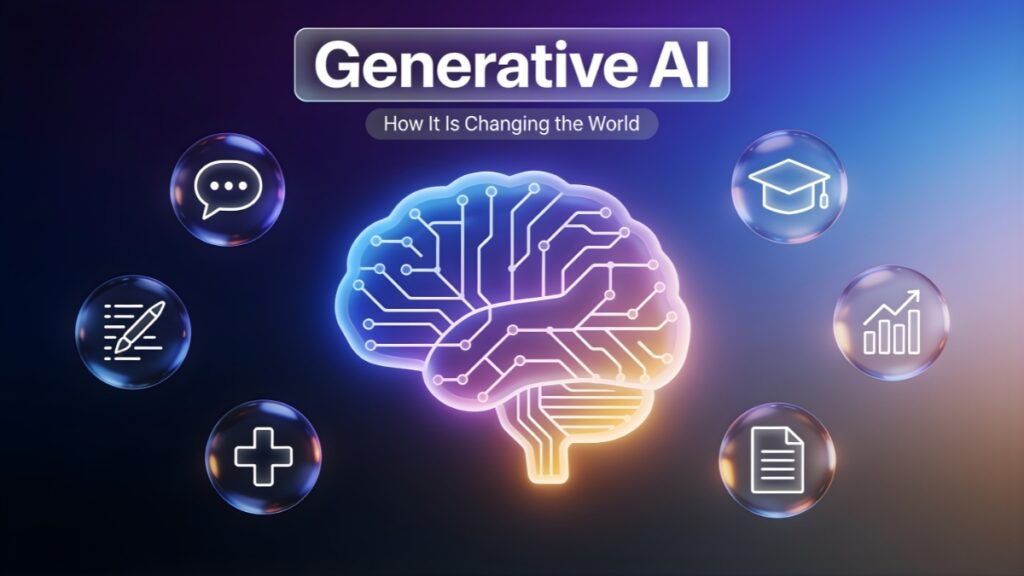
A quiet shift has taken place inside offices, classrooms, hospitals, and creative studios over the past few years. Software that once simply processed information can now produce it: essays, images, music, code, and even video, generated from a short prompt typed by a human. This is generative AI, and it has moved from research labs into daily life faster than almost any technology before it. Understanding how it works, where it is already being used, and what it means for the years ahead has become essential knowledge for professionals across nearly every field.
This article offers a simple explanation of generative AI for readers who want a clear, practical understanding of the technology without wading through technical jargon. It covers how generative AI is changing the world across industries, the real-world uses already reshaping daily routines, the jobs it affects, the ethical questions it raises, and where the technology appears to be heading by the end of the decade. Whether the goal is professional curiosity, academic research, or simply staying informed, this guide lays out the full picture in a structured, easy-to-follow format.
What Is Generative AI? A Simple Explanation
Generative AI refers to a category of artificial intelligence systems capable of creating new content rather than merely analyzing or sorting existing information. Traditional software follows fixed rules: input goes in, a predetermined process runs, and a predictable output comes out. Generative AI works differently. It studies enormous quantities of existing text, images, audio, or code, learns the underlying patterns and structures within that data, and then generates original content that follows those same patterns without copying any single source directly.
For students encountering the topic for the first time, a generative AI definition that sticks is this: it is a computer system trained to recognize patterns in human-created content and then produce new content that resembles what it learned, whether that means writing a paragraph, drawing an illustration, composing a melody, or drafting a block of software code. The system does not “understand” content the way a person does. Instead, it calculates the statistical likelihood of what should come next in a sequence, whether that sequence is a string of words, pixels, or musical notes, and builds its output one step at a time based on those probabilities.
Explaining how generative AI works simply usually starts with the concept of a neural network, a layered mathematical structure loosely inspired by the way neurons connect in the human brain. During training, this network is shown millions or billions of examples, such as sentences from books and websites, or images paired with descriptive captions. Through repeated exposure, the network adjusts internal parameters until it becomes skilled at predicting the next word in a sentence or the next pixel in an image. Once trained, the same network can be prompted with a new instruction and will generate fresh content by applying everything it learned during that training phase.
Large language models, a well-known subset of generative AI, specialize in text. Diffusion models, another common architecture, specialize in images, gradually transforming random noise into a coherent picture that matches a text description. Other generative systems handle audio, video, or three-dimensional design. Despite the different formats, all of these systems share the same foundational idea: learning patterns from existing data and then generating new content that follows those patterns convincingly.
A Brief History and Evolution of Generative AI
The history and evolution of generative AI stretches back further than most people realize, even though public attention only intensified in the past few years. Early generative techniques emerged in the 1960s and 1970s with simple rule-based chatbots and pattern-generation programs, which could produce basic text responses but lacked any real understanding of context or nuance. These early systems were rigid, limited to narrow scripts, and far from anything resembling genuine creativity.
The next major shift arrived with the development of neural networks in the 1980s and 1990s, followed by a breakthrough moment in 2014 with the introduction of generative adversarial networks, commonly known as GANs. This architecture pitted two neural networks against each other, one generating content and the other evaluating how convincing it was, pushing both networks to improve continuously. GANs became the foundation for realistic image generation and sparked a wave of academic research into synthetic media.
A second turning point came in 2017, when researchers introduced the transformer architecture, a design that dramatically improved how machines process sequences of text by allowing the system to weigh the importance of different words relative to each other, regardless of their position in a sentence. This architecture became the backbone of nearly every major language model that followed, including the systems that eventually became household names after 2022, when publicly accessible chatbots demonstrated just how fluent and useful generative AI had become.
Since that public debut, the pace of development has accelerated substantially. Model capabilities that once required specialized research access became available through simple web interfaces and mobile apps, opening the technology to hundreds of millions of everyday users, students, small business owners, and independent creators who previously had no direct access to advanced machine learning tools. Understanding this progression from rigid, rule-based scripts to today’s flexible and remarkably capable systems helps explain why the current moment feels like such a distinct turning point in computing history.
How Generative AI Is Changing the World: The Big Picture
Asking how is generative AI changing the world requires looking beyond any single industry, because its influence is spreading across nearly every sector of the global economy simultaneously. Unlike earlier waves of automation that primarily affected manual or repetitive tasks, generative AI reaches into knowledge work, creative work, and decision-making processes that were previously considered uniquely human territory. This breadth is precisely what distinguishes it from previous technological shifts.
The impact on society is visible in how people now approach research, writing, design, and problem-solving. Tasks that once required specialized skills or significant time investment, such as drafting a business proposal, designing a marketing graphic, or debugging a piece of software, can now be completed in a fraction of the time with AI assistance. This does not eliminate the need for human judgment, but it does compress the time between having an idea and producing a usable first draft, which changes how work gets planned and executed across countless professions.
There is also a social dimension to this shift that extends beyond productivity. Generative AI is altering how information is created and consumed, how education is delivered, and how creative industries operate. Some of these changes bring clear benefits, such as expanded access to personalized tutoring or faster medical research. Others raise legitimate concerns, including questions about misinformation, the authenticity of digital content, and the displacement of certain job categories. A balanced view of the social impact of generative AI has to hold both realities at once: meaningful benefits paired with real risks that require thoughtful management.
What makes this moment particularly significant is the speed of adoption. Technologies like electricity, the internet, and smartphones took years or decades to reach mainstream global use. Generative AI tools reached hundreds of millions of users within months of their public release, compressing what historically took a generation into a much shorter window. This speed amplifies both the opportunities and the challenges, since institutions, regulations, and social norms have had far less time to adapt compared to previous technological transitions.
Real-World Uses and Everyday Examples of Generative AI
Understanding the real-world uses of generative AI becomes much clearer through concrete, everyday examples rather than abstract descriptions. Many people already interact with generative AI multiple times a day without necessarily labeling it as such, which is part of why its influence can feel simultaneously enormous and invisible.
Consider a few generative AI everyday examples that have become routine for millions of people. Email platforms now suggest complete sentences or entire draft replies based on a short prompt. Photo editing apps can remove unwanted objects from a picture and intelligently fill in the background using AI-generated content that matches the surrounding scene. Navigation apps use predictive models to suggest routes, while streaming services rely on generative recommendation systems to personalize what appears on a user’s home screen. Voice assistants on phones and smart speakers increasingly rely on generative language models to hold more natural, flowing conversations rather than responding with rigid, pre-programmed scripts.
Practical examples of generative AI in professional settings are equally widespread. A small business owner might use an AI writing assistant to draft product descriptions for an online store. A student might use an AI tutor to get a plain-language explanation of a difficult chemistry concept. A graphic designer might generate several initial concept sketches with an AI image tool before refining the strongest option by hand. A customer support team might deploy an AI chatbot to handle routine inquiries around the clock, freeing human agents to focus on complex cases that require empathy and judgment.
How generative AI affects daily life also shows up in less obvious ways. Search engines increasingly summarize information using generative models rather than simply listing links. News aggregators use similar technology to condense lengthy articles into quick summaries. Even grammar and spell-check tools, once based on simple rule sets, now rely on generative language models to suggest more natural phrasing and tone adjustments. These small, cumulative interactions add up to a daily experience that is subtly but continuously shaped by generative AI, even for people who have never deliberately opened an AI chatbot.
How Generative AI Transforms Industries
Looking at how generative AI transforms industries reveals a pattern: the technology tends to automate the repetitive, time-consuming portions of a task while leaving strategic, relationship-driven, and judgment-heavy work to humans. This pattern repeats across sectors, though the specific applications vary considerably depending on the nature of the work involved.
Generative AI in Healthcare
The question of how generative AI changes healthcare touches nearly every part of the medical field, from drug discovery to patient communication. Pharmaceutical researchers use generative models to propose new molecular structures with a higher likelihood of therapeutic effectiveness, compressing a process that traditionally took years of trial and error into a much shorter research cycle. Medical imaging tools use generative techniques to enhance scan clarity and flag potential abnormalities for radiologists to review, acting as a second set of eyes rather than a replacement for clinical expertise.
On the administrative side, generative AI helps reduce the paperwork burden that contributes heavily to physician burnout. Systems that automatically summarize patient visits, draft clinical notes, and generate discharge instructions save clinicians measurable time each day, time that can be redirected toward direct patient care. Personalized patient education materials, generated based on a specific diagnosis and reading level, also improve health literacy among patients who might otherwise struggle to understand dense medical terminology. It is worth noting that these tools function as decision-support aids; the final clinical judgment continues to rest with licensed medical professionals, particularly for diagnosis and treatment decisions.
Generative AI in Finance
Generative AI applications in finance span fraud detection, personalized financial advice, and automated reporting. Banks use generative models to draft summaries of complex financial documents, helping analysts review large volumes of contracts, earnings reports, and regulatory filings far more quickly than manual reading would allow. Customer-facing chatbots handle routine banking questions, account inquiries, and basic financial planning guidance, operating continuously without the staffing constraints of a traditional call center.
Risk assessment has also benefited, with generative systems helping to simulate market scenarios and stress-test investment portfolios against a wider range of hypothetical conditions than earlier statistical models could practically generate. Compliance teams use generative AI to draft initial versions of regulatory filings, which are then reviewed and finalized by licensed professionals to ensure accuracy and legal compliance. As with healthcare, the technology accelerates the drafting and analysis stages while leaving final decisions, particularly those involving client funds or regulatory obligations, under human oversight.
Generative AI in Education
The discussion of generative AI in education benefits usually centers on personalization and accessibility. Traditional classrooms often teach to the average student, which can leave some learners behind while under-challenging others. Generative AI tutoring systems can adjust the pace, complexity, and explanation style of a lesson in real time based on a student’s responses, offering a level of individualized attention that would be difficult for a single teacher to provide across a full classroom.
Teachers benefit as well, using generative tools to draft lesson plans, generate practice questions at varying difficulty levels, and create rubrics for grading assignments more consistently. Language learners use conversational AI to practice speaking with a patient, always-available partner rather than relying solely on structured classroom time. Students with learning differences or disabilities also gain from generative AI’s ability to reformat content, whether that means converting dense text into simpler language or generating audio versions of written material. These benefits do come with a responsibility to teach digital literacy alongside AI use, since students also need to learn how to evaluate AI-generated content critically rather than accepting it uncritically.
Generative AI in Content Creation and Digital Marketing
Few areas illustrate the creative uses of generative AI as clearly as content creation and marketing. Generative AI in content creation now supports blog writing, social media captions, video scripts, and product descriptions, often serving as a starting point that a human editor refines rather than a finished, publish-ready product. This shift has changed the economics of content production, allowing smaller teams to produce a higher volume of material without necessarily sacrificing quality, provided human review remains part of the workflow.
Generative AI changing digital marketing is evident in how campaigns are built today. Marketers use AI tools to generate dozens of ad copy variations for A/B testing, produce personalized email content tailored to different customer segments, and create product images or short promotional videos without the cost of a full studio production. Search engine optimization has also evolved, with generative tools assisting in keyword research, content structuring, and identifying gaps in existing coverage on a given topic.
Beyond marketing, creative uses of generative AI extend into music composition, video game asset design, film pre-visualization, and concept art for architecture and product design. Independent musicians use generative tools to experiment with new arrangements, while game studios use them to rapidly prototype environments and characters before committing resources to final production. This does not replace the creative vision of the artist or designer; rather, it accelerates the exploration phase, allowing more ideas to be tested before settling on a final direction.
Generative AI in Software Development
The generative AI software development impact has been particularly pronounced within the technology industry itself. Code-generation tools can suggest entire functions based on a brief comment describing the desired behavior, catch bugs before they reach production, and translate code from one programming language to another. Developers report substantial reductions in time spent on repetitive coding tasks such as writing boilerplate code, generating test cases, and documenting existing codebases.
This shift changes the nature of a developer’s daily work rather than eliminating the role entirely. Engineers increasingly spend more time reviewing, refining, and architecting systems, while the AI handles a larger share of the initial code drafting. Junior developers, in particular, benefit from having an AI assistant available to explain unfamiliar code or suggest alternative approaches, functioning as an on-demand mentor during the learning process. Software teams that have integrated these tools effectively often report faster development cycles, though experienced engineers caution that AI-generated code still requires careful review, since generated suggestions can occasionally introduce subtle errors or security vulnerabilities that a less experienced reviewer might miss.
Generative AI’s Impact on Jobs and the Workforce
Few topics generate as much public discussion as generative AI’s impact on jobs, and the honest answer is more nuanced than either the most optimistic or the most alarming headlines suggest. Research from Goldman Sachs has estimated that generative AI could expose the equivalent of roughly 300 million full-time jobs worldwide to some degree of automation, with white-collar roles in administrative support, legal services, and similar knowledge-based fields facing the highest exposure, while physically demanding occupations such as construction and skilled trades face comparatively limited direct exposure.
It is important to distinguish between exposure and outright elimination. Being exposed to automation means that a meaningful share of a role’s tasks could be handled by AI, not that the entire job disappears. Many roles are expected to be transformed rather than eliminated, with workers taking on a greater share of judgment-based, relationship-driven, or strategic responsibilities while routine components of their work shift to AI assistance. At the same time, new job categories are emerging around AI oversight, prompt engineering, model training, and AI ethics compliance, roles that barely existed a few years ago.
Generative AI productivity statistics help put this transformation in perspective. Research from McKinsey estimates that generative AI could add between roughly 2.6 trillion and 4.4 trillion dollars in annual value to the global economy through productivity gains across functions such as customer operations, marketing, sales, and software engineering, with the potential impact roughly doubling when accounting for broader integration into existing business software. These figures illustrate why so many organizations are investing heavily in adoption despite the workforce disruption that accompanies the transition.
For individual workers, the most practical response to this shift involves building comfort and fluency with generative AI tools rather than avoiding them. Professionals who learn to direct, edit, and critically evaluate AI-generated output tend to be better positioned than those who either ignore the technology entirely or rely on it without applying independent judgment. Reskilling and continuous learning, long recommended during previous waves of technological change, remain the most reliable strategy for navigating this current transition as well.
Popular Generative AI Tools for Beginners and Creators
For anyone getting started, choosing from the many generative ai tools for beginners can feel overwhelming, especially given how quickly new options appear. A curated generative ai tools list for creators typically groups tools by the type of content they generate, since text, image, audio, and video tools each serve distinct purposes and workflows.
| Tool Category | Popular Example | Primary Use Case | Best Suited For |
|---|---|---|---|
| Text and writing | ChatGPT | Drafting content, answering questions, brainstorming | Writers, students, business professionals |
| Image generation | Midjourney | Creating illustrations and concept art from text prompts | Designers, marketers, hobbyist artists |
| Code assistance | GitHub Copilot | Suggesting and completing code in real time | Software developers, engineering teams |
| Voice and audio | ElevenLabs | Generating realistic voiceovers and narration | Podcasters, video creators, e-learning developers |
| Presentation design | Gamma | Turning outlines into formatted slide decks | Business teams, educators, consultants |
| Video creation | Synthesia | Producing AI avatar-led video content | Corporate training teams, marketers |
Beginners are generally advised to start with a single text-based tool to become comfortable with prompt writing, the skill of describing a desired outcome clearly enough for the AI to generate a useful response. Prompt writing improves quickly with practice, and most tools offer templates or example prompts that help new users understand effective phrasing before experimenting with more advanced, open-ended requests. Once comfortable with text generation, branching into image or audio tools tends to be a natural next step for anyone working in a creative or marketing-adjacent role.
Advantages and Disadvantages of Generative AI
A fair assessment of generative ai advantages and disadvantages requires looking honestly at both sides, since enthusiasm about the technology’s capabilities should not overshadow its genuine limitations and risks.
| Advantages | Disadvantages |
|---|---|
| Significantly speeds up drafting, research, and repetitive tasks | Can produce factually incorrect or fabricated information |
| Expands access to personalized education and creative tools | Raises questions about copyright and training data usage |
| Lowers the cost of content production for small businesses | May displace certain categories of routine, repetitive jobs |
| Assists with accessibility for people with disabilities | Requires significant energy and computing resources to run |
| Available around the clock without staffing constraints | Can be misused to create misinformation or deceptive content |
| Helps non-experts complete specialized tasks with guidance | Outputs still require human review for accuracy and quality |
The limitations of generative AI technology deserve particular attention because they are often underestimated by new users. These systems generate output based on statistical patterns rather than verified facts, which means they can produce confident-sounding but inaccurate statements, a phenomenon often referred to as hallucination. They also reflect biases present in their training data, which can surface in subtle or unexpected ways depending on the topic. Recognizing these limitations is not a reason to avoid the technology, but it is a strong argument for maintaining human oversight, particularly in contexts involving medical, legal, financial, or safety-critical decisions.
Ethical Issues and Dangerous Aspects of Generative AI
Discussions of generative AI ethical issues typically center on a handful of recurring themes: intellectual property, misinformation, privacy, and accountability. Generative models are trained on vast datasets that often include copyrighted material scraped from the internet, and questions about whether this training process constitutes fair use or infringement remain unsettled in many jurisdictions, with ongoing legal cases likely to shape future industry practices.
Misinformation represents one of the more dangerous aspects of generative AI, particularly as image, audio, and video generation tools become more realistic. Synthetic media, sometimes called deepfakes, can convincingly depict people saying or doing things that never happened, raising serious concerns for elections, journalism, and personal reputation. Detecting manipulated content has become an ongoing technical challenge, with detection tools racing to keep pace with increasingly sophisticated generation methods.
Privacy concerns also warrant attention, since generative AI systems trained on personal data, whether scraped from public sources or submitted by users, can sometimes reproduce fragments of that data in unexpected ways. Organizations deploying generative AI in customer-facing applications need clear policies around data handling, retention, and consent to avoid exposing sensitive information inadvertently. Accountability presents a further challenge: when an AI-generated recommendation leads to a harmful outcome, questions about who bears responsibility, the developer, the deploying organization, or the end user, remain an active area of legal and policy debate.
Addressing these risks responsibly involves a combination of technical safeguards, such as watermarking AI-generated content and building in fact-checking mechanisms, alongside policy measures like clearer labeling requirements and updated intellectual property frameworks. Organizations adopting generative AI are increasingly expected to establish internal guidelines covering acceptable use, human review requirements, and transparency with end users about when they are interacting with AI-generated content.
Generative AI’s Global Economic Impact
The generative ai global economic impact extends well beyond individual companies adopting new software tools; it represents a structural shift in how value gets created across entire economies. Beyond the McKinsey productivity estimates mentioned earlier, Goldman Sachs research has projected that widespread AI adoption, including generative AI, could raise global GDP by as much as 7 percent over a decade, a figure roughly equivalent to several trillion dollars in additional annual economic output once fully realized.
This growth is not evenly distributed. Sectors such as banking, high technology, retail, and life sciences are projected to see some of the largest gains, driven by the concentration of knowledge work, customer interaction, and research activity within these industries. Emerging economies face a more complex picture, since the infrastructure investment, digital literacy, and workforce reskilling required to capture these gains vary considerably depending on regional readiness, meaning the economic benefits of generative AI could widen existing gaps between well-resourced and under-resourced regions if adoption support is not distributed thoughtfully.
Investment trends reflect this optimism, with capital flowing rapidly into companies developing generative AI infrastructure, chips, and applications. This investment surge has created new categories of employment around AI infrastructure, data center construction, and specialized engineering roles, partially offsetting displacement in other areas. Policymakers in multiple countries have begun exploring how to balance encouraging this economic growth with managing the workforce transition responsibly, recognizing that the scale of potential economic impact is too large to ignore but too disruptive to leave entirely unmanaged.
Current Trends and the Future Scope of Generative AI
Several current trends in generative AI technology point toward where the field is heading next. Multimodal systems, capable of processing and generating text, images, audio, and video within a single unified model, are becoming increasingly common, reducing the need to switch between separate specialized tools for different content types. This convergence is making generative AI feel less like a collection of separate apps and more like a single, flexible assistant capable of handling varied tasks.
Another significant trend involves the shift toward AI agents, systems that do not just respond to a single prompt but can carry out multi-step tasks autonomously, such as researching a topic, drafting a report, and formatting it correctly without step-by-step human instruction at every stage. This agentic capability represents a meaningful evolution beyond simple content generation toward genuine task completion, and it is likely to reshape how software applications are designed going forward.
Looking at generative ai future scope more broadly, smaller and more efficient models are also gaining traction, allowing generative AI capabilities to run directly on personal devices rather than requiring constant connections to large cloud-based systems. This shift improves privacy, reduces latency, and lowers operating costs, making advanced AI capabilities accessible even in environments with limited internet connectivity. Industry-specific models, fine-tuned for specialized fields such as legal research, medical diagnostics, or scientific research, are also becoming more common, trading general-purpose flexibility for deeper expertise within a narrower domain.
How Will Generative AI Evolve by 2030?
Projecting how will generative AI evolve by 2030 involves informed extrapolation rather than certainty, but several patterns seem likely to continue. Model accuracy and reliability are expected to keep improving, gradually reducing, though probably not eliminating, the hallucination problem that currently requires careful human oversight. Regulatory frameworks are also likely to mature considerably, with clearer rules around content labeling, copyright, and liability emerging as courts and legislatures catch up with the technology’s rapid deployment.
Workforce integration will likely deepen further, with generative AI becoming a standard, expected skill within most knowledge-based professions rather than a specialized or optional capability, similar to how spreadsheet proficiency became a baseline expectation in office jobs decades ago. Educational curricula are already beginning to incorporate AI literacy at earlier stages, suggesting that workers entering the job market by the end of the decade will have grown up with generative AI as a familiar tool rather than a novel technology.
Economic estimates suggest the value created by generative AI will continue compounding as adoption spreads from early-adopter industries into sectors that have been slower to integrate the technology, including government services, traditional manufacturing, and smaller businesses that currently lack the resources to experiment extensively. By 2030, generative AI is likely to feel less like a distinct technology category and more like an embedded layer within most digital tools and services, much the way cloud computing became invisible infrastructure rather than a standalone product category.
Why Generative AI Matters Today
Understanding why generative AI matters today comes down to timing and scale. The technology has reached a level of capability, accessibility, and affordability that makes meaningful engagement possible for individuals, small businesses, and large enterprises alike, not just well-funded research institutions. This democratization means the decisions made today, by individuals choosing whether to build AI fluency and by organizations choosing how to deploy these tools responsibly, will shape competitive positioning and social outcomes for years to come.
Ignoring the technology entirely carries its own risks, given how quickly competitors, classmates, and colleagues are integrating these tools into their workflows. At the same time, adopting generative AI without critical thinking, fact-checking, and ethical consideration carries risks of its own, from spreading inaccurate information to producing work that lacks genuine originality or insight. The most sustainable path forward involves treating generative AI as a capable but imperfect collaborator, one that accelerates certain tasks substantially while still requiring human judgment, oversight, and accountability for the final result.
Generative AI is neither a passing trend nor a fully solved technology; it sits somewhere in between, evolving rapidly while still carrying meaningful limitations. Approaching it with informed curiosity, rather than uncritical enthusiasm or reflexive dismissal, offers the most practical foundation for navigating the changes it continues to bring to industries, education, creative work, and everyday life.
Frequently Asked Questions
What is the simplest way to explain generative AI to someone new to the topic?
Generative AI is technology trained on large amounts of existing text, images, or audio that learns patterns from that data and then creates new, original content following those same patterns. Rather than following a fixed script, it predicts what should come next based on probability, whether generating a sentence, an image, or a piece of code.
How is generative AI changing the world outside of technology companies?
Its influence now extends into healthcare, finance, education, retail, and creative industries, changing how professionals draft documents, analyze data, personalize services, and produce content. The shift is not limited to tech-focused roles, since generative AI tools are increasingly built into everyday software used across nearly every profession.
Will generative AI eliminate more jobs than it creates?
Research suggests a mixed outcome, with a significant share of jobs exposed to some degree of task automation while new roles emerge around AI oversight, development, and ethics. Most existing jobs are expected to be transformed rather than eliminated outright, with routine tasks shifting to AI while judgment-based responsibilities remain with human workers.
What are the biggest risks associated with generative AI?
The most significant concerns include misinformation from realistic synthetic media, unresolved copyright questions around training data, potential bias in AI-generated output, and the tendency for these systems to occasionally produce confidently stated but incorrect information. Responsible use requires human review and fact-checking rather than blind trust in AI-generated content.
Which generative AI tools are best for someone just getting started?
Beginners generally benefit from starting with a widely used text-based tool to build comfort with writing effective prompts before exploring image, audio, or video generation tools. Most platforms offer built-in templates and examples that make the learning curve manageable for first-time users.
How much economic value could generative AI generate globally?
Estimates from major research firms suggest generative AI could add between roughly 2.6 trillion and 4.4 trillion dollars annually to the global economy through productivity gains, with some projections reaching considerably higher when accounting for broader software integration. Actual outcomes will depend heavily on how quickly and responsibly organizations adopt the technology.