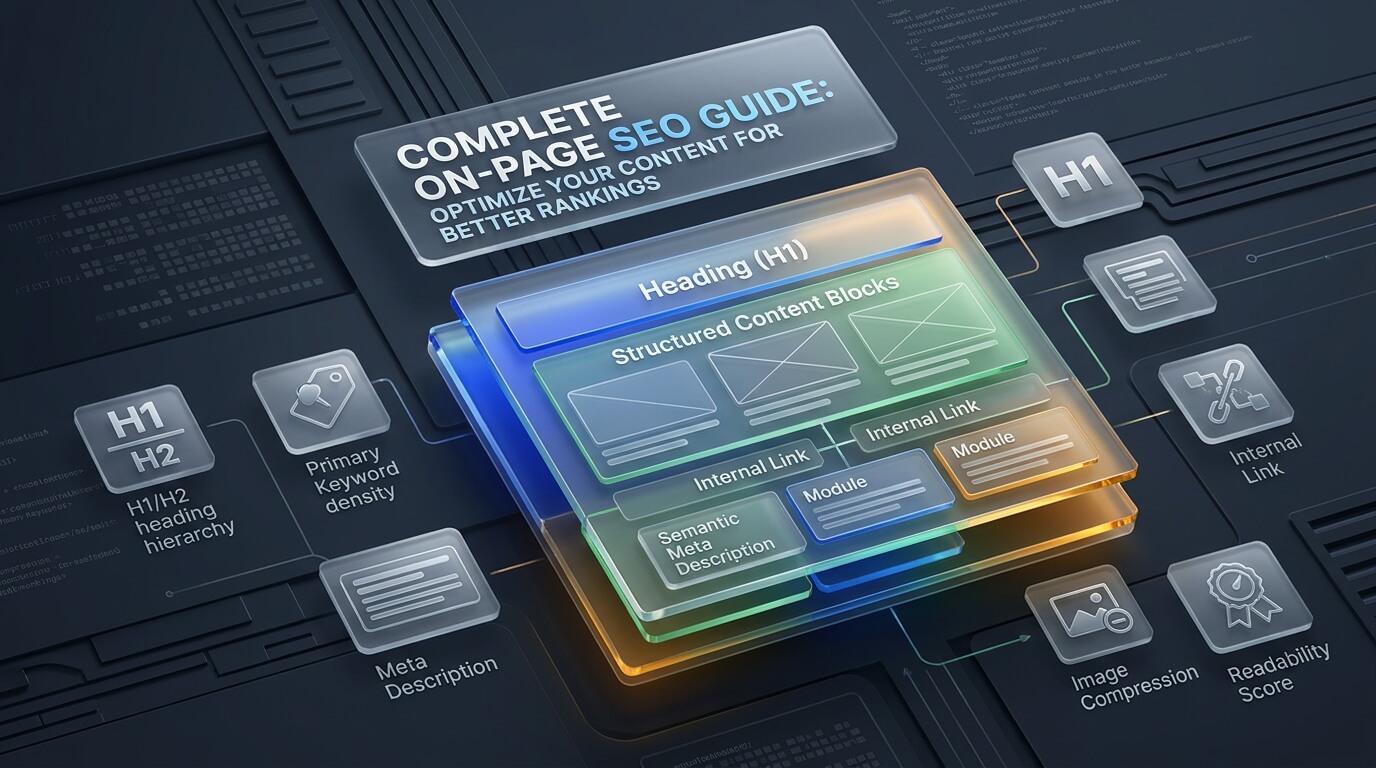
Search engine algorithms evaluate hundreds of ranking signals every second. Some factors, such as external backlinks and brand mentions, rely on third parties outside your immediate control. However, the most direct way to influence search performance sits right on your website.
Mastering on page seo gives you total command over your organic search presence. When you optimize page structure, meta tags, and written content, you tell search engines exactly what your pages deliver. Clear signals help algorithms index your pages accurately and rank them for relevant customer queries.
Modern search optimization goes far beyond repeating keywords in body paragraphs. Today, successful publishers balance search engine requirements with genuine human reader satisfaction. Search engines actively reward web pages that load quickly, provide thorough answers, and guide visitors through intuitive page architecture.
In this comprehensive guide, you will master proven on-page seo strategies to improve your organic rankings. We cover essential meta tags, content formatting, internal link architecture, and image handling. You will also review the top optimization software suites and follow an actionable checklist for every page you publish.
Key Takeaways: On-Page Optimization Essentials
- On-page optimization encompasses all elements directly within your control on a single webpage.
- Search intent alignment and thorough answer delivery outweigh artificial keyword density metrics.
- Clean header hierarchies and descriptive meta tags dramatically improve search click-through rates.
- Strategic internal linking distributes page authority and helps search engine crawlers map your site.
- Optimizing images and technical page elements ensures fast loading speeds across mobile devices.
Understanding On-Page SEO: Principles and Core Mechanics
Before implementing specific tactics, you must grasp what seo on page truly accomplishes. On-page optimization refers to the practice of optimizing individual web pages to rank higher and earn more relevant traffic in search engines. It includes optimizing both the visible content and the underlying HTML source code.
Digital marketing divides search engine optimization into three primary pillars: technical SEO, off-page SEO, and on-page SEO. Technical SEO focuses on website crawling, indexing, and server speed. Off-page SEO centers on building backlinks, brand authority, and digital PR. On-page optimization bridges these disciplines by ensuring that individual pages satisfy user intent and communicate clearly with search engine bots.
Google’s ranking algorithms continuously evolve through machine learning models like RankBrain and helpful content systems. These systems evaluate whether a webpage provides a complete, satisfying answer to the user’s initial query. If a visitor clicks your search listing and immediately returns to the search results to find another source, search engines recognize that your content failed to satisfy the query.
Effective on-page strategy aligns technical clarity with engaging writing. When your content answers customer questions thoroughly, visitors spend more time reading your pages. This engagement sends positive behavioral signals to search engines, reinforcing your high ranking positions over time.
Critical Meta Elements: Titles, Descriptions, and URL Architecture
Meta elements serve as your website’s digital packaging. They are the first elements potential visitors see when browsing search engine results pages (SERPs). Optimizing these elements ensures strong click-through rates and clear algorithmic comprehension.
Crafting a High-Performing SEO Title
Your seo title (technically the title tag) is the single most powerful on-page ranking signal. The title tag appears as the clickable headline in search results and at the top of browser tabs. An effective title must accomplish two competing goals: signal relevance to search algorithms and compel human users to click.
Follow these established best practices when writing title tags:
Place Primary Keywords Early: Position your core target phrase near the beginning of the title tag. Search engines assign slightly more weight to words appearing early in the headline.
Maintain Proper Character Length: Keep your title between 50 and 60 characters, or roughly 580 pixels wide. Titles that exceed this length get truncated by search engines with awkward ellipses.
Include Compelling Modifiers: Add action words, numbers, or descriptive brackets such as “Complete Guide,” “Checklist,” or the current year to increase organic click-through rates.
Make Every Title Unique: Never duplicate title tags across multiple pages. Duplicate titles confuse search crawlers and dilute your ranking authority.
Writing Persuasive Meta Descriptions
Your seo meta description is the short snippet of text displayed beneath the title tag in search results. While search engines do not use meta descriptions as a direct ranking factor, your description directly impacts organic click-through rates (CTR). A higher CTR signals to search engines that your page is appealing to searchers.
Keep your meta descriptions between 145 and 155 characters. Summarize the primary benefit of the page, include your target keyword naturally, and end with a clear call to action such as “Learn how to optimize your pages today.” When users search for terms contained in your meta description, search engines highlight those words in bold text, drawing extra visual attention to your listing.
Configuring Clean SEO Meta Tags
Beyond titles and descriptions, configuring standard seo meta tags ensures proper page indexing. Use meta robots tags to instruct crawlers whether to index a page and follow its outbound links. Setting a canonical tag (`rel=”canonical”`) tells search engines which version of a page is the master copy, preventing duplicate content issues across different URL parameters.
In addition, include Open Graph meta tags and Twitter Card tags. These social meta tags control how your headlines, descriptions, and preview images appear when readers share your articles across social media platforms and messaging apps.
Building a Logical SEO URL Structure
A well-organized seo url structure helps both search engines and human readers understand where a page lives within your website hierarchy. Clean URLs improve user trust and click-through rates.
Keep your URL slugs short, descriptive, and focused on your primary keyword. Use lowercase letters and separate individual words with standard hyphens. Avoid inserting dates, numbers, category strings, or dynamic parameters into your URLs. Evergreen URLs allow you to update and republish content year after year without breaking existing backlinks or creating unnecessary redirects.
Content Architecture & Formatting: Structuring for Readability and Depth
High-ranking web pages do not happen by accident. They follow deliberate structural patterns that make long-form text easy to read for humans and simple to parse for search algorithms.
Organizing Content with SEO Header Tags
Search engines rely on seo header tags (H1, H2, H3, and H4) to understand the organizational structure and topical hierarchy of your writing. Headers act like a table of contents, breaking long articles into digestible subtopics.
Every page must have exactly one H1 tag that clearly states the primary subject. In terms of seo h1 tags, make sure your primary keyword appears naturally within this main headline. Never use multiple H1 tags on a single page, as this confuses search crawlers regarding the central focus of the article.
Use H2 tags to introduce major thematic sections throughout your article. Use H3 tags for supporting points, step-by-step instructions, or individual tool reviews under each H2 section. This logical cascading hierarchy allows readers to scan the page quickly and find specific answers to their questions.
The Craft of SEO Content Writing and Copywriting
Modern seo content writing requires balancing factual thoroughness with conversational clarity. Gone are the days when repeating a keyword ten times produced high search rankings. Today, professional seo writing focuses on topical completeness, authoritative sourcing, and clear communication.
Effective seo copywriting uses active voice, short sentences, and everyday words. Keep sentences between 8 and 14 words on average. Limit paragraphs to two or three sentences to create generous white space on mobile screens. Break up dense blocks of text with bulleted lists, numbered steps, and visual callout boxes.
Creating genuine seo friendly content means answering user questions directly without unnecessary filler. Start your articles with an engaging introduction that validates the reader’s problem and outlines what they will learn. Address common counterarguments, provide concrete examples, and offer practical takeaways that readers can implement immediately.
Designing High-Converting SEO Landing Pages
Whether you are optimizing an informational blog article or a commercial seo landing page, the structural rules remain consistent. Every high-performing seo page must balance educational value with clear conversion pathways.
For transactional and service pages, place your primary value proposition and call to action above the fold. Support your claims with customer testimonials, security badges, and clear pricing tables. For informational guides, guide readers toward related articles and downloadable resources that keep them engaged with your brand.
Pro-Tip: Optimize for Featured Snippets and Direct Answers
Search engines frequently award position zero—the coveted Featured Snippet box—to pages that answer questions in concise, structured formats. Whenever you target a question query, provide a clear, direct answer in a single 40 to 60-word paragraph immediately following your H2 or H3 heading. Follow this definition with a bulleted list or comparison table to capture listicle snippets.
Advanced On-Page Techniques: Internal Linking and Image Handling
Once your content is written and formatted, two technical elements determine whether your page reaches its full ranking potential: internal linking architecture and image optimization.
The Strategic Power of SEO Internal Linking
Many site owners obsess over external backlinks while completely ignoring seo internal linking. Internal links are hyperlinks that connect one page on your website to another page on the same domain. They are one of the most powerful ranking tools available because you have 100 percent control over them.
Internal links serve three essential functions in search engine optimization:
1. Passing Page Authority (PageRank): When high-authority pages on your website link to newer or lower-ranking articles, they pass ranking power. Linking from your homepage or top-performing articles gives new content an immediate ranking boost.
2. Establishing Topic Clusters: Linking related articles together signals to search engines that your website possesses deep, comprehensive expertise on a topic. Use a hub-and-spoke model where a central pillar guide links out to detailed subtopic articles, and each subtopic article links back to the pillar.
3. Guiding User Navigation: Internal links keep visitors engaged on your site longer by offering helpful reading recommendations. Increased time on site reduces bounce rates and increases conversion opportunities.
Always use descriptive, keyword-rich anchor text for internal links. Avoid generic phrases like “click here” or “read more.” Descriptive anchor text tells search engines exactly what topic the linked page covers.
Best Practices for SEO Image Optimization
Images enrich written content, illustrate complex ideas, and keep readers engaged. However, poorly optimized images can drastically slow down your website and destroy mobile usability. Mastering seo image optimization ensures your media supports fast page speeds and earns traffic from image search.
Follow these essential image guidelines:
Descriptive File Naming: Rename your image files before uploading them to your media library. Instead of generic names like “IMG_4921.jpg,” use descriptive, hyphen-separated filenames like “on-page-seo-checklist-diagram.png.”
Descriptive Alt Text: Write clear, concise alternative text (alt text) for every meaningful image. Alt text helps visually impaired visitors using screen readers understand the image content. In addition, search engine bots read alt text to index visual assets accurately.
Modern Image Formats: Use modern compressed formats like WebP or AVIF instead of legacy JPEG and PNG formats. WebP images provide superior visual quality while reducing file sizes by up to 30 percent.
Responsive Dimensions and Lazy Loading: Specify explicit image width and height attributes in your HTML to prevent layout shifts. Enable native browser lazy loading (`loading=”lazy”`) so off-screen images only load as the visitor scrolls down the page.
Producing Truly SEO Optimized Content
Ultimately, producing seo optimized content means crafting resources that stand out as the definitive answer on the web. Evaluate your competitors’ top-ranking articles. Note what topics they cover, what questions they leave unanswered, and where their explanations feel outdated. Then, create a resource that is more detailed, better formatted, and easier to understand.
Comprehensive Reviews: Top 8 On-Page SEO Tools & Software
Manually auditing every header, meta tag, and keyword relationship across hundreds of web pages is time-consuming. Modern on page seo checker software automates this process by comparing your content against top-ranking competitors in real time. The following eight platforms lead the industry in on-page analysis.
1. Surfer SEO
Surfer SEO is an industry-leading content intelligence platform designed to guide on-page writing and content auditing. Surfer analyzes over 500 on-page signals across the top-ranking pages on Google to create data-driven content recommendations.
Its real-time Content Editor scores your writing from 0 to 100 as you type. Surfer suggests optimal word counts, header hierarchies, image quantities, and essential semantic terms to include. The platform integrates smoothly with Google Docs, WordPress, and Jasper AI.
Content teams and agencies rely on Surfer SEO to standardize writing quality and accelerate publishing workflows. It takes the guesswork out of content optimization by providing clear, measurable scoring benchmarks.
2. Clearscope
Clearscope is an enterprise content optimization platform celebrated for its clean interface and sophisticated natural language processing models. Clearscope evaluates search intent to help writers produce authoritative, comprehensive content.
The platform assigns letter grades from F to A+ based on how thoroughly your article covers essential subtopics and concepts. Clearscope provides clean keyword recommendation lists categorized by importance, heading usage, and search volume. Its content inventory tool monitors existing published pages to flag content decay over time.
Clearscope is the gold standard for high-growth tech companies and professional editorial teams who prioritize editorial readability and semantic completeness over mechanical keyword quotas.
3. Yoast SEO
Yoast SEO is the most popular WordPress search optimization plugin in the world, powering millions of websites globally. Yoast provides instant on-page feedback through its famous red, orange, and green traffic light scoring system.
The plugin audits key on-page fundamentals directly inside the WordPress block editor. Yoast checks focus keyword placement in titles, headings, and introductions. It also features a dedicated Readability analysis that flags passive voice, long sentences, and subheadings that contain too much text.
Yoast SEO is an outstanding free starting point for bloggers, small business owners, and WordPress beginners who need automated guidance on title tags, meta descriptions, and XML sitemaps.
4. Rank Math
Rank Math is a modern, lightweight WordPress SEO plugin that has gained rapid market adoption due to its extensive feature set and clean modular design. Rank Math includes dozens of advanced features in its free tier that other plugins lock behind expensive paywalls.
The plugin evaluates your content against a 100-point on-page checklist. It monitors keyword density, title readability, heading structure, image alt text, and internal link counts. Rank Math also provides built-in Schema markup generation, automated image SEO, and Google Search Console performance tracking right inside WordPress.
For site owners seeking maximum on-page control without bloating their website with multiple individual plugins, Rank Math delivers exceptional performance and value.
5. MarketMuse
MarketMuse is an advanced AI-powered content strategy and on-page auditing platform built for large editorial teams and enterprise publishers. MarketMuse analyzes millions of web pages to map out complete topical models for any subject.
Its patented Content Score measures the depth and comprehensiveness of your writing compared to competing pages. MarketMuse identifies critical content gaps where competitors fail to explain important subtopics, allowing you to build differentiated articles. The platform also evaluates your site’s existing authority to predict ranking difficulty.
Enterprise marketing teams rely on MarketMuse to plan comprehensive content clusters and produce authoritative thought leadership at scale.
6. PageOptimizer Pro
PageOptimizer Pro (POP) is a specialized on-page optimization tool created by renowned SEO researcher Kyle Roof. Built upon patented mathematical correlation models, POP focuses strictly on factors proven to influence Google’s ranking algorithm.
The platform generates precise recommendations detailing exactly how many times to place primary, secondary, and supporting terms across specific HTML elements. POP specifies exact keyword counts for H1, H2, and H3 tags, body text, anchor text, and page titles. It eliminates speculative advice in favor of pure algorithmic data.
PageOptimizer Pro is a favorite among technical SEOs, affiliate marketers, and local agencies who want rigorous, statistically backed on-page tuning.
7. Frase
Frase is an all-in-one content platform that combines competitive research, AI-powered writing assistance, and on-page optimization. Frase dramatically cuts down the time required to research and draft search-optimized content.
The tool automatically analyzes the top twenty search results for your target query and generates comprehensive research briefs in seconds. Frase highlights common questions from Google, Quora, and Reddit, while its live content scoring editor guides writers on term inclusion and topical coverage.
Frase offers an ideal balance of speed, affordability, and practical utility for solo content creators, freelance copywriters, and small marketing agencies.
8. Semrush On Page SEO Checker
Semrush features a dedicated On Page SEO Checker as part of its expansive digital marketing suite. The tool automatically scans your entire website and provides prioritized recommendations to boost organic rankings.
Semrush evaluates on-page factors across seven distinct categories: content strategy, semantic keyword ideas, backlink targets, user experience metrics, technical issues, SERP feature opportunities, and competitive analysis. It directly compares your pages against top-ranking rivals and generates actionable to-do lists.
For organizations already using Semrush for keyword research and backlink tracking, its On Page SEO Checker provides direct, automated auditing across the entire domain.
On-Page SEO Tools Comparison Matrix
Choosing an appropriate on-page optimization platform depends on your workflow requirements, technical depth, and publishing volume. The matrix below summarizes key differentiators among the top solutions.
| Platform | Core Focus | Integration Type | Starting Cost | Best For |
|---|---|---|---|---|
| Surfer SEO | Real-time content scoring & NLP analysis | Web app, Google Docs & WordPress | $89 monthly | Agencies, publishers & content teams |
| Clearscope | Enterprise semantic depth & grading | Web app, Google Docs & WordPress | $189 monthly | Enterprise brands & editorial teams |
| Yoast SEO | Baseline on-page & readability checks | Native WordPress plugin | Free / $99 yearly | Bloggers & WordPress beginners |
| Rank Math | Advanced on-page scoring & Schema builder | Native WordPress plugin | Free / $69 yearly | Site owners seeking full CMS control |
| MarketMuse | Topical modeling & content gap analysis | Web application | Free tier / $149 monthly | Enterprise content strategists |
| PageOptimizer Pro | Mathematical correlation SEO auditing | Web app & Chrome extension | $34 monthly | Technical SEOs & affiliate publishers |
| Frase | AI content briefs & fast drafting | Web app & Google Docs | $15 monthly | Freelance writers & lean teams |
| Semrush On Page | Automated site-wide on-page recommendations | All-in-one web marketing suite | $139 monthly | Established marketing teams |
Step-by-Step Implementation: The Complete On-Page SEO Checklist
To ensure consistent quality across your website, execute your optimization using structured on page seo techniques. Follow this practical on page seo checklist before publishing any new article or landing page.
Checklist: Definitive On-Page Optimization Protocols
- Verify Search Intent: Confirm whether target searchers expect a tutorial, comparison guide, or product landing page.
- Craft an Engaging Title Tag: Include your primary keyword near the beginning while keeping total length under 60 characters.
- Write a Compelling Meta Description: Summarize the core reader benefit in 145 to 155 characters with a clear call to action.
- Format a Short, Clean URL Slug: Use lowercase words separated by hyphens containing only your core target phrase.
- Assign a Single H1 Header: Ensure your main page title uses the H1 tag and reflects your primary target topic.
- Organize Subheadings Logically: Break content into clear subtopics using H2 and H3 tags containing secondary keywords.
- Front-Load Core Keywords: Mention your primary keyword naturally within the first 100 to 150 words of body text.
- Write in Short, Scannable Blocks: Keep sentences under 14 words and paragraphs under three sentences for effortless mobile reading.
- Deploy Strategic Internal Links: Add three to five descriptive internal links pointing to relevant supporting articles on your site.
- Include Helpful External Citations: Link to reputable industry sources, official documentation, or original research studies.
- Optimize Images and Visuals: Compress all image files, use descriptive filenames, and write informative alt text tags.
- Configure Schema Structured Data: Add appropriate Article, FAQ, or Product Schema markup to earn rich search snippets.
Core Principles of On-Page SEO Best Practices
Following established on page seo best practices ensures that your optimizations stand the test of time. Avoid chasing short-term algorithmic tricks or manipulative loopholes. Google constantly refines its systems to demote thin, low-quality content that attempts to game rankings.
The secret to lasting search visibility is delivering genuine value. Ask yourself honestly: Does this page answer the searcher’s question better than any other resource currently ranking on page one? If the answer is yes, clean on-page mechanics will ensure search algorithms recognize and reward your contribution.
Frequently Asked Questions About On-Page SEO
Here are clear answers to the most common questions digital marketers, webmasters, and writers ask regarding on-page optimization.
What is the ideal keyword density for on-page SEO?
There is no ideal keyword density percentage in modern search engine optimization. Google does not rank pages based on how many times a word appears mathematically. Focus on mentioning your primary keyword naturally in key locations—such as the title, H1, introduction, and URL—and write informative body copy using natural synonyms.
How many internal links should I include in a blog post?
A good rule of thumb is to include three to five relevant internal links for every 1,500 words of content. Only link to pages that genuinely provide value or extra context for the reader. Avoid forcing unnatural links, and always use descriptive anchor text rather than generic phrases.
Does word count directly impact search engine rankings?
Word count is not a direct ranking factor in Google’s algorithm. Longer articles often rank well simply because they answer complex questions more thoroughly. Your goal should always be topical completeness rather than hitting an arbitrary word count target.
What is the difference between an H1 tag and a title tag?
The title tag is an HTML meta element displayed in search engine results and browser tabs, while the H1 tag is the visible main heading on the webpage itself. While they often share similar wording, your title tag is optimized for search clicks, while your H1 is formatted for reader engagement.
How long does it take for on-page SEO changes to take effect?
On-page optimization changes typically take between a few days and several weeks to reflect in search rankings. Search engines must recrawl and reindex the updated page before recalculating ranking positions. You can request faster recrawling by submitting your updated URL through Google Search Console.
Can on-page SEO compensate for a lack of backlinks?
For low-competition long-tail queries, excellent on-page optimization can rank on page one without many external backlinks. However, for competitive commercial queries, winning top three positions usually requires a combination of strong on-page relevance and established domain backlink authority.
Final Verdict: Winning the Organic Ranking Battle
On-page optimization is the foundation upon which all other digital marketing efforts rest. You can spend thousands of dollars on advertising or backlink campaigns, but if your landing pages fail to communicate clearly with search algorithms and human visitors, those investments will underperform.
Take full ownership of the elements within your control. Audit your existing articles, refine your title tags, format your headings for effortless reading, and link your related pages into coherent topic clusters. By executing these fundamentals consistently, you establish sustainable organic visibility that continues driving qualified traffic for years to come.