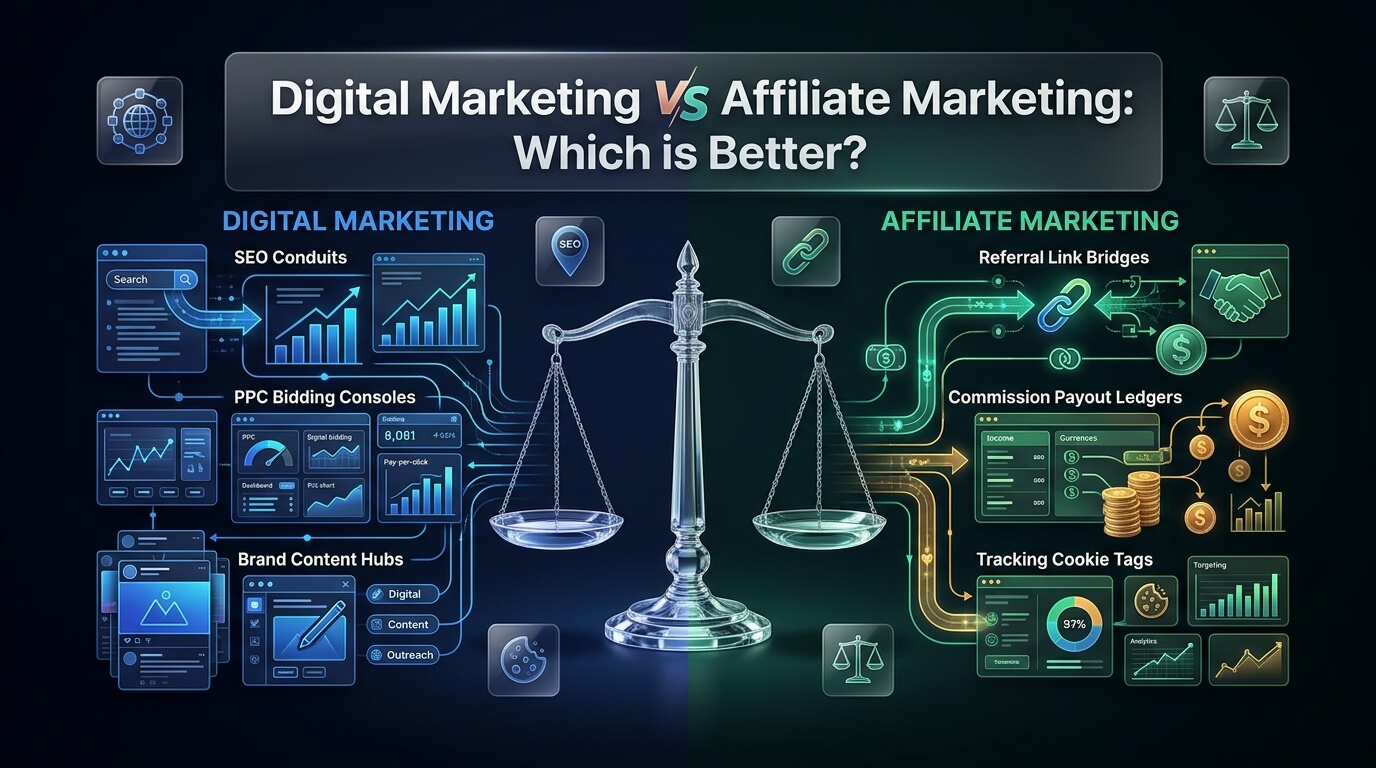
Key Takeaways: Digital Marketing vs Affiliate Marketing
- Digital marketing represents the overarching discipline of promoting products, services, and brands across all online channels.
- Affiliate marketing is a specialized performance-based monetization model operating directly under the digital marketing umbrella.
- Understanding the digital marketing affiliate marketing difference helps you choose between predictable client income and scalable commission revenue.
- Joining a high-converting digital marketing affiliate program allows marketers to monetize their existing traffic and technical skills.
- Mastering both disciplines provides maximum career resilience and diverse income streams.
Choosing an online career path can feel overwhelming with so many competing strategies. Beginners often ask about digital marketing vs affiliate marketing which is better for building sustainable income. Both paths offer strong financial potential, but they operate on fundamentally different business models.
Digital marketing involves managing comprehensive online campaigns for businesses, clients, or employers. It encompasses search engine optimization, paid advertising, social media management, and email automation. Practitioners earn predictable salaries, monthly client retainers, or hourly consulting fees for their specialized services.
In contrast, affiliate marketing focuses strictly on earning commissions by promoting third-party products. You do not manage clients, handle customer support, or create physical goods. Instead, you drive targeted web traffic to merchant offers through dedicated tracking links.
Understanding how digital marketing and affiliate marketing connect is essential before investing your time. Many successful professionals do not choose just one path. They use foundational digital marketing skills to launch profitable affiliate ventures, creating multiple streams of revenue.
The rise of creator economies and remote work has made both paths highly desirable. Whether you prefer the structured career ladder of an agency or the solitary freedom of affiliate publishing, each direction offers distinct lifestyle advantages. Evaluating your personal strengths helps you pick the right trajectory.
Core Relationship: Umbrella vs Performance Channel
To evaluate digital marketing vs affiliate marketing, you must understand their structural relationship. Digital marketing is the broad parent industry. It covers every tactic used to attract, engage, and convert internet users across digital devices.
Affiliate marketing is a distinct subset of that parent industry. When people discuss affiliate digital marketing, they refer to using core digital channels to generate affiliate sales. An affiliate marketer uses search engine optimization, paid search, and content creation to drive affiliate conversions.
Practicing affiliate digital marketing allows solo operators to test cutting-edge promotion techniques without corporate bureaucracy. You can deploy new landing page designs or test ad angles within hours. The feedback loop is immediate because your dashboard displays conversions in real time.
The clearest digital marketing affiliate marketing difference lies in who pays you and why. In traditional digital marketing, clients or employers pay you for your strategic time and technical labor. In affiliate marketing, merchants pay you exclusively when an actual transaction or lead occurs.
This distinction changes your daily workflow and financial exposure. A digital marketer focuses on meeting client deliverables, reporting key metrics, and maintaining stakeholder relationships. An affiliate marketer focuses on audience acquisition, click-through rates, and offer conversion rates.
Neither model is inherently superior to the other. Digital marketing offers stability, structured career advancement, and immediate cash flow. Affiliate marketing provides operational freedom, location independence, and unbounded income scalability once traffic flows consistently.
What is Digital Marketing? Scope, Careers, and Daily Operations
Digital marketing encompasses all promotional activities executed through electronic devices and the internet. Businesses rely on digital marketers to generate brand awareness, capture qualified sales leads, and retain existing customers. It is a massive global industry with diverse career specializations.
A professional in this field might specialize in pay-per-click advertising, managing large ad budgets across Google and Meta. Another might focus on technical search engine optimization, helping corporate websites rank for high-value search queries. Others specialize in lifecycle email automation, social media community building, or content marketing.
Agency roles expose marketers to fast-paced client accounts across multiple industries. You learn how to run client onboarding meetings, build monthly performance dashboards, and pitch strategic campaign expansions. This environment accelerates your learning curve across many marketing software tools.
In-house marketing roles offer depth within a single brand. You collaborate closely with product engineers, sales teams, and corporate executives. In-house positions provide steady corporate salaries, employee benefits, and clear advancement paths into executive leadership.
Freelance digital marketing consulting bridges agency freedom and in-house focus. As an independent consultant, you choose your clients, set your project rates, and work from anywhere. However, you must also handle client invoicing, contract negotiations, and business development.
The daily routine of a digital marketer centers on cross-functional communication and strategic analysis. You review analytics dashboards, identify underperforming segments, and adjust creative messaging. Collaboration with copywriters, graphic designers, and web developers is constant.
What is Affiliate Marketing? Mechanics and Commission Models
Affiliate marketing is a performance-based sales system where an external publisher earns a commission for generating sales for a merchant. It is one of the oldest and most effective commercial models on the internet. Brands love it because they only pay marketing fees when a verified sale occurs.
The ecosystem consists of four main participants: the merchant, the affiliate network, the publisher, and the consumer. The merchant creates the product or service. The affiliate network provides tracking software, reporting dashboards, and payment processing. The publisher drives audience traffic, and the consumer completes the purchase.
Commission models vary widely across different niches and product categories. Physical product programs, like Amazon Associates, typically pay commissions between one and ten percent per sale. Digital software and SaaS subscriptions often offer recurring monthly commissions ranging from twenty to forty percent.
Pay-per-lead programs compensate affiliates whenever a user fills out a quote request or registers for a free trial. Financial services, insurance policies, and legal consultations frequently pay fifty to two hundred dollars per verified lead. These high payouts attract sophisticated media buyers and search specialists.
Becoming an effective digital marketing affiliate requires mastering audience trust. Top affiliates build dedicated review portals, comparison blogs, YouTube channels, or email newsletters. They review products thoroughly, provide genuine tutorials, and help readers solve specific problems before recommending solutions.
Operating as a digital marketing affiliate gives you full ownership over your work schedule. You choose when to write, what software to evaluate, and how to structure your campaigns. That level of operational freedom makes the model especially appealing to independent creators.
Head-to-Head Comparison: Digital Marketing vs Affiliate Marketing
Comparing these two paths side by side highlights the tradeoffs between immediate income, client management, and operational independence. Below are the key evaluation criteria every aspiring marketer must consider.
1. Upfront Capital and Startup Costs
Starting a traditional digital marketing career requires minimal financial investment. You need a reliable computer, an internet connection, and baseline knowledge. You can learn core skills through free tutorials, documentation, and entry-level internships. Client retainers provide immediate positive cash flow from day one.
Launching an affiliate marketing business requires modest upfront capital for web hosting, domain names, content creation, and testing software. If you choose paid advertising to drive affiliate traffic, you need dedicated ad spend budget. Paid affiliate campaigns carry financial risk because poorly optimized ad spend can result in net losses.
2. Client Management vs Complete Autonomy
Client management is a central component of traditional digital marketing. You must answer client emails, attend weekly status calls, and explain performance fluctuations. Difficult clients or shifting internal priorities can cause stress regardless of how well your campaigns perform.
Affiliate marketing eliminates client management entirely. You never attend client meetings, answer support tickets, or defend monthly invoices. Your primary relationship is with your audience and your affiliate network dashboard. This complete autonomy attracts individuals who prefer working independently without corporate meetings.
3. Income Stability and Revenue Timing
Digital marketing provides predictable, timely compensation. Employers deposit paychecks on fixed schedules, and consulting clients pay monthly retainer invoices. This predictability makes it easy to budget personal living expenses and plan major life commitments.
Affiliate marketing revenue can be volatile, especially in the early stages. Affiliate networks often hold commission payouts for thirty to sixty days to account for customer returns and fraud checks. In addition, search engine algorithm updates or seasonal demand shifts can cause affiliate earnings to fluctuate substantially from month to month.
4. Skill Diversification and Mastery
Working in general digital marketing forces you to develop broad competence across branding, customer retention, and multi-channel attribution. You become a versatile strategic marketer capable of advising diverse businesses.
Affiliate marketing requires sharp, deep specialization in high-intent conversion pathways. You become an expert at identifying search queries with commercial intent and crafting persuasive product comparisons. Both skill sets are immensely valuable across the modern online economy.
Finding the Right Digital Marketing Affiliate Program
For marketing professionals, promoting marketing tools offers some of the highest affiliate conversion rates in the industry. Every business needs website hosting, email automation, keyword research software, and landing page builders. Promoting these tools allows you to earn substantial affiliate revenue while recommending products you already use daily.
A reputable digital marketing affiliate program offers transparent cookie tracking, competitive commission rates, and timely payouts. Many SaaS software providers offer recurring monthly commissions for the lifetime of the referred customer. A single customer subscribing to an eighty-dollar monthly tool can generate twenty-four dollars every month for years.
When selecting programs, look for generous cookie durations. A sixty-day or ninety-day cookie window ensures you receive credit even if a prospect takes weeks to finalize their purchasing decision. Short twenty-four-hour cookies reduce your effective conversion rate significantly.
Top companies also provide dedicated affiliate managers who share high-converting banners, exclusive discount codes, and upcoming product roadmaps. Working closely with an affiliate manager helps you plan promotional campaigns around major product launches or holiday discounts.
Finding a reliable digital marketing affiliate program requires researching affiliate networks and merchant terms. Check payout thresholds, supported payment methods, and international availability before committing resources. Consistent, on-time payments are essential for running a predictable publishing business.
Ensure you disclose affiliate links clearly in accordance with Federal Trade Commission guidelines. Transparent disclosures build audience trust and protect your website from regulatory penalties. Readers appreciate honesty when you explain that you earn a small commission at no additional cost to them.
How Digital Marketing and Affiliate Marketing Work Together
Viewing these fields as mutually exclusive competitors is a common mistake. In reality, affiliate marketing digital marketing strategies thrive when combined intelligently. Each discipline strengthens the other, creating powerful professional synergies.
An affiliate website serves as a live laboratory to test digital marketing tactics. When you experiment with new SEO schema markup, conversion rate optimization, or copywriting hooks on your own affiliate site, you risk only your own assets. The lessons you learn can then be applied to high-paying client accounts with absolute confidence.
Conversely, practicing full-service digital marketing sharpens your affiliate execution. Working on large corporate ad accounts teaches you how to analyze attribution models, set up server-side conversion tracking, and manage landing page A/B tests. Applying that institutional rigor to affiliate campaigns separates you from amateur affiliates.
In addition, an agency can monetize non-qualifying client leads through affiliate partnerships. If an inbound lead cannot afford your five-thousand-dollar monthly retainer, you can direct them to an entry-level software tool through an affiliate link. This workflow turns lost prospects into passive software commissions.
Building specialized affiliate digital marketing assets also creates valuable proof of work. When prospective clients see that you built a profitable niche affiliate portal from scratch, your credibility is proven. You are not just teaching theory; you are demonstrating practical execution.
Top Software Platforms for Affiliate and Digital Marketing
Choosing reliable affiliate networks and tracking software is essential for scaling your campaigns and securing timely payments. Below are eight top platforms that empower digital marketers and affiliate publishers.
1. Impact
Impact is an enterprise partnership automation platform that connects publishers directly with premium global brands. It manages end-to-end partnership lifecycles, from recruitment and contracting to tracking, attribution, and payment processing. Brands like Uber, Microsoft, and Shopify run their partner programs through Impact.
The platform features sophisticated tracking capabilities, including cross-device tracking, promo code attribution, and custom contract negotiation. Its clean publisher dashboard makes it simple to search for relevant merchant programs, view conversion rates, and generate custom tracking links.
Publishers can set up automated payout rules to deposit commission earnings directly to their bank accounts. The reporting tools allow you to filter performance data by device, landing page, and referring traffic channel. This granular visibility helps you scale winning affiliate partnerships rapidly.
Pricing: Free for affiliate publishers and content creators. Merchants and enterprise brands pay custom SaaS licensing fees based on tracked revenue volume.
Best For: Premium brand partnerships, enterprise software affiliates, and direct merchant contracts.
2. ShareASale
ShareASale is one of the most established affiliate networks on the web, hosting over sixteen thousand merchant programs across retail, technology, and home services. Acquired by Awin, ShareASale remains a favorite destination for content bloggers, niche reviewers, and digital marketing affiliates.
The network offers reliable real-time tracking, deep-linking tools, and automated monthly payments. Publishers can browse merchants by category, average commission rate, seven-day earnings per click, and average sale amount. This transparency helps you evaluate whether an offer is profitable before applying.
ShareASale also provides automated data feeds that allow publishers to import thousands of merchant products directly into their review catalogs. Video creative tools and custom banner generators make it easy to integrate visual assets without slowing down your site.
Pricing: Free for publishers with no sign-up fees. Merchants pay a one-time network integration fee plus transaction fees on generated sales.
Best For: Niche content blogs, mid-market retail brands, and lifestyle affiliates.
3. CJ Affiliate
CJ Affiliate, formerly Commission Junction, is a heavyweight global affiliate network known for enterprise brand partnerships. It connects publishers with household names in travel, consumer electronics, finance, and telecommunications. CJ powers partner programs for brands like Barnes & Noble, Office Depot, and Priceline.
The network provides advanced tracking technology, cookieless attribution, and detailed audience insights. Publishers gain access to deep-linking browser extensions and API integrations that automate product feed imports directly into content management systems.
CJ features an intuitive Page-Based Reporting dashboard that displays revenue down to the exact URL on your website. This insight reveals which specific blog posts generate the highest revenue per visitor, allowing you to prioritize high-value content updates.
Pricing: Free for publishers. Enterprise merchants pay setup fees and ongoing network usage overrides.
Best For: High-volume content publishers, comparison portals, and enterprise brand campaigns.
4. ClickBank
ClickBank is an established e-commerce marketplace specializing in digital information products, health supplements, and niche software. It has paid out billions of dollars in commissions over more than twenty-five years of operation, making it a foundational platform for direct-response affiliates.
Digital products on ClickBank frequently offer commission rates as high as fifty to seventy-five percent per sale. Many merchants also provide high-converting upsell funnels and recurring subscription options, allowing affiliates to generate substantial revenue per converted customer.
ClickBank provides detailed metrics such as Gravity Score, which indicates how many distinct affiliates made sales on an offer over the past twelve weeks. A high Gravity Score signals a proven offer with reliable buyer demand, lowering your testing risk.
Pricing: Free for affiliate publishers. Product vendors pay a one-time activation fee and standard payment processing charges.
Best For: Direct-response media buyers, digital education offers, and health and fitness affiliates.
5. Amazon Associates
Amazon Associates is the largest physical product affiliate program in the world, allowing creators to monetize virtually any physical product sold on Amazon. Because consumer trust in Amazon is exceptionally high, conversion rates on Amazon affiliate links often surpass standard e-commerce benchmarks.
When a visitor clicks your affiliate link, you earn a commission on their entire shopping cart over the next twenty-four hours, even if they purchase completely unrelated items. This universal cart attribution creates steady, diversified commission earnings for product review websites.
Amazon provides an easy-to-use SiteStripe toolbar directly in your browser. You can generate text links, image links, and custom banners while browsing any product page on Amazon. This convenience makes publishing product recommendations effortless.
Pricing: Completely free to join. Approval requires generating three qualified sales within the first one hundred eighty days of account creation.
Best For: Product review sites, niche hobby blogs, and beginner content creators.
6. Awin
Awin is a global affiliate marketing network operating in over one hundred eighty countries, representing over twenty-five thousand advertisers. It has a massive presence in European, North American, and Latin American retail markets, offering publishers extensive international reach.
The platform features an intuitive publisher portal, robust link-building plugins, and automated cross-device tracking. Awin also supports single-click merchant applications and fast-track payment cycles, ensuring affiliates receive verified commission earnings without lengthy delays.
Its cross-device attribution technology ensures publishers receive full credit when a user clicks an ad on mobile and completes the purchase on desktop. This multi-device reliability protects your earned commissions across complex consumer buying paths.
Pricing: Publishers pay a five-dollar refundable deposit upon sign-up, which is credited back upon account approval. Free for publishers thereafter.
Best For: Global retail campaigns, international e-commerce sites, and fashion publishers.
7. Post Affiliate Pro
Post Affiliate Pro is a dedicated in-house affiliate software platform that allows businesses to create, manage, and track their own proprietary affiliate programs. Instead of relying on third-party networks, merchants run private partner portals directly on their custom domains.
The software features customizable sign-up forms, multi-tier commission structures, split commissions, and fraud protection mechanisms. It integrates smoothly with popular e-commerce platforms like Shopify, WooCommerce, Magento, and Stripe.
Running in-house software allows brands to avoid network transaction fees and build direct, long-term relationships with top publishers. You maintain complete control over affiliate terms, payout schedules, and promotional asset distribution.
Pricing: SaaS subscription tiers start at one hundred thirty-nine dollars monthly for up to one million tracking requests, with enterprise tiers scaling higher.
Best For: E-commerce brands, SaaS companies, and digital marketing agencies running private partner programs.
8. ThirstyAffiliates
ThirstyAffiliates is a dedicated WordPress affiliate link management plugin designed specifically for bloggers and content marketers. It transforms ugly, complex affiliate tracking URLs into clean, branded links that build reader trust and prevent link hijacking.
The plugin includes automatic keyword linking, geographic link redirection, click tracking analytics, and proactive broken link checking. When a merchant changes their affiliate link structure, you update the URL once in your plugin dashboard, and all blog posts update automatically.
It also automatically inserts required rel attributes such as nofollow and sponsored to ensure compliance with search engine guidelines. Built-in statistics reports show your top-performing links directly within your WordPress administration panel.
Pricing: Basic plugin is completely free on WordPress.org. Pro version starts at ninety-nine dollars and fifty cents annually for advanced geolocation and auto-linking features.
Best For: WordPress content creators, affiliate review sites, and niche publishers.
Platform Comparison for Affiliate Marketers
Selecting the right network or tool depends on whether you promote physical goods, digital products, or SaaS software. The table below outlines key attributes of each platform.
| Platform | Core Model | Primary Strength | Pricing / Cost | Best Use Case |
|---|---|---|---|---|
| Impact | Partnership SaaS | Enterprise brand direct contracts | Free for publishers | SaaS, tech, and premium brand deals |
| ShareASale | Affiliate Network | Vast mid-market merchant directory | Free for publishers | Content blogs and niche review portals |
| CJ Affiliate | Global Network | Enterprise retail and travel reach | Free for publishers | High-volume comparison websites |
| ClickBank | Digital Marketplace | High commission rates (up to 75%) | Free for publishers | Direct-response and paid media buyers |
| Amazon Associates | Retail Program | Universal cart conversion power | Free to join | Physical product reviews and gift guides |
| Awin | Global Network | International e-commerce advertiser base | $5 refundable deposit | Cross-border e-commerce and retail |
| Post Affiliate Pro | In-House Tracking | Private white-label partner portal | Starts at $139/mo | Brands managing in-house partner programs |
| ThirstyAffiliates | WordPress Plugin | Link cloaking, geolocation, auto-link | Free / Pro $99.50/yr | WordPress publishers managing links |
The Decision Framework: Which Path Fits Your Goals?
Determining digital marketing vs affiliate marketing which is better depends on your personality, financial runway, and career ambitions. Neither option is universally superior, but each caters to different strengths and work styles.
You should focus on full-service digital marketing if you value predictable monthly cash flow and collaborative environments. If you enjoy working with teams, solving diverse corporate problems, and climbing structured career ladders, digital marketing provides clear stability. It is also the ideal path if you need immediate income to pay monthly living expenses.
You should pursue affiliate marketing if you crave complete operational independence and location autonomy. If you prefer building digital assets, writing in-depth reviews, and analyzing conversion metrics without client meetings, affiliate marketing offers unparalleled freedom. However, you must possess the discipline to work for weeks or months before seeing your first commission check.
- Choose digital marketing if you need immediate income and enjoy client collaboration.
- Choose affiliate marketing if you want independent asset building without client deliverables.
- Consider a hybrid model where you work a day job in digital marketing while building affiliate sites on weekends.
- Reinvest client revenue into affiliate assets to build long-term passive equity.
The hybrid strategy often yields the highest long-term success. Many top affiliates started by working at digital agencies or in-house marketing departments. They honed their SEO and media-buying skills on corporate budgets during the day, then applied those proven lessons to their own affiliate projects at night.
Common Pitfalls in Both Disciplines to Avoid
Both career directions contain common traps that can derail your progress if you are unprepared. Recognizing these mistakes early protects your mental energy and financial capital.
In traditional digital marketing, the biggest pitfall is client scope creep and burnout. Agencies often take on demanding clients with unrealistic expectations and inadequate budgets. Without firm boundaries, you can easily find yourself working sixty-hour weeks managing endless revisions and emergency calls.
In affiliate marketing, the most common trap is chasing saturated niches with low-quality affiliate products. Promoting spammy offers or publishing superficial AI-generated listicles rarely generates sustainable search rankings. Search engines consistently reward comprehensive, firsthand experience over generic regurgitated content.
Another major affiliate pitfall is platform dependency. Relying entirely on organic search traffic leaves your business vulnerable to major search engine core updates. Successful publishers diversify their traffic sources by building owned email newsletters, YouTube channels, and social communities.
Finally, avoid jumping between monetization strategies every few weeks. Mastering either digital marketing or affiliate marketing requires months of deliberate practice. Pick one primary discipline, execute consistently for six months, and measure results before pivoting.
Long-Term Industry Outlook and Future Trends
As internet commerce continues to expand globally, both digital marketing and affiliate marketing will remain essential commercial pillars. However, technological changes are reshaping how both fields operate.
Artificial intelligence is automating routine marketing tasks like basic copywriting, ad variation testing, and data reporting. As a result, both digital marketers and affiliates must move up the value chain. Strategic positioning, deep industry knowledge, and authentic human perspectives are becoming more valuable than repetitive manual tasks.
Privacy regulations and the phaseout of third-party tracking cookies are altering attribution. First-party data collection and server-side tracking are now essential technical proficiencies. Affiliates who build direct, trusted relationships with readers via email lists will thrive while anonymous arbitrageurs struggle.
The convergence of influencer culture and affiliate marketing is also accelerating. Modern consumers buy from people they trust rather than faceless corporate websites. Developing a recognizable personal brand amplifies your authority whether you pitch client services or share affiliate product recommendations.
Frequently Asked Questions: Digital vs Affiliate Marketing
Can I start affiliate marketing without any digital marketing experience?
Yes, you can start as a complete beginner, but learning core digital marketing skills will drastically shorten your path to profitability. Understanding basic search engine optimization, content creation, and analytics allows you to build traffic effectively. Without these baseline skills, generating affiliate sales is much more challenging.
How much money can a beginner earn in their first year?
In traditional digital marketing, an entry-level professional can earn forty to sixty thousand dollars annually in an in-house role or junior agency position. In affiliate marketing, earnings depend entirely on traffic and conversion volume. A dedicated beginner might earn nothing for six months, then scale to several thousand dollars monthly once their assets rank.
Is affiliate marketing considered passive income?
Affiliate marketing can generate passive revenue once content ranks and traffic flows automatically. However, reaching that stage requires hundreds of hours of intense upfront research, content writing, and technical setup. Even established affiliate websites require regular updates to maintain search rankings and replace outdated merchant links.
Do I need a website to do affiliate marketing successfully?
While you can promote affiliate links on social media platforms or YouTube, having your own website is strongly recommended for long-term security. A self-hosted website gives you complete control over your content, branding, and tracking. It also protects your business from sudden social media account suspensions or policy shifts.
Which path offers better career longevity over the next decade?
Both career paths offer excellent longevity because businesses will always need to attract and convert online customers. Traditional digital marketing provides steady corporate leadership opportunities, while affiliate marketing builds independent equity assets that you can sell for significant multiples on marketplaces.
Conclusion and Next Steps
When weighing digital marketing vs affiliate marketing, remember that they are complementary disciplines rather than competing opposites. Digital marketing equips you with the broad strategic toolkit needed to drive online growth. Affiliate marketing gives you an independent performance vehicle to monetize that knowledge directly.
If you need dependable income immediately, begin your journey by mastering core digital marketing services for clients or employers. As your expertise deepens, launch your own affiliate websites to build scalable passive equity. Combining both approaches creates true career autonomy, financial resilience, and professional freedom.