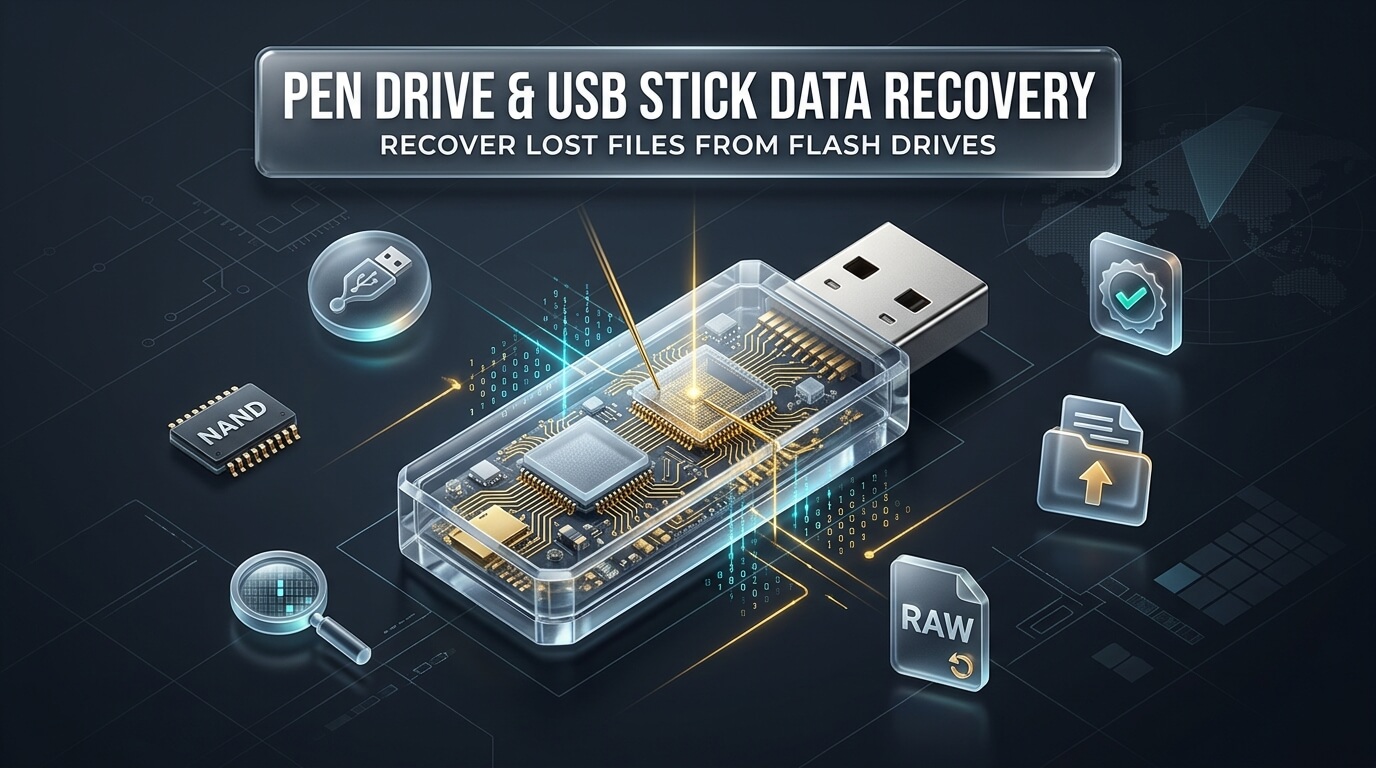
USB flash drives and thumb drives remain the world’s most popular portable storage tools. We carry them in our pockets, plug them into office workstations, use them for school assignments, and store vital digital archives on them. Then a sudden failure strikes. You plug your pen drive into a USB port, only to be greeted by a disheartening chime and a Windows error message: “USB device not recognized” or “You need to format the disk in drive G: before you can use it.” Or perhaps you accidentally bumped your laptop while a drive was connected, snapping the metal USB connector off the circuit board. In these high-stress situations, executing structured usb drive data recovery procedures determines whether you rescue your files or face permanent data loss.
Flash memory devices operate under physical and logical principles that differ fundamentally from traditional mechanical hard drives. A USB flash drive stores digital records on solid-state NAND flash chips governed by a miniature micro-controller. When an unmount operation is interrupted, file allocation tables scramble into a RAW filesystem state. When physical pins bend or solder joints break, electrical signals cannot reach the memory controller. In these complex scenarios, executing targeted pen drive data recovery workflows and selecting specialized usb data recovery software is essential to reconstruct corrupted directory nodes and extract files directly from flash sectors. Whether you need an urgent data recovery usb drive workflow, a swift data recovery usb stick extraction, or general data recovery usb methods, understanding flash memory behavior protects your irreplaceable records.
This comprehensive technical guide provides an exhaustive roadmap for rescuing lost files from all flash memory storage devices. We explain the internal anatomy of thumb drives, distinguish between logical corruption and hardware damage, and outline safe emergency triage steps. We detail reliable methods for corrupted usb data recovery, step-by-step procedures for formatted usb data recovery, and hardware soldering techniques for broken usb drive data recovery. In addition, mastering usb flash drive data recovery principles and practical usb stick data recovery strategies empowers you to retrieve missing documents without risking further storage corruption. Whether you require practical pen drive data recovery software, precise data recovery from pen drive storage, or an enterprise-grade usb drive data recovery service, this guide provides tested, dependable solutions.
- Never Click “Format Disk”: When Windows states that a USB drive must be formatted before use, cancel the prompt immediately. Formatting creates a new file allocation table that complicates file reconstruction.
- Do Not Flex Broken Connectors: If a USB plug is bent or loose, repeated wiggling tears copper circuit board traces, turning a simple solder repair into an expensive cleanroom procedure.
- Check Windows Disk Management First: If a drive does not appear in File Manager, open Disk Management. If the drive displays its correct physical capacity (e.g., 32GB), the hardware is functional and the issue is purely logical.
- Image the Drive Before Scanning: Flash drives with degrading NAND cells can fail permanently during intensive software scans. Always create a raw byte-for-byte disk image (IMG or DD file) and scan the image instead.
- Monolithic Drives Require Chip-Off Specialists: Compact, ultra-slim thumb drives encapsulate the controller and flash chip inside a solid plastic block. If a monolithic drive suffers electrical failure, recovery requires specialized cleanroom micro-probing.
The Anatomy of a USB Flash Drive: How Flash Memory Operates
To successfully perform data recovery from usb drive media, you must understand the physical components inside a flash drive and how they process digital information.
Physical Components of a Standard USB Drive
A standard printed circuit board (PCB) USB flash drive consists of four primary internal components:
- USB Connector: The male Type-A or Type-C interface that plugs into your computer. It features four primary pins: Pin 1 (VCC +5V Power), Pin 2 (Data -), Pin 3 (Data +), and Pin 4 (Ground).
- NAND Flash Memory Chip: The non-volatile storage chip (typically packaged as TSOP-48 or BGA) that retains digital bits even when disconnected from electrical power.
- Mass Storage Controller: The miniature microprocessor that manages data transfers between the computer and the flash chip. It translates operating system commands, manages wear-leveling, and handles error-correcting codes (ECC).
- Crystal Oscillator: Generates the 12MHz or 24MHz clock timing signal required for synchronized data transmission across the USB bus.
Standard PCB Drives vs. Monolithic Flash Drives
Modern flash drives fall into two distinct manufacturing categories, which dictate physical recovery options:
Standard PCB Flash Drives: Traditional thumb drives feature discrete components soldered onto a small green or blue circuit board. If the USB connector snaps off or a surface-mount resistor blows, an experienced technician can solder jumper wires or transplant the NAND chip to a donor board to recover files.
Monolithic Flash Drives: Many ultra-compact thumb drives (such as low-profile fit drives or novelty metal keychains) use monolithic architecture. The controller, memory chip, circuit traces, and connector are integrated into a single solid piece of epoxy resin. Monolithic drives have no exposed solder pins. If a monolithic drive fails electrically, recovering data requires painstakingly grinding away the protective epoxy coating and attaching microscopic wire probes to tiny internal test pads.
Understanding Logical vs. Physical Failures
Diagnosing whether your flash drive suffered logical or physical damage dictates the recovery path you must follow:
Logical Failures: The physical hardware is undamaged. The computer detects the USB drive controller and reports the correct capacity, but the filesystem is unreadable. Examples include accidental file deletion, corrupted FAT32/exFAT allocation tables, RAW filesystem states, and accidental formatting. Logical failures are solved entirely using specialized usb data recovery software.
Physical Failures: The physical hardware is broken, shorted, or degraded. The computer does not chime when the drive is connected, reports “Unknown USB Device (Device Descriptor Request Failed),” or displays 0MB capacity in Disk Management. Physical failures cannot be solved with software alone; they require hardware diagnostics, soldering, or cleanroom laboratory intervention.
Emergency Triage: Diagnosing Unrecognized and Broken Drives
When a USB stick malfunctions, taking hasty or incorrect diagnostic steps can push a fragile memory chip into permanent failure. Follow these systematic triage steps.
Never run diagnostic scans on a malfunctioning USB drive through unpowered front-panel desktop ports, keyboard pass-throughs, or cheap multi-port USB hubs. Front ports often suffer from voltage drops and loose internal wiring. Always plug the drive directly into a rear motherboard USB port on a desktop PC, or a primary port on a laptop connected to wall power.
Step 1: Inspect Windows Disk Management
When a drive fails to open in Windows, press Win + X and select Disk Management. Inspecting system utilities is the primary starting point for usb drive not detected data recovery investigations. Look through the list of disks at the bottom of the window to identify your USB drive (e.g., Disk 2 or Disk 3):
- Status A: Shows Correct Capacity and “RAW”: The controller and memory chip are functioning perfectly. The filesystem allocation table is corrupt. Proceed directly to software data recovery.
- Status B: Shows “No Media” or “0 Bytes”: The computer detects the USB controller chip, but the controller cannot communicate with the NAND flash memory chip due to blown traces or firmware corruption. Software cannot scan the drive; hardware intervention is required.
- Status C: Drive Does Not Appear at All: The drive is receiving zero electrical power, or the data pins are broken. Proceed to physical port checks and cable testing.
Step 2: Resolving “USB Device Not Recognized” Errors
If Windows displays a notification stating that the USB device is not recognized, the operating system failed to establish a handshake with the drive controller. When starting usb not recognized data recovery tasks, isolating operating system driver conflicts from electrical failures is vital:
- Open Device Manager (
devmgmt.msc) and expand Universal Serial Bus controllers. - Look for entries with a yellow warning triangle labeled “Unknown USB Device.”
- Right-click the entry, select Uninstall device, and disconnect the USB drive.
- Restart your computer. Upon reboot, reconnect the USB drive to allow Windows to reinstall clean USB stack drivers.
- Alternatively, test the drive on a computer running macOS or an Ubuntu Linux Live USB. Linux is significantly more resilient at mounting drives with degraded partition maps.
Step 3: Handling Physically Damaged Connectors
Accidental impacts frequently snap or bend the metal USB connector. If you are dealing with a broken pen drive data recovery scenario:
Carefully inspect the four copper contact pins inside the connector. If the connector is bent at an angle, gently pry open the plastic outer housing using an electronics spudger. Inspect the PCB under bright light. If the four solder pads connecting the plug to the board have lifted or cracked, do not plug the drive in again. Running current through bridged pins can short-circuit the NAND memory chip, frying it instantly.
If you possess basic soldering equipment, strip an old USB cable to expose the red (+5V), white (Data -), green (Data +), and black (Ground) wires. Solder the matching wires directly to the corresponding solder points on the circuit board. Plug the modified cable into your computer, copy your critical files immediately, and dispose of the broken drive.
Step-by-Step Software Recovery for Corrupted USB Drives
When your drive is physically intact but suffers logical corruption, executing a disciplined recovery procedure ensures complete file retrieval. Initiating usb stick corrupted data recovery or standard data recovery pen drive operations requires methodical execution to prevent overwriting unallocated clusters.
Method 1: Resolving Drive Letter Conflicts and Dirty Bits
Occasionally, a healthy USB drive fails to appear simply because Windows assigned it a drive letter already reserved by a mapped network drive or virtual disk:
- Open Disk Management (
diskmgmt.msc). - Right-click the volume partition of your USB drive.
- Select Change Drive Letter and Paths.
- Click Change, select an unused letter from the dropdown (such as
X:orZ:), and click OK. - Open your file manager and check if the drive contents are now visible.
Method 2: Non-Destructive Sector Check via Command Prompt
If your flash drive reports a filesystem error or files have vanished into hidden folders, run the native Windows disk checker:
# Launch Command Prompt as Administrator and execute:
chkdsk E: /f /r
Replace E: with your actual drive letter. The /f parameter fixes directory errors, while /r locates bad sectors and recovers readable information. Note: If the drive is physically clicking, heating up rapidly, or dropping connections, avoid running CHKDSK, as aggressive sector writes can degrade failing flash cells.
Method 3: Creating a Byte-for-Byte Raw Disk Image
Before launching intensive deep-scan utilities, create a byte-level image of your USB drive. Professional tools like Disk Drill, R-Studio, and FTK Imager allow you to clone the entire drive into a single .raw or .dd image file stored on your computer’s internal SSD.
Once the disk image is safely captured, disconnect the physical USB drive. Mount the disk image inside your recovery software and run all scans against the image file. This completely eliminates hardware wear and protects failing NAND cells from dying mid-recovery.
Method 4: Deep Signature Carving for Formatted Drives
If you accidentally performed a format on your pen drive, file system metadata is wiped, but the underlying data clusters remain intact. Launch a professional carving utility (such as PhotoRec, Disk Drill, or EaseUS) and select the Deep Scan option.
The carver bypasses the blank file allocation table, reads raw sectors, identifies unique file signatures (such as DOCX, PDF, XLSX, and JPEG), and extracts the files directly to your computer’s hard drive.
When to Seek Professional USB Drive Data Recovery Services
While software resolves logical errors, hardware breakdowns require specialized cleanroom engineering. You should consider a professional usb drive data recovery service in the following circumstances:
- Dead Controller on Monolithic Drives: If a compact monolithic drive is not detected, software is powerless. A professional lab uses laser decapping and micro-soldering spiderboards to read the raw flash memory.
- Severe Electrical Shorts: If the flash drive emits a burning plastic odor, becomes boiling hot to the touch, or trips your computer’s USB port surge protection, the circuit board is shorted. Continued power application will destroy the NAND die.
- Firmware Panic Lock: When NAND flash memory develops excessive bad blocks, the controller locks itself into a read-only panic state, reporting 0MB capacity or generic controller names (e.g., “Phison PS2251” or “Silicon Motion SM3257”). Laboratories deploy specialized hardware programmers (like PC-3000 Flash) to bypass the controller and rebuild the data using algorithmic wear-leveling translators.
Top 8 USB Drive Data Recovery Software Tools Reviewed
Selecting the right recovery software is critical to rescuing your visual and document records safely. Below are detailed, objective reviews of the top eight tools available.
1. Disk Drill Data Recovery
Disk Drill by CleverFiles is widely celebrated for its clean, accessible graphical user interface paired with powerful raw signature carving algorithms. It is specifically engineered to handle corrupted, formatted, and unreadable USB flash drives smoothly.
Disk Drill automatically runs a multi-stage scan combining partition detection with deep file carving. It excels at recovering lost FAT32, exFAT, and NTFS filesystems commonly found on pen drives. The software features an outstanding file preview window, enabling users to view photos, play audio and video clips, and inspect text documents before committing to recovery. Disk Drill also includes free auxiliary tools, such as byte-to-byte disk image creation, allowing users to clone a failing flash drive prior to scanning. The Windows edition includes 500MB of free data recovery.
Key Strengths:
- Sleek, intuitive user interface suitable for both beginners and technical users.
- Integrated byte-to-byte disk imaging tool protecting fragile flash memory chips.
- Comprehensive preview window verifying file integrity prior to recovery.
- Generous 500MB free recovery tier on Windows.
Limitations: Deep scans across high-capacity USB 3.0 drives can require substantial system memory.
Best For: Home users, office staff, and students needing an intuitive, visually guided recovery tool for corrupted USB sticks.
2. EaseUS Data Recovery Wizard
EaseUS Data Recovery Wizard is an industry-standard commercial utility recognized for its simple three-step recovery workflow: Select, Scan, and Recover. It handles all forms of USB logical corruption with high reliability.
When connected to a formatted or RAW pen drive, EaseUS executes quick and deep scans concurrently. It organizes retrieved files into two primary categories: original directory paths (retaining original folder structures where possible) and raw carved files sorted by file extension. The utility also features built-in automated file repair algorithms that repair lightly corrupted JPEG photos, MP4 videos, and Office documents during the recovery process. The free edition allows up to 2GB of data recovery when shared via social channels.
Key Strengths:
- Extremely straightforward three-click recovery process.
- Built-in file repair tool fixing corrupted photos and video files.
- Concurrent scanning engine providing rapid initial directory results.
- Free tier allows up to 2GB of data recovery.
Limitations: Subscription pricing model is relatively high compared to perpetual competitor licenses.
Best For: General consumers seeking a fast, automated recovery process with integrated photo and document repair.
3. Recuva
Recuva, developed by Piriform (a subsidiary of Gen Digital), is a classic, lightweight file recovery utility for Windows. Renowned for its speed and zero-cost entry barrier, Recuva is a staple in portable troubleshooting toolkits.
Recuva provides both a user-friendly wizard for non-technical users and an advanced interface for power users. When dealing with corrupted or formatted USB thumb drives, enabling its “Deep Scan” option activates raw file carving across unallocated sectors. While Recuva lacks the deep partition reconstruction capabilities of enterprise suites, its lightweight executable footprint, fast scanning speeds, and completely free unlimited recovery make it an outstanding first-line diagnostic utility.
Key Strengths:
- Completely free version available with zero artificial data recovery caps.
- Ultra-lightweight installation footprint with minimal resource consumption.
- Simple traffic-light color indicators showing the recoverable health of found files.
- Secure file overwrite module included for permanent data shredding.
Limitations: Less effective on severely damaged RAW partitions; lacks disk imaging capabilities.
Best For: Quick, lightweight recovery attempts on accidentally deleted files and simple formatted USB sticks.
4. Stellar Data Recovery Professional
Stellar Data Recovery Professional is a dependable, well-established recovery utility trusted by millions of consumers and businesses globally. It is fully optimized for retrieving files from corrupted, unreadable, and formatted flash memory devices.
The software features an intuitive, wizard-driven interface that asks users what type of data they wish to recover (e.g., Photos, Audio, Videos, Documents) before selecting the target pen drive. Its Deep Scan mode thoroughly inspects raw flash sectors, successfully carving data from corrupted FAT32, exFAT, and NTFS volumes. Stellar also includes a disk cloning module to create raw image files, and its interactive preview window allows users to inspect documents and visual records prior to saving.
Key Strengths:
- Guided, step-by-step wizard interface accessible to all technical levels.
- Dedicated “Can’t Find Drive” module designed to scan for unmounted or lost partitions.
- Reliable recovery across all major flash memory brands (SanDisk, Kingston, Samsung, PNY).
- Clear preview window displaying documents, photos, and video files.
Limitations: Deep scan speeds can be sluggish on heavily fragmented high-capacity drives.
Best For: Business users and consumers seeking a polished, reliable commercial recovery tool with official customer support.
5. R-Studio Data Recovery
R-Studio by R-Tools Technology is a heavyweight commercial recovery suite designed for forensic specialists, data recovery technicians, and IT administrators. It provides unmatched manual parameter tuning and raw file carving capabilities.
R-Studio excels at parsing heavily damaged filesystems. If a USB drive suffered sudden power loss during a write operation, R-Studio’s pattern recognition engine reconstructs virtual partitions, allowing users to browse surviving directory trees. It supports creating raw and compressed disk images, handles multi-pass imaging on failing flash drives, and allows technicians to define custom file signatures using hexadecimal patterns. It runs across Windows, macOS, and Linux platforms.
Key Strengths:
- Forensic-grade parsing engine with extensive manual parameter controls.
- Multi-pass disk imaging module capable of handling failing flash sectors safely.
- Custom file signature creator for proprietary or rare file extensions.
- Cross-platform support spanning Windows, Linux, and macOS.
Limitations: The complex, data-dense interface presents a steep learning curve for non-technical users.
Best For: IT professionals, technicians, and forensic analysts requiring precision control over scan parameters.
6. TestDisk & PhotoRec
TestDisk and PhotoRec form a legendary open-source recovery suite created by Christophe Grenier. Distributed entirely free under the GNU General Public License, these companion tools deliver professional-grade partition recovery and file carving without licensing fees.
TestDisk focuses on partition table repair and boot sector reconstruction. If an accidental format or dirty bit converted your USB drive into RAW space, TestDisk can locate backup boot sectors and restore the original partition structure in place. PhotoRec serves as the dedicated file carver. It ignores the damaged filesystem entirely and scans underlying raw sectors, recognizing over 480 file extensions with surgical precision across Windows, macOS, and Linux.
Key Strengths:
- 100% free and open-source with zero data recovery caps or paywalls.
- Exceptional raw signature carving capability across virtually every storage format.
- Can restore original partition tables directly to disk without copying files elsewhere.
- Completely portable executable requiring zero software installation.
Limitations: Operates strictly through a command-line terminal interface; lacks graphical file previews.
Best For: Technical users, system administrators, and students who are comfortable working in command-line environments.
7. DMDE (DM Disk Editor and Data Recovery Software)
DMDE is a compact, ultra-powerful disk editing and partition recovery utility favored by hardware technicians and storage engineers. Distributed as a lightweight portable executable, DMDE delivers enterprise-grade reconstruction capabilities without software bloat.
DMDE incorporates sophisticated algorithms that search for directory remnants and reconstruction parameters even when the file system allocation table has been wiped. It allows users to browse corrupted USB drives as virtual filesystems, inspecting individual clusters and directory records directly. It also features a full-featured hexadecimal disk editor, partition manager, and disk cloning utility. Remarkably, the free edition permits recovering up to 4,000 files per directory with zero financial investment.
Key Strengths:
- Incredible recovery performance packed into an ultra-lightweight portable executable.
- Full-featured hex editor, partition table reconstructor, and disk cloner included.
- Generous free edition allows substantial file recovery without purchasing a license.
- Extremely affordable perpetual licensing for professional repair shops.
Limitations: Complex, technical interface designed for engineers; unfamiliar terminology for everyday users.
Best For: Technicians, system builders, and advanced users seeking maximum recovery power at minimal cost.
8. Wondershare Recoverit
Wondershare Recoverit is a modern, comprehensive recovery suite designed to handle a broad range of data loss scenarios, including corrupted pen drives, formatted USB sticks, and damaged partitions. It features an intuitive, modern graphical interface.
Recoverit uses an advanced scanning engine that reconstructs corrupted FAT32, exFAT, and NTFS partitions smoothly. Its standout feature is its patent-pending “Enhanced Video Recovery” technology, which scans and merges non-contiguous video fragments from external drives, camcorders, and drones. This makes Recoverit particularly effective for users whose USB thumb drives hold fragmented video footage or high-resolution photos.
Key Strengths:
- Patent-pending Enhanced Video Recovery reassembles fragmented video files.
- Clean, polished interface with multi-language support.
- Supports over 1,000 file formats and all major storage hardware brands.
- Includes tools to create bootable recovery USB drives for unbootable computers.
Limitations: Free version only allows scanning and previewing with a tiny 100MB recovery allowance.
Best For: Content creators, videographers, and everyday users recovering photos and video clips from corrupted USB sticks.
USB and Pen Drive Data Recovery Tools Comparison Table
The table below provides a side-by-side technical comparison of the evaluated recovery utilities across critical performance and capability metrics.
| Tool Name | RAW File Carving | Disk Imaging Tool | Free Recovery Cap | Primary Specialty |
|---|---|---|---|---|
| Disk Drill Data Recovery | Yes (Deep scan) | Yes (Byte-to-byte) | 500MB (Windows) | User-friendly UI & file preview |
| EaseUS Data Recovery | Yes | No | 2GB (with share) | Simple three-step automated scan |
| Recuva | Yes (Deep scan) | No | 100% Free / Unlimited | Lightweight free file rescue |
| Stellar Data Recovery | Yes | Yes | 1GB (Free edition) | Guided wizard & partition repair |
| R-Studio Data Recovery | Yes (Forensic level) | Yes (Multi-pass) | Demo only (< 256KB) | Advanced parameter customization |
| TestDisk & PhotoRec | Yes (480+ signatures) | Yes (via dd) | 100% Free / Unlimited | Open-source partition restoration |
| DMDE | Yes | Yes | 4,000 files per folder | Low-cost professional disk editor |
| Wondershare Recoverit | Yes (Video carver) | No | 100MB | Fragmented photo & video recovery |
Best Practices for Flash Drive Longevity and Data Safety
Preventing data corruption on USB flash drives requires adopting disciplined physical and operational habits.
- Always Use “Safely Remove Hardware”: Never rip a USB drive out of a port while active. Clicking “Safely Remove Hardware” flushes unwritten cache buffers to the drive and safely cuts power to the controller.
- Never Treat a USB Stick as a Permanent Backup: Flash memory drives are designed for temporary transport, not long-term archival. Always keep primary copies on an internal SSD or cloud storage.
- Protect Connectors from Mechanical Strain: Avoid bumping drives while plugged into laptop ports. Use a short USB extension cable if working in cramped or mobile environments.
- Store in Protective Protective Cases: Keep protective caps on USB plugs to prevent lint, dust, and moisture from accumulating on internal electrical contacts.
- Retire Aging Drives Periodically: Flash memory cells have finite program-erase (P/E) cycles. If a thumb drive begins exhibiting slow transfer speeds or intermittent disconnects, replace it immediately.
Configuring Windows for Safe Quick Removal
Windows allows you to configure USB drives to minimize corruption from sudden unplugging:
- Open Device Manager and expand Disk drives.
- Right-click your USB flash drive and select Properties.
- Navigate to the Policies tab.
- Ensure “Quick removal (default)” is selected. This disables write caching in Windows, reducing the risk of filesystem corruption if the drive is unplugged unexpectedly.
Frequently Asked Questions
Can I recover files from a USB flash drive that prompts to be formatted?
Yes. When Windows prompts you to format a USB drive, it indicates that the file allocation table or partition boot record is damaged, causing the drive to register as RAW. However, your actual files remain intact on the NAND flash sectors. Cancel the formatting prompt and use tools like Disk Drill, PhotoRec, or EaseUS to scan the raw sectors and extract your files safely.
How can I recover data from a USB drive that shows 0 bytes or “No Media”?
When a USB drive reports “0 Bytes” or “No Media” in Disk Management, the computer is communicating with the USB controller chip, but the controller cannot read the NAND flash memory chip due to damaged solder traces or corrupted controller firmware. Standard software cannot scan a drive reporting zero bytes. Recovery requires hardware repair, re-flowing solder joints, or cleanroom chip-off recovery.
Can a physically broken USB connector be repaired to recover files?
Yes, provided the drive is a standard PCB model and the main NAND flash memory chip is not cracked. If the metal USB connector snapped off, an electronics technician can solder jumper wires from the four USB data and power pins directly to the circuit board traces. Once electrical connectivity is restored, the drive can be plugged in to copy files immediately.
Why do recovered files from a formatted pen drive lose their original names?
When you format a USB drive, the directory allocation table (such as FAT32 or exFAT) is overwritten. The allocation table stores file names, folder structures, and timestamps. When recovery utilities rely on raw signature carving, they identify files solely by their binary headers and footers, extracting file contents without original file names or directory paths.
Is data recovery possible on monolithic USB flash drives?
Yes, but it requires professional laboratory intervention. Monolithic flash drives encapsulate the controller and memory chip inside a solid block of epoxy without exposed pins. Technicians must gently polish off the epoxy casing under a microscope, identify the internal pinout test pads using a logic analyzer, and solder microscopic wires to connect the chip directly to specialized NAND readers.
Final Recommendations and Action Plan
Facing a corrupted, unrecognized, or physically damaged USB flash drive is stressful, but disciplined execution provides the best odds of rescuing your essential files. Begin by canceling any prompt to format the drive.
Inspect Disk Management to determine if the drive is recognized with its proper physical capacity. If the issue is logical, create a sector-by-sector disk image using Disk Drill or FTK Imager to protect failing flash cells, then scan the virtual image using tools like PhotoRec, EaseUS, or Stellar Data Recovery. If the drive has suffered physical connector damage, avoid repeated bending and seek a skilled soldering technician or certified data recovery laboratory. Finally, never rely on a portable USB stick as your sole data repository: maintain automated redundant backups on internal drives and cloud storage to ensure your files remain permanently protected.