Driving traffic to a website without a structured sales system is one of the most expensive mistakes a business can make. Many companies spend thousands of dollars on advertising clicks each month. Yet over ninety-five percent of visitors leave without making a purchase or submitting contact information. Understanding how to build an effective digital marketing funnel transforms random web visitors into qualified prospective clients and loyal repeat buyers.
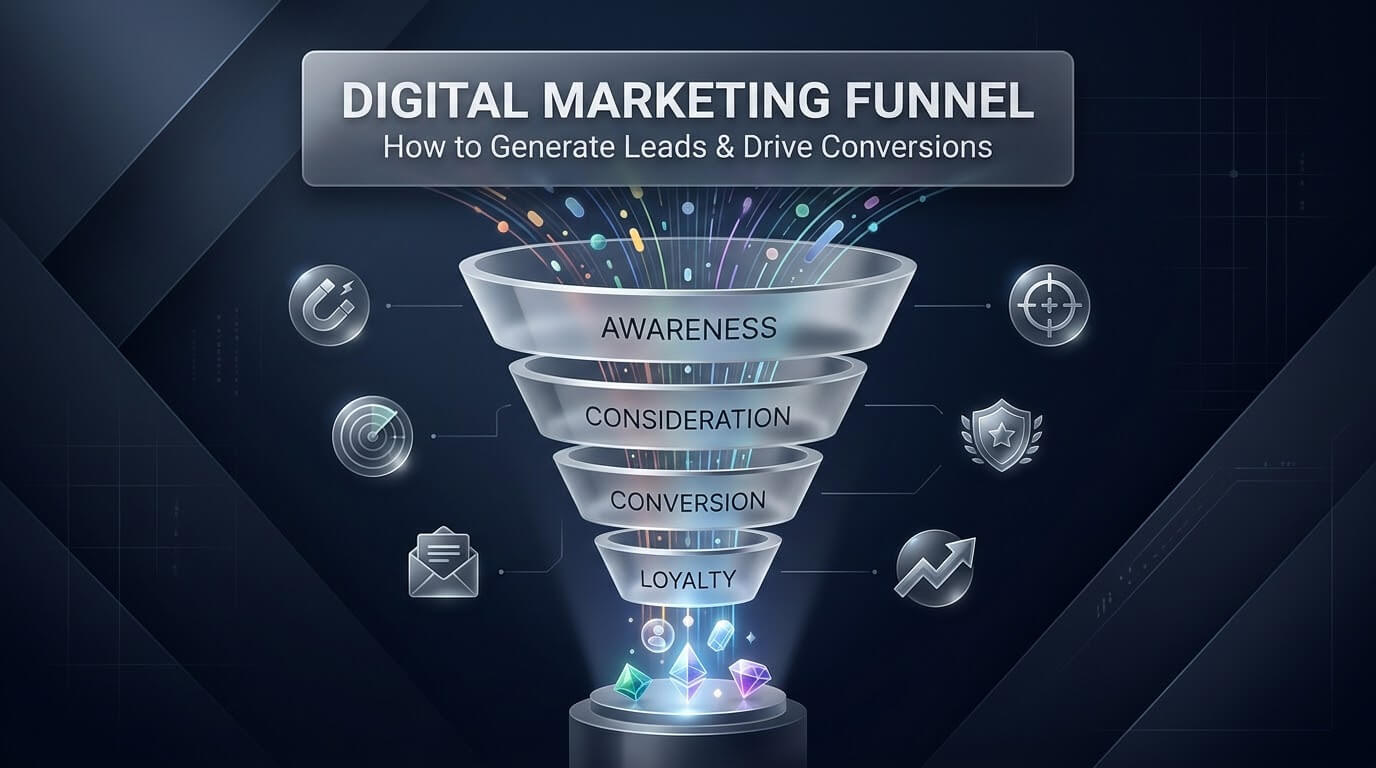
A marketing funnel visually represents the path people take from their first brand interaction to a completed purchase. Rather than asking cold prospects to buy immediately, a funnel guides users through progressive stages of education, trust building, and value demonstration. When you align your content and promotional offers with buyer intent, conversion rates increase dramatically across every digital marketing channel.
Mastering digital marketing lead generation enables modern businesses to scale revenue predictably. Whether you sell high-ticket enterprise software, local plumbing repairs, or consumer physical products, a well-engineered funnel eliminates guesswork. A cohesive digital marketing funnel strategy aligns your creative ads, landing pages, and email automation into an integrated growth engine. This comprehensive guide details the foundational stages of modern conversion funnels, proven lead capture workflows, and the essential software platforms required to automate your customer pipeline.
Key Takeaways
- Multi-Stage Alignment: Matching promotional messaging to specific funnel stages ensures prospects receive the right information at the right psychological moment.
- High-Value Lead Magnets: Offering practical, immediate resources converts casual blog readers and ad clickers into responsive email subscribers.
- Automated Nurture Flows: Consistent email follow-up sequences bridge the gap between initial interest and final buying decisions.
- Systematic Conversion Optimization: Running ongoing split tests on page headlines, forms, and calls to action lowers customer acquisition costs over time.
- Unified Technology Stack: Integrating dedicated landing page builders, CRM platforms, and behavioral heatmaps provides full visibility into your conversion pipeline.
Digital Marketing Conversion Funnel
The concept of a purchasing funnel has existed for over a century, originally known as the AIDA model (Attention, Interest, Desire, Action). However, consumer buying behavior has evolved into a dynamic journey. Modern buyers conduct thorough research across search engines, social media platforms, and third-party review directories before ever speaking with a sales representative.
A digital marketing conversion funnel mirrors this non-linear research pattern. The funnel is divided into three primary operational tiers: Top of Funnel (TOFU), Middle of Funnel (MOFU), and Bottom of Funnel (BOFU). Each tier corresponds to a distinct phase in the digital marketing customer journey. Understanding this progression allows marketing teams to address objections proactively before asking for a financial commitment.
At the top of the funnel, prospective clients experience a specific symptom or business challenge. They search for informational answers rather than commercial products. In the middle of the funnel, prospects evaluate various approaches to resolve their dilemma. At the bottom of the funnel, ready buyers compare specific vendors, pricing options, and service guarantees.
Designing an effective digital marketing funnel strategy requires creating specific content assets and marketing offers for each tier. Attempting to close a sale with a top-of-funnel visitor alienates prospects. Conversely, offering a basic introductory article to a bottom-of-funnel prospect stalls the purchase process. Mapping each customer touchpoint across the digital marketing customer journey ensures smooth progression toward commercial conversion.
Core Stages of the Digital Marketing Funnel
To construct a dependable revenue pipeline, you must optimize each stage of your conversion architecture. Below is a detailed breakdown of the four essential stages that turn anonymous browsers into enthusiastic brand advocates.
1. Top of Funnel (TOFU): Awareness and Discovery
The top of the funnel represents the broadest audience segment. At this stage, individuals do not know your brand exists. They are searching for answers to practical questions or seeking relief from everyday pain points.
Primary promotional channels for awareness include organic search engine optimization, educational YouTube videos, social media reels, and podcast guest interviews. Content at this stage must remain strictly educational and problem-centric. Avoid pitching your paid services. Instead, provide clear, comprehensive answers that establish your brand as an authoritative, helpful industry resource.
Top-of-funnel content captures high search volumes at low acquisition costs. By answering foundational questions about industry best practices, you introduce thousands of targeted readers to your company name. When these visitors encounter future challenges, your brand is already a trusted voice in their minds.
2. Middle of Funnel (MOFU): Consideration and Lead Capture
Once prospects recognize your brand, they enter the consideration phase. At this stage, your goal shifts toward digital marketing lead capture. You must exchange valuable proprietary resources for the prospect’s contact information, transforming anonymous website traffic into identified digital marketing leads.
Effective middle-of-funnel lead assets include downloadable checklists, proprietary benchmark reports, interactive pricing calculators, and live educational webinars. Interactive quizzes and self-assessment scorecards work exceptionally well because they provide personalized diagnostic feedback in exchange for an email address.
Once a user opts in, an automated email nurture sequence begins. These automated messages demonstrate how your solutions resolve common industry problems, gently moving the prospect toward commercial consideration. Providing consistent educational value during this phase builds immense relational equity that competitors cannot easily duplicate.
3. Bottom of Funnel (BOFU): Decision and Purchase
The decision stage is where qualified prospective buyers choose a specific provider. Prospects evaluate price, return on investment, contract terms, and customer implementation timelines. Here, your digital marketing sales funnel must remove all friction and buying anxiety.
High-converting bottom-of-funnel offers include free software trials, live video demonstrations, one-on-one strategy consultations, and detailed client case studies. Transparent pricing calculators and money-back guarantees provide the reassurance cautious prospects need to execute a final transaction.
In addition, live customer chat and automated calendar scheduling eliminate administrative delays. When a high-intent prospect is ready to discuss pricing or implementation details, providing immediate access to a product specialist seals the commercial relationship before enthusiasm cools.
4. Post-Purchase: Retention, Upselling, and Advocacy
Many traditional marketing guides treat the purchase as the finish line. In reality, customer acquisition represents the beginning of long-term profitability. Retaining an existing customer costs five to seven times less than acquiring a new one.
Post-purchase funnel workflows include prompt onboarding emails, product tutorial libraries, and proactive customer success check-ins. Delighted customers naturally purchase add-on services and refer colleagues. By building referral incentives into your post-purchase workflows, happy clients feed new prospective digital marketing leads directly back into the top of your funnel.
Proven Digital Marketing Lead Generation Strategy
A funnel cannot function without a continuous influx of prospective buyers. Executing a modern digital marketing lead generation strategy requires moving beyond generic “subscribe to our newsletter” forms. Website visitors guard their inboxes carefully and only trade their contact details for tangible, immediate value.
1. Crafting High-Converting Lead Magnets
An irresistible lead magnet solves a specific, acute problem for your ideal client persona in under ten minutes. Lengthy eighty-page digital books rarely convert well because busy professionals lack the time to read them.
Instead, offer concise, actionable resources. Excellent lead magnet formats include one-page checklists, spreadsheet audit templates, swipe files of proven ad copy, and interactive quiz evaluations. When the resource delivers quick, tangible utility, the prospect immediately associates your brand with competence and value.
Ensure that your lead magnet directly aligns with your core commercial offer. A free spreadsheet audit tool naturally leads into a paid software subscription or professional audit service. When the introductory resource logically bridges into your primary product, your conversion rates skyrocket.
2. Qualifying Digital Marketing Leads: MQL vs. SQL
Not every contact who downloads a resource represents a viable buyer. Treating every email opt-in as an urgent sales opportunity wastes valuable time and annoys prospects. Modern organizations categorize contacts into Marketing Qualified Leads (MQLs) and Sales Qualified Leads (SQLs).
A marketing qualified digital marketing lead is someone who engages with top-of-funnel content, downloads a guide, or opens multiple emails. They demonstrate interest but have not signaled an intent to purchase. In contrast, a sales qualified lead requests a custom proposal, books a demo, or visits your commercial pricing page repeatedly. Developing clear lead scoring criteria in your CRM ensures sales teams focus their energy on prospects ready to buy.
Assign positive point values to high-intent actions, such as visiting your pricing page three times or downloading a technical product comparison sheet. Conversely, deduct points when subscribers become inactive. When a contact crosses your predetermined scoring threshold, your CRM alerts an account executive to initiate personalized outreach.
3. Speed-to-Lead Automation and Omnichannel Routing
Research consistently shows that response velocity dictates lead conversion rates. Contacting a prospective inbound inquiry within five minutes makes you twenty-one times more likely to qualify that lead compared to waiting thirty minutes.
Connecting your website contact forms to automated SMS and phone routing systems ensures immediate engagement. If a prospect submits an inquiry after hours, automated email confirmations and self-scheduling calendar links allow them to book a consultation instantly while interest remains peak. Implementing an automated lead generation strategy ensures zero opportunities slip through administrative cracks.
Real-World Digital Marketing Funnel Examples
Examining practical digital marketing funnel examples helps illustrate how different business models guide buyers through the conversion journey. Below are three proven funnel architectures across major industry sectors.
1. The B2B Professional Services and SaaS Funnel
Business-to-business organizations operate on extended evaluation cycles involving multiple decision-makers. A high-performing B2B digital marketing sales funnel balances education with strategic touchpoints.
The journey begins with an organic search article analyzing an emerging industry challenge. Within the article, the reader downloads a proprietary benchmarking spreadsheet. This action triggers a four-part automated email nurture sequence detailing relevant customer case studies. The final email invites the prospect to attend a live platform demonstration. After the demo, sales representatives provide a customized pricing proposal with electronic signature integration.
This multi-stage structure nurtures cold enterprise buyers systematically. Rather than pitching immediately, the organization establishes authority, educates stakeholders, and proves ROI before requesting a high-ticket budget allocation.
2. The Local Service Business Lead Funnel
Local businesses such as dental clinics, roofing contractors, and legal practices require rapid, localized conversion funnels. Prospective clients often experience an urgent need and evaluate local providers within hours.
A homeowner searching for “emergency roof repair” clicks on a local Google Search Ad. The ad directs them to a clean mobile landing page highlighting five-star customer reviews, licensing credentials, and a click-to-call phone number. An interactive estimate calculator allows the visitor to input their address and roof square footage in sixty seconds. Submitting the form immediately sends an automated SMS confirmation while alerting the contractor’s dispatch team to call the prospect within three minutes.
This rapid local digital marketing lead funnel captures high-intent homeowners during their moment of urgent distress. By prioritizing mobile speed and instant phone connectivity, local contractors routinely outperform larger regional competitors.
3. The E-Commerce Direct-to-Consumer Funnel
Online retailers depend on visual appetite appeal, social proof, and rapid checkout workflows to maximize transaction velocity.
A shopper discovers a skincare brand through an Instagram video reel ad showcasing customer before-and-after results. Clicking the ad takes them to a curated product collection page. An exit-intent popup offers a ten percent welcome discount in exchange for an email address and mobile phone number. If the shopper adds an item to their cart but abandons the checkout, an automated SMS reminder is dispatched sixty minutes later with a direct checkout link, recovering the lost sale.
After the customer receives their first order, an automated post-purchase email sequence shares skincare application tips and suggests matching moisturizing creams. This thoughtful follow-up turns single-order shoppers into predictable recurring subscribers.
Digital Marketing Conversion Optimization (CRO)
Driving traffic to a funnel with poor conversion rates is like pouring water into a leaky bucket. Implementing systematic digital marketing conversion optimization allows organizations to extract significantly more revenue from their existing website traffic without increasing advertising spend.
Conversion optimization relies on data-driven experimentation rather than personal aesthetic opinions. By measuring micro-conversions at each stage of your digital marketing conversion funnel, you can identify exact drop-off bottlenecks and deploy targeted improvements.
1. Streamlining Form Fields and Friction
Every unnecessary form field reduces user completion rates. Demanding a home address, company size, and annual revenue on an introductory lead magnet form discourages qualified prospects. For top-of-funnel lead capture, request only an email address and first name.
Reserve detailed intake questions for bottom-of-funnel demo requests or consultation forms where user commitment is high. Multi-step forms that break questions into two or three progressive screens convert significantly better than long single-page questionnaires.
Using progress bars on multi-step forms taps into user psychology. When people see they are already fifty percent complete, they are motivated to finish the final questions. Removing friction from forms is often the easiest way to double your inbound digital marketing leads overnight.
2. Deploying Heatmaps and Session Recordings
Traditional analytics platforms show you what happened, but behavioral analytics tools show you why it happened. Installing visual software like Hotjar allows you to observe user scroll depth, rage clicks, and form abandonment patterns.
If session recordings reveal that seventy percent of mobile visitors never scroll down to view your client testimonials, move your social proof elements higher up the page. Fixing these visual stumbling blocks produces immediate conversion lifts across your digital marketing conversion funnel.
3. Systematic A/B Split Testing
Never assume your initial marketing copy or landing page design is optimal. Continuous split testing is the foundation of high-performing conversion funnels. Test one variable at a time, such as headline value propositions, call-to-action button phrasing, background colors, or video versus text testimonials.
Run split tests until you achieve statistical significance. A modest five percent lift in landing page conversion combined with a ten percent improvement in email click-through rates compounds into dramatic revenue growth across your entire customer pipeline.
4. Dynamic Landing Page Personalization
Modern consumers expect personalized experiences. Dynamic text replacement tools allow you to match the landing page headline automatically to the exact search query a prospect entered on Google Ads.
For example, if a prospect searches for “enterprise accounting software,” the headline displays “The Premier Enterprise Accounting Software.” If another user searches for “accounting software for medical clinics,” the headline adapts to “The Premier Accounting Software for Medical Clinics.” This exact message match reassures visitors that they have landed in the perfect place, dramatically lowering bounce rates.
Top Platforms for Funnels and Lead Generation
Building and scaling an automated conversion funnel requires dependable software infrastructure. Below are eight top platforms that help organizations build landing pages, automate customer nurture flows, track behavioral data, and optimize conversion rates.
1. HubSpot
HubSpot is an industry-leading inbound marketing, sales CRM, and customer service platform that excels at orchestrating complex multi-stage conversion funnels.
The platform unites lead capture web forms, landing page design, automated email nurturing, and sales pipeline tracking into a single synchronized database. Marketers can build behavioral workflows that trigger specific email follow-ups based on the exact pages a prospect visited or resources they downloaded.
HubSpot features granular lead scoring, enabling sales teams to identify high-intent prospects automatically. Its multi-touch revenue attribution reveals which top-of-funnel blog posts and ad campaigns generate the highest lifetime customer value. HubSpot offers free core CRM tools, with professional marketing suites starting around $800 per month.
2. ClickFunnels
ClickFunnels is a specialized sales funnel builder designed to guide prospective buyers through sequential, high-converting purchasing steps.
The platform eliminates the technical complexity of building multi-page sales funnels. Users can select from hundreds of pre-designed funnel templates, including webinar registration flows, product launch sequences, and high-ticket consultation funnels. ClickFunnels includes one-click upsells, order bumps, and custom checkout pages that maximize average order value.
ClickFunnels also features built-in email automation, affiliate management, and customer membership areas. Plans start at $147 per month, making it a popular choice for digital creators, ecommerce merchants, and boutique agency owners.
3. Unbounce
Unbounce is an acclaimed landing page builder that leverages artificial intelligence to maximize conversion rates for paid ad campaigns.
The platform features an intuitive drag-and-drop visual builder that allows marketing teams to publish custom, mobile-responsive landing pages without developer assistance. Unbounce includes Smart Traffic, an AI routing engine that automatically analyzes visitor attributes and directs each user to the page variant most likely to convert.
Unbounce also provides dynamic text replacement, matching the landing page headline directly to the exact keyword a user typed into Google Ads. Pricing starts at $99 per month.
4. ActiveCampaign
ActiveCampaign is a premier email marketing, marketing automation, and CRM platform renowned for its advanced visual workflow automation engine.
The software allows organizations to build sophisticated middle-of-funnel nurture sequences with conditional logic. You can segment contacts dynamically based on email opens, link clicks, website visits, and purchase history. ActiveCampaign’s predictive sending technology delivers messages at the exact time individual subscribers are most likely to engage.
ActiveCampaign connects smoothly with hundreds of third-party platforms, including Shopify, WordPress, and Stripe. Pricing begins around $29 per month for starter automation plans.
5. Hotjar
Hotjar is a visual behavioral analytics tool that reveals how visitors interact with your website, landing pages, and conversion forms.
The platform provides interactive heatmaps displaying where users click, move their mouse, and scroll. Its session recording feature allows marketers to watch real anonymized playback of visitor journeys, identifying points of friction, broken design elements, and form drop-offs.
Hotjar also includes user feedback widgets and micro-surveys that capture real-time visitor opinions on pricing pages. Hotjar offers a generous free tier, with paid plans starting around $39 per month.
6. Typeform
Typeform is an interactive form and survey platform that transforms traditional static forms into engaging conversational experiences.
The tool presents questions one at a time, creating an intimate, conversational atmosphere that significantly reduces form abandonment. Typeform supports conditional logic branching, displaying customized follow-up questions based on a user’s previous answers. This capability makes it ideal for lead qualification quizzes, intake assessments, and quote calculators.
Typeform integrates natively with major CRM platforms and email marketing tools. Plans start around $25 per month.
7. Zapier
Zapier is a dominant workflow automation platform that connects thousands of web applications without custom API programming.
In a modern conversion funnel, leads originate across multiple disparate channels, including Facebook Lead Ads, landing page forms, and webinar registrations. Zapier acts as the central operational bridge, instantly transferring new contact records into your CRM, alerting your sales team via Slack, and triggering automated welcome SMS messages.
Zapier ensures zero lead drop-off and eliminates manual data entry errors. A free tier is available, with professional automation plans starting around $19.99 per month.
8. Google Analytics
Google Analytics 4 (GA4) is the global standard for digital marketing analytics, providing comprehensive visibility into customer acquisition channels and conversion journeys.
GA4 features robust Funnel Exploration reports, allowing marketers to visualize multi-step user progression and pinpoint exact abandonment stages across web and mobile applications. Marketers can track custom conversion events, compare acquisition channels, and evaluate user lifetime value across diverse traffic sources.
Google Analytics integrates natively with Google Ads, enabling automated audience remarketing based on specific funnel drop-off behaviors. The standard platform is 100% free to use.
Funnel & Lead Generation Platforms Comparison
Selecting the ideal software tools depends on your specific business model, technical capabilities, and conversion goals. Below is an overview comparing the eight featured platforms across strategic role, standout advantages, and starting costs.
| Platform | Primary Strategic Role | Standout Advantage | Best For | Starting Cost |
|---|---|---|---|---|
| HubSpot | All-in-One CRM & Inbound Automation | Multi-Touch Attribution & Lead Scoring | B2B Firms, Growing SaaS, Agencies | Free Core Tools / ~$800/mo (Pro) |
| ClickFunnels | Sales Funnels & Checkout Architecture | One-Click Upsells & Turnkey Templates | Course Creators, Direct Sellers, Coaches | $147 per month |
| Unbounce | AI Landing Pages & Smart Routing | Smart Traffic Optimization & Fast Drag-Drop | Paid Media Specialists & CRO Teams | $99 per month |
| ActiveCampaign | Visual Automation & Nurture Sequences | Conditional Workflow Logic & Predictive Send | Lifecycle Marketers & E-Commerce | $29 per month |
| Hotjar | Behavioral Analytics & User Heatmaps | Session Playbacks & Visual Click Maps | UX Designers & Funnel Optimizers | Free tier / $39 per month |
| Typeform | Conversational Lead Capture Forms | One-Question-at-a-Time High Completion | Lead Qualification & Quote Forms | $25 per month |
| Zapier | Cross-App Funnel Automation | Thousands of No-Code App Integrations | Workflow Engineers & Marketing Ops | Free tier / $19.99 per month |
| Google Analytics | Funnel Exploration & Attribution | Multi-Step User Path Analysis & Free GA4 | Data Analysts & Growth Marketers | 100% Free |
Step-by-Step Funnel Launch Checklist
Before driving paid traffic to a newly built conversion funnel, review this operational checklist. Verifying these technical and promotional elements ensures a frictionless user journey.
Funnel Architecture & Launch Checklist
- Audience Persona Defined: Is the funnel tailored to a specific target audience with clearly defined pain points?
- High-Value Lead Magnet Ready: Does the introductory lead resource solve an acute problem in under ten minutes?
- Mobile Responsiveness Verified: Does the landing page load in under two seconds and render cleanly across mobile devices?
- Tracking Pixels Configured: Are Google Analytics 4, Meta Pixel, and conversion tags tracking events accurately?
- Form Integrations Tested: Do form submissions successfully transmit contact data into your CRM and email marketing tool?
- Automated Nurture Scheduled: Is a three-to-five message welcome email sequence activated to nurture new leads?
- Confirmation Pages Optimized: Does the thank-you page guide leads to their next logical action, such as booking a call?
- Heatmap Tracking Active: Is Hotjar recording visitor sessions to identify future conversion optimization opportunities?
Common Digital Marketing Funnel Mistakes to Avoid
Building a successful conversion funnel requires avoiding common strategic errors. Many businesses sabotage their promotional campaigns by overlooking basic user psychology.
1. Selling Too Aggressively to Cold Traffic
Demanding a marriage proposal on a first date never works. Similarly, directing cold top-of-funnel traffic directly to a high-ticket checkout page results in abysmal conversion rates. Warm up prospects with helpful educational content and low-friction lead resources before presenting your commercial sales offer.
2. Neglecting Middle-of-Funnel Nurture Sequences
Capturing an email address is only the first step. Organizations that fail to send consistent follow-up emails experience rapid lead decay. If you do not communicate with new subscribers within their first week of opting in, they will forget who you are and mark future promotional messages as spam.
3. Ignoring Mobile Page Load Speed
Over sixty percent of all funnel traffic originates on mobile smartphones. If your landing page takes more than three seconds to load, over half of your prospective visitors will bounce before seeing your headline. Compress images, eliminate bulky scripts, and choose fast hosting to preserve hard-earned advertising traffic.
4. Failing to Track Funnel Drop-Off Points
Evaluating your marketing pipeline strictly by final sales revenue blinds you to operational defects. If two thousand people visit your landing page, three hundred opt in for your lead magnet, but only two people open your nurture emails, your bottleneck is email deliverability and subject line engagement. Track micro-conversion metrics at every step to direct your optimization energy effectively.
Frequently Asked Questions
What is the difference between a website and a digital marketing funnel?
A traditional website functions like an exploratory brochure with dozens of navigation links, menus, and sidebars. In contrast, a digital marketing funnel is a focused, linear path designed with a single goal: guiding the visitor toward a specific conversion action without distractions.
How long does it take to build an effective digital marketing funnel?
A straightforward lead generation funnel featuring a single landing page, thank-you page, and automated email welcome sequence can be built in two to three days. More complex funnels involving webinar integrations, dynamic upsells, and customized CRM scoring typically require two to four weeks of development.
What is a good conversion rate for a digital marketing lead magnet landing page?
High-performing lead magnet landing pages typically convert between twenty and thirty-five percent of cold visitors into email leads. If your opt-in rate falls below fifteen percent, your headline value proposition, form friction, or mobile page speed requires immediate optimization.
How many emails should be included in an automated nurture sequence?
An effective introductory nurture sequence usually consists of four to six automated emails sent over ten to fourteen days. The initial messages deliver the promised lead magnet and share practical case studies, while later emails introduce your paid solutions and invite the lead to schedule a consultation.
Can small local businesses benefit from digital marketing sales funnels?
Yes. Local service businesses benefit enormously from simplified lead funnels. Directing localized search traffic to dedicated mobile estimate pages with instant click-to-call buttons produces significantly more booked jobs than sending traffic to a generic homepage.
Conclusion
Constructing a high-performing digital marketing funnel is the single most effective way to eliminate revenue volatility in your business. By guiding prospective clients through structured stages of awareness, evaluation, and decision, you build lasting trust while filtering out unqualified prospects.
Begin by analyzing your ideal customer journey and creating an irresistible top-of-funnel lead magnet. Connect your capture forms to automated email sequences using platforms like ActiveCampaign or HubSpot, and monitor user behavior with Hotjar heatmaps. With continuous split testing, clear value communication, and speed-to-lead automation, your digital marketing funnel will consistently generate qualified leads and drive sustainable commercial growth.