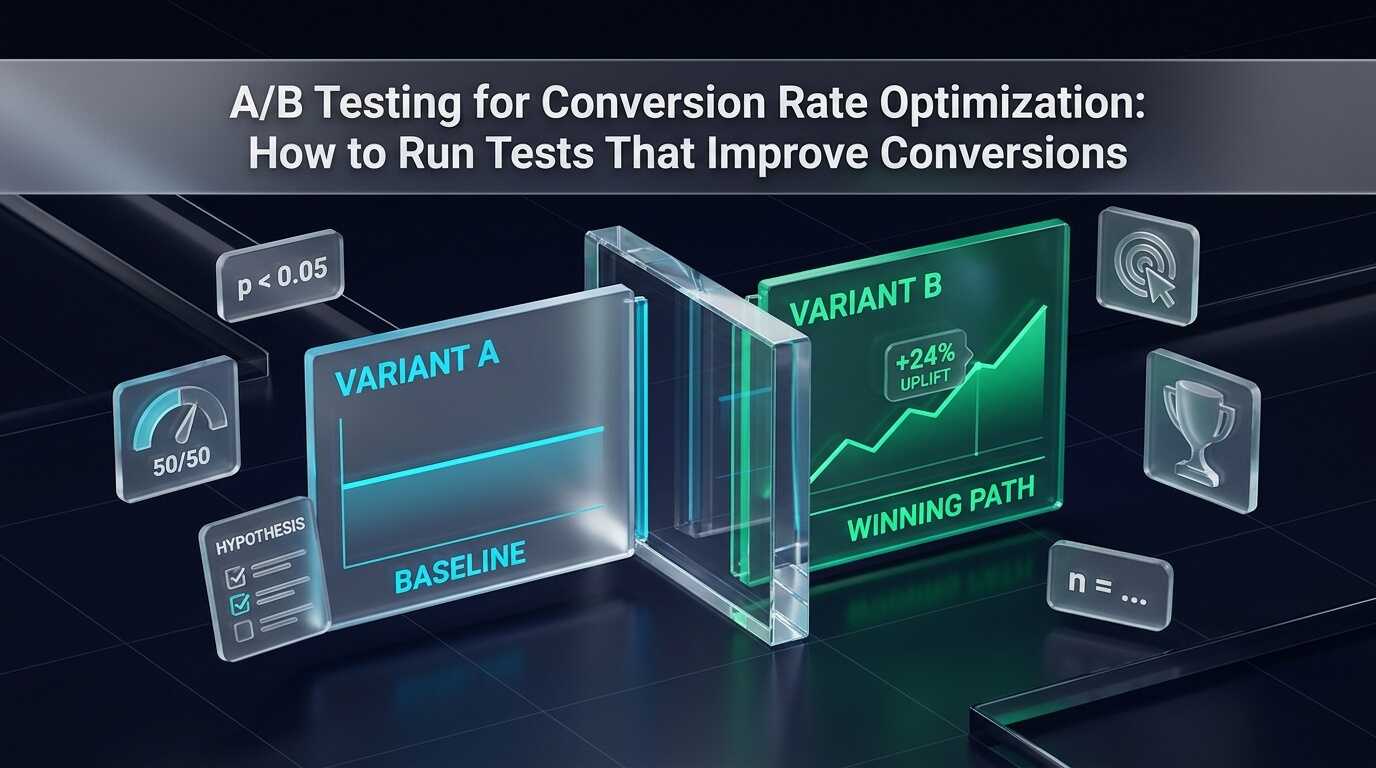
Every website redesign involves substantial risk. Modifying headlines, reorganizing navigation menus, or altering checkout flows based solely on internal intuition frequently damages sales. In contrast, high-growth organizations rely on empirical evidence rather than executive guesswork.
Mastering ab testing for conversion rate optimization allows growth teams to validate changes directly with real customer traffic. Instead of debating design preferences in meeting rooms, you let visitor behavior dictate your digital roadmap. Integrating rigorous a/b testing and conversion rate optimization turns marketing from an unpredictable expense into a scientific revenue engine.
Executing continuous experimentation requires clear hypotheses, solid statistical foundations, and reliable measurement tools. This comprehensive guide outlines the methodologies, statistical models, and frameworks needed to run trustworthy experiments that consistently lift customer conversions.
Key A/B Testing Takeaways:
- A/B testing serves as the scientific measurement layer of conversion rate optimization.
- Testing bold value propositions consistently produces larger revenue lifts than testing button colors.
- Experiments must run for full weekly business cycles to account for day-of-week behavioral swings.
- Pre-calculating statistical sample sizes prevents misleading results caused by early test stopping.
- Checking for Sample Ratio Mismatch (SRM) ensures your traffic allocation remains mathematically valid.
- Bayesian statistical engines deliver intuitive probability metrics tailored for business decisions.
- Documenting flat and losing experiments builds an invaluable institutional knowledge archive.
The Relationship Between CRO and A/B Testing
Marketers frequently conflate conversion optimization with split testing. However, understanding conversion rate optimization cro and a b testing dynamics requires separating the overall methodology from the measurement tool. Conversion rate optimization represents the complete discipline of researching user friction, studying customer psychology, and identifying usability bottlenecks.
In contrast, a b testing for cro is the experimental mechanism used to validate those discoveries. You cannot run successful split tests without deep customer research. Testing random ideas without behavioral evidence wastes traffic and produces inconclusive results.
When you combine user research with controlled experimentation, your win rate accelerates. Qualitative insights from user recordings reveal what elements confuse visitors. Controlled split tests prove whether your proposed design solution actually increases sales.
Core Testing Methodologies: A/B vs Multivariate vs Split URL
Experimentation teams utilize different technical approaches depending on the scope of changes and available visitor volume. Selecting the appropriate test structure ensures reliable data collection.
A/B Testing (Split Testing)
Traditional conversion rate optimization a b testing compares an original control page against one or more modified variations. Traffic is divided evenly between variants using client-side JavaScript or server-side routing. This method isolates a single major conceptual change, such as an alternative headline or a streamlined form layout.
Practicing split testing conversion rate optimization provides clean, unambiguous data regarding which variation generated higher conversions. It represents the most reliable testing method for low to medium-traffic websites.
Multivariate Testing (MVT)
When teams want to test multiple page elements simultaneously, they deploy multivariate testing conversion rate optimization. For example, you might test three headlines alongside two hero images and two call-to-action buttons. The testing software generates twelve distinct combinations to measure both individual element impacts and compound interaction effects.
Because traffic must be divided across numerous variations, multivariate testing demands substantial monthly visitor volume. Websites with under 100,000 monthly visits should avoid complex multivariate experiments and focus on focused A/B tests.
Split URL Testing
Split URL testing directs visitors between two completely different web page URLs. This approach is ideal for comprehensive page redesigns, major structural template overhauls, or alternative multi-step checkout funnels. Server-side redirects route incoming traffic without page flickering.
Advanced digital teams often choose to experiment website conversion rate optimization with a b and multivariate testing across different stages of their funnel. They use radical split URL tests for homepage redesigns while using multivariate tests for subtle checkout form tweaks.
Developing a Strategic CRO Testing Strategy
Running random experiments without an underlying plan leads to inconclusive outcomes and wasted engineering hours. Building a structured conversion rate optimization testing strategy guarantees that every test addresses a verified business bottleneck.
Phase 1: Quantitative Analytics Discovery
Begin your strategic planning inside Google Analytics 4. Analyze multi-step conversion funnels to pinpoint where prospective buyers drop off in the largest numbers. Look at mobile versus desktop completion rates, browser performance differences, and landing page bounce rates.
Phase 2: Qualitative Behavioral Investigation
Quantitative data reveals where visitors leave, but qualitative tools reveal why they leave. Inspect session replays and scroll heatmaps using tools like Microsoft Clarity or Hotjar. Watch where users hesitate, rage-click, or abandon form fields.
Phase 3: Scientific Hypothesis Formulation
A rigorous test hypothesis connects user research to an expected behavioral outcome. Avoid vague statements like “let us try a green button.” Instead, structure every hypothesis using a formal three-part framework:
“Because we observed [user research finding], modifying [specific page element] will result in [measurable metric lift], because [psychological reason].”
Phase 4: Prioritizing Your Testing Backlog
A mature testing program generates dozens of competing test concepts. Prioritize your backlog using established scoring models like PIE (Potential, Importance, Ease) or PXL. Focus your immediate development resources on high-traffic pages with verified friction points and straightforward technical implementation.
Experimentation Pro Tip:
Never conclude an A/B test early just because the software displays a temporary ninety-nine percent statistical significance. Early sample sizes contain extreme variance. Always run tests for at least two full weeks to capture natural day-to-day shopping habits.
Client-Side vs Server-Side Experimentation Architecture
Choosing the correct implementation architecture impacts both testing agility and website loading speed. Modern experimentation platforms support two distinct execution methods.
Client-Side Experimentation
Client-side testing executes directly inside the visitor’s web browser using JavaScript tags. The browser downloads the original webpage from your web server, and the testing script modifies the Document Object Model (DOM) before the page paints on screen.
The primary advantage of client-side testing is speed and operational independence. Non-technical marketers and growth specialists can deploy visual changes, swap hero banners, and launch landing page variants without waiting for internal engineering sprints. However, care must be taken to implement anti-flicker snippets to prevent visual content flashes.
Server-Side Experimentation
Server-side testing renders variations directly on your web application servers before sending HTML to the visitor’s browser. Variations are governed by software development kits (SDKs) and feature flags embedded within backend application code.
Server-side experimentation eliminates page flickering and works across mobile mobile apps, connected television interfaces, and secure authenticated customer portals. It allows product engineering teams to test complex functional modifications, such as alternative search algorithms, dynamic pricing engines, and multi-step checkout logic. While requiring dedicated developer resourcing, server-side testing provides bulletproof security and zero performance latency.
Detailed Step-by-Step Anatomy of a High-Impact Test
Executing an experimentation program requires methodical execution across every stage of the test lifecycle. Moving systematically through these five operational phases maximizes data integrity.
Step 1: Deep Usability Audit and Friction Mapping
Start by auditing the specific page template slated for testing. Review historical user feedback tickets, exit survey responses, and session replays. Identify specific cognitive blockers, such as confusing shipping terms, hidden fees, or ambiguous form labels.
Step 2: Wireframing and Conversion Copywriting
Design your test variation with a single, clear objective. Strip away unnecessary visual clutter that distracts visitors from completing the primary call to action. Draft concise, benefit-driven headlines that answer core buyer objections immediately.
Step 3: Rigorous Pre-Launch Technical QA
Before allocating real traffic, thoroughly test your variation across multiple browser viewports. Check that buttons trigger goal events accurately in your analytics debugging console. Verify that form submissions pass leads into your CRM database without formatting errors.
Step 4: Live Data Monitoring and SRM Checks
Monitor your active test during its first forty-eight hours to ensure traffic splits evenly. Use a chi-square calculator to verify that your actual visitor counts match your intended split ratio. If a Sample Ratio Mismatch occurs, pause the test immediately to diagnose tracking defects.
Step 5: Post-Test Segmentation Analysis
When your test reaches its pre-calculated sample size, analyze performance across visitor sub-segments. Check whether mobile visitors reacted differently from desktop users. Determine whether paid advertising traffic converted at higher rates than organic search visitors to uncover hidden nuances.
Essential Best Practices for Reliable Experimentation
Flawed test setups produce invalid conclusions that mislead executive decision-makers. Adhering to proven conversion rate optimization ab testing best practices protects your organization against false-positive results and wasted development cycles.
1. Pre-Calculate Required Sample Size
Before launching any conversion rate optimization test, use a sample size calculator to determine the required visitor count. Input your baseline conversion rate, minimum detectable effect (MDE), and statistical power (typically 80%). Committing to a predetermined sample size prevents premature test conclusions.
2. Test for Full Weekly Cycles
Consumer behavior fluctuates significantly between Tuesday afternoon and Sunday evening. Running an experiment for five days introduces severe weekday bias. Always run live conversion rate optimization tests for full seven-day cycles, preferably for two to four full weeks.
3. Verify Sample Ratio Mismatch (SRM)
When an A/B test is configured for a 50/50 traffic split, incoming visitors should divide evenly. If your reporting dashboard shows 52,000 visitors in Control and 48,000 in Variant B, a Sample Ratio Mismatch exists. SRM indicates technical tracking failures, bot filtering errors, or redirect latency that invalidates the test data.
4. Avoid Testing Too Many Minor Variations
Testing minute cosmetic variations—such as slightly different shades of blue—rarely produces meaningful business impacts. Focus your creative energy on testing distinct value proposition angles, alternative pricing presentations, and simplified form structures.
5. Isolate External Marketing Factors
Do not launch major new paid advertising campaigns or overhaul email marketing sequences midway through an active test. Sudden shifts in traffic quality distort test data and make it impossible to isolate true cause and effect.
Statistical Engines: Frequentist vs Bayesian Explained
Modern experimentation software relies on sophisticated mathematical models to evaluate test variations. Understanding the difference between Frequentist and Bayesian frameworks helps teams interpret data correctly.
The Frequentist Framework
Frequentist statistics has been the traditional scientific standard for decades. It relies on p-values and null hypothesis significance testing. The model assumes the null hypothesis is true—meaning there is no difference between variations—until sample data provides overwhelming proof to reject it.
Frequentist testing requires strict adherence to predetermined sample sizes. Checking results daily and stopping the test early when p < 0.05 introduces severe alpha error, producing false-positive results.
The Bayesian Framework
Bayesian statistics calculates the actual probability that a variation outperforms the control. Instead of reporting abstract p-values, Bayesian engines output clear statements: “Variant B has a 94% probability of beating Control, with an expected revenue lift of 4.2%.”
Bayesian models incorporate prior historical knowledge and update probabilities continuously as new visitor data arrives. This makes Bayesian metrics far more actionable and intuitive for business leadership teams making risk-weighted marketing decisions.
Building an Institutional Experimentation Knowledge Archive
In high-performing experimentation organizations, between fifty and seventy percent of tests do not produce winning lifts. Treating these experiments as failures wastes valuable commercial intelligence. High-growth organizations document every test outcome in a centralized experimentation repository.
Your experimentation archive should document the original hypothesis, visual screenshots of the control and variation, sample size metrics, and final lift figures. Most importantly, record the qualitative behavioral takeaway explaining why the audience reacted the way they did.
Maintaining a searchable knowledge base prevents incoming team members from repeating already-disproven design ideas. It allows leadership to identify recurring behavioral patterns across product lines, informing future brand positioning and product development roadmaps.
Top A/B Testing & Optimization Platforms: In-Depth Reviews
Executing a scalable testing program requires dependable software that provides reliable audience targeting, rapid page rendering, and rigorous statistical analysis. The following seven conversion rate optimization testing tools deliver enterprise-grade capabilities.
1. VWO
VWO is an integrated experimentation platform combining visual split testing, multivariate testing, and behavioral user research. Its intuitive visual editor allows marketing teams to deploy copy adjustments, image swaps, and layout changes without engineering support. The platform features built-in heatmaps and session recordings linked directly to test variations.
VWO uses a sophisticated Bayesian statistical engine that provides clear probability-to-beat-control metrics. It offers a generous free tier for websites testing up to 50,000 monthly users, making it accessible to growing businesses and mid-market brands alike.
2. Optimizely
Optimizely is the established enterprise gold standard for digital experimentation. It offers powerful client-side visual testing alongside advanced server-side experimentation tools. Its Stats Engine utilizes sequential testing mathematics that prevents false-positive errors caused by repeated data peeking.
The platform supports complex web architectures, single-page applications, and mobile apps. Optimizely complies with strict corporate data governance, HIPAA regulations, and SOC 2 security standards, catering to large enterprise organizations.
3. Convert
Convert is a privacy-first A/B testing tool built specifically for optimization agencies and privacy-conscious enterprises. It delivers ultra-fast script execution that prevents visible page flickering during tests. The software complies strictly with GDPR, CCPA, and global privacy mandates by avoiding persistent third-party cookies.
Convert includes an intuitive visual editor, custom JavaScript code editors, and direct Google Analytics 4 integration. Its transparent pricing tiers and agency multi-workspace management make it a favorite among dedicated CRO specialists.
4. AB Tasty
AB Tasty is an AI-powered experimentation and personalization platform designed for digital marketing and product teams. It combines client-side testing with server-side feature flagging and customer journey personalization. Its predictive AI algorithms help marketers segment visitors and deliver tailored promotions in real time.
The platform includes robust widgets for social proof, exit-intent modals, and urgency countdown timers. AB Tasty provides rich ROI reporting that connects winning variations directly to bottom-line ecommerce revenue metrics.
5. Kameleoon
Kameleoon is a powerful experimentation and AI personalization platform built for performance-focused enterprise teams. It features a high-performance visual editor, full-stack SDKs for developer-driven testing, and real-time predictive segmentation. Its lightweight tracking script ensures zero performance degradation on complex digital storefronts.
The platform includes real-time sample ratio mismatch monitoring and automated anomaly detection. Kameleoon delivers exceptional multi-variant testing capabilities for financial institutions, healthcare providers, and high-volume media publishers.
6. Statsig
Statsig is a modern product experimentation platform built by former Facebook infrastructure engineers. It bridges the gap between marketing experimentation and engineering feature management. Statsig allows product teams to run A/B tests, manage automated feature rollouts, and monitor technical application metrics in real time.
The platform provides automated root-cause analysis that identifies which specific page components drove metrics changes. Its generous free tier and transparent usage-based pricing make it popular among fast-growing technology startups.
7. Microsoft Clarity
Microsoft Clarity is a free behavioral analytics tool provided by Microsoft that complements active A/B testing programs. While it does not deploy live code variations directly, it delivers essential qualitative research that inspires winning test hypotheses. It records user sessions, generates click and scroll heatmaps, and tracks user frustration metrics.
Clarity highlights rage clicks, dead clicks, and rapid scroll reversals without traffic sampling limits. Reviewing Clarity recordings before launching an experiment ensures your test concepts solve authentic usability bottlenecks.
| Platform Name | Primary Specialty | Statistical Engine | Target Audience |
|---|---|---|---|
| VWO | Visual Testing & Integrated Heatmaps | SmartStats Bayesian Engine | Growing mid-market brands & agencies |
| Optimizely | Full-Stack & Server-Side Testing | Sequential Frequentist Testing | High-traffic enterprise organizations |
| Convert | Privacy-First Testing & Zero Flicker | Bayesian & Frequentist Hybrid | Optimization agencies & retailers |
| AB Tasty | AI Personalization & Social Proof | Bayesian Probability Framework | Ecommerce & digital retail brands |
| Kameleoon | Predictive Targeting & High Performance | Bayesian & Sequential Models | Regulated enterprise organizations |
| Statsig | Feature Flags & Product Analytics | Frequentist & Automated Root Cause | Software engineers & modern SaaS |
| Microsoft Clarity | Session Replays & Frustration Metrics | Qualitative Behavioral Engine | All teams seeking hypothesis research |
A/B Testing Quality Assurance Checklist:
Complete this operational QA checklist before pushing any experiment live:
- Hypothesis Integrity: Does the experiment address a verified customer struggle identified in user recordings or analytics?
- Cross-Browser QA: Have you inspected the variation across Safari, Chrome, Edge, and iOS WebKit viewports?
- Tracking Validation: Do primary and secondary conversion goal events trigger correctly in your analytics debugging console?
- Sample Size Pre-Calculation: Have you determined the required sample volume and scheduled a minimum two-week run time?
- Anti-Flicker Protection: Is your testing snippet placed correctly in the site header to prevent flash of original content (FOOC)?
- Sample Ratio Monitoring: Are traffic allocations balancing evenly between control and treatment variants without skew?
- Knowledge Archiving: Have you scheduled a post-test review to document learnings regardless of whether the test won or lost?
- Segmentation Rules: Have you separated mobile smartphone traffic from desktop workstation users?
Common A/B Testing Pitfalls That Invalidate Results
Even seasoned marketing teams fall victim to common experimental errors. Recognizing these pitfalls protects your data integrity and prevents costly misinterpretations.
The Peeking Problem and Early Stopping
The most widespread testing error is stopping an experiment the moment statistical significance appears in your dashboard. Statistical confidence fluctuates wildly during the initial days of a test. Terminating an experiment prematurely inflates false-positive rates to over thirty percent.
Commit to running your test until the pre-calculated sample size is reached and full weekly business cycles conclude. Patience ensures that your observed metrics lift reflects genuine, lasting customer preference.
Ignoring Mobile and Desktop Discrepancies
Combining mobile smartphone traffic with desktop workstation traffic into a single aggregate test pool hides critical behavioral differences. A layout adjustment that delights mobile shoppers might confuse desktop visitors. Always segment test results by device type to evaluate performance accurately.
Declaring Inconclusive Tests as Total Failures
In mature testing programs, between fifty and seventy percent of experiments produce flat or inconclusive results. Viewing an inconclusive test as a total waste is an operational mistake. Inconclusive tests prove that a proposed redesign did not harm revenue, saving your engineering team from building permanent changes that fail to move the needle.
Frequently Asked Questions
What is the difference between CRO and A/B testing?
Conversion rate optimization is the comprehensive process of researching user friction, studying consumer psychology, and optimizing websites. A/B testing is simply the quantitative scientific tool used to validate whether proposed CRO changes improve conversions.
How much traffic do I need to run statistically valid A/B tests?
Most testing experts recommend having at least 15,000 to 25,000 monthly unique visitors and several hundred conversions per month. Websites with lower traffic should prioritize qualitative research and heuristic improvements instead.
How long should an A/B test run before declaring a winner?
An A/B test should run for at least two full weeks (fourteen days) and reach its pre-calculated sample size. Running tests across full weekly cycles accounts for day-of-week behavioral fluctuations between weekdays and weekends.
What is Sample Ratio Mismatch (SRM) and why does it matter?
Sample Ratio Mismatch occurs when the actual traffic split differs significantly from the expected allocation (e.g., 55/45 instead of 50/50). SRM indicates technical tracking issues, bot filtering biases, or code loading latency that invalidates test results.
What is the difference between Frequentist and Bayesian statistics in testing?
Frequentist statistics calculates the probability of observing data under the assumption that no difference exists (p-values). Bayesian statistics calculates the direct probability that a specific variation is superior, making it easier to interpret for business decisions.
Can A/B testing slow down my website loading speeds?
Client-side testing scripts can cause minor loading delays or page flickering if implemented incorrectly. Using modern asynchronous testing scripts, pre-hiding snippets, or server-side experimentation eliminates noticeable performance delays.
When should I choose multivariate testing over A/B testing?
Choose multivariate testing only when your website has high monthly traffic (over 100,000 visits) and you need to understand how multiple page elements interact together. For most scenarios, sequential A/B tests provide faster and clearer conclusions.
What should I do if an A/B test shows flat or inconclusive results?
An inconclusive test indicates that your change did not significantly alter user behavior. Document the findings in your experimentation knowledge repository, analyze sub-segments (mobile vs desktop), and formulate a bolder hypothesis for your next experiment.
Can A/B testing hurt my search engine optimization (SEO)?
No, Google officially supports A/B testing when conducted properly. Follow Google’s guidelines by avoiding cloaking, using 302 temporary redirects for split URLs, and adding canonical tags pointing back to the original page.
What is the difference between client-side and server-side testing?
Client-side testing executes within the visitor’s browser using JavaScript to modify page elements on the fly. Server-side testing renders variations on the web server before delivery, eliminating flickering and enabling back-end functional testing.
How many variations should I include in a single A/B test?
For most websites, testing one control against a single challenger variation (A vs B) is optimal. Testing multiple variations (A vs B vs C) divides your traffic and lengthens the test duration needed to achieve statistical validity.
What is the biggest mistake beginners make in A/B testing?
The most common mistake is stopping experiments prematurely upon seeing early positive statistical significance. Waiting for the full sample size and running across complete weekly business cycles prevents costly false-positive decisions.
Conclusion: Cultivate an Empirical Experimentation Culture
Sustainable digital growth is not the byproduct of sudden creative breakthroughs or copying competitor layouts. Lasting competitive advantage comes from building a disciplined, data-driven experimentation practice that continuously tests customer-centric hypotheses.
Treat your website as a dynamic laboratory rather than a static digital brochure. Embrace inconclusive experiments as valuable business intelligence that saves engineering resources from unproven redesigns.
Audit your user analytics, study your behavioral session recordings, and construct your next evidence-based testing hypothesis this week. Compounding iterative improvements will transform your conversion rates and accelerate long-term revenue.