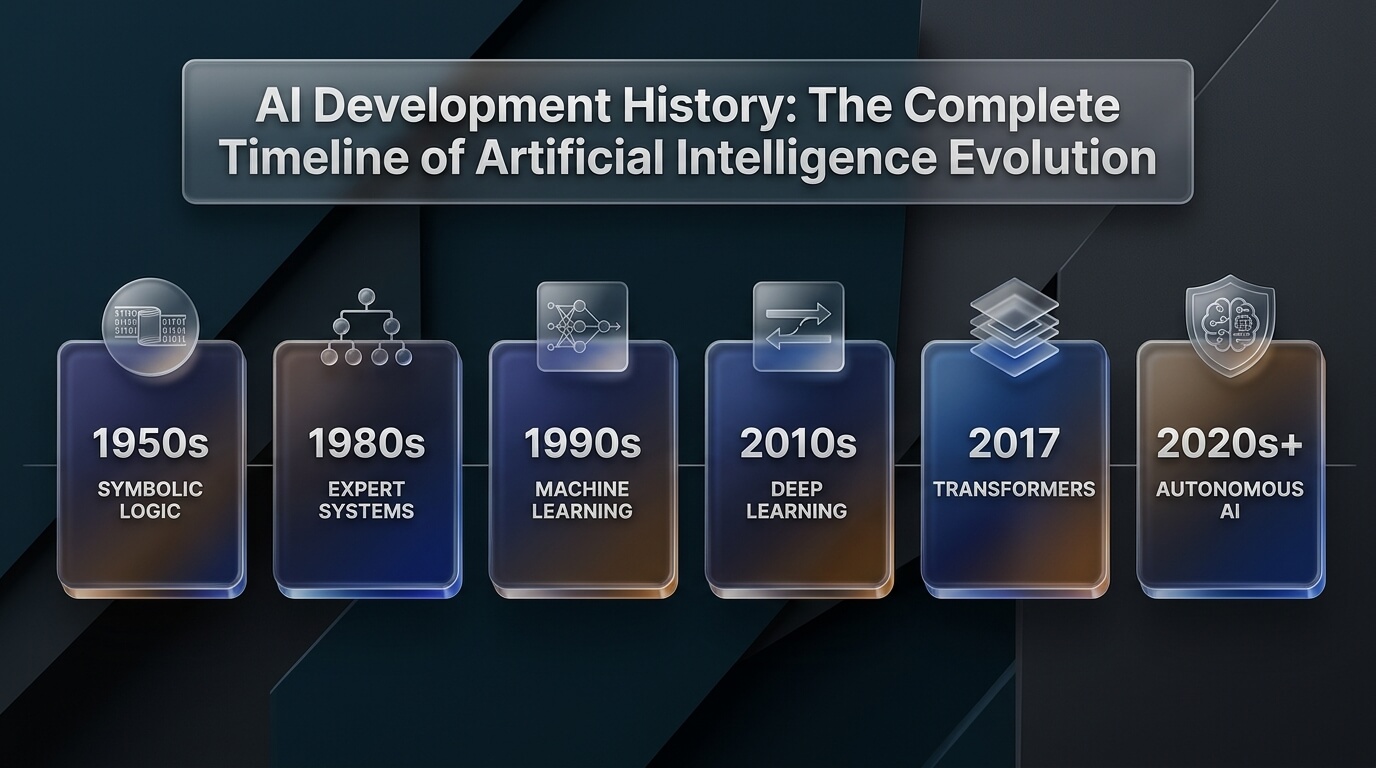
Artificial intelligence seems like a recent invention that arrived with modern chatbots. In reality, scientists have spent more than seven decades laying this computational foundation. Brilliant mathematicians, philosophers, and computer pioneers worked through long winters of skepticism to make thinking machines real. Studying the complete ai development history gives software engineers vital perspective on how we arrived here.
The journey of machine intelligence is full of bold breakthroughs, crushing disappointments, and triumphant revivals. Early pioneers believed human-level thinking was only twenty years away. When those early promises met technical limits, research funding dried up repeatedly. Yet curious researchers kept pushing the boundaries of math and silicon chips until algorithms finally learned to see, hear, and reason.
Understanding this historical timeline helps modern technology leaders separate true innovation from short-lived hype. Many modern neural architectures are refined versions of mathematical ideas proposed in the 1960s and 1980s. This comprehensive historical guide breaks down every defining era, key milestones, and pivotal turning points across the history of ai development.
Key Takeaways for AI Historians and Engineers
- Alan Turing laid the philosophical foundation of machine intelligence with his 1950 imitation game paper.
- The term Artificial Intelligence was officially coined at the famous 1956 Dartmouth Summer Research Project.
- Two harsh AI winters occurred when early symbolic systems failed to deliver on exaggerated promises.
- The 2012 AlexNet breakthrough proved that deep neural networks running on GPUs beat traditional algorithms.
- The 2017 Transformer architecture unlocked the current era of large language models and generative agents.
The Birth Era: When Did AI Development Start?
Many students ask when did ai development start in modern human history. The intellectual roots took formal shape in 1950 when British mathematician Alan Turing published his famous paper on computing machinery and intelligence. Turing asked a simple yet radical question: Can machines think? He proposed the Turing Test to measure whether a computer could imitate human conversation convincingly.
Six years later, the discipline earned its official name at the 1956 Dartmouth Summer Research Project in New Hampshire. Pioneer scientists John McCarthy, Marvin Minsky, Claude Shannon, and Nathaniel Rochester gathered for a month of intense collaborative research. They proposed that every aspect of learning and intelligence could be described so precisely that a machine could simulate it. This historic gathering established artificial intelligence as an independent scientific field.
Early optimism ran extraordinarily high during these founding years. Researchers created programs like the Logic Theorist, which proved mathematical theorems using symbolic logic. Herbert Simon famously predicted that machines would be capable of doing any work a man can do within twenty years. These ambitious dreams captured public imagination and attracted substantial government defense research funding.
To see how modern development workflows evolved from these foundations, review our guide on the AI development lifecycle.
Symbolic Reasoning: The First Golden Era of AI Research
The first major era of artificial intelligence focused on symbolic reasoning, formal logic, and rule-based manipulation. Computers were programmed with explicit if-then rules to solve well-defined puzzles, play checkers, and parse simple English sentences. Scientists believed that human intelligence was essentially the manipulation of physical symbols.
During this period, Joseph Weizenbaum created ELIZA at MIT, one of the earliest conversational programs in history. ELIZA simulated a Rogerian psychotherapist by reflecting user statements back as open-ended questions. Even though ELIZA used simple pattern-matching rules without true understanding, users formed deep emotional connections with the program. This psychological reaction highlighted early human tendencies to attribute empathy to machines.
In 1958, Frank Rosenblatt introduced the Perceptron at Cornell University, creating the first hardware implementation of an artificial neural network. The Perceptron could learn to classify simple visual shapes by adjusting electrical potentiometers. The New York Times boldly reported that the Navy expected the Perceptron to soon walk, talk, see, and write. However, underlying mathematical limitations would soon bring this optimism crashing down.
The First Winter: Broken Promises and Funding Freezes
By the early 1970s, the grand promises of early researchers collided with harsh computational reality. Early computers had only tiny amounts of memory and operated at fraction-of-a-megahertz speeds. Real-world problems like machine translation turned out to be vastly more complex than toy chess puzzles. The field entered the first of several historical stages of ai development known as an AI winter.
In 1969, Marvin Minsky and Seymour Papert published their influential book titled Perceptrons. They mathematically proved that single-layer perceptrons could not solve basic non-linear logic problems like the Exclusive-OR (XOR) function. While they noted that multi-layer networks might overcome this, funding agencies interpreted the book as proof that neural networks were a dead end. Research grants for neural networks evaporated almost overnight.
In the United Kingdom, mathematician Sir James Lighthill published a scathing 1973 report evaluating government-funded AI research. Lighthill concluded that AI research had failed to achieve its promised real-world breakthroughs. In response, the British government slashed academic funding across universities. Concurrently, DARPA in the United States redirected funds toward direct military hardware, freezing civilian academic research for several cold years.
Commercial Rebirth: The Boom of Corporate Expert Systems
Artificial intelligence enjoyed a massive commercial resurgence in the 1980s driven by the rise of expert systems. Instead of trying to create general human intelligence, researchers focused on narrow, specialized domain expertise. Expert systems encoded hundreds of domain rules extracted from human specialists into structured knowledge bases.
Corporations quickly realized that expert systems could save millions of dollars in routine industrial operations. Digital Equipment Corporation built XCON, an expert system that automated the hardware configuration of VAX minicomputer customer orders. XCON reportedly saved the company forty million dollars annually by eliminating configuration errors. Global banks and airlines rushed to build custom knowledge systems of their own.
Specialized hardware manufacturers like Lisp Machine Inc. and Symbolics built custom workstation computers optimized to run symbolic AI code. Japan launched its ambitious Fifth Generation Computer Systems project, investing hundreds of millions of dollars to build parallel computing machines. Artificial intelligence had transitioned from an academic curiosity into a booming multi-billion-dollar global commercial industry.
The Second Winter: The Collapse of Specialized AI Workstations
The commercial boom of expert systems proved fragile when generic desktop personal computers caught up in speed. By the late 1980s, standard microprocessors from Intel and Apple became faster than specialized Lisp workstations at a fraction of the cost. The specialized AI hardware market collapsed rapidly, bankrupting major vendor companies like Symbolics.
At the same time, corporations discovered that expert systems were extraordinarily expensive to maintain over time. As business rules changed, updating thousands of interlocking if-then rules created fragile software that broke easily. Knowledge systems could not learn from new data automatically, requiring constant manual updates by expensive knowledge engineers. Corporate enthusiasm turned into sharp disappointment.
Government agencies again slashed funding as commercial interest cooled. Researchers stopped using the term artificial intelligence on grant applications to avoid immediate rejection. Instead, scientists quietly conducted research under alternative labels like machine learning, pattern recognition, and neural computation. This quiet underground work laid the seeds for the next great revolution.
The Statistical Shift: Data-Driven Machine Learning Triumphs
During the 1990s and 2000s, artificial intelligence underwent a profound philosophical pivot away from handcrafted logic rules toward statistical data analysis. Instead of telling computers how to think, researchers taught algorithms to infer patterns from historical data. Support vector machines, random forests, and Bayesian networks became the dominant tools of the era.
In May 1997, IBM supercomputer Deep Blue made global front-page headlines by defeating reigning world chess champion Garry Kasparov in a six-game match. Deep Blue combined custom chess processing chips with brute-force search algorithms capable of evaluating two hundred million board positions every second. While Kasparov was shocked by the machine tactical prowess, Deep Blue relied on fast calculation rather than learning.
Meanwhile, the invention of the backpropagation training algorithm by Geoffrey Hinton, David Rumelhart, and Ronald Williams in 1986 slowly breathed new life into multi-layer neural networks. In the late 1990s, Yann LeCun created LeNet-5, a convolutional neural network that successfully read handwritten zip codes on United States bank checks. The internet boom began generating massive digital datasets, setting the stage for deep learning to explode.
Deep Learning Awakening: The 2012 AlexNet Breakthrough
The watershed moment in modern ai development progress arrived in October 2012 at the ImageNet visual recognition competition. University of Toronto researchers Alex Krizhevsky, Ilya Sutskever, and Geoffrey Hinton submitted AlexNet, a deep convolutional neural network trained on NVIDIA graphic cards. AlexNet crushed rival algorithms, reducing visual classification error rates by an astonishing ten percentage points.
AlexNet proved that deep neural networks were not just theoretical toys. When supplied with massive labeled datasets and accelerated by parallel GPU chips, deep learning beat handcrafted algorithms decisively. Tech giants pivoted their entire corporate engineering strategies overnight. Google, Meta, Microsoft, and Apple acquired deep learning startups and invested billions into neural compute infrastructure.
In 2016, Google DeepMind made history with AlphaGo, defeating eighteen-time world Go champion Lee Sedol in Seoul. Go was long considered impossible for brute-force computers due to its astronomical number of board configurations. AlphaGo combined deep neural policy networks with reinforcement learning, playing millions of games against itself to master intuitive artistic moves. The world realized that machine learning had entered an entirely new cognitive realm.
The Modern Era: Transformers, Foundation Models, and GenAI
In June 2017, a team of Google researchers published a landmark research paper titled Attention Is All You Need. They introduced the Transformer architecture, replacing recurrent neural loops with self-attention mechanisms. Transformers allowed models to process entire text documents simultaneously rather than word by word, enabling massive parallel training across thousands of GPUs.
The Transformer architecture sparked an unprecedented wave of foundation models. OpenAI launched GPT-1 in 2018, followed by GPT-2, GPT-3, and the public release of ChatGPT in November 2022. ChatGPT became the fastest-growing consumer software application in history, reaching one hundred million active users in two months. People around the world witnessed computers writing poetry, drafting legal contracts, and debugging software code in real time.
The ai development timeline 2026 marks the rapid transition from passive text chatbots to proactive autonomous agent swarms. Modern models reason across text, images, video, and audio simultaneously. Open-source models like Meta Llama give independent developers the power to run enterprise-grade intelligence locally on private hardware. The evolution of artificial intelligence has moved from academic theory into the fabric of everyday human civilization.
Studying this rich ai development history timeline reveals that progress is cumulative and compounding across generations.
Milestone Continuum: Key Turning Points in AI Development Over Time
Tracking the ai development evolution across the decades reveals how computing power, algorithmic design, and big data converged. Below is a structured chronological review of the most critical turning points in ai development over the years.
1950: Alan Turing proposes the Turing Test in his paper Computing Machinery and Intelligence.
1956: The Dartmouth Summer Research Project officially founds the field of Artificial Intelligence.
1958: Frank Rosenblatt creates the Perceptron, the earliest hardware artificial neural network.
1966: Joseph Weizenbaum creates ELIZA, the world’s first conversational computer program.
1973: The Lighthill Report triggers the first major AI winter across academic research labs.
1980: The rise of commercial Expert Systems and specialized Lisp machine workstations begins.
1986: Geoffrey Hinton and colleagues popularize the backpropagation algorithm for neural training.
1987: The collapse of specialized AI hardware vendors initiates the second harsh AI winter.
1997: IBM Deep Blue defeats world chess champion Garry Kasparov in a historic tournament match.
2012: AlexNet wins the ImageNet competition, launching the modern deep learning revolution.
2016: Google DeepMind AlphaGo defeats world Go champion Lee Sedol in Seoul, South Korea.
2017: Google researchers publish Attention Is All You Need, introducing the Transformer architecture.
2020: OpenAI releases GPT-3, demonstrating emergent in-context learning in large foundation models.
2022: OpenAI launches ChatGPT, bringing generative artificial intelligence into mainstream culture.
2024 to 2026: Multimodal reasoning models and autonomous agent swarms reshape global enterprise software.
These historic ai development milestones show how each computing breakthrough paved the way for modern deep learning. Many academic researchers compile this data into an ai development history pdf to teach future engineering generations. Reviewing these milestones reminds engineers that overnight revolutions require decades of patient research.
Actionable Checklist: Historical Lessons for Modern AI Teams
- Avoid over-promising technical capabilities to executive sponsors to prevent internal AI winters.
- Prioritize high-quality data engineering over overly complex theoretical model architectures.
- Leverage open-source pre-trained foundation models rather than training basic networks from scratch.
- Benchmark algorithms against real business outcomes rather than artificial toy puzzle scores.
- Monitor computational energy consumption and cloud GPU costs during training iterations.
- Design systems with transparent audit trails to comply with modern global AI safety regulations.
- Study past computing shifts to identify lasting technological trends versus short-term media hype.
Hype vs. Reality: Surviving the Cycles of Technological Optimism
Throughout the history of artificial intelligence, intense public optimism has consistently oscillated with deep disappointment. Understanding this recurring pattern helps modern software engineers maintain balance and long-term vision. Hype cycles occur when marketing promises run far ahead of practical engineering capabilities.
During peak hype phases, business leaders often believe that artificial intelligence will automate away all human labor overnight. When real-world edge cases prove stubborn and complex, disillusionment can set in quickly. Engineering teams that survive these cycles focus on solving narrow, high-value customer problems with dependable software. Pragmatic utility always outlasts marketing hype.
The current generative AI boom differs from previous eras in one crucial way: real commercial adoption is already massive. Unlike the expert systems of the 1980s, modern language and vision models are used by hundreds of millions of people every single day. The technology delivers genuine commercial productivity, ensuring that machine learning is here to stay.
Essential Research Tools and Archives for AI Historians and Developers
Studying artificial intelligence history requires access to academic preprint repositories, open-source model registries, and historical research archives. Below are comprehensive reviews of eight essential platforms used by researchers to track AI history and modern breakthroughs.
1. arXiv
arXiv is the world’s most influential open-access scientific repository, hosted by Cornell University. Founded in 1991, arXiv revolutionized scientific publishing by allowing researchers to share electronic preprints before formal peer review. Nearly every breakthrough in modern machine learning, from AlexNet to the Transformer paper, appeared first on arXiv.
The repository computer science (cs.AI and cs.LG) categories receive thousands of new research papers every single month. Independent researchers and university scholars around the world rely on arXiv to follow cutting-edge research without paywalls. arXiv is the ultimate open living record of modern artificial intelligence history.
2. Papers with Code
Papers with Code is a free, open resource that links machine learning research papers directly to their official code implementations and evaluation benchmarks. Now part of Meta AI, the platform tracks state-of-the-art results across thousands of machine learning tasks like image classification and text summarization. Researchers can see how algorithm performance evolved on standardized benchmarks over time.
Its historical leaderboard charts show how different model architectures replaced one another across the decades. Developers can browse clean PyTorch and TensorFlow code repositories to understand how famous models were constructed. Papers with Code provides indispensable transparency into empirical machine learning progress.
3. OpenAI Research
OpenAI Research index documents the landmark papers and technical reports that ignited the modern generative artificial intelligence boom. Founded in 2015 as a non-profit research lab, OpenAI published foundational papers on unsupervised representation learning, reinforcement learning from human feedback (RLHF), and scaling laws. Their publications detail the technical evolution from GPT-1 through GPT-4 and Sora.
The platform provides interactive model demos, safety alignment research evaluations, and system cards detailing model capabilities and limitations. Engineers and historians study OpenAI research papers to understand how scaling parameters and compute compute transformed deep learning into general-purpose intelligence. It represents the commercial vanguard of modern AI development.
4. Google DeepMind
Google DeepMind is one of the world’s premier artificial intelligence research laboratories, founded in London in 2010 by Demis Hassabis, Shane Legg, and Mustafa Suleyman. DeepMind achieved historic milestones by mastering Atari video games with deep Q-networks, solving protein folding with AlphaFold, and defeating human champions in Go with AlphaGo. Their research pushes the boundaries of artificial general intelligence (AGI).
Their publication archive covers breakthrough research in reinforcement learning, robotics, neuroscience-inspired computing, and multimodal foundation models like Gemini. DeepMind scientific breakthroughs have solved fundamental biological challenges that baffled human scientists for fifty years. Google DeepMind stands as an intellectual titan in the history of computational intelligence.
5. Hugging Face Hub
Hugging Face Hub is the central public square of modern open-source artificial intelligence development. It hosts over five hundred thousand open-source models, datasets, and interactive demos shared by researchers worldwide. The platform allows developers to trace the architectural lineage of models, compare fine-tuned checkpoints, and inspect training datasets.
Its Open LLM Leaderboard has become the standard testing ground for evaluating open-source foundation models on reasoning and math benchmarks. Hugging Face has preserved open scientific collaboration during an era of intense commercial competition. It democratizes AI research by making powerful models accessible to any programmer with a laptop.
6. Stanford AI Lab
The Stanford Artificial Intelligence Laboratory (SAIL) has been a cradle of artificial intelligence innovation since its founding by John McCarthy in 1963. SAIL pioneered early research in robotics, computer vision, expert systems, and autonomous vehicles. Famous alumni and professors include Andrew Ng, Fei-Fei Li, and Sebastian Thrun, who led Stanford team to win the DARPA Grand Challenge.
SAIL introduced ImageNet under the leadership of Dr. Fei-Fei Li in 2009, creating the massive labeled visual dataset that made the 2012 deep learning revolution possible. Stanford continuing research programs and annual AI Index Reports provide authoritative data on global AI trends, technical progress, and societal impact. SAIL remains a towering pillar of academic computer science.
7. MIT CSAIL
MIT Computer Science and Artificial Intelligence Laboratory (CSAIL) is one of the oldest and most pioneering computing research institutions in the world. Formed by merging the MIT AI Lab (founded in 1959 by Marvin Minsky and John McCarthy) and the Laboratory for Computer Science, CSAIL helped invent the internet, personal computing, and symbolic robotics. CSAIL researchers pioneered early expert systems, optical character recognition, and computer vision algorithms.
Today, CSAIL leads groundbreaking research in bio-inspired robotics, quantum computing, and ethical AI systems. Its historical archives contain primary source documents detailing the earliest debates over machine consciousness and automated labor. MIT CSAIL continues to shape the technological and philosophical destiny of artificial intelligence.
8. Allen Institute for AI
The Allen Institute for AI (AI2) is a non-profit research institute founded in 2014 by late Microsoft co-founder Paul Allen and computer scientist Oren Etzioni. AI2 mission is to conduct high-impact artificial intelligence research and engineering in service of the common good. Their projects include Semantic Scholar, an AI-powered academic search engine that indexes over two hundred million research publications.
AI2 is a leading champion of fully open-source foundation models, releasing the OLMo (Open Language Model) family with completely open training data, code, and model weights. By providing total transparency into how language models are constructed, AI2 enables academic researchers to study model mechanics without proprietary restrictions. AI2 ensures that open scientific inquiry remains vibrant in modern AI research.
Software Comparison: Leading Research Platforms and Historical Archives
Exploring the evolution of artificial intelligence requires consulting academic preprint repositories, benchmark indexes, and open model hubs. Compare the primary research capabilities, ideal audiences, and access models of leading AI research platforms below.
| Platform / Archive | Primary Historical Function | Best For | Access Model |
|---|---|---|---|
| arXiv | Open-Access Scientific Preprint Repository | Academic Researchers & Theoretical Scientists | 100% Free Open Access |
| Papers with Code | Benchmark Tracking & Implementation Code Links | Engineers Replicating State-of-the-Art Results | 100% Free Open Source |
| OpenAI Research | Generative AI Papers & System Safety Cards | Enterprise Architects & Policy Makers | Free Publications / Paid API Tiers |
| Google DeepMind | Reinforcement Learning & Scientific Breakthroughs | Biologists, Roboticists & AGI Researchers | Free Open Scientific Publications |
| Hugging Face Hub | Open-Source Model Registry & LLM Leaderboards | Software Developers Building Custom AI Apps | Free Core Hub / Paid Inference Tiers |
| Stanford AI Lab | Academic Research Reports & AI Index Trends | University Students & Technology Analysts | Free Academic Public Access |
| MIT CSAIL | Historical Computing Archives & Robotics Lab | Robotics Engineers & Computer Historians | Free Academic Public Access |
| Allen Institute AI | Fully Open Foundation Models & Semantic Scholar | Academic Researchers Seeking Open Auditing | 100% Free Non-Profit Open Access |
Frequently Asked Questions About AI Development History
Who is considered the true founding father of artificial intelligence?
Alan Turing laid the philosophical and mathematical foundations of computing and machine intelligence in 1950. In 1956, John McCarthy coined the term Artificial Intelligence and co-founded the field alongside Marvin Minsky, Claude Shannon, and Nathaniel Rochester at the Dartmouth Conference.
What caused the historical AI winters and could another winter happen?
AI winters were caused by inflated expectations and over-promising followed by technical failure to deliver on commercial claims. When early symbolic systems and expert systems proved brittle, funding agencies froze grants. Today, machine learning delivers tangible economic value, making a complete winter unlikely, though funding hype cycles continue.
What made the 2012 ImageNet competition such a pivotal turning point in AI?
In 2012, AlexNet proved that deep convolutional neural networks running on parallel graphics processing units (GPUs) crushed traditional computer vision algorithms. AlexNet dropped error rates by ten percentage points, sparking the modern deep learning boom across global tech companies.
Why was the 2017 Transformer paper such a monumental breakthrough?
The Transformer architecture eliminated sequential processing loops, using self-attention mechanisms to process entire documents simultaneously. This allowed models to train on massive web-scale datasets across thousands of GPUs, leading directly to modern foundation models like ChatGPT and Gemini.
How did early symbolic AI differ fundamentally from modern deep learning?
Early symbolic AI relied on human programmers manually writing explicit if-then logic rules and knowledge graphs. In contrast, modern deep learning algorithms infer statistical patterns and feature representations directly from massive amounts of raw data without manual rule coding.
What was the significance of IBM Deep Blue defeating Garry Kasparov in 1997?
Deep Blue victory proved that computers could defeat the greatest human mind in an intellectually demanding game using specialized hardware and rapid heuristic tree search. While Deep Blue did not learn, it shattered philosophical assumptions about machine capabilities.
How did Google DeepMind AlphaGo differ from IBM Deep Blue?
Deep Blue used brute-force search and human-programmed chess rules to evaluate positions. In contrast, AlphaGo used deep neural networks and reinforcement learning, playing millions of games against itself to learn novel strategies that human masters had never seen in three thousand years.
What role did Dr. Fei-Fei Li and ImageNet play in deep learning history?
Dr. Fei-Fei Li realized that machine learning algorithms needed massive, diverse real-world datasets to learn effectively. She created ImageNet, a dataset of fourteen million labeled images. ImageNet provided the training ground that enabled AlexNet to trigger the deep learning revolution in 2012.
What is the difference between narrow artificial intelligence and general AI?
Narrow artificial intelligence solves specific tasks like chess, spam detection, or facial recognition. In contrast, artificial general intelligence (AGI) refers to hypothetical systems capable of learning, reasoning, and performing any intellectual task that a human can accomplish across diverse domains.
What can modern software engineers learn from seventy years of AI history?
History teaches engineers that computing hardware, clean data, and simple scalable algorithms always outlast complex handcrafted rules over time. Avoiding short-term hype, prioritizing empirical testing, and solving real user problems are the best ways to build enduring software systems.
Historical Pro-Tip: Remember Sutton Bitter Lesson When Planning Tech Stacks
Computer scientist Rich Sutton published an influential essay titled The Bitter Lesson in 2019. Sutton observed that seventy years of AI history prove that general methods leveraging massive search and learning compute always outperform clever human-crafted domain heuristics in the long run. When designing your machine learning systems, invest in scalable compute pipelines and rich data collection rather than hardcoding complex domain rules by hand.
Silicon Evolution: How Hardware Advances Enabled Algorithmic Dreams
Many of the neural network mathematical concepts powering modern artificial intelligence were understood decades ago. Frank Rosenblatt designed perceptron networks in 1958, and backpropagation was popularized in 1986. Yet these algorithms could not deliver their full potential because physical computing hardware was millions of times too slow.
Early computing machines relied on bulky vacuum tubes and magnetic core memory that could only hold a few kilobytes of instructions. Training a modern large language model on 1960s hardware would have taken millions of years. The relentless pace of Moore Law steadily shrank silicon transistors, making high-density microprocessors affordable for global research labs.
The true tipping point occurred when researchers realized that gaming graphics cards were essentially massive parallel matrix multipliers. NVIDIA GPUs, originally built to render 3D video game graphics, turned out to be the perfect silicon engines for deep learning. Today, custom chips like Google TPUs, AWS Trainium, and Apple Neural Engines continue pushing hardware efficiency to unprecedented heights.
Modern semiconductor fabrication facilities now manufacture chips with billions of microscopic transistors spaced mere nanometers apart. Advanced packaging techniques place high-bandwidth memory directly beside compute cores to eliminate data transfer bottlenecks. These hardware innovations allow researchers to train trillion-parameter models in weeks rather than decades. Silicon engineering continues to power new frontiers for machine intelligence.
Societal Transformation: The Expanding Horizon of Computational Intelligence
Artificial intelligence has evolved from an obscure academic debate into the central economic driver of the modern global economy. Machine learning algorithms now power internet search engines, diagnose medical scans, forecast weather patterns, and recommend life-saving pharmaceuticals. The societal stakes of computational intelligence have never been higher.
As algorithms assume greater autonomy, society faces critical questions regarding algorithmic fairness, intellectual property rights, and economic labor transitions. Governments worldwide are drafting regulatory safety frameworks to ensure artificial intelligence aligns with human values. Studying historical mistakes helps policymakers craft thoughtful rules that protect human rights while encouraging continued technical innovation.
The boundary between human creativity and computational capability continues to blur with each passing year. Yet history shows that artificial intelligence has consistently served as an amplifier of human potential rather than a replacement for human curiosity. Understanding where we came from gives us the wisdom to guide where we are going next.
Conclusion: Honoring the Past While Building the Future
The story of artificial intelligence reflects human resilience, scientific curiosity, and relentless intellectual determination. From Alan Turing early philosophical papers through the harsh freezes of AI winters to modern generative foundation models, generations of researchers laid the bricks of our digital future. Knowing this complete ai development history equips modern developers to build wiser, more resilient systems.
Embrace the valuable lessons learned by earlier computing pioneers. Prioritize scalable, data-driven learning over fragile handcrafted heuristics, and maintain healthy skepticism during periods of intense media hype. Ground your engineering projects in empirical benchmarks, transparent documentation, and real customer value.
Follow ongoing scientific developments on arXiv, experiment with open-source checkpoints on Hugging Face, and study the historical research papers that made our modern tools possible. The next chapter of artificial intelligence history is being written right now in code repositories around the globe. Start building your knowledge today to take an active role in shaping the future of intelligent computing.