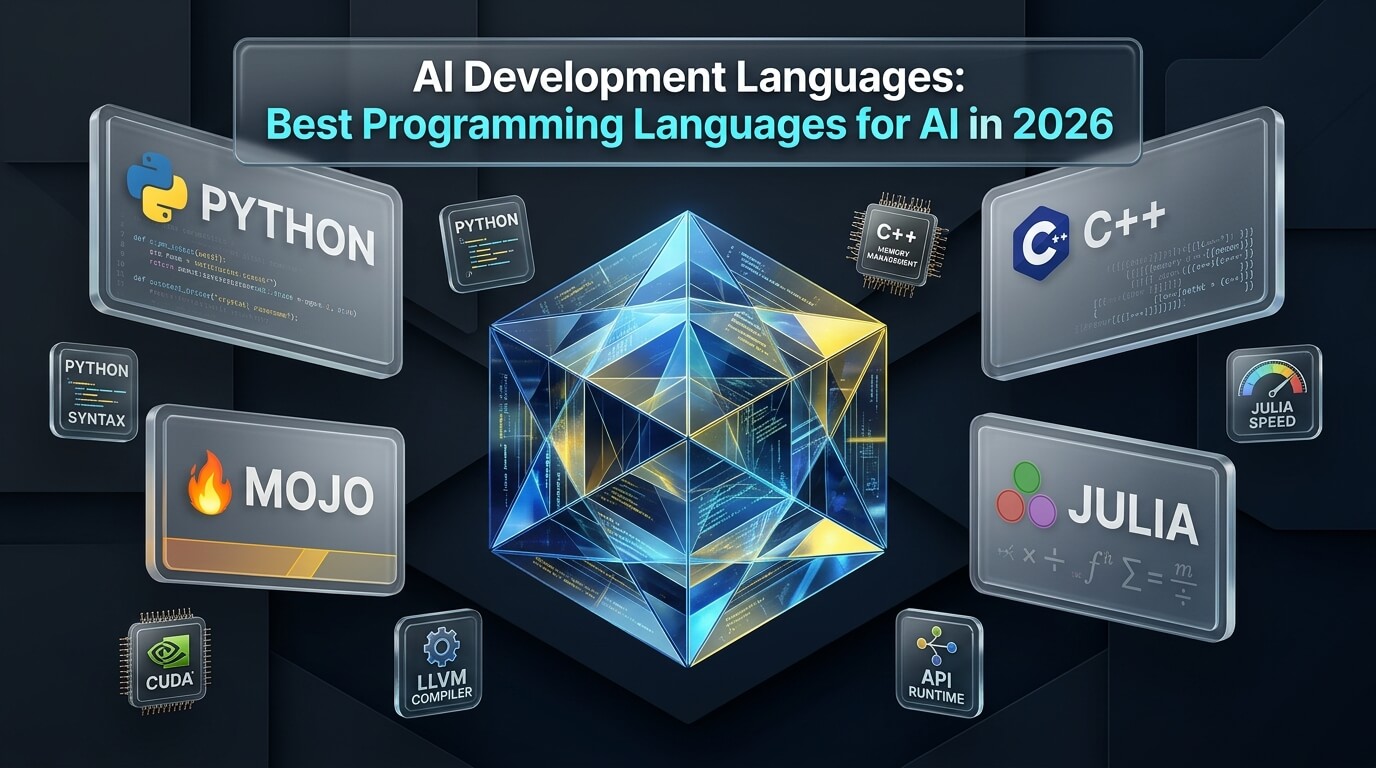
Building artificial intelligence requires choosing the right software code foundation. Every smart app, neural network, and automated bot starts with code. Programmers must pick tools that run fast and stay reliable. Choosing the right ai development language shapes how quickly your team can build, train, and launch models.
Different coding tasks need different technical strengths. Some projects demand fast math operations on graphic chips. Other projects need simple syntax so researchers can test new ideas quickly. Today, several ai development languages power modern deep learning and machine learning systems. Understanding these options helps engineering teams pick the best stack for their goals.
Software engineers often wonder which code language to learn first. You do not need to master ten different languages to build great software. Learning two complementary tools often gives you everything you need. This detailed guide breaks down top programming tools, core trade-offs, and practical advice to help you choose with confidence.
Key Takeaways for AI Engineers and Developers
- Python remains the undisputed market leader for model training and deep learning research.
- Rust and C++ deliver maximum raw speed for low-latency model inference on edge devices.
- Go powers modern microservices, Kubernetes operators, and cloud model hosting pipelines.
- Java and C# allow enterprise teams to integrate machine learning into existing business systems.
- Picking two languages—one for research and one for production serving—gives you the best results.
Why Language Selection Shapes AI Development Success
Writing artificial intelligence software differs from standard web development. Machine learning models run billions of matrix math calculations every second. An inefficient code runtime burns expensive cloud compute credits quickly. Selecting the right programming languages for ai development ensures your hardware resources run at full capacity.
Developer velocity is just as important as raw computing speed. If a language is hard to write, building new prototypes takes months. Engineers need rich open-source libraries that handle complex neural math out of the box. A thriving developer community means you can solve bugs quickly and recruit talented engineers easily.
Production environments also introduce strict latency constraints. When a user sends a prompt, they expect an answer in milliseconds. Slow inference code hurts user experience and increases server costs. Balancing training speed with deployment speed is the central challenge in choosing a language for ai development.
To see how modern web developers deploy these models online, review our guide on Python web development.
Python: The Undisputed Leader in AI Development
Python dominates the artificial intelligence ecosystem by a massive margin. Nearly every major machine learning breakthrough starts with Python code. Its clean, readable syntax reads almost like plain English. This simplicity makes python for ai development the premier choice for researchers and engineers worldwide.
The biggest strength of Python is its unmatched software ecosystem. Pre-built libraries like PyTorch, TensorFlow, NumPy, and Pandas handle heavy mathematical workloads effortlessly. These packages use high-performance C++ code under the hood while giving developers friendly Python interfaces. This hybrid design gives you simple scripting with blazing fast mathematical execution.
Using ai development with python allows startups and enterprise teams to move rapidly. You can clean training datasets, build neural layers, and run test evaluations in just a few lines of code. The massive global community means thousands of pre-trained models are available on Hugging Face for instant use. Python ai development remains the gold standard for good reason.
Universities, research labs, and tech giants all standardize on python for data science ai & development. New graduates enter the workforce already knowing how to build models in Jupyter notebooks. This widespread adoption ensures that ai development using python will remain dominant for decades to come.
Modern data pipelines also rely on Python to automate data collection and cleaning. Python connects easily with web scrapers, database drivers, and cloud storage buckets. Teams can collect training examples, format data schemas, and trigger automated retraining jobs from unified Python scripts. This flexibility makes daily engineering work smooth and productive.
Rust: The Modern Contender for High-Speed Inference
While Python rules model training, it can struggle with raw execution speed and heavy memory consumption. Modern production deployments need lean binaries that run without bulky virtual machines. This need has sparked massive interest in ai development with rust across high-performance engineering teams.
Rust provides raw execution speed comparable to C++ while preventing memory crashes through its strict compiler borrow checker. Developers can write high-concurrency model serving servers without worrying about memory leaks or data races. Frameworks like Candle and Burn let engineers run neural networks directly in pure Rust. Eliminating garbage collection pauses keeps API response times predictable under heavy traffic.
WebAssembly support makes Rust uniquely valuable for running models directly inside web browsers. You can compile a local vision model into WebAssembly and run it on a client laptop without sending private data to cloud servers. Rust gives developers unmatched control over hardware memory and energy efficiency.
C++: The High-Speed Bedrock of Deep Learning Compute
Behind every popular Python AI library sits a massive engine written in C++. NVIDIA CUDA kernels, TensorRT runtimes, and ONNX engines rely on C++ to talk directly to graphics cards. High-frequency trading firms, robotics companies, and autonomous vehicle makers build their core systems in C++ for maximum throughput.
C++ gives engineers granular control over CPU cache lines, GPU memory allocation, and vector processing units. When self-driving cars process live camera feeds, they cannot afford a single millisecond of garbage collection delay. C++ guarantees deterministic real-time performance that keeps mission-critical systems safe and responsive.
Modern deep learning compilers like TVM and MLIR use C++ to translate high-level neural graphs into optimized machine instructions. While C++ has a steep learning curve, mastering it lets you understand how AI models interact with physical silicon chips. C++ remains the foundational bedrock of all modern computing hardware.
Java: Powering Enterprise Scale & Big Data AI Pipelines
Global banks, insurance carriers, and healthcare systems run their core business operations on Java backends. These enterprise companies already manage massive server clusters and secure data lakes built on the Java Virtual Machine. Choosing ai development java lets enterprise teams add machine learning capabilities without rewriting their entire software infrastructure.
Java shines when managing massive data processing pipelines before model training begins. Distributed computing frameworks like Apache Spark and Apache Flink are built natively in Java and Scala. These tools clean and transform terabytes of raw customer data across thousands of server nodes every night. Having your data pipelines and machine learning code on the same runtime simplifies enterprise maintenance.
Libraries like Deeplearning4j provide commercial-grade deep learning tools designed specifically for Java developers. Enterprise teams can train neural networks and deploy them directly inside existing Spring Boot microservices. Java delivers rock-solid stability, strong static type checking, and extensive security tooling for corporate AI systems.
C#: Integrating Machine Learning into .NET Environments
Microsoft has made massive investments in modern artificial intelligence through its cloud platforms and developer tools. Millions of software engineers build internal enterprise software using C# and the .NET framework. Leveraging ai development c# allows these developers to build smart apps using tools they already know and trust.
ML.NET is Microsoft official open-source machine learning framework built specifically for .NET developers. It allows engineers to build custom models for sentiment analysis, product recommendations, and fraud detection directly in C#. Developers do not need to switch to Python or manage complex external microservices to add smart features to their apps.
C# also integrates smoothly with the ONNX Runtime for high-speed model inference. You can train a state-of-the-art vision or text model in Python, convert it to the open ONNX format, and run it inside a C# desktop or mobile app. This workflow combines the experimental flexibility of Python with the production polish of C#.
Go: Building Lean Microservices and Cloud-Native AI Backends
Go (or Golang) was designed by Google to make cloud network services simple, fast, and highly reliable. Most modern cloud infrastructure, including Docker and Kubernetes, is written in Go. Adopting ai development with go allows engineering teams to build lean API gateways and model orchestration microservices.
Go built-in concurrency model, powered by lightweight goroutines, handles tens of thousands of simultaneous web requests with minimal RAM. While Go is rarely used to train large foundational models from scratch, it is fantastic for serving predictions to users. An inference proxy written in Go can route user prompts, manage rate limits, and stream model responses with ultra-low latency.
Go compiles into a single static binary with zero external dependencies. This makes deploying AI microservices into Docker containers fast and clean. Container images stay tiny, boot up in seconds, and scale down smoothly to save cloud hosting costs.
Julia & R: Specialized Powerhouses for Science & Statistics
Beyond the mainstream giants, specialized languages serve specific academic and scientific communities. R has been the primary tool of academic statisticians, clinical researchers, and bioinformaticians for decades. It offers peerless statistical packages, elegant data visualization tools like ggplot2, and rich libraries for clinical trial analysis.
Julia was created specifically to solve the famous two-language problem in scientific computing. In traditional workflows, researchers prototype math models in Python but must rewrite them in C++ for production speed. Julia combines the syntax simplicity of Python with the execution speed of compiled C. Its native support for multiple dispatch and differential equations makes it popular for advanced physics-informed neural networks.
While Julia and R have smaller developer communities than Python, they excel in specialized mathematical domains. Research institutions and quantitative finance funds use them to run complex mathematical simulations that require extreme numerical precision. Choosing these tools depends entirely on your specific scientific discipline.
Decision Guide: Choosing the Best Programming Languages for AI Development
Selecting among the best programming languages for ai development depends on your team skills, project timeline, and hardware targets. No single coding language solves every engineering challenge perfectly. Experienced architects pick the right tool for each specific phase of the machine learning lifecycle.
If you are building a new prototype, training custom models, or conducting scientific research, choose Python without hesitation. Python gives you immediate access to pre-trained weights, helpful tutorials, and open-source frameworks. Starting with Python lets you validate your machine learning ideas in days rather than months.
If you are deploying models to low-power edge chips, mobile phones, or high-throughput servers, pair Python with Rust, C++, or Go. Train your model in Python, export the final weights to an open format, and run inference using a compiled language. This two-tier architecture gives you fast research agility alongside blazing production performance.
Consider your existing corporate technology stack before introducing new programming runtimes. If your company already runs large enterprise systems in Java or C#, using ML.NET or Deeplearning4j can save months of infrastructure setup. Aligning with your existing engineering team skills keeps maintenance simple and manageable.
Actionable Checklist: Picking Your AI Programming Stack
- Choose Python as your primary language for dataset preparation and neural model training.
- Export completed neural models to the open ONNX format for cross-language compatibility.
- Use Rust or C++ when building real-time robotics, gaming, or sub-ten-millisecond inference engines.
- Use Go to build cloud-native API gateways, prompt routers, and streaming microservices.
- Stick to C# or Java if your product lives inside an established corporate enterprise environment.
- Test model inference latency and RAM usage early before locking in your deployment architecture.
- Ensure your chosen language has active open-source bindings for NVIDIA GPU acceleration libraries.
The Two-Tier Architecture: Splitting Model Training and Production Serving
Modern machine learning engineering rarely relies on a single programming language across the entire tech stack. Instead, leading technology teams divide their architecture into two distinct operational phases. One phase focuses on creative model research, while the second phase focuses on high-efficiency production serving.
During the training phase, data scientists need extreme flexibility to tweak model layers, test loss functions, and visualize weights. Python is the perfect tool for this exploratory work because it runs interactively in Jupyter notebooks. Engineers can experiment quickly without waiting for lengthy code compilation cycles. Speed of thought matters most during model training.
During the serving phase, thousands of paying users query the trained model simultaneously. Here, memory bloat and slow script execution can cost millions of dollars in cloud server bills. Engineering teams export the trained model into compiled execution engines written in C++, Rust, or Go. Splitting training and serving into two tiers gives you the best of both worlds.
Essential Software Tools and Frameworks for AI Developers
Writing artificial intelligence software requires specialized runtime engines, model compilers, and training frameworks. These tools translate high-level code instructions into optimized GPU math operations. Below are comprehensive reviews of eight essential software tools used by modern AI developers.
1. PyTorch
PyTorch is the world’s most popular open-source machine learning framework, created by Meta AI and maintained by the Linux Foundation. It features dynamic computational graphs that let developers modify neural networks on the fly during training. Its native Python integration feels natural and intuitive to write, making it the favorite framework of academic researchers and industry engineers alike.
PyTorch provides robust GPU acceleration through NVIDIA CUDA and AMD ROCm drivers. The framework powers many of the world’s most famous large language models, including Meta Llama family. Its rich ecosystem includes torchvision for computer vision and torchaudio for speech processing. PyTorch is the foundational centerpiece of modern deep learning development.
2. TensorFlow
TensorFlow is Google comprehensive open-source platform for building and deploying machine learning models at enterprise scale. It offers high-level neural modeling through its intuitive Keras interface, alongside low-level tools for detailed graph optimization. TensorFlow excels at large-scale distributed training across massive clusters of Google Cloud Tensor Processing Units (TPUs).
Its production ecosystem includes TensorFlow Serving for cloud model hosting and TensorFlow Lite for running models on mobile and IoT devices. While PyTorch leads in academic research, TensorFlow remains heavily used in global enterprise production systems. Its mature tooling provides dependable stability for commercial applications.
3. JAX
JAX is an innovative Python library developed by Google Research for high-performance numerical computing and machine learning research. It combines NumPy familiar mathematical syntax with automatic differentiation and GPU/TPU compilation via XLA (Accelerated Linear Algebra). JAX allows researchers to write pure Python math functions that compile down to blazing fast machine code.
Its powerful just-in-time (JIT) compilation automatically vectorizes loops and fuses math operations for maximum hardware throughput. Leading AI research labs, including Google DeepMind, use JAX to build cutting-edge generative models and scientific simulations. JAX represents the cutting edge of modern numerical computing.
4. Hugging Face
Hugging Face is the central collaboration platform and open-source model hub for the global artificial intelligence community. It hosts hundreds of thousands of pre-trained models for natural language processing, computer vision, and audio synthesis. Its open-source Transformers library makes downloading and running state-of-the-art models as simple as three lines of Python code.
The platform also provides helpful tools for dataset hosting, model evaluation, and serverless API inference. Developers can test open-source models directly in browser spaces before integrating them into production code. Hugging Face has democratized artificial intelligence development by making premier models accessible to everyone.
5. ONNX Runtime
ONNX Runtime is a high-performance cross-platform scoring engine developed by Microsoft for running machine learning models across diverse hardware chips. It supports the Open Neural Network Exchange (ONNX) format, allowing models trained in PyTorch or TensorFlow to run on any operating system. It features built-in execution providers for NVIDIA GPUs, Intel CPUs, and Qualcomm mobile chips.
The runtime provides language bindings for C++, C#, Java, Python, and JavaScript, making it the ultimate tool for cross-language deployments. By applying graph optimizations and memory reuse techniques, ONNX Runtime drastically reduces inference latency. It is the premier bridge connecting Python model training with production software systems.
6. LangChain
LangChain is a popular open-source software development framework designed to simplify the creation of applications using large language models. It provides modular abstractions for chaining model prompts, integrating vector databases, and managing document retrieval pipelines. LangChain is available natively in both Python and TypeScript, giving web developers flexible implementation choices.
Its rich integration catalog connects with hundreds of external data sources, cloud APIs, and specialized search tools. Developers use LangChain to build autonomous agents, intelligent customer support bots, and internal company document search tools. LangChain accelerates the development of smart generative AI applications.
7. Triton Inference Server
Triton Inference Server is NVIDIA open-source production model serving software engineered for maximum GPU utilization in cloud data centers. It allows engineering teams to deploy models trained in any framework, including PyTorch, TensorFlow, TensorRT, and ONNX, on a single unified server. Triton handles concurrent model execution, dynamic request batching, and automated GPU memory management.
The server provides standard HTTP/REST and gRPC interfaces for fast communication with web clients and microservices. Enterprise companies use Triton to serve billions of model predictions daily while keeping hardware infrastructure costs low. Triton delivers gold-standard performance for large-scale production model hosting.
8. vLLM
vLLM is a high-throughput, memory-efficient open-source inference and serving engine built specifically for large language models. Developed by researchers at UC Berkeley, vLLM introduces PagedAttention, an innovative memory management algorithm inspired by operating system virtual memory. PagedAttention eliminates memory fragmentation, allowing servers to handle up to twenty-four times higher request concurrency than standard huggingface pipelines.
The engine integrates seamlessly with popular open-source LLM architectures, including Llama, Mistral, and Qwen models. It offers an OpenAI-compatible API server, making it a drop-in replacement for proprietary cloud endpoints. vLLM has quickly become the premier serving engine for self-hosted generative AI models.
Software Comparison: Top Frameworks and Tools for AI Developers
Selecting the optimal framework stack depends on whether your project focuses on exploratory research, high-speed inference, or enterprise system integration. Compare the primary capabilities, ideal use cases, and licensing terms of top AI development tools below.
| Tool / Framework | Primary Engineering Function | Best For | License |
|---|---|---|---|
| PyTorch | Deep Learning Neural Training & Dynamic Graphs | AI Researchers & Machine Learning Engineers | Open Source (BSD) |
| TensorFlow | Distributed Model Training & Mobile Deployment | Enterprise Systems & IoT Edge Devices | Open Source (Apache 2.0) |
| JAX | Autograd & XLA High-Speed Math Compilation | Scientific Computing & Advanced Generative Models | Open Source (Apache 2.0) |
| Hugging Face | Pre-Trained Model Hub & Transformers Library | Rapid Prototyping & Open-Source LLMs | Open Source / Cloud Hosting Tiers |
| ONNX Runtime | Cross-Platform Low-Latency Inference Engine | Cross-Language Serving in C#, Java, and C++ | Open Source (MIT) |
| LangChain | LLM Prompt Chaining & Vector Database Pipelines | Autonomous Agents & Context-Aware Chatbots | Open Source (MIT) |
| Triton Server | Multi-Model High-Throughput GPU Inference | Cloud Data Centers & High-Concurrency APIs | Open Source (BSD) |
| vLLM | Memory-Optimized PagedAttention LLM Serving | Self-Hosted Open-Source Language Models | Open Source (Apache 2.0) |
Frequently Asked Questions About AI Development Languages
Which programming language is the absolute best for starting in AI development?
Python is the best starting language for beginners and experienced developers alike. It features the largest collection of machine learning libraries, tutorials, and pre-trained models. Learning Python gives you immediate access to PyTorch, Hugging Face, and NumPy, letting you build working prototypes quickly.
Can developers build modern artificial intelligence models using only JavaScript or TypeScript?
Yes, developers can run models in JavaScript using TensorFlow.js or ONNX Runtime Web. While heavy deep learning models are rarely trained in JavaScript, TypeScript is widely used to build frontend user interfaces and orchestrate API calls to language models.
Why is Python preferred over C++ for training complex neural networks?
Python offers clean, readable syntax that lets researchers test mathematical hypotheses in minutes. However, Python AI libraries run optimized C++ code under the hood to handle heavy GPU math. This gives developers the rapid development speed of Python combined with the execution speed of C++.
Is Rust fast enough to replace Python for machine learning workflows?
Rust provides blazing speed and memory safety, making it fantastic for serving model predictions. However, Rust has a smaller collection of specialized machine learning libraries than Python. Most engineering teams use Python for training and Rust for high-throughput production serving.
How does C# support artificial intelligence and machine learning development?
C# supports machine learning through Microsoft ML.NET framework and the cross-platform ONNX Runtime. Developers can build fraud detection, sentiment analysis, and recommendation systems directly in .NET without maintaining separate Python servers.
What role does the Go programming language play in artificial intelligence infrastructure?
Go powers cloud infrastructure, API gateways, and microservices that sit in front of AI models. It handles thousands of concurrent user web requests with minimal memory overhead, routing prompts efficiently to GPU inference clusters.
What is the Open Neural Network Exchange (ONNX) and why is it important?
ONNX is an open format built to represent machine learning models across different tools. It allows models trained in Python using PyTorch to run in production environments powered by C++, C#, Java, or Rust with zero friction.
How does Julia compare to Python for scientific and numerical AI computing?
Julia offers syntax simplicity similar to Python while compiling directly to native machine code like C. It excels at complex numerical simulations and differential equations, though its general developer ecosystem remains smaller than Python.
Do AI developers need to learn CUDA programming to build machine learning models?
Most developers do not need to write raw CUDA code because libraries like PyTorch handle GPU operations automatically. However, engineers building custom hardware kernels or high-performance inference engines benefit greatly from understanding CUDA.
How can engineering teams minimize cloud server costs when deploying AI models?
Teams minimize costs by using optimized inference engines like vLLM and ONNX Runtime. Quantizing model weights from 16-bit floats to 8-bit or 4-bit integers reduces GPU memory requirements by more than half, enabling cheaper cloud hardware.
Engineering Pro-Tip: Standardize on ONNX for Cross-Team Production Hand-Offs
Train and validate your neural networks in Python using PyTorch or JAX to maximize research speed. When the model passes accuracy benchmarks, immediately export the weights into the standardized ONNX format. This allows your backend systems engineering team to deploy the model in C++, Rust, or C# without managing fragile Python runtime environments. Standardized model hand-offs prevent production bugs and accelerate release cycles.
Hardware Acceleration: Tying Languages to GPUs, TPUs, and NPUs
Writing artificial intelligence software requires understanding the physical silicon chips that run your code. Central processing units (CPUs) handle general-purpose system logic well, but they struggle with massive parallel matrix calculations. Graphics processing units (GPUs) and neural processing units (NPUs) contain thousands of small compute cores designed specifically for parallel math.
NVIDIA CUDA platform remains the industry standard for accelerating deep learning workloads. Most Python frameworks call pre-compiled CUDA kernels to execute matrix multiplications on tensor cores. Modern compilers like Triton allow engineers to write custom GPU kernels using Python-like syntax, reducing the need to write raw C++ CUDA code by hand.
Cloud providers also offer specialized chips like Google TPUs and AWS Inferentia processors. Frameworks like JAX and TensorFlow compile neural graphs directly to these custom chips using specialized graph compilers. Matching your software code with modern hardware accelerators reduces training times from weeks to hours.
Community Power: Why Vibrant Open-Source Ecosystems Win
A programming language is only as valuable as the open-source community supporting it. When thousands of engineers build libraries, write tutorials, and share pre-trained weights, everyone moves faster. Python absolute dominance in AI is largely a product of its welcoming, active open-source contributor network.
When selecting a language for your project, look beyond raw syntax features to evaluate community health. Check how frequently key machine learning repositories receive updates, bug fixes, and security patches. A language with rich documentation and helpful Stack Overflow discussions saves your team countless hours of frustrating troubleshooting.
Participating in open-source AI communities also helps your company recruit top-tier engineering talent. Talented developers want to work with modern, popular tools that advance their personal careers. Embracing open-source AI standards positions your engineering organization at the forefront of technical innovation.
Precision Engineering: Model Quantization and Low-Bit Inference
Modern generative models often contain tens of billions of neural parameters. Running these massive networks in full sixteen-bit floating point precision requires expensive cloud hardware. Model quantization techniques solve this bottleneck by converting weights into smaller eight-bit or four-bit integers. Choosing languages with mature quantization support slashes infrastructure hosting bills.
Frameworks like llama.cpp and bitsandbytes demonstrate the immense power of low-level quantization code. Written in pure C and C++, these engines let consumer laptops run powerful language models with modest RAM. Memory-efficient bit-manipulation allows edge devices to process complex queries locally. Understanding low-bit representation helps developers deploy high-performing models on tight computing budgets.
Modern quantization methods maintain high mathematical accuracy while cutting memory usage in half. Techniques like AWQ and GPTQ calibrate weights carefully to protect model reasoning capabilities. Deploying quantized models allows software startups to scale services affordably without burning venture capital on oversized GPU clusters.
Embedded Intelligence: Running Machine Learning on Edge Chips
Not every artificial intelligence application lives inside massive air-conditioned cloud data centers. Millions of smart devices operate in factory floors, agricultural fields, hospital rooms, and autonomous drones. These physical devices require lightweight embedded code runtimes that execute reliably without internet connections.
C, C++, and embedded Rust are the undisputed champions of edge machine learning. Frameworks like TensorFlow Lite for Microcontrollers and TinyML fit neural models into tiny kilobytes of flash memory. Running vision and acoustic models directly on microcontroller sensors eliminates cloud transmission latency and protects user privacy.
Edge machine learning demands extreme battery efficiency and thermal management. A smart sensor deployed in an orchard must run for five years on a single coin-cell battery. Compiled system languages give embedded engineers total control over sleep cycles and power consumption states. Edge intelligence brings smart decision-making to the physical world.
Defensive Coding: Ensuring Memory Safety and Security in AI Applications
As autonomous systems take control of medical diagnoses, financial transfers, and industrial machinery, software security becomes critical. Traditional C and C++ codebases are notoriously vulnerable to memory buffer overflows and dangling pointers. A single memory flaw in a neural robot controller can cause catastrophic physical failures.
Modern programming languages like Rust provide mathematical guarantees of memory safety at compile time. By eliminating null pointers and data races, Rust ensures that concurrent model threads never corrupt shared memory buffers. Building critical safety controllers in memory-safe languages protects autonomous software against malicious exploits and unexpected crashes.
Application developers must also protect AI APIs against adversarial prompt injection attacks and data leakage. Wrapping model execution endpoints in secure, sandboxed container runtimes keeps internal company databases safe. Disciplined software engineering practices ensure your machine learning solutions remain robust, safe, and dependable under real-world scrutiny.
Conclusion: Mastering the Languages of Artificial Intelligence
The artificial intelligence revolution is transforming how software is designed, tested, and delivered. Outdated reliance on rigid, hand-coded business logic is giving way to dynamic probabilistic machine learning systems. Choosing the right ai development language equips your engineering team to build smart apps that scale smoothly under real-world demand.
Start your AI journey by mastering Python and its premier deep learning frameworks. Experiment with pre-trained models on Hugging Face, build clean training pipelines in PyTorch, and validate your product ideas quickly. As your application grows in traffic and complexity, incorporate compiled languages like Rust, C++, or Go to optimize serving efficiency.
Equip your team with modern model compilers, inference servers, and hardware acceleration tools to streamline production execution. Stay curious, follow open-source developments closely, and keep testing new runtime innovations. Start building your AI programming roadmap today to create high-impact, intelligent software for the future.