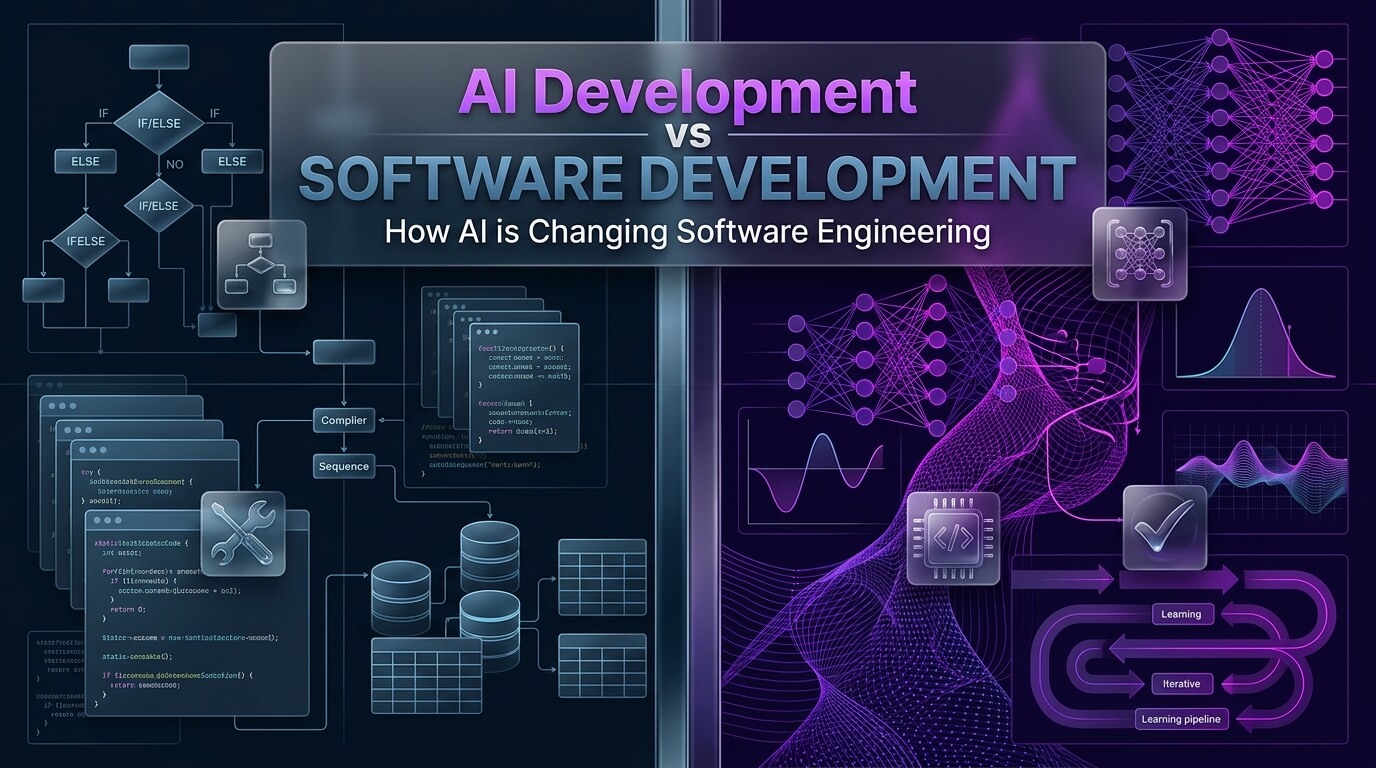
The convergence of machine learning and modern software engineering is transforming how digital applications are conceived, programmed, tested, and maintained. Comparing ai development vs software development reveals profound differences in fundamental engineering paradigms, computational lifecycles, and failure modes. Traditional software relies on deterministic human logic, while artificial intelligence models learn complex statistical patterns directly from data.
Understanding the intersection of ai development and software development is essential for engineering leaders modernizing their technology organizations. Today, modern software development with ai spans two distinct dimensions: building machine learning models and enhancing developer productivity with intelligent coding assistants. Navigating these complementary practices enables teams to deliver resilient, intelligent software architectures at scale.
Whether you want to understand how ai software development alters architectural design, analyze the rise of ai driven development, or evaluate premier coding assistants, this comprehensive guide provides the complete comparative blueprint. We dissect core paradigm shifts, compare developer workflows, and review the top eight platforms powering modern intelligent engineering.
Key Engineering Differences & Takeaways
- Deterministic vs. Probabilistic: Traditional software produces identical outputs for given inputs, while neural models output probability distributions over potential responses.
- Code Logic vs. Learned Weights: Developers write explicit algorithms in classical software, whereas machine learning engineers design training curricula to optimize matrix weights.
- Testing and Regression: Unit tests verify exact binary assertions in traditional code, whereas AI validation requires statistical evaluation across diverse test sets.
- Lifecycle Maintenance: Software systems degrade due to dependency rot, while machine learning models suffer from real-world data drift and semantic concept shifts.
- The Rise of Agentic Coding: Intelligent developer tools have evolved from simple line completion into autonomous pair programmers executing multi-file refactoring.
Deterministic Code vs. Stochastic Models: The Core Paradigm Shift
The foundational distinction between traditional software engineering and machine learning lies in how computational behavior is defined. In conventional programming, human engineers formulate explicit algorithms using deterministic control flow, boolean logic, and relational data structures. The program state executes predictably along predefined logical branches, guaranteeing that identical inputs produce identical outputs every execution.
In contrast, artificial intelligence development operates within a stochastic, probabilistic framework. Machine learning algorithms do not follow handwritten business rules; instead, they learn mathematical associations from large datasets by adjusting billions of floating-point parameters through numerical gradient descent. The resulting system does not guarantee binary certainty, but instead calculates probability distributions over possible outputs.
This fundamental paradigm shift changes how software systems are conceptualized. Classical programming excels at rigid, highly structured tasks like financial accounting, database indexing, and network routing where deterministic precision is mandatory. Machine learning thrives in ambiguous, unstructured domains like natural language comprehension, computer vision, and speech synthesis where explicit handwritten rules cannot capture real-world complexity.
How AI is Transforming the Software Engineering Lifecycle
The integration of ai in software development touches every stage of the classical systems development lifecycle. From initial requirements gathering to automated code generation and production monitoring, machine learning acts as a powerful cognitive amplifier. Engineering teams transitioning to ai assisted development experience dramatic reductions in repetitive boilerplate implementation time.
During the design phase, language models synthesize user stories into formal software architecture specifications and relational database schemas. Developers interact with conversational reasoning engines to evaluate design trade-offs, choose optimal data structures, and identify potential concurrency bottlenecks before writing code. This collaborative ideation accelerates architectural consensus across distributed engineering teams.
In addition, the implementation phase has been radically altered by ai powered development environments. Programmers no longer spend hours memorizing obscure library syntax or navigating lengthy documentation portals. Context-aware developer assistants suggest complete function implementations, generate comprehensive unit tests, and translate legacy codebases across modern programming languages in real time.
Adopting ai development in software engineering creates a profound shift toward high-level system supervision. Individual developers operate as technical directors, orchestrating fleets of intelligent agents to execute low-level coding tasks. This acceleration allows small engineering teams to build complex, enterprise-scale software platforms that previously required dozens of specialized developers.
SDLC vs. MLOps: Contrasting Development Pipelines
Comparing the software development lifecycle (SDLC) with machine learning operations (MLOps) reveals vastly different pipeline requirements. In traditional software, source code represents the primary variable governing system behavior. Once code passes linting, unit tests, and compilation checks, it can be containerized and deployed into production with high predictability.
In machine learning development, source code represents only a small fraction of the operational pipeline. System performance is determined by the complex interplay of three dynamic variables: training data, model architecture, and hyperparameters. A change in the statistical distribution of real-world input data can degrade model accuracy even if the underlying inference software code remains unchanged.
Consequently, MLOps requires specialized infrastructure for continuous data ingestion, automated feature engineering, experiment versioning, and drift monitoring. While software developers track bugs using stack traces and unit test failures, machine learning engineers track validation loss curves, precision-recall trade-offs, and perplexity scores. Merging these two disciplines requires building unified pipelines that manage code and data lineage simultaneously.
Testing and Debugging: Binary Assertions vs. Statistical Evaluations
Debugging traditional software is a deterministic process of isolating logical flaws within explicit source code statements. Software engineers utilize interactive debuggers, set line breakpoints, inspect memory stack traces, and construct binary pass-fail unit tests. If a bug appears, tracing execution steps leads inevitably to the errant conditional branch or null pointer exception.
Debugging artificial intelligence systems is fundamentally statistical and empirical. When a neural network produces an incorrect prediction or exhibits a hallucination, you cannot easily step through individual matrix multiplications to identify the error. The flaw is distributed across billions of interconnected numerical weights rather than localized within a single line of code.
Validation in machine learning requires continuous benchmarking against held-out golden datasets, human evaluation rubrics, and automated red-teaming pipelines. Teams measure statistical aggregate metrics like F1-scores, mean reciprocal rank, and latency percentiles rather than expecting perfection on every discrete query. Ensuring system safety demands defensive guardrails, structured validation layers, and fallback handlers to catch anomalous outputs gracefully.
The Evolution of Developer Tooling: From Autocomplete to Autonomous Agents
The progression of developer assistance tools has moved through three distinct generational waves over the past decade. The first generation was rule-based code completion built into traditional IDEs, relying on language servers and static abstract syntax trees. These tools offered static variable autocompletion and basic syntax highlighting based on strict grammar rules.
The second generation introduced deep learning models for line-level and function-level completion. Systems trained on public GitHub repositories suggested syntactically plausible snippets based on immediate cursor context. While these early tools increased typing speed, they lacked whole-project contextual awareness and frequently hallucinated non-existent library methods.
Today, the third generation features fully agentic, multi-file software engineering assistants. Modern coding agents read entire repositories, index codebase architecture using vector embeddings, execute terminal commands, and run automated test suites autonomously. Developers collaborate with intelligent agents capable of refactoring cross-file dependencies and submitting pull requests with complete documentation.
Top 8 AI Tools for Modern Software Development
Modern software engineering teams leverage specialized coding assistants to accelerate development velocity and improve software quality. We evaluated the leading platforms based on codebase indexing, tool-calling autonomy, multi-file editing, and enterprise security. Here are the top eight platforms leading ai for software development.
1. GitHub Copilot
GitHub Copilot is the pioneer of modern AI-assisted code generation, deeply integrated into Visual Studio Code, Visual Studio, and JetBrains IDEs. Powered by advanced OpenAI models, Copilot analyzes surrounding code comments, function names, and open workspace tabs to suggest real-time completions. Its conversational chat interface allows developers to explain unfamiliar algorithms, generate unit tests, and troubleshoot syntax bugs.
With Copilot Workspace, the platform has expanded into task-level agentic orchestration. Developers can assign high-level GitHub issues to Copilot, which formulates an architectural plan, writes code changes across multiple files, and prepares pull requests for human review. Its enterprise tiers include strict intellectual property indemnification and private proxy controls, making it a reliable corporate standard.
2. Cursor
Cursor is an AI-first code editor built as an intelligent fork of Visual Studio Code. Unlike traditional IDEs with attached plugin sidebars, Cursor integrates artificial intelligence natively into the editor core. Its signature Composer feature allows developers to initiate complex multi-file refactoring and feature generation using simple natural language prompts.
Cursor indexes entire local git repositories using fast vector embeddings, allowing it to answer architectural questions and locate relevant classes instantly. Its interactive inline editing interface lets developers highlight code blocks and apply surgical transformations with a single keystroke. For engineers seeking the most intuitive, keyboard-centric agentic coding experience, Cursor represents the cutting state of the art.
3. Tabnine
Tabnine is an enterprise-grade AI coding assistant designed specifically for security-conscious organizations with strict intellectual property requirements. Tabnine allows enterprises to run code generation models on-premise, in private virtual clouds, or in air-gapped environments. The platform guarantees that customer proprietary code is never used to train shared public models.
Tabnine supports dozens of programming languages and integrates smoothly across Visual Studio Code, Eclipse, Android Studio, and IntelliJ. Its contextual engine can be fine-tuned directly on private corporate codebases, enabling it to suggest internal proprietary APIs and adhere to company coding standards. For financial institutions and defense contractors, Tabnine delivers productivity without compromising security.
4. Codeium
Codeium provides a high-performance, ultra-fast artificial intelligence coding assistant featuring an exceptionally generous free tier for individual developers. Powered by proprietary custom-trained models and dedicated inference infrastructure, Codeium delivers near-instantaneous autocomplete suggestions. The platform supports over seventy programming languages across more than forty integrated development environments.
In addition to inline autocomplete, Codeium provides Windsurf, an agentic development environment that orchestrates complex coding tasks across multi-file repositories. Its enterprise tier includes centralized administrative controls, self-hosting deployment options, and strict copyright filtering. Codeium has earned massive popularity among developers seeking exceptional speed and versatile editor support.
5. Replit Ghostwriter
Replit Ghostwriter is built directly into the Replit cloud-based development environment, providing an all-in-one platform where developers write, run, and host software in a browser. Ghostwriter combines real-time code completion with interactive chat debugging and proactive error explanations. Because Replit controls the execution runtime, Ghostwriter can run generated code and inspect execution errors immediately.
The platform agentic feature, Replit Agent, allows users to describe full-stack web applications in plain English. The agent provisions databases, installs backend packages, writes frontend templates, and deploys live web applications autonomously. Replit is an extraordinary productivity platform for rapid prototyping, educational exploration, and launching full-stack applications in minutes.
6. Amazon Q Developer
Amazon Q Developer is Amazon Web Services specialized generative assistant for software development, cloud infrastructure management, and code transformation. Integrated into VS Code, JetBrains, and the AWS Management Console, Amazon Q assists developers with writing application logic, authoring AWS CloudFormation templates, and configuring IAM policies safely.
One of its standout enterprise capabilities is automated code transformation, which analyzes and upgrades legacy Java applications across major framework versions autonomously. Amazon Q scans code for security vulnerabilities, suggests remediation patches, and explains complex AWS architecture best practices. For enterprises heavily invested in the Amazon cloud ecosystem, it provides unmatched infrastructure synergy.
7. Sourcegraph Cody
Sourcegraph Cody leverages Sourcegraph industry-leading Code Intelligence platform to provide deep contextual awareness across vast, enterprise-scale multi-repository codebases. While many assistants only comprehend the active file or small local folders, Cody utilizes Sourcegraph comprehensive code graph to pull precise semantic context from millions of lines of code.
Developers can ask Cody complex architectural questions spanning multiple microservices and legacy dependencies. It generates accurate code snippets adhering to internal corporate conventions, writes comprehensive unit tests, and summarizes multi-repository pull requests. For large engineering organizations managing massive monorepos, Cody delivers unmatched architectural comprehension.
8. Continue.dev
Continue.dev is a premier open-source artificial intelligence coding extension for Visual Studio Code and JetBrains IDEs. Unlike commercial closed-source alternatives, Continue gives developers complete control over their model configuration. Users can connect to commercial APIs from OpenAI and Anthropic, or run completely private local open-weight models using Ollama, LM Studio, or vLLM.
Continue allows developers to customize system prompts, configure custom slash commands, and build specialized documentation search indexes. Because the platform is entirely open-source, engineering teams can audit every network request and customize extension logic to fit unique internal workflows. It is the premier choice for developers who demand complete software freedom and privacy.
Direct Comparison: Top AI Coding Assistants
Selecting the best coding assistant depends on your organization security policies, budget, and development environment preferences. Here is a direct comparison of the top eight tools.
| Tool | Deployment Mode | Key Strength | Multi-File Editing | Pricing Model |
|---|---|---|---|---|
| GitHub Copilot | Managed Cloud | GitHub & VS Code ecosystem integration | Yes (Workspace) | Paid ($10–$39/user/mo) |
| Cursor | Local IDE (Cloud LLMs) | Native AI-first Composer editing | Yes (Native) | Freemium ($20/mo Pro) |
| Tabnine | Cloud, VPC & Air-gapped | Strict privacy & on-premise security | Yes | Paid ($12–$39/user/mo) |
| Codeium | Cloud & Enterprise SaaS | Ultra-fast latency & free individual tier | Yes (Windsurf) | Free tier / Paid Enterprise |
| Replit Ghostwriter | Browser Cloud Sandbox | Full-stack autonomous app generation | Yes (Agent) | Subscription / Usage credits |
| Amazon Q Developer | AWS Cloud Native | AWS infrastructure & legacy code upgrade | Yes | Free tier / $19/user/mo |
| Sourcegraph Cody | Enterprise Code Graph | Massive multi-repo codebase context | Yes | Free tier / $9–$19/user/mo |
| Continue.dev | Local / Self-hosted / Open | 100% Open source & local model freedom | Yes | 100% Free & Open Source |
The Evolving Role of the Software Engineer in the AI Era
As intelligent code generators commoditize routine syntax writing, the responsibilities of the modern software engineer are evolving rapidly. Rather than typing boilerplate CRUD handlers or styling basic HTML buttons, engineers focus on higher-order systems architecture, data pipeline integrity, and security hardening. The engineer transitions from an individual manual bricklayer to a software architect guiding automated construction systems.
Domain expertise and clear specification writing have become paramount engineering skills. An engineer who writes vague prompts receives generic, buggy implementations. Conversely, an engineer who can articulate precise architectural constraints, interface contracts, and failure boundary conditions extracts extraordinary performance from intelligent coding agents. Clear technical communication is now as vital as algorithmic proficiency.
In addition, verification and critical code review have become the primary safeguards of software reliability. Because language models can generate code that appears syntactically elegant while harboring insidious race conditions or security vulnerabilities, engineers must practice rigorous skepticism. Becoming a disciplined reviewer who scrutinizes automated suggestions protects production systems against accumulated technical debt.
Managing Technical Debt and Hallucinations in Generated Code
While coding assistants increase code generation velocity, they also create the risk of accelerating technical debt accumulation. Studies show that developers using AI assistants sometimes generate code faster than they can comprehend, leading to bloated codebases with redundant logic and subtle architectural inconsistencies. Blindly accepting multi-line suggestions without line-by-line inspection introduces dormant vulnerabilities into production pipelines.
Hallucinated library methods and deprecated API invocations represent another recurring operational challenge. Language models occasionally suggest functions or parameters that do not exist, or introduce insecure dependencies with package names susceptible to typosquatting attacks. To mitigate these risks, organizations must enforce automated dependency vulnerability scanners, static type checking, and mandatory peer code reviews.
Establishing clear coding standards for generated code ensures long-term system maintainability. Development teams should require comprehensive automated test coverage for all generated functions, including unit tests verifying boundary values and unexpected inputs. Treating generated code with the same rigorous scrutiny applied to unverified third-party libraries maintains enterprise software integrity.
Engineering Economics: Balancing Token Budgets and Developer Capital
The widespread adoption of intelligent development tooling is altering the unit economics of software engineering. Historically, the primary expense in software creation was human developer compensation measured in hourly engineering rates. Today, organizations balance human talent costs against commercial API token expenditures and dedicated cloud inference clusters.
An experienced engineer equipped with agentic coding environments can accomplish in hours what previously required several days of tedious manual coding. This efficiency gain yields immense economic returns, easily justifying monthly software subscription fees for modern developer tooling. However, enterprise teams must establish clear usage guardrails to prevent runaway token bills resulting from uncontrolled background multi-agent loops.
Smart engineering organizations implement tiered routing architectures for internal developer assistants. Routine syntax autocompletion runs on inexpensive, low-latency compact models, while complex whole-repository refactoring tasks route to premium frontier reasoning engines. This tiered allocation maximizes developer speed while keeping corporate cloud infrastructure costs fully predictable.
Data Engineering as the New Code: Curating the Foundations of Intelligence
In traditional software development, bugs are identified and resolved directly within the application source code. If a calculation produces an incorrect sum, the engineer edits the mathematical operator or conditional branch. In artificial intelligence systems, fixing errors rarely involves modifying algorithmic code; instead, bugs are corrected by curating, cleaning, and balancing the underlying training data.
This fundamental distinction makes rigorous data engineering the true engine of machine learning success. Machine learning engineers spend the vast majority of their operational time constructing extract-transform-load (ETL) pipelines, filtering noisy label anomalies, and eliminating statistical bias from training sets. The quality, diversity, and lineage of your data directly dictate the ultimate intelligence and reliability of your models.
Additionally, managing data versioning has become as vital as tracking code commits in Git. Tools like DVC and Feast allow engineering teams to maintain immutable snapshots of training corpora corresponding to specific model checkpoints. When an inference model exhibits anomalous behavior, tracing the error back to specific training data samples ensures full scientific reproducibility.
Security Paradigms: Comparing Memory Safety to Prompt Injections
The security threat landscape differs radically between classical software applications and artificial intelligence systems. Traditional software vulnerabilities center on deterministic execution exploits such as buffer overflows, cross-site scripting, and SQL injection flaws. These vulnerabilities are mitigated through static code analysis, memory-safe languages like Rust, and parameterized database queries.
Conversely, artificial intelligence models introduce novel probabilistic attack vectors that bypass traditional network firewalls. Adversarial prompt injections, indirect data poisoning, and model weight inversion cannot be stopped with conventional web application filters. An attacker can craft carefully structured linguistic inputs that manipulate the model into disclosing private corporate secrets or executing unauthorized tool operations.
Securing modern intelligent applications requires implementing defense-in-depth architectural boundaries. Developers must enforce strict sandboxing around agent code execution runtimes, limit API permissions using least-privilege principles, and employ secondary guardrail models to inspect inputs and outputs continuously. Treating natural language input as untrusted executable instructions is the core tenet of modern AI security engineering.
Pro-Tip: Pair AI Assistants with Strict Test-Driven Development (TDD)
The most effective strategy to prevent subtle bugs in AI-generated code is practicing strict Test-Driven Development (TDD). Before prompting an intelligent assistant to write business logic, write comprehensive unit tests with explicit assertions defining expected inputs, outputs, and edge cases. Provide these failing unit tests to the assistant and instruct it to implement only the minimum code required to pass the test suite. This disciplined practice forces the model into a deterministic verification loop, ensuring high code quality while completely eliminating silent logical hallucinations.
Modern AI-Assisted Engineering Workflow Checklist
- ✅ Establish Code Review Guardrails: Mandate human inspection and automated CI/CD unit testing for all generated code pull requests.
- ✅ Configure Indexing Exclusions: Protect sensitive enterprise secrets and private API keys by configuring .ignore files for codebase indexers.
- ✅ Adopt Native Agentic Editors: Evaluate IDEs like Cursor or Continue to streamline multi-file refactoring and contextual editing.
- ✅ Run Local Static Type Checkers: Enforce strict compiler validation (e.g., TypeScript, mypy, Rust compiler) to catch hallucinated syntax immediately.
- ✅ Train Developers on Prompt Specifications: Coach engineering teams to provide explicit interface contracts and boundary conditions in coding prompts.
- ✅ Enforce Enterprise IP Policies: Audit assistant terms of service to ensure proprietary corporate code is never ingested for public model training.
Architectural Patterns: Designing Hybrid Deterministic-AI Systems
The most resilient enterprise systems do not replace traditional software with machine learning models; instead, they integrate both paradigms into robust hybrid architectures. Deterministic software provides the rigid, auditable skeleton of the application, while intelligent models supply flexible cognitive capabilities. Understanding where to place the boundary between code and models is the hallmark of sophisticated systems architecture.
A classic hybrid pattern is the Sandwich Architecture, where incoming user requests are first validated and sanitized by deterministic software rules before reaching a machine learning model. Once the model processes the query and generates an output, a deterministic validation layer parses the response, verifies schema compliance, and enforces business logic constraints before persisting data. If the model output fails schema validation, the system falls back gracefully to a deterministic handler.
In addition, event-driven message brokers decouple asynchronous model inference from synchronous user-facing web services. Because neural network inference introduces variable latency, placing inference requests onto message queues prevents blocking critical web worker threads. This decoupled pattern ensures that transient model outages or latency spikes do not bring down core customer-facing transactions.
The Career Transition: From Software Engineer to AI Developer
Thousands of traditional software developers are actively upskilling to capitalize on surging demand for machine learning talent. Transitioning from traditional full-stack or backend engineering into software engineer ai development offers an exceptional career trajectory. Software engineers already possess vital foundational skills, including distributed systems architecture, API design, database optimization, and CI/CD automation.
The primary learning curve involves shifting mental models from deterministic logic to probabilistic optimization. Software engineers must master linear algebra, matrix operations in NumPy, and neural network training loops in PyTorch. Additionally, learning how to evaluate model hallucinations, implement vector semantic search, and fine-tune open-weight architectures equips backend engineers to build enterprise-grade intelligence platforms.
Bridging this divide creates uniquely valuable hybrid professionals: engineers who understand both how to train neural models and how to build high-concurrency cloud infrastructure to serve them. As enterprises seek to deploy private, sovereign models inside existing cloud infrastructure, hybrid engineers who command both disciplines are among the most sought-after technical professionals in the global technology industry.
The Horizon: Natural Language as the Ultimate Programming Language
Computer science has continually evolved through layers of higher abstraction, moving from binary machine punch cards to assembly language, compiled languages like C, and interpreted scripting languages like Python. Today, natural language is emerging as the highest-level programming interface, allowing engineers to describe system intentions while automated models synthesize underlying executable syntax.
However, this transition does not diminish the intellectual discipline of engineering. Formulating complex software architectures still requires rigorous logical decomposition, boundary condition analysis, and state space modeling. An engineer who does not understand database normalization or distributed consensus algorithms will struggle to direct intelligent agents effectively, regardless of how fluent their conversational prompts may be.
The software engineer of the future will be a systems designer, prompt architect, and formal verifier. By offloading routine syntactic typing to intelligent assistants, developers can dedicate their cognitive energy to solving profound algorithmic and domain challenges. Mastering this collaborative synthesis between human creative intuition and automated machine intelligence defines the cutting frontier of modern software engineering.
Frequently Asked Questions About AI in Software Development
Here are concise, direct answers to the most common questions engineers, technology leaders, and engineering students ask about the intersection of artificial intelligence and software engineering.
Will artificial intelligence replace software developers?
No, artificial intelligence will not replace software developers, but developers who master intelligent tools will replace developers who do not. AI automates routine syntax writing and boilerplate implementation, allowing engineers to focus on higher-level architecture, system security, and business requirements.
What is the core difference between AI development and software development?
Software development uses deterministic logic where human programmers write explicit handwritten code rules. AI development uses statistical optimization where machine learning models learn patterns from training data to generate probabilistic predictions.
Which AI coding assistant is best for enterprise privacy?
Tabnine is widely regarded as premier for strict enterprise privacy because it offers on-premise, virtual private cloud, and air-gapped deployment options with strict guarantees that customer code is never used to train public foundation models.
How does Cursor differ from standard Visual Studio Code?
Cursor is an AI-first fork of VS Code that integrates language models natively into its core architecture. Features like Composer allow direct multi-file editing, automatic codebase indexing, and terminal error fixing directly within the editor workflow.
How can engineering teams prevent bugs in AI-generated code?
Teams prevent bugs by enforcing strict Test-Driven Development (TDD), running automated unit and integration test suites, and performing mandatory peer code reviews. Never commit generated code without inspecting its logic line by line.
Can I run an AI coding assistant completely locally offline?
Yes, open-source extensions like Continue.dev allow developers to connect to local open-weight models running on Ollama or LM Studio. This setup runs entirely on your local workstation without transmitting code across external internet connections.
What skills should traditional software engineers learn for AI development?
Engineers should focus on Python, matrix algebra, vector embeddings, PyTorch fundamentals, and retrieval-augmented generation (RAG) architectures. Learning how to evaluate model hallucination rates and optimize inference latency is equally essential.
What is an agentic coding environment?
An agentic coding environment is an advanced development system where an intelligent agent can autonomously read multiple files, execute terminal commands, run test suites, interpret compiler errors, and refactor codebases with minimal human intervention.
How does Amazon Q Developer support legacy enterprise applications?
Amazon Q Developer features specialized code transformation engines that analyze, migrate, and upgrade legacy Java codebases across framework versions autonomously, saving enterprise engineering teams hundreds of hours of manual migration labor.
Does AI-assisted coding cause licensing or copyright issues?
Public model suggestions can occasionally reproduce licensed snippets verbatim. Commercial tools like GitHub Copilot and Codeium include automated copyright filters and enterprise indemnification clauses to protect organizations against intellectual property claims.
How do vector databases fit into traditional software architectures?
Vector databases operate alongside traditional relational or document databases to provide semantic similarity search. Instead of querying exact string matches using SQL statements, systems convert documents and user queries into high-dimensional numerical embeddings. The vector database calculates cosine similarity distances to retrieve conceptually relevant context for language models.
What are the hardware trade-offs of running local AI coding models?
Running local coding models requires modern workstations equipped with thirty-two or sixty-four gigabytes of unified memory or dedicated graphics VRAM. While local inference guarantees absolute data privacy and eliminates API subscription fees, processing large multi-file repositories locally can increase battery consumption and strain thermal cooling systems.
How do continuous integration pipelines differ for AI applications?
Continuous integration pipelines for AI applications test both code integrity and statistical model quality. In addition to running unit tests and linting source code, automated pipelines evaluate model latency, verify schema compliance, benchmark hallucination rates against golden validation sets, and ensure model weights load properly across GPU nodes.
Conclusion: Building the Future of Intelligent Software
The relationship between artificial intelligence and software engineering is one of deep synergy rather than mutual exclusion. Traditional deterministic software provides the foundational backbone of reliable digital systems, while machine learning unlocks powerful cognitive capabilities that were previously impossible to program by hand. Embracing both paradigms enables software organizations to solve more complex human challenges with greater speed and resilience.
As you integrate intelligent coding assistants and machine learning pipelines into your engineering practice, maintain an unyielding commitment to software craftsmanship, automated testing, and security verification. The most impactful software engineers of tomorrow will not be those who write code the fastest, but those who orchestrate intelligent systems with the greatest architectural discipline. The future of software engineering is collaborative, intelligent, and profoundly transformative.