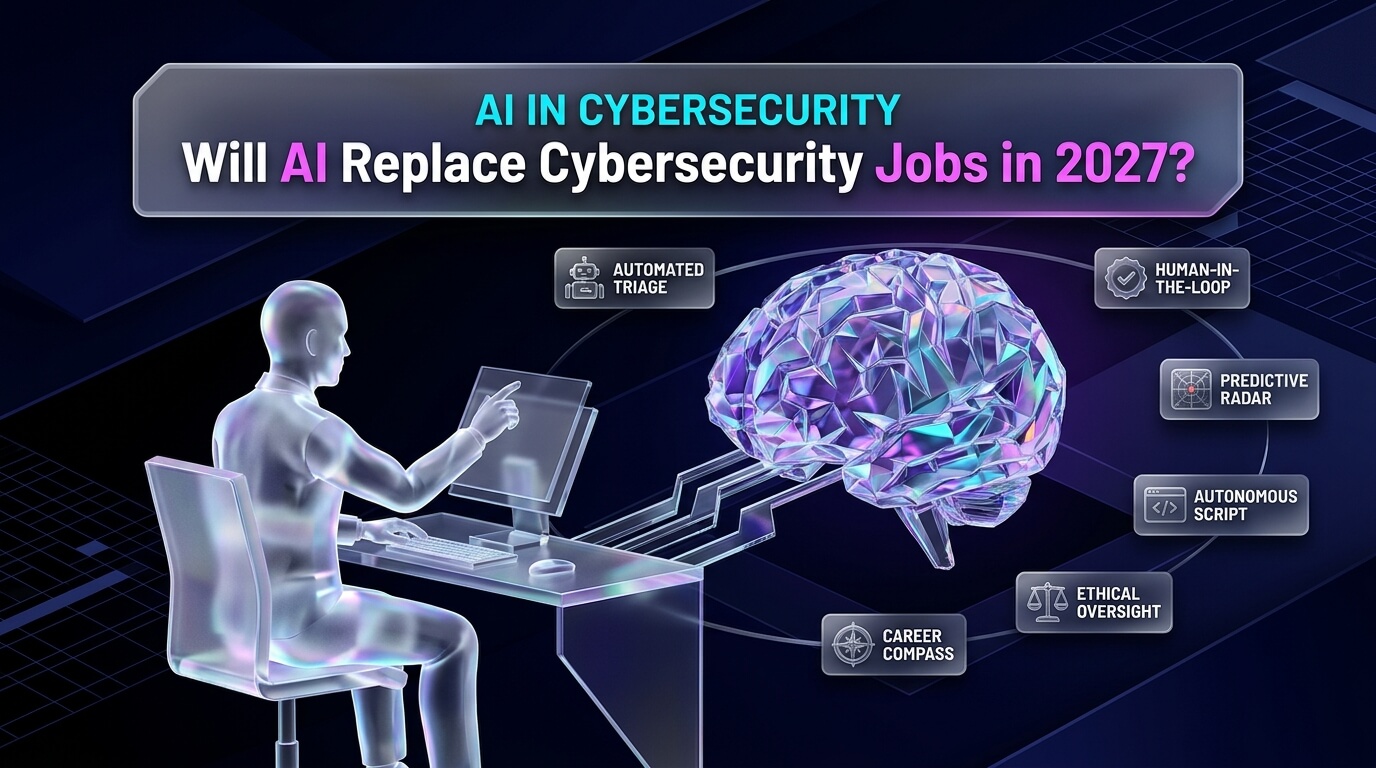
Artificial intelligence is redefining enterprise digital defense at unprecedented speed. Modern security operations teams face thousands of telemetry alerts each hour, creating immense cognitive strain. Defending complex cloud environments requires computational speed that exceeds manual human capacity. As machine learning models advance, security leaders evaluate the profound intersection of cybersecurity and ai.
The rapid rise of large language models and neural networks has sparked intense debate regarding career longevity. Anxious practitioners frequently ask: will cybersecurity be replaced by ai? Others wonder: will cybersecurity jobs be replaced by ai or can cybersecurity be replaced by ai? Clear industry data suggests that while automation changes daily routines, human defenders remain indispensable.
Modern enterprises actively deploy ai cybersecurity systems to detect stealthy adversary behaviors. These sophisticated platforms apply cybersecurity ai algorithms to analyze identity patterns, inspect network flows, and flag suspicious lateral movement. Understanding how ai in cybersecurity operates helps organizations defend critical infrastructure while empowering security engineers to work more strategically.
The discipline of cybersecurity artificial intelligence combines statistical machine learning with offensive threat intelligence. Rather than substituting human ingenuity, cybersecurity with ai augments analyst capabilities by eliminating repetitive manual triage. Navigating the evolving relationship between human defenders and intelligent software is essential for every technology professional.
Key Takeaways: AI in Modern Cybersecurity
- AI accelerates threat triage by correlating millions of telemetry logs in seconds, reducing mean time to detect.
- Human analysts remain irreplaceable for adversary attribution, strategic decision-making, and critical business context.
- Defenders must combat adversarial AI, as threat actors weaponize machine learning for sophisticated phishing and polymorphic malware.
- Career resilience requires mastering AI tools, prompt engineering, and security orchestration rather than fearing automation.
Will AI Replace Cybersecurity Jobs? Deconstructing the Threat of Automation
The fear of robotic obsolescence troubles many early-career analysts and university students. People question: will ai replace cybersecurity jobs or will ai take over cybersecurity jobs entirely? A closer look at operational security workflows reveals that automation targets tasks, not complete professions.
Historically, entry-level analysts spent hours reviewing repetitive firewall alerts, copying IP addresses into threat intelligence portals, and closing false alarms. In modern security operations centers, will cybersecurity be automated? Repetitive low-level alert categorization is indeed automated through security orchestration, automation, and response systems. This structural shift eliminates monotonous busywork, allowing junior defenders to investigate complex compromises.
Cybersecurity is fundamentally an asymmetric, adversarial conflict between human minds. While machine learning excels at identifying historical data anomalies, it lacks human intuition, psychological insight, and lateral reasoning. Threat actors constantly alter their social engineering techniques and operational cadence to deceive statistical baselines. Human defenders must evaluate business context, assess organizational risk tolerances, and negotiate incident responses during crises.
Complete reliance on automated systems introduces severe operational blind spots. Algorithms produce hallucinations, struggle with novel zero-day attack concepts, and misinterpret benign administrative software updates. Security leaders realize that removing human oversight invites catastrophic breach scenarios. Therefore, AI transforms the nature of cybersecurity careers from manual triage toward high-level threat hunting, architecture design, and strategic response.
Role-by-Role Impact: How AI Reshapes Cybersecurity Careers
To understand the practical impact of intelligent automation, we must examine specific cybersecurity job roles. Different specializations experience different degrees of workflow transformation.
Tier 1 SOC Analysts: This role experiences the most dramatic operational transformation. Basic alert parsing, IP reputation lookups, and ticket routing are now largely handled by machine learning engines. Rather than copying log data between browser tabs, analysts validate automated triage assessments and initiate guided containment playbooks.
Threat Hunters: Threat hunters benefit immensely from machine learning acceleration. Instead of writing complex query syntax across fragmented databases, hunters use natural language prompts to surface subtle adversary persistence mechanisms. Analysts spend their time hypothesizing adversary tactics rather than debugging search scripts.
Penetration Testers & Ethical Hackers: AI helps penetration testers generate automated vulnerability scanning templates and draft customized exploit payloads. However, discovering subtle business logic flaws and chained vulnerabilities still requires creative human intuition that algorithms cannot replicate.
Incident Responders: During active ransomware outbreaks, AI coordinates rapid endpoint isolation and telemetry aggregation. Incident commanders provide the critical strategic leadership, crisis communication, and regulatory negotiation that keep organizations functioning during high-stakes disasters.
Security Architects & GRC Specialists: Governance, risk, and compliance professionals design overarching security policies and verify statutory compliance. Translating complex corporate business goals into defensible technical controls requires human diplomacy, legal comprehension, and strategic oversight.
How AI Powers Modern Cyber Defense: Speed, Scale, and Precision
Modern enterprise defense requires continuous visibility across identity providers, endpoints, cloud workloads, and operational networks. Analyzing this torrent of telemetry requires ai powered cybersecurity systems that operate in real time. Machine learning algorithms establish dynamic behavioral baselines for every employee, service account, and connected server.
Deploying ai driven cybersecurity transforms passive logging into proactive threat interception. When an employee account initiates an unusual credential query at midnight from an unmanaged country, machine learning identifies the contextual anomaly instantly. Rather than waiting for a morning review, automated playbooks isolate the affected workstation, revoke session tokens, and notify the security team.
The rise of generative ai in cybersecurity marks an unprecedented paradigm shift for defensive efficiency. Generative assistants read complex PowerShell attack scripts, translate binary code into readable explanations, and generate tailored remediation commands. Junior analysts leverage natural language prompts to run comprehensive database threat queries that previously required advanced SQL knowledge.
Industry research initiatives like openai cybersecurity research partnerships and frontier model evals help standardize defensive defenses. OpenAI and leading software vendors continuously audit model behaviors, prevent malicious jailbreaks, and release defensive grants to strengthen global open-source resilience. Applying artificial intelligence cybersecurity ensures organizations respond to sophisticated network incursions in seconds rather than weeks.
Core Machine Learning Disciplines in Cyber Defense
Modern security platforms employ several distinct machine learning disciplines to safeguard enterprise assets. Each discipline addresses specific operational challenges.
Unsupervised Anomaly Detection: Unsupervised clustering algorithms ingest petabytes of unlabelled network telemetry. By calculating multi-dimensional mathematical distances between observed activities, these models identify anomalous beaconing patterns and insider data exfiltration without requiring pre-existing signature definitions.
Supervised Classification: Supervised neural networks train on millions of known clean and malicious software binaries. When an unknown executable attempts to run on an endpoint, the model computes thousands of static and behavioral features in milliseconds to predict malicious intent.
Natural Language Processing (NLP): Advanced language models inspect incoming corporate email correspondence for linguistic deception. By evaluating semantic intent, urgency markers, and domain authenticity, NLP engines block sophisticated executive impersonation and vendor invoice fraud that bypass legacy spam filters.
Graph Neural Networks (GNNs): Enterprise Active Directory environments contain complex webs of trust relationships and access permissions. Graph neural networks analyze credential paths, identifying hidden lateral movement vectors that attackers exploit to achieve domain dominance.
The Dark Side: AI Cybersecurity Risks and Weaponized Models
As defensive teams adopt machine learning, criminal syndicates and nation-state threat groups harness identical technologies for malicious campaigns. Understanding the scope of ai cybersecurity risks is vital for risk mitigation. Attackers no longer craft crude, misspelled phishing emails; they generate highly personalized, grammatically flawless spear-phishing messages at industrial scale.
Generative audio and video deepfakes pose direct threats to enterprise authentication and financial operations. Attackers clone executive voices to authorize fraudulent wire transfers and bypass biometric voiceprint verification controls. Machine learning tools also enable automated vulnerability discovery, allowing adversaries to scan millions of lines of open-source repository code for zero-day vulnerabilities in minutes.
Adversaries also target corporate machine learning infrastructure directly through model evasion, prompt injection, and data poisoning attacks. By subtly manipulating training datasets, attackers teach corporate algorithms to ignore malicious traffic signatures. This ongoing tension creates a dynamic contest of cybersecurity vs ai, where defensive neural networks must actively defend against weaponized offensive algorithms.
Understanding the MITRE ATLAS Framework
To help security teams categorize threats against artificial intelligence systems, the MITRE Corporation established the ATLAS (Adversarial Threat Landscape for Artificial-Intelligence Systems) framework. ATLAS documents practical adversary tactics, techniques, and procedures used against machine learning systems.
Key attack patterns cataloged in ATLAS include indirect prompt injection via untrusted web documents, data extraction from model parameters, and adversarial perturbations designed to bypass computer vision filters. Organizations deploying production language models must integrate ATLAS defense matrix validations into their routine vulnerability assessments.
Pro-Tip: Defending Corporate AI Pipelines Against Data Poisoning
Secure all machine learning development environments with immutable audit logs, strict data provenance tracking, and cryptographic signature validation. Regularly audit internal language models against indirect prompt injection attacks by testing user inputs through sandboxed validation layers.
The Market Landscape: AI Cybersecurity Companies and Investment Trends
The enterprise appetite for intelligent defense tools has catalyzed unprecedented growth across the security software industry. Every modern ai cybersecurity company competes to offer autonomous detection, endpoint isolation, and generative co-pilots. Venture capital investment and enterprise spending have surged, cementing artificial intelligence as the foundational pillar of modern defense.
Forward-thinking organizations seek comprehensive ai powered cybersecurity solutions that consolidate fragmented tool stacks into unified architectures. Deploying a single, high-performing ai cybersecurity solution reduces operational overhead and eliminates security visibility blind spots. Modern Chief Information Security Officers favor unified vendor ecosystems over dozens of isolated point products.
Public financial markets mirror this technology shift. Institutional and retail investors closely monitor ai cybersecurity stock tickers, recognizing that defense automation delivers durable recurring revenue. Established ai cybersecurity companies with proprietary model training datasets hold immense competitive moats against market newcomers.
As enterprise procurement shifts toward autonomous platforms, vendors differentiate through model transparency, explainable alert logic, and strict compliance boundaries. Companies that explain why an algorithm flagged an incident gain enterprise trust far faster than opaque black-box systems.
Evaluation Criteria for AI Defense Procurement
When selecting artificial intelligence security solutions, enterprise buyers must look beyond vendor marketing claims. Key technical criteria separate resilient platforms from superficial wrappers.
Telemetry Diversity and Volume: The predictive power of any machine learning model depends entirely on its training dataset. Vendors analyzing billions of daily cross-domain events deliver far fewer false positives than vendors trained on narrow, homogeneous logs.
Explainability and Auditability: Black-box algorithms that issue opaque risk scores without contextual reasoning hinder incident investigations. Platforms must provide transparent decision trees showing exactly which telemetry anomalies triggered an alert.
Autonomous Containment Safety: Autonomous response actions must be proportional and precise. Security leaders need granular policy controls to specify whether models can automatically terminate host processes or require human analyst approval.
In-Depth Reviews: Top 8 AI Cybersecurity Platforms in 2027
Evaluating enterprise security tools requires reviewing algorithmic accuracy, telemetry scale, ease of management, and response automation. The following eight industry-leading platforms illustrate the state of artificial intelligence in cyber defense.
1. Darktrace
Darktrace is a pioneer in self-learning artificial intelligence for autonomous cyber defense. Founded by mathematicians and defense intelligence specialists, the platform uses unsupervised machine learning to calculate a dynamic understanding of normal behavior for every digital asset.
Rather than relying on static threat intelligence feeds or signatures, Darktrace detects emerging anomalies by identifying subtle deviations from normal baseline traffic. Its autonomous response engine, Darktrace Antigena, takes surgical, proportional actions to neutralize in-progress ransomware attacks and insider threats within seconds, ensuring business continuity.
The platform covers network, email, cloud workloads, and operational technology environments. Darktrace Cyber AI Analyst automates the triage process by compiling disparate alert threads into comprehensive root-cause investigations, dramatically reducing mean time to understand incidents.
2. CrowdStrike Falcon
CrowdStrike Falcon is a cloud-native cybersecurity platform that protects millions of enterprise endpoints across global networks. Central to the platform is Charlotte AI, a specialized generative security assistant trained on trillions of high-fidelity telemetry events collected by the CrowdStrike Threat Graph.
CrowdStrike leverages machine learning to stop fileless attacks, credential stuffing, and zero-day exploits before execution. Charlotte AI empowers security analysts of all skill levels to conduct deep telemetry queries, generate plain-language threat summaries, and trigger coordinated endpoint containment across vast corporate fleets.
The platform features a lightweight single-agent architecture that installs in seconds without requiring host reboots. CrowdStrike Falcon integrates endpoint detection, identity threat protection, cloud security posture management, and threat intelligence into one centralized web management console.
3. SentinelOne Singularity
SentinelOne Singularity delivers autonomous endpoint, cloud workload, and identity protection through on-agent behavioral artificial intelligence. The platform executes local behavioral analysis directly on host devices, allowing continuous protection even when endpoints disconnect from the Internet.
SentinelOne incorporates Purple AI, an advanced generative threat-hunting engine that translates natural language questions into complex analytical queries. When malicious activity triggers, the platform automatically rolls back infected files to clean, pre-attack states via native Windows shadow copy integration, neutralizing ransomware impact.
The platform eliminates alert fatigue through Storyline technology, which automatically connects related events into a single visual graph. SentinelOne Singularity provides enterprise-wide visibility across Linux, macOS, Windows, and containerized Kubernetes environments.
4. Palo Alto Networks Cortex
Palo Alto Networks Cortex represents an enterprise-grade extended detection and response platform powered by Precision AI. Precision AI combines advanced machine learning models with rich network, cloud, identity, and endpoint telemetry to automate security operations center workflows.
The platform’s flagship offering, Cortex XSIAM, ingests petabytes of operational security data, stitching disparate logs into coherent, contextual incidents. By automating up to ninety percent of routine tier-1 alert analysis, Cortex allows enterprise response teams to concentrate on advanced persistent threats.
Cortex integrates seamlessly with Palo Alto Networks Next-Generation Firewalls and Prisma Cloud infrastructure. Built-in security orchestration playbooks enable automated policy enforcement across multi-cloud enterprise estates.
5. Microsoft Security Copilot
Microsoft Security Copilot is an enterprise-scale generative AI assistant designed specifically for security and IT specialists. Built on OpenAI frontier models, the system processes over sixty-five trillion daily signals collected across Microsoft Defender, Entra ID, Purview, and Sentinel.
Security Copilot allows analysts to investigate complex breach incidents using conversational natural language prompts. It rapidly summarizes active threat alerts, reconstructs multi-stage attack chains across identity and cloud workloads, and generates step-by-step remediation scripts for immediate containment.
The assistant operates within familiar Microsoft administrative portals, providing contextual insights directly where analysts work. Security Copilot enforces enterprise-grade privacy controls, ensuring proprietary tenant telemetry is never used to train global commercial foundation models.
6. Check Point Infinity AI
Check Point Infinity AI delivers comprehensive, AI-powered threat prevention across hybrid networks, cloud data centers, and remote workers. The architecture relies on ThreatCloud AI, a massive threat engine analyzing billions of daily web transactions and inspection requests.
Check Point incorporates Infinity AI Copilot, which automates firewall policy creation, troubleshoots rule misconfigurations, and manages threat mitigation workflows. Its predictive models stop unknown zero-phishing attacks and malware delivery before malicious payloads reach corporate mailboxes.
The platform offers unified management across on-premises network appliances and cloud-native security gateways. Check Point provides comprehensive zero-trust access controls, ensuring secure remote connectivity for distributed corporate workforces.
7. Splunk Enterprise Security
Splunk Enterprise Security is an industry-standard security information and event management platform enhanced with deep machine learning and automated orchestration. Splunk ingests heterogeneous data from across the enterprise, offering complete operational visibility.
Splunk AI assists security operations teams with automated anomaly detection, predictive risk scoring, and intelligent alert clustering. By grouping related alert signals into single high-fidelity incident investigations, Splunk drastically minimizes alert fatigue and accelerates incident resolution times.
The platform features extensive integration libraries with hundreds of commercial security tools and cloud infrastructure providers. Splunk SOAR enables teams to automate complex response playbooks, coordinating actions across firewalls, endpoint agents, and ticketing systems.
8. OpenAI
OpenAI drives global advancements in artificial intelligence through frontier reasoning models, safety evaluations, and enterprise security frameworks. Through specialized red-teaming programs and defensive initiatives, OpenAI helps organizations understand the dual-use nature of advanced machine learning.
OpenAI collaborates with leading defense companies, government agencies, and research universities to identify systemic vulnerabilities before malicious adversaries exploit them. Its frontier models power leading commercial security assistants, establishing the core natural language intelligence layer for modern digital protection.
OpenAI actively funds defensive security research through its Cybersecurity Grant Program. By promoting open-source defensive tools and establishing rigorous safety benchmarks, OpenAI works to ensure AI advances benefit defensive teams worldwide.
AI Cybersecurity Platform Comparison Matrix
Selecting an intelligent security platform requires comparing architectural design, automation capabilities, and target operational scale. The matrix below highlights key differentiators across top solutions.
| Platform | Core AI Architecture | Primary Defensive Focus | Key Automation Strengths | Target Organization |
|---|---|---|---|---|
| Darktrace | Self-learning unsupervised ML | Network & email anomaly detection | Autonomous containment (Antigena) | Mid-market to global enterprise |
| CrowdStrike Falcon | Threat Graph & Charlotte AI | Endpoint & cloud workload protection | Conversational query & rapid isolation | Enterprises of all sizes |
| SentinelOne Singularity | Local on-agent AI & Purple AI | Extended detection & response (XDR) | Automated ransomware rollback | Small business to large enterprise |
| Palo Alto Networks Cortex | Precision AI & XSIAM data engine | SOC operational consolidation | Automated alert grouping & triage | Large distributed enterprises |
| Microsoft Security Copilot | OpenAI LLMs & 65T daily signals | Multi-product security orchestration | Attack reconstruction & PowerShell generation | Microsoft 365 enterprise tenants |
| Check Point Infinity AI | ThreatCloud AI & Infinity Copilot | Hybrid network & zero-phishing defense | Automated policy management | Mid-sized to large enterprises |
| Splunk Enterprise Security | Splunk AI & machine learning engine | Enterprise SIEM & telemetry analytics | Anomaly detection & alert correlation | Mature SOC teams & enterprises |
| OpenAI | Frontier reasoning neural models | AI safety, red teaming & reasoning | Natural language code auditing & synthesis | Developers, vendors & researchers |
Career Evolution: Skills, Certifications, and Thriving with AI
As intelligent automation becomes mainstream, security professionals must adapt their technical skill sets. Rather than fearing replacement, proactive engineers learn how to master cybersecurity with ai tools. Becoming proficient in AI-driven telemetry investigation, automated playbook construction, and model auditing positions you as an invaluable team leader.
Earning an industry-recognized credential proves your ability to navigate modern defense environments. Pursuing an ai cybersecurity certification validates your understanding of machine learning principles, adversarial attack vectors, and automated incident response workflows. Similarly, earning a cybersecurity ai certification demonstrates your capability to build robust defenses around sensitive machine learning pipelines.
Professional associations now offer structured curricula covering cybersecurity with ai certification paths. These comprehensive programs teach practitioners how to evaluate algorithmic bias, prevent model inversion attacks, and audit API integrations. By blending traditional network defense principles with machine learning fluency, you create durable career security for decades to come.
High-Demand Skills for the AI Security Era
Thriving alongside machine learning systems requires cultivating complementary technical and human skills. Security teams actively seek practitioners with well-rounded capabilities.
Prompt Engineering for Threat Analysis: Crafting precise prompts allows analysts to extract maximum utility from security assistants. Learning how to supply context, specify output formats, and request step-by-step reasoning transforms assistants into expert investigative partners.
Python & API Integration: Scripting remains the universal glue of modern security operations. Writing clean Python code enables engineers to extract telemetry from cloud APIs, route data into machine learning pipelines, and automate incident response actions across diverse tool sets.
AI Model Governance & Red Teaming: As companies integrate artificial intelligence into customer applications, specialized security professionals must assess those models for vulnerabilities. Testing applications against prompt injection and data extraction attacks represents one of the fastest-growing niches in information security.
Strategic Business Acumen: Communicating cyber risk to executive leadership requires empathy, storytelling, and financial comprehension. Security leaders who articulate technical risks in clear business terms will always enjoy high demand across every corporate sector.
Checklist: Future-Proofing Your Cybersecurity Career
- Master Prompt Engineering: Learn to write precise, context-rich prompts for tools like Microsoft Security Copilot and ChatGPT to accelerate script deobfuscation and incident summaries.
- Study Adversarial Machine Learning: Understand how attackers execute prompt injection, data poisoning, and model evasion against enterprise AI applications.
- Develop Python and API Skills: Build custom automation scripts to connect machine learning models with enterprise SIEM and SOAR platforms.
- Earn Specialized Certifications: Complete practical AI security training credentials from recognized bodies such as ISACA, CompTIA, or cloud providers.
- Cultivate Strategic Judgment: Deepen your knowledge of business risk management, regulatory compliance, and incident leadership where human decisions are mandatory.
Frequently Asked Questions: AI and the Future of Cybersecurity
Here are detailed answers to the most common questions regarding artificial intelligence, career automation, and enterprise security.
Will AI replace entry-level cybersecurity analysts?
AI will not eliminate entry-level cybersecurity analysts, but it fundamentally transforms their daily tasks. Instead of manually inspecting repetitive firewall logs, junior analysts now oversee automated triage bots, validate flagged incidents, and escalate complex threats. Entry-level professionals who learn to manage AI tools will find ample job opportunities.
Can AI fully automate incident response during a data breach?
No, AI cannot fully automate end-to-end incident response during a serious data breach. While automation can instantly isolate endpoints or block compromised user credentials, human incident commanders must assess business operational impacts, coordinate with legal counsel, notify regulators, and communicate with customers.
Do cybersecurity professionals need a computer science degree to work with AI?
Cybersecurity professionals do not require a dedicated computer science degree to utilize AI effectively. Most modern security platforms feature conversational, natural language interfaces that require no coding background. However, basic familiarity with Python, REST APIs, and data structures is highly beneficial for custom automation.
What are the biggest security risks introduced by generative AI?
The primary security risks include unauthorized corporate data leakage via public chatbots, sophisticated spear-phishing campaigns generated at scale, and prompt injection attacks that manipulate enterprise AI systems. Organizations must enforce strict data loss prevention policies and secure AI gateway controls.
Which certifications are best for learning AI in cybersecurity?
Top credentials include the Certified AI Security Practitioner (CAISP), CompTIA SecurityX, and cloud-specific credentials such as AWS Certified Machine Learning – Specialty or Microsoft Certified: Azure AI Fundamentals paired with SC-200. These programs validate both offensive defense and model governance.
Will cybersecurity salaries decline due to artificial intelligence automation?
Industry salary data indicates that cybersecurity salaries continue to rise despite increasing automation. As routine manual triage is automated, organizations place higher financial value on strategic professionals capable of managing automated workflows, interpreting complex alerts, and securing machine learning infrastructure.
How does adversarial machine learning threaten enterprise systems?
Adversarial machine learning involves threat actors deliberately manipulating model inputs to cause incorrect classifications or bypass security controls. Attackers execute data poisoning during training phases or deploy subtle evasions that deceive computer vision and fraud detection algorithms, requiring specialized defense techniques.
Final Verdict: The Enduring Partnership of Human and Machine
The rise of artificial intelligence does not signal the demise of cybersecurity careers. Instead, it marks the beginning of an era characterized by human-machine teaming. In this new landscape, computational algorithms handle the immense scale of telemetry parsing, while human analysts provide the critical reasoning, adversarial empathy, and ethical stewardship required to outsmart human adversaries.
Organizations that combine advanced machine learning platforms with skilled, empowered security engineers achieve the highest defensive resilience. Threat actors will continue to innovate with malicious algorithms, making human vigilance, continuous upskilling, and disciplined governance more vital than ever before.
For aspiring and established cybersecurity professionals, the directive is clear. Rather than viewing artificial intelligence as an existential threat to your livelihood, embrace it as the most powerful force multiplier in the history of information security. Master the tools, understand the risks, and lead the future of digital defense.