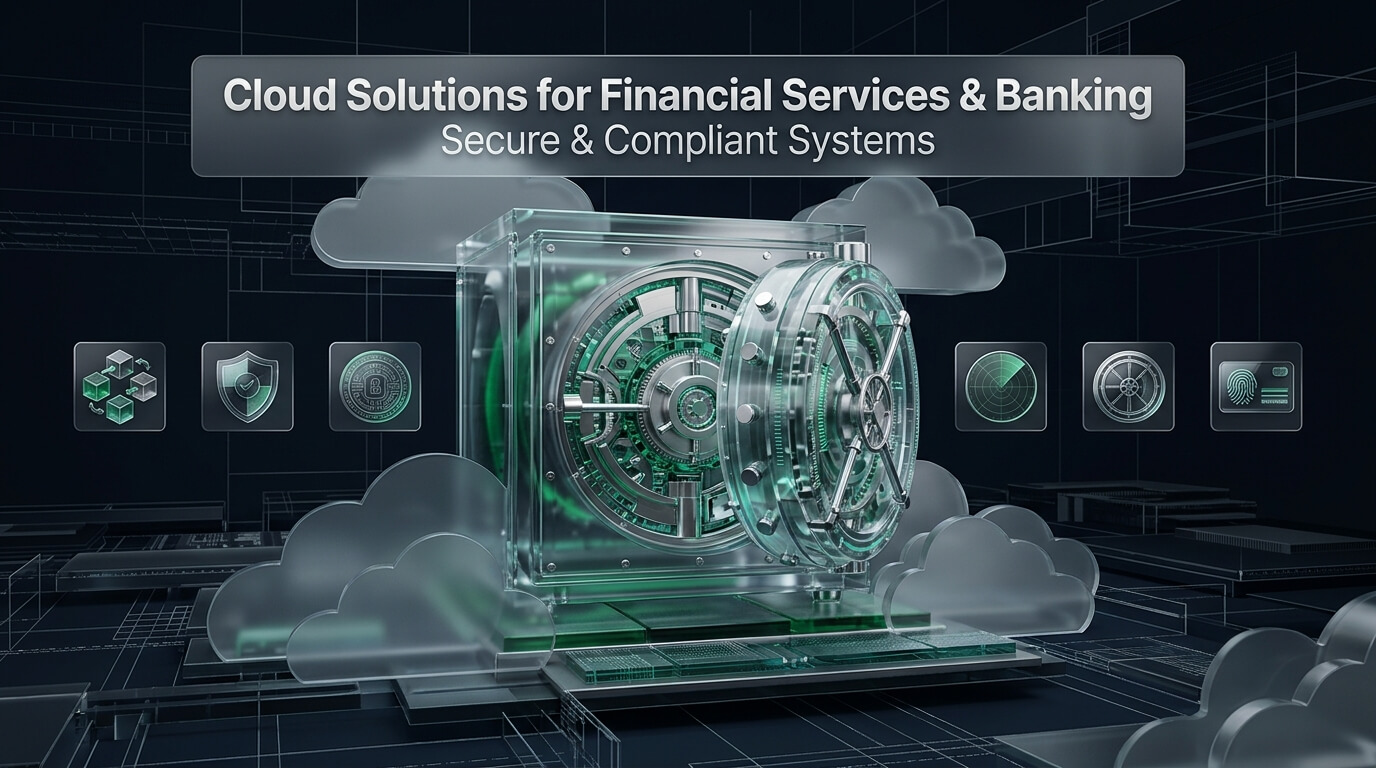
Modern banking institutions and investment firms face mounting pressure to modernize aging transaction networks while satisfying stringent global regulatory standards. Deploying dedicated cloud solutions for financial services enables institutions to replace rigid mainframe architectures with responsive, fault-tolerant infrastructure. In fact, adopting proven cloud financial solutions allows commercial lenders and wealth managers to process high-volume transactions with sub-second latency.
Global financial leaders increasingly embrace secure banking cloud solutions to accelerate digital transformation initiatives across retail branch networks. Implementing modern cloud solutions for banks provides enterprise elasticity that handles intense market trading spikes without system degradation. At the same time, specialized cloud solutions for insurance carriers streamline claims processing and actuarial underwriting models. Fast-moving digital startups leverage versatile cloud solutions for fintech to launch digital banking applications rapidly. Unifying front-office client portals with back-office accounting engines through a scalable financial services cloud fosters deep institutional agility.
Adopting comprehensive banking industry cloud solutions eliminates physical data center maintenance expenses while enhancing transaction throughput. Modern financial firms depend on automated cloud compliance solutions to enforce strict audit reporting mandates effortlessly. In addition, implementing advanced cloud risk management solutions shields institutional capital from systemic market shocks and credit default hazards. Integrating tokenized cloud payment processing solutions protects consumer payment card records across digital checkout gateways. Finally, commercial credit unions and community banks utilize modular cloud lending solutions to automate borrower underwriting workflows from application through final loan servicing.
Key Takeaways for Financial Cloud Architecture
- Financial cloud infrastructure mandates FIPS 140-3 Level 4 Hardware Security Modules for cryptographic key management.
- Modern core banking platforms decouple monolithic mainframe databases into composable, event-driven microservices.
- Automated Write Once Read Many (WORM) storage vaults satisfy strict SEC Rule 17a-4 and FINRA record retention mandates.
- Confidential computing enclaves protect sensitive transactional financial data in memory during active computational processing.
The Regulatory Landscape: Basel III, SEC 17a-4, FINRA, and DORA
Financial institutions operate under the most rigorous regulatory scrutiny of any commercial industry. Government supervisory agencies, including the Federal Reserve, the SEC, FINRA, and the European Central Bank, enforce strict operational mandates. Systemic financial stability requires continuous transaction auditability, capital adequacy reserves, and robust disaster recovery capabilities.
Securities and Exchange Commission Rule 17a-4 and FINRA Rule 4511 dictate that electronic brokerage records must reside in non-rewritable, non-erasable formats. Cloud storage vaults enforce immutable Write Once Read Many (WORM) object locks to satisfy these strict federal retention rules. Once financial trade confirmations write to cloud vaults, no user or administrative credential can alter or delete records before designated retention periods expire.
In Europe, the Digital Operational Resilience Act (DORA) establishes comprehensive cybersecurity and operational testing mandates for financial entities. Regulated institutions must prove that their cloud providers can withstand severe cyberattacks and localized data center outages without disrupting critical market operations. Regular penetration testing and documented multi-cloud exit strategies ensure compliance with modern financial supervisory frameworks.
Pro-Tip on Confidential Computing
Implement hardware-isolated Confidential Computing enclaves when processing unencrypted cardholder data or running risk modeling algorithms. Memory encryption prevents hypervisor administrators and cloud provider personnel from inspecting sensitive financial data while in active use.
Architectural Foundations: Hardware Security Modules and Confidential Computing
Traditional data center security focused on protecting data at rest using storage disk encryption and data in transit using TLS network protocols. However, financial transaction data remained exposed in plaintext memory during active central processing unit calculations. Highly sophisticated memory-scraping malware could theoretically intercept cryptographic keys or credit card account numbers during active processing cycles.
Confidential computing technology eliminates this architectural vulnerability by establishing hardware-enforced trusted execution environments (TEEs). Hardware processors from Intel and AMD create encrypted memory enclaves that isolate financial calculations from underlying host operating systems and cloud hypervisors. Even root administrative accounts on the physical host hardware cannot view or manipulate data processed inside secure enclaves.
Cryptographic master key ownership remains entirely within client control through dedicated Cloud Hardware Security Modules (HSMs). FIPS 140-3 Level 3 and Level 4 certified HSMs generate, store, and manage encryption keys inside tamper-resistant physical silicon chips. If physical tampering or unauthorized physical access attempts occur, the hardware module zeroes out stored cryptographic keys instantly. This cryptographic isolation guarantees that financial institutions retain absolute sovereignty over sensitive consumer assets.
Core Banking Modernization: Transitioning Mainframes to Cloud Microservices
Legacy retail banks built their core transaction ledgers on monolithic COBOL mainframes during the late twentieth century. These centralized mainframe systems processed nightly batch files reliably for decades, but they cannot support real-time digital consumer expectations. Adding new mobile banking features or integrating third-party fintech applications into rigid mainframe architectures requires months of fragile custom programming.
Cloud-native core banking platforms replace monolithic mainframes with composable, event-driven microservices running on elastic container infrastructure. Each banking function, such as account deposits, lending origination, and card issuing, operates as an independent microservice connected via RESTful APIs. When mobile banking usage surges on national paydays, specific ledger microservices scale horizontally in seconds to handle transaction spikes.
Event-driven ledger architectures utilize distributed transaction logs to record account balance updates in sub-second real time. Continuous transaction streaming eliminates overnight batch delays, providing retail consumers and commercial treasury officers with instant visibility into cleared funds. Financial institutions deploy software improvements and security patches continuously without taking critical core banking ledgers offline.
Top 8 Financial Services Cloud Platforms
We evaluated dozens of specialized cloud infrastructure providers, core banking suites, and financial technology platforms across security certifications, transaction throughput, and regulatory compliance. The following eight platforms lead the global financial technology sector.
1. AWS for Financial Services
AWS for Financial Services provides an enterprise cloud infrastructure portfolio engineered specifically for commercial banks, capital markets firms, and global insurance carriers. Powering premier financial institutions including Goldman Sachs, Nasdaq, and Capital One, AWS delivers unrivaled scale, availability, and security tooling. Financial organizations choose AWS for its mature compliance catalog and expansive ecosystem of financial software partners.
The platform features specialized financial services offerings including Amazon FinSpace, an analytics service that aggregates, prepares, and catalogs financial market data at petabyte scale. AWS CloudHSM provides dedicated, single-tenant hardware security module appliances inside client virtual private clouds for FIPS-validated key storage. In addition, Amazon Aurora provides fault-tolerant database clustering with automated multi-region replication to support high-throughput payment ledgers.
AWS enforces rigorous compliance frameworks, maintaining independent audit validations for PCI-DSS Level 1, SOC 1, SOC 2, ISO 27001, and SEC 17a-4 WORM storage. Capital markets trading firms leverage ultra-low-latency AWS Direct Connect links and dedicated local zones to execute high-frequency algorithmic trades with microsecond precision. AWS for Financial Services represents the foundational computing backbone for institutional banking transformation.
2. Microsoft Cloud for Financial Services
Microsoft Cloud for Financial Services brings together Microsoft Azure, Dynamics 365, Microsoft 365, and Power Platform into a unified enterprise banking environment. Designed specifically to accelerate customer onboarding, enhance banking employee collaboration, and combat financial crime, the platform integrates deeply with corporate enterprise workflows. Retail banks and investment institutions select Microsoft for its unified corporate data models and comprehensive security controls.
The platform includes the Financial Services Common Data Model, which standardizes customer banking profiles, retail accounts, loans, and investment portfolios across disparate banking systems. Retail branch personnel collaborate securely using Microsoft Teams for Financial Services, which features secure document co-authoring and integrated regulatory compliance recording. Azure Confidential Computing protects sensitive client financial transactions in memory using hardware-isolated execution enclaves.
Microsoft maintains comprehensive financial regulatory certifications globally, providing contractual compliance support for Federal Reserve, FINRA, and European Banking Authority standards. Built-in artificial intelligence models automate commercial loan onboarding and assist wealth managers with personalized client investment recommendations. Microsoft Cloud for Financial Services provides an outstanding end-to-end operational platform for established commercial banking institutions.
3. Google Cloud for Financial Services
Google Cloud for Financial Services delivers an advanced data analytics and artificial intelligence platform designed to modernize capital markets trading and risk modeling. Leveraging Google’s world-class big data infrastructure and machine learning capabilities, the platform helps financial firms uncover deep market insights and detect fraudulent transactions. Quantitative hedge funds and progressive digital retail banks choose Google Cloud for its high-speed computational analytics.
The platform features Google Cloud Anti Money Laundering AI, an automated machine learning product that analyzes complex transaction networks to identify suspicious financial behavior. Unlike rigid rule-based legacy monitoring tools, AML AI adapts continuously to evolving money laundering typologies, reducing false-positive alerts by up to sixty percent. Google BigQuery allows financial risk officers to run massive liquidity stress testing models across petabytes of market data in minutes.
Google Cloud provides comprehensive compliance governance through the Google Cloud Financial Services Regulatory Resource Center, ensuring alignment with global supervisory standards. Customer-managed encryption keys, automated DLP scanners, and secure software supply chains safeguard institutional financial assets. Google Cloud for Financial Services represents the premier destination for quantitative capital modeling, real-time risk analysis, and fraud prevention.
4. IBM Cloud for Financial Services
IBM Cloud for Financial Services is a specialized public cloud architecture engineered with pre-configured regulatory compliance controls designed in collaboration with major global banks. Designed specifically to alleviate third-party systemic risk concerns for financial institutions, the platform enforces automated compliance guardrails across all hosted applications. Tier-one global banks trust IBM for its deep regulatory pedigree and mainframe hybrid integration capabilities.
The platform features the IBM Cloud Framework for Financial Services, a comprehensive set of built-in security and compliance controls that satisfy rigorous global banking regulations. IBM Cloud Security and Compliance Center monitors cloud configurations continuously, blocking non-compliant changes and generating audit-ready reports automatically. IBM Hyper Protect Crypto Services provides Keep Your Own Key (KYOK) encryption powered by FIPS 140-2 Level 4 certified hardware security modules.
IBM Cloud supports native integration with IBM zSystems enterprise mainframes, enabling hybrid modernization that connects core legacy banking systems with modern cloud applications. Red Hat OpenShift provides a consistent container orchestration layer that runs identically across on-premises data centers and multi-cloud environments. IBM Cloud for Financial Services is the premier choice for risk-averse institutional banks requiring guaranteed regulatory compliance.
5. Salesforce Financial Services Cloud
Salesforce Financial Services Cloud is the industry-leading customer relationship management and client engagement platform built specifically for financial institutions. Engineered to bridge the gap between transactional banking ledgers and customer relationship management, the platform creates unified client views for bankers and advisors. Retail banks, wealth management practices, and commercial lending institutions adopt Salesforce to personalize customer financial journeys.
The platform provides specialized data models for wealth management, commercial banking, retail banking, and insurance claims administration. Financial advisors manage holistic household wealth profiles, tracking multi-generational family assets, trust accounts, and financial goals on a single interactive dashboard. Automated workflow rules streamline commercial loan applications, routing paperwork between borrowers, underwriters, and credit approval committees.
Salesforce Financial Services Cloud adheres to strict financial compliance standards, supporting granular role-based access permissions and comprehensive interaction audit logging. Built-in artificial intelligence tools summarize customer financial histories and suggest relevant banking products based on life events like home purchases or retirement planning. Salesforce Financial Services Cloud represents an indispensable platform for delivering client-centric banking experiences.
6. Mambu Cloud Banking
Mambu is a leading cloud-native, SaaS core banking engine built on a pure composable architecture for digital banks, fintechs, and modern retail lenders. Operating entirely in the cloud, Mambu allows financial institutions to design, launch, and service innovative banking and lending products in weeks rather than years. Fast-moving digital challenger banks and established institutions launching digital spinoffs choose Mambu for its radical product agility.
The platform features a modular engine that allows financial product managers to configure loan products, deposit accounts, and interest accrual rules without writing software code. Mambu operates on a pure API-first architecture, connecting smoothly with third-party payment gateways, credit scoring bureaus, and card processors. The system manages high-speed transaction accounting, automated loan amortizations, and regulatory fee deductions effortlessly.
Mambu runs on modern multi-cloud infrastructure hosted across AWS, Microsoft Azure, and Google Cloud, ensuring high uptime availability and regional data sovereignty. Continuous software releases deliver new banking features automatically without requiring disruptive system downtime or expensive software version upgrades. Mambu represents the gold standard for composable, modern cloud core banking and digital lending.
7. nCino Cloud Banking Platform
nCino is the worldwide leader in cloud banking software engineered to digitize commercial lending, retail loan origination, and customer onboarding workflows. Built on the secure Salesforce platform, nCino unites commercial borrowers, relationship managers, credit analysts, and loan operations personnel into a single digital workspace. Major global financial institutions and community credit unions rely on nCino to accelerate loan origination speed.
The platform features Commercial Banking Solution, which automates complex commercial loan underwriting, financial statement spreading, and covenant compliance tracking. nCino eliminates cumbersome paper documentation by digitizing borrower financial disclosures, automated collateral valuations, and electronic document signing. Real-time workflow dashboards provide complete transparency into loan approval pipelines, reducing commercial loan closing cycles by over thirty percent.
nCino complies with strict banking regulations including Fair Lending, CECL accounting standards, and Bank Secrecy Act requirements. Built-in portfolio analytics evaluate credit risk distributions across loan portfolios, helping bank executives navigate shifting macroeconomic conditions safely. nCino Cloud Banking Platform is an indispensable tool for financial institutions seeking to dominate commercial lending markets.
8. Stripe Financial Infrastructure
Stripe delivers a comprehensive financial infrastructure platform that powers global digital commerce, payment processing, and embedded fintech solutions. Processing hundreds of billions of dollars annually for businesses of all sizes, Stripe eliminates the friction of traditional merchant acquiring banks. Modern fintech innovators and global enterprise corporations choose Stripe for its developer ergonomics and legendary payment reliability.
The platform features Stripe Payments, which allows businesses to accept credit cards, mobile wallets, and localized payment methods across more than forty-five countries with a single integration. Stripe Radar applies machine learning models trained on billions of global payment transactions to detect and block fraudulent card charges in real time. Stripe Issuing allows companies to create, program, and distribute virtual and physical commercial payment cards programmatically.
Stripe maintains certified compliance with PCI-DSS Level 1 standards, offloading complex payment card data security burdens from merchant systems completely. Stripe Treasury provides embedded banking-as-a-service APIs that allow commercial platforms to offer deposit accounts and business cards directly to their business users. Stripe Financial Infrastructure represents the undisputed industry leader for programmatic payment processing and modern financial software engineering.
| Platform | Primary Financial Strength | Key Differentiator | Compliance Standard | Best For |
|---|---|---|---|---|
| AWS for Finance | Hyperscale cloud & market analytics | FinSpace data catalog & CloudHSM | PCI-DSS, SEC 17a-4 & FINRA | Capital markets & large banks |
| Microsoft Cloud | Enterprise banking & Teams collaboration | Financial Services Data Model | SOC 1/2, ISO 27001 & DORA | Retail banks & wealth managers |
| Google Cloud | Quantitative risk & AI fraud detection | Anti Money Laundering AI & BigQuery | PCI-DSS, FedRAMP & SOC 2 | Quant hedge funds & digital banks |
| IBM Cloud | Heavily regulated compliance framework | FIPS 140-2 Level 4 Keep Your Own Key | Custom Global Banking Rules | Global tier-1 institutional banks |
| Salesforce FSC | Wealth & client journey management | 360-degree household financial view | SOC 2, PCI-DSS & GLBA | Wealth advisors & commercial banking |
| Mambu | Composable cloud core banking engine | Pure API-driven modular ledger setup | ISO 27001 & SOC 2 Type II | Challenger banks & fintech lenders |
| nCino | Commercial lending workflow automation | Digital credit spreading & underwriting | CECL, BSA & Fair Lending | Commercial banks & credit unions |
| Stripe | Global payment processing & issuing | Stripe Radar machine learning fraud tools | PCI-DSS Level 1 & PSD2 | Digital merchants & fintech platforms |
Real-Time Fraud Prevention and Machine Learning Transaction Screening
Financial cybercrime syndicates deploy automated botnets, credential-stuffing engines, and stolen identities to execute fraudulent transactions. Legacy rule-based fraud detection systems rely on static thresholds, such as flagging transactions exceeding specific dollar amounts. Unfortunately, static rules fail to catch subtle multi-account fraud patterns while generating excessive false positives that frustrate legitimate banking consumers.
Modern cloud risk management platforms apply advanced machine learning algorithms to evaluate transactions in microsecond real time. Graph neural networks analyze relationships between consumer device fingerprints, geographic IP locations, behavioral typing cadences, and historical spending patterns. Cloud fraud engines calculate dynamic risk scores before payments clear, prompting step-up biometric authentication when anomalies occur.
In addition, continuous transaction monitoring accelerates Anti-Money Laundering (AML) and Counter-Terrorist Financing (CTF) regulatory compliance. Automated cloud pipelines ingest global sanctions watchlists continuously, scanning wire transfer beneficiaries in real time. Replacing manual clerical screening with automated machine learning protects financial balance sheets while satisfying stringent federal enforcement mandates.
Cloud Payment Processing: Tokenization, PSD2, and Real-Time Rails
Digital consumer payment preferences have shifted rapidly away from physical paper checks toward mobile digital wallets and instant peer-to-peer transfers. Financial institutions must process high-volume card payments and direct bank account transfers securely across global retail checkout networks. Meeting this consumer demand requires cloud payment architectures built on end-to-end payment tokenization.
Payment tokenization replaces sensitive sixteen-digit credit card primary account numbers (PAN) with randomized cryptographic tokens. When consumers purchase merchandise online, real card details never enter merchant computer servers or internal databases. Tokens remain completely useless if intercepted by cybercriminals, ensuring zero liability and full compliance with Payment Card Industry Data Security Standards (PCI-DSS).
Cloud payment gateways also integrate natively with modern real-time payment rails, including the Federal Reserve’s FedNow service and The Clearing House RTP network. In Europe, Open Banking regulations (PSD2) mandate that banks provide secure RESTful APIs allowing licensed third-party fintechs to initiate payments with customer consent. Cloud payment solutions allow financial institutions to embrace open banking innovations while safeguarding consumer financial data.
Cloud Lending Platforms: Automated Underwriting and Portfolio Servicing
Traditional commercial and consumer lending workflows were notoriously paper-intensive, requiring borrowers to submit physical tax returns, pay stubs, and bank statements. Underwriting analysts spent days transcribing financial statements manually into credit spreading spreadsheets before loan committees met to review applications. This sluggish lending origination cycle frustrated qualified borrowers and inflated administrative loan processing expenses.
Cloud lending platforms digitize the complete loan lifecycle from initial borrower pre-qualification through final loan payoff. Prospective borrowers link their financial accounts directly through secure Open Banking APIs, allowing underwriting engines to verify income and cash flow balances instantly. Automated credit decisioning engines evaluate credit bureau reports, debt-to-income ratios, and collateral valuations to approve low-risk loans within minutes.
For complex commercial real estate and corporate loans, cloud lending platforms coordinate multi-party review workflows smoothly. Loan officers, independent property appraisers, and credit analysts collaborate on shared digital loan files in real time. Post-closing servicing modules automate loan amortizations, interest rate adjustments, escrow payments, and early delinquency intervention alerts, ensuring disciplined portfolio risk governance.
Disaster Recovery, Operational Resilience, and Regulatory Stress Testing
Regulatory authorities enforce stringent operational resilience requirements to ensure financial institutions survive unexpected catastrophic disruptions. Under European DORA regulations and United States Federal Reserve supervisory guidance, banks must demonstrate active-active multi-region redundancy. Relying on a single physical data center or localized cloud facility introduces unacceptable systemic financial risk.
Financial cloud architectures configure synchronous database replication across multiple geographically separated cloud availability zones. If an electrical grid failure or severe weather event knocks out an entire metropolitan data center, transaction ledgers fail over to secondary zones instantaneously. Trading platforms and mobile banking applications continue processing customer transactions without dropped connections or ledger discrepancies.
Regular disaster recovery simulation drills verify operational failover protocols under realistic emergency conditions. Automated testing runbooks spin up isolated recovery environments to execute simulated trading loads and verify data integrity. Testing recovery runbooks systematically ensures that banking operations remain fully resilient against unforeseen geopolitical crises or natural disasters.
FinOps for Financial Institutions: Managing Sovereign Data and Cloud TCO
Financial institutions invest heavily in digital transformation, but maintaining fiscal discipline requires rigorous cloud financial governance. In banking environments, cloud spending can escalate rapidly due to intensive machine learning workloads, petabyte-scale data lakes, and multi-region data replication. Establishing a disciplined FinOps program aligns technical cloud investments with clear commercial return on investment metrics.
Automated resource tagging maps cloud infrastructure expenses directly to specific banking products, retail branches, and digital application services. Financial controllers analyze unit cost metrics, such as the exact infrastructure cost per cleared payment transaction or loan origination. When engineering teams possess transparent visibility into their daily computational spending, they design more efficient software architectures.
Automated lifecycle tiering transfers multi-year-old audit logs and transaction archives to economical cloud cold storage tiers automatically. Storing immutable compliance archives in low-cost cloud vaults slashes monthly storage bills by up to ninety percent while maintaining strict SEC 17a-4 retention compliance. Proactive financial management ensures that financial institutions modernize their technology infrastructure without eroding operational profit margins.
Automated savings instruments like AWS Savings Plans and Microsoft Azure Reservations allow financial engineering teams to secure predictable discounted rates for steady-state ledger workloads. In addition, real-time cost anomaly detectors alert treasury officers if algorithmic trading backtests exceed pre-approved budget thresholds. Disciplined financial governance transforms cloud computing from an unpredictable technical expense into a strategic competitive asset.
Actionable Financial Cloud Migration Checklist
- Conduct an exhaustive risk and compliance audit to map all regulatory requirements across SEC, FINRA, Basel III, and DORA.
- Deploy dedicated Hardware Security Modules (HSMs) to retain exclusive institutional ownership of cryptographic master keys.
- Implement Confidential Computing enclaves to safeguard sensitive cardholder records and transaction data in memory.
- Establish automated Write Once Read Many (WORM) storage retention locks to satisfy regulatory broker-dealer archive rules.
- Pilot composable core banking microservices with a small retail deposit product before planning full mainframe migrations.
- Perform semi-annual multi-region disaster recovery failover simulations to verify zero-data-loss business continuity.
Central Bank Digital Currencies and ISO 20022 Cloud Pipelines
Global central banks are actively researching and piloting Central Bank Digital Currencies (CBDCs) to modernize wholesale settlement systems. In addition, the global financial industry is transitioning rapidly to the ISO 20022 financial messaging standard. These modern digital rails demand high-throughput cloud messaging architectures capable of processing rich payment metadata without network bottlenecks.
Cloud-native payment engines parse, validate, and enrich ISO 20022 XML messages in sub-second real time. Rich payment data feeds include detailed remittance information, invoice identifiers, and regulatory compliance flags that legacy SWIFT MT messages could not accommodate. Ingesting structured metadata streamlines automated reconciliation across corporate accounts payable and accounts receivable departments.
Distributed ledger infrastructure hosted in secure cloud enclaves allows participating commercial banks to settle interbank transactions instantaneously. By eliminating multi-day clearing delays, tokenized interbank settlement reduces counterparty risk and frees up billions of dollars in trapped overnight liquidity. Financial institutions modernizing their messaging architectures position themselves to dominate emerging digital asset ecosystems.
Quantum-Safe Cryptography and Future-Proofing Financial Encryption
The eventual emergence of cryptographically relevant quantum computers represents a profound structural threat to global banking security. Legacy public-key cryptographic algorithms like RSA and elliptic-curve cryptography (ECC) could theoretically be cracked by sufficiently powerful quantum processors. Hostile cyber intelligence agencies already execute harvest-now, decrypt-later campaigns, capturing encrypted financial traffic to decrypt in future decades.
To neutralize this existential threat, leading financial cloud providers are deploying post-quantum cryptography (PQC) standards. Cloud platforms integrate post-quantum key encapsulation mechanisms standardized by the National Institute of Standards and Technology (NIST), such as ML-KEM and ML-DSA. Hybrid classical-quantum key exchange algorithms protect sensitive banking data against both contemporary and future cryptographic attacks.
Hardware Security Modules deployed across financial cloud environments feature firmware upgrades that support quantum-resistant digital signatures. Migrating cryptographic infrastructure early ensures that long-term sovereign bond records, custodial trust assets, and consumer identities remain impervious to quantum decryption. Forward-looking financial institutions build cryptographic agility directly into their cloud architectures today.
Frequently Asked Questions About Financial Services Cloud Solutions
Are public cloud platforms secure enough to host mission-critical core banking ledgers?
Yes, leading public cloud providers maintain advanced physical, technical, and cryptographic safeguards that far exceed traditional private banking server capabilities. Multi-tenant cloud facilities feature biometric perimeters, automated threat detection, and certified compliance with PCI-DSS Level 1, SOC 1, and SOC 2 Type II standards.
What is Confidential Computing and why is it vital for banking applications?
Confidential Computing isolates sensitive financial calculations inside hardware-encrypted CPU enclaves during active memory processing. This hardware protection ensures that hypervisors, server administrators, and cloud provider personnel cannot view unencrypted cardholder data or cryptographic keys.
How does immutable WORM storage help broker-dealers comply with SEC Rule 17a-4?
Write Once Read Many (WORM) cloud storage enforces cryptographic locks that prevent electronic financial records from being altered, overwritten, or deleted during mandated retention periods. This guarantees that audit trails and trade confirmations remain tamper-proof for regulatory investigators.
What is the primary difference between legacy core banking mainframes and cloud core banking?
Legacy core banking relies on monolithic on-premises mainframes that process batch files overnight and require complex manual updates. Cloud core banking utilizes modular, event-driven microservices that balance ledgers in real time and scale horizontally on demand.
How does machine learning improve transaction monitoring and anti-money laundering compliance?
Machine learning models evaluate continuous behavioral telemetry, IP footprints, and relational graph networks to detect sophisticated financial fraud patterns in real time. Automated artificial intelligence reduces false-positive alerts by up to sixty percent compared to static rule-based systems.
How does payment tokenization reduce PCI-DSS compliance burdens for financial institutions?
Payment tokenization replaces sensitive primary credit card numbers with randomized cryptographic strings before data enters merchant systems. Because tokens have zero commercial value if stolen, merchant systems avoid storing sensitive card numbers and simplify compliance audits significantly.
What operational resilience requirements does the European DORA regulation impose on banks?
DORA mandates that financial entities establish comprehensive cybersecurity testing, continuous ICT third-party risk management, and multi-region operational failover capabilities. Institutions must prove that critical banking services survive severe cloud infrastructure outages without market disruptions.
Can community banks and regional credit unions afford enterprise-grade cloud banking solutions?
Yes, software-as-a-service platforms like Mambu and nCino allow smaller financial institutions to access enterprise-class lending and core banking capabilities through subscription pricing. Community banks avoid expensive capital investments while delivering modern digital banking experiences.
What is the role of Cloud Hardware Security Modules (HSMs) in financial data protection?
Cloud HSMs are dedicated, tamper-resistant physical hardware appliances that generate and protect cryptographic keys inside secure silicon modules. They ensure that financial institutions maintain exclusive ownership of encryption master keys without exposing keys to cloud providers.
How do cloud lending solutions accelerate commercial loan underwriting approvals?
Cloud lending platforms digitize financial statement spreading, automate collateral appraisals, and connect with accounting APIs to verify borrower cash flows instantly. Replacing paper documentation with digital collaboration cuts loan approval cycles by more than thirty percent.
How does FinOps help financial institutions manage cloud data egress and multi-cloud costs?
FinOps enforces automated resource tagging, continuous rightsizing, and archival storage tiering across multi-cloud environments. Tracking unit economic costs per transaction helps financial controllers optimize monthly cloud bills without impacting core banking performance.
How does Open Banking PSD2 regulation interact with cloud financial architectures?
Open Banking mandates that financial institutions provide secure RESTful APIs allowing licensed third-party fintech applications to access customer banking data and initiate payments with customer consent. Cloud platforms provide scalable API gateways and identity controls to manage these connections securely.
Final Verdict: The Future of Cloud-Powered Finance
Transitioning financial services infrastructure to the cloud is no longer an optional innovation project; it is an existential operational requirement. Retiring depreciating server hardware and brittle mainframe batch routines slashes operational expenses while granting financial institutions unmatched agility. An elastic cloud architecture ensures that banks and fintech leaders deliver modern, real-time financial services that win consumer loyalty.
Large global banking institutions and capital markets leaders achieve extraordinary computational performance and regulatory assurance with AWS for Financial Services, Microsoft Cloud, or IBM Cloud. Innovative digital challenger banks and fintech lenders achieve rapid time-to-market and composable flexibility with Mambu, nCino, or Stripe. Organizations prioritizing quantitative risk modeling and AI fraud detection find exceptional value in Google Cloud. Evaluate your compliance requirements, enforce hardware-isolated cryptographic key ownership, and modernize your financial infrastructure with absolute confidence.