Modern digital retail has entered an era of intense commercial competition. Digital advertising costs across paid search and social channels continue to escalate each quarter. Online merchants who rely exclusively on buying more website traffic face shrinking profit margins and unsustainable customer acquisition costs.
Mastering systematic conversion rate optimization for ecommerce transforms digital retail performance. Rather than spending more capital on paid customer acquisition, optimization extracts maximum revenue from your existing store visitors. Implementing structured testing roadmaps and refining customer touchpoints produces compounding commercial profitability.
Executing focused ecommerce conversion rate optimization bridges the gap between consumer psychology, visual design, and statistical data science. Whether you manage a fast-scaling direct-to-consumer storefront or direct an enterprise multi-channel retail brand, disciplined experimentation is essential. This comprehensive guide delivers validated frameworks, technical teardowns, and actionable methodologies to scale your online store.
Key Ecommerce CRO Takeaways:
- Streamlining collection filters and faceted search menus accelerates product discovery on mobile devices.
- Product detail page conversions depend on sticky mobile add-to-cart buttons, clear variant swatches, and upfront shipping estimates.
- Accelerated digital wallets like Apple Pay and Shop Pay reduce mobile checkout abandonment by up to forty percent.
- Slide-out cart drawers featuring interactive free shipping progress bars expand average order values by fifteen to twenty percent.
- DTC brands scale revenue faster by pairing quantitative funnel audits with direct qualitative customer interviews.
- Partnering with specialized agencies or consultants accelerates testing velocity through structured data-backed experimentation.
The Economics of Ecommerce CRO: Why Traffic Acquisition Is Not Enough
Every commercial retail operator understands that customer acquisition costs have reached historic highs. Relying solely on paid media to expand gross revenue often masks deep underlying unit economics issues. Increasing your baseline conversion rate from 2.0% to 3.0% represents a fifty percent expansion in top-line revenue without spending an additional dollar on advertising.
For modern direct-to-consumer operators, executing dtc conversion rate optimization provides the necessary financial breathing room to outbid rivals. Higher on-site conversion rates lower effective cost-per-acquisition metrics across all marketing channels. This operational advantage allows agile brands to reinvest capital into product development, inventory expansion, and customer retention programs.
In addition, successful conversion rate optimization for ecommerce stores requires examining the lifetime commercial value of acquired shoppers. A friction-free first purchase experience establishes strong consumer trust and drives higher repeat purchase rates. Experimentation improves both immediate transaction volume and long-term brand equity.
The Compounding Mathematics of Incremental Gains
Many digital store owners seek dramatic overnight wins that double sales instantly. In professional experimentation, real commercial transformation occurs through compounding incremental gains. Securing modest five percent lifts across consecutive funnel stages produces dramatic cumulative revenue expansion.
A five percent improvement in collection click-throughs paired with a five percent gain in add-to-cart rates yields significant top-line expansion. Compounding small experimental wins over twelve months completely alters a retailer’s profitability trajectory. Discipline and consistency consistently outperform sporadic visual redesigns.
Aligning Search Intent with Commercial Funnels
Driving broad, unqualified traffic to specific product catalog pages inevitably depresses site-wide conversion statistics. Visitors searching for educational how-to guides possess fundamentally different intent than shoppers searching for specific product models. Optimization begins by aligning promotional campaign messaging directly with target page layouts.
Ensure that commercial ad copy reflects the exact promotional claims, discount codes, and product imagery displayed on destination pages. Tight message matching reassures shoppers that they arrived at the correct destination. Aligning intent with page presentation cuts bounce rates dramatically.
The Ecommerce Conversion Funnel: Diagnosing Leaks from Discovery to Purchase
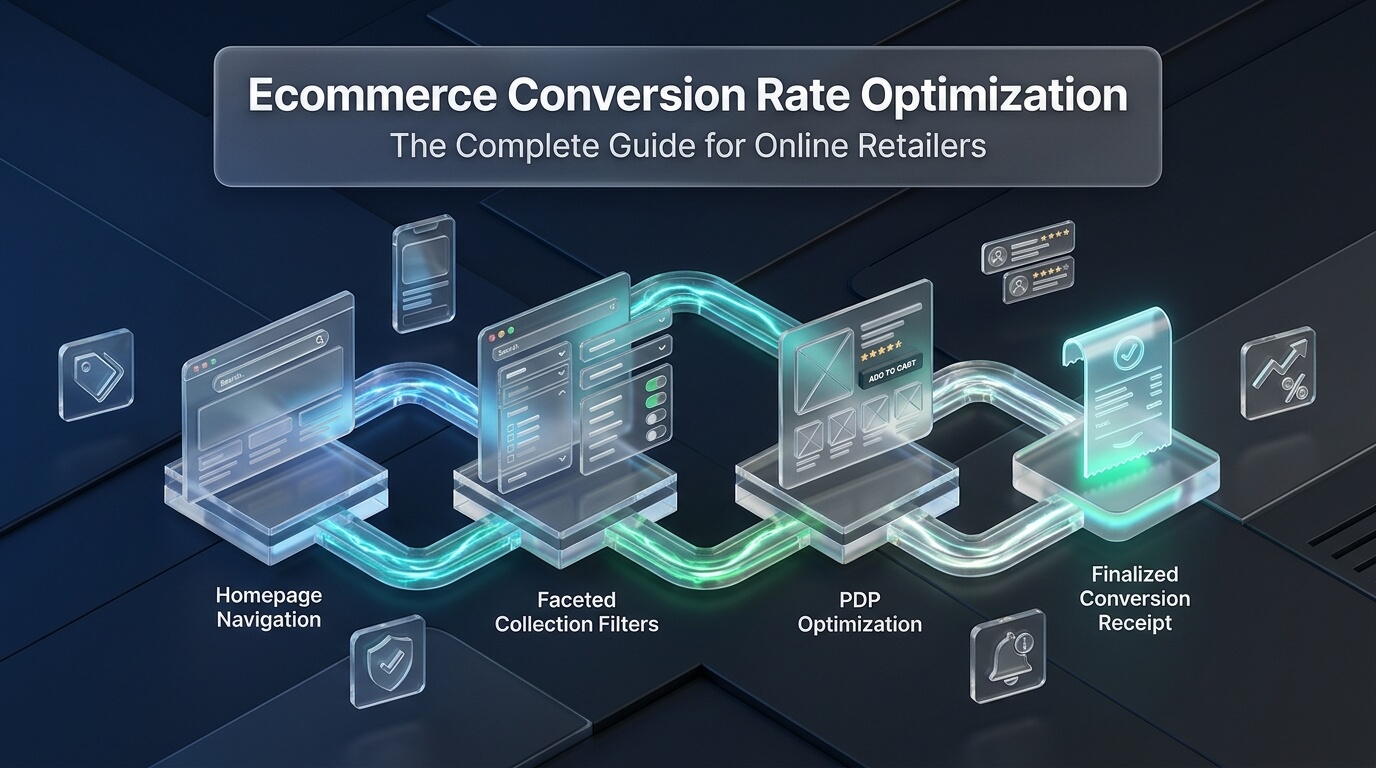
An online retail storefront functions as an interconnected commercial pipeline. Friction at any single stage prevents shoppers from advancing toward final transaction completion. Diagnosing funnel bottlenecks requires evaluating performance across collection catalogs, product detail templates, and shopping carts.
When analyzing conversion rate optimization ecom brands, UX researchers frequently identify severe drop-offs on category collection pages. Overwhelming shoppers with disorganized product grids or confusing faceted search filters causes immediate bounce spikes. Simplifying collection layouts allows visitors to locate desired merchandise effortlessly.
In addition, deploying targeted ecommerce conversion rate optimization tips across product detail pages ensures that high-intent shoppers receive immediate clarity. Highlighting stock availability, transparent sizing charts, and verified customer reviews disarms natural buyer skepticism. Clear product presentation accelerates purchase decisions.
Ecommerce CRO Pro Tip:
Never hide estimated delivery dates or shipping thresholds until the final payment step. Displaying clear delivery estimates and transparent return policies directly beneath the product add-to-cart button eliminates unexpected surprises and slashes checkout abandonment.
Streamlining Collection Pages and Faceted Search
Shoppers navigating large retail catalogs rely heavily on collection filters to narrow options. Clunky dropdown menus and slow-loading filter resets frustrate mobile visitors. Implement sticky filter bars with visual chips that allow shoppers to refine products by size, color, and price instantly.
Incorporate visual collection pills at the top of category pages to guide shoppers into popular subcategories. Enable a clean “Load More” button or infinite scroll rather than multi-page pagination. Fast, intuitive collection browsing accelerates the path toward product selection.
Product Detail Page (PDP) Architecture and Visual Clarity
The product detail page represents the critical decision hub of your entire storefront. Replace traditional text dropdowns with clickable visual color swatches and sizing buttons. Ensure that selecting variant swatches dynamically updates pricing and gallery photography without screen flickering.
Deploy a persistent sticky add-to-cart bar pinned to the bottom of mobile viewports as shoppers scroll through reviews. Organize technical specifications, material origins, and shipping policies within clean collapsible accordions. Structured accordions keep pages scannable while providing thorough answers for hesitant shoppers.
Interactive Slide-Out Cart Drawers
Redirecting shoppers to a separate full-page cart creates unnecessary friction and page loading delay. Modern high-converting stores utilize an AJAX slide-out cart drawer that slides smoothly from the screen edge. A slide-out drawer keeps shoppers anchored on the current page while displaying a clear order summary.
Incorporate an interactive progress bar showing how much more the customer must add to qualify for free shipping. Feature one-click add-on accessories, warranties, or gift packaging directly inside the drawer. Subtle in-cart incentives consistently expand average order values by fifteen to twenty percent.
Checkout Architecture: Eliminating the Final Purchase Barriers
Cart abandonment remains the single most frustrating bottleneck facing online retail merchants. Industry benchmark studies indicate that nearly seventy percent of initiated checkouts are abandoned before payment processing. Executing disciplined ecommerce checkout conversion rate optimization and modern ecommerce checkout optimization recovers substantial lost revenue.
The primary driver of modern checkout conversion is the activation of accelerated digital wallets. Offering Apple Pay, Google Pay, Shop Pay, and PayPal allows customers to complete transactions with a single biometric touch. Accelerated checkouts eliminate the friction of manually typing credit card numbers and billing addresses on mobile keyboards.
Additionally, stores must address unexpected shipping costs, which represent the leading cause of abandoned checkouts worldwide. Presenting clear flat-rate shipping tiers or prominent free delivery thresholds eliminates unpleasant surprises on the final payment screen. Transparent pricing protects customer purchase momentum.
Guest Checkout Defaults and Address Autocomplete
Forcing first-time shoppers to register a user account before completing an order causes immediate checkout abandonment. Always make guest checkout the default experience, inviting shoppers to create an account on the order confirmation screen after payment is secured. Minimizing initial barriers protects transaction completion rates.
Enable address autocomplete powered by Google Places API to speed up address entry. Autocomplete reduces typing effort on mobile devices while eliminating costly shipping address typos that cause delivery delays. Fast, accurate address entry ensures smooth transaction completion.
Trust Seals and Security Reassurance at Decision Points
Financial anxiety peaks at the exact moment a shopper enters payment information. Displaying recognizable payment logos like Visa, Mastercard, and PayPal alongside SSL encryption badges disarms hesitation. Positioning security badges directly adjacent to the payment submission button provides essential peace of mind.
Highlight clear customer guarantees, such as thirty-day hassle-free returns and package delivery insurance. Reassuring buyers that their transaction is secure and risk-free eliminates lingering doubts. Trust validation protects conversions at the critical moment of financial commitment.
Real-World Case Studies and Validated Strategies
Studying documented ecommerce conversion rate optimization case studies provides invaluable tactical guidance. Analyzing how other digital retail brands resolved operational bottlenecks helps you formulate stronger testing hypotheses. Examining empirical results separates proven commercial strategies from theoretical design conjecture.
Deploying established ecommerce conversion rate optimization strategies and proven ecommerce conversion optimization strategies shortens testing cycles. Below are two concrete operational case studies demonstrating how structured experimentation produces dramatic commercial returns.
Case Study 1: Apparel Retailer Slashes Mobile Checkout Drop-Off
A fast-growing direct-to-consumer apparel brand noticed that while mobile traffic represented 74% of site visits, mobile visitors converted at only 1.1%, compared to 3.2% on desktop. A user session recording audit revealed that shoppers struggled with tiny sizing charts and encountered severe checkout lag when entering credit card details.
The optimization team implemented an interactive size recommendation calculator, introduced a persistent mobile sticky add-to-cart bar, and activated one-click Shop Pay checkout. Within eight weeks, mobile conversion rates jumped from 1.1% to 2.4%, generating an incremental $340,000 in monthly revenue.
Case Study 2: Home Goods Store Boosts Average Order Value
A specialty furniture and home decor retailer suffered from high cart abandonment on their traditional full-page cart. Shoppers frequently abandoned orders after discovering that shipping costs were calculated only on the final checkout screen. The site also failed to present complementary accessories during the buying journey.
The team replaced the cart page with an AJAX slide-out cart drawer featuring a tiered free shipping progress bar. They also introduced one-click cross-sell recommendations for matching cushions and protective covers. The revisions lifted overall site conversion rates by 18% and increased average order value by $24 per transaction.
Ecommerce Optimization in 2027: Emerging Technology Trends
As the digital commerce landscape advances, staying ahead of technological innovation is vital. Developing strategies for ecommerce conversion rate optimization 2027 and mastering conversion rate optimization ecommerce 2027 requires embracing new data architectures. Emerging artificial intelligence and server-side testing frameworks are redefining retail experimentation.
Modern retail platforms are transitioning away from clunky client-side visual testing scripts toward edge-based server-side experimentation. Server-side testing executes experimental variations directly on content delivery networks before the page HTML reaches the browser. Eliminating client-side script overhead prevents visual layout shifts and accelerates page load times.
In addition, machine learning algorithms now enable real-time dynamic merchandising and 1:1 personalization. Stores can dynamically rearrange collection catalog grids, modify hero promotions, and adjust pricing tiers based on individual customer browsing history and predictive purchase intent. Personalization transforms static retail stores into adaptive commercial environments.
Privacy-First Measurement and First-Party Data
With third-party browser cookies largely deprecated, tracking customer behavior requires robust first-party data collection. Retailers must invest in server-side tracking containers and direct API integrations with analytics platforms. Accurate data governance ensures reliable conversion attribution.
Deploying interactive zero-party data capture tools like sizing quizzes and preference surveys allows brands to collect customer data ethically. Shoppers willingly share preferences in exchange for tailored product recommendations. Zero-party data powers highly effective on-site personalization and automated lifecycle marketing.
Top 7 Ecommerce Conversion Rate Optimization Software Platforms
Executing continuous experimentation across an online retail storefront requires enterprise-grade software infrastructure. Leading platforms allow merchandising teams to deploy tests, personalize catalog content, and analyze customer behavior without heavy engineering dependencies. Below are detailed evaluations of the top seven ecommerce CRO platforms available today.
1. Dynamic Yield
Dynamic Yield, a Mastercard company, is an industry-leading enterprise personalization and experience optimization engine. Built specifically for high-traffic ecommerce retailers, the platform combines machine learning algorithms with robust split testing tools. Retailers can deliver individualized product recommendations, dynamic promotional banners, and personalized search navigation in real time.
Their algorithmic recommendation engine analyzes customer browsing behavior, past purchase history, and real-time contextual data to predict consumer intent. Merchandisers can deploy multi-armed bandit testing to allocate traffic automatically to top-performing promotional variations. Dynamic Yield supports both web and mobile app personalization.
With deep omnichannel data integration, Dynamic Yield allows retailers to unify in-store, digital, and mobile customer profiles. The software represents a premier choice for global retail enterprises seeking sophisticated predictive personalization at massive scale.
2. Optimizely
Optimizely has long served as the dominant digital experimentation suite for Fortune 500 commerce brands. The platform delivers unmatched statistical rigor through its proprietary Stats Engine, which protects teams from premature test conclusions and false-positive errors. Optimizely supports both client-side visual testing and enterprise server-side experimentation.
Their Feature Experimentation suite allows engineering teams to deploy tests via server-side SDKs and feature flags. This decoupled architecture allows retailers to test complex checkout flows, algorithmic search sorting, and dynamic pricing models with zero impact on page load speed. Fast rendering protects critical retail revenue.
Optimizely provides advanced role-based permissions, comprehensive audit logging, and enterprise security compliance. For high-volume online retailers requiring rock-solid stability and deep technical experimentation capabilities, Optimizely remains the industry benchmark.
3. VWO
VWO is an internationally recognized experimentation and user research suite trusted by thousands of ecommerce brands worldwide. Rather than functioning solely as a split testing tool, VWO provides an integrated environment to research, test, and personalize digital customer journeys. The platform pairs visual testing editors with deep behavioral analytics.
With VWO Insights, merchandisers can record visitor browsing sessions, generate interactive heatmaps, and deploy on-site customer feedback surveys. Diagnosing visual friction bottlenecks directly informs high-impact testing hypotheses. VWO Testing then allows teams to execute complex A/B, split URL, and multivariate tests across catalog pages.
VWO’s asynchronous smart code prevents annoying page flickering while preserving rapid page loading speeds. For growing retail brands seeking an accessible, all-in-one suite of research and testing tools, VWO delivers exceptional commercial value.
4. AB Tasty
AB Tasty is an AI-powered experience optimization and feature management platform designed for modern digital commerce teams. The software combines client-side experimentation, server-side testing, and intelligent product recommendations into an intuitive unified interface. Retailers can deploy personalized promotions and split tests with minimal technical overhead.
Their predictive behavioral segmentation algorithms automatically group visitors based on engagement levels and purchasing likelihood. Marketers can trigger tailored urgency notifications, promotional countdowns, or personalized cross-sells to high-intent shoppers. AB Tasty also includes advanced multi-armed bandit algorithms to maximize campaign yield.
The platform features robust server-side feature flagging capabilities via Flagship, enabling safe canary releases and backend testing. AB Tasty represents an agile, highly effective optimization solution for mid-market and enterprise online retailers.
5. Nosto
Nosto is an AI-powered commerce experience platform built specifically to personalize every touchpoint across the online shopping journey. The platform analyzes millions of individual customer data points to deliver individualized merchandising, product recommendations, and visual content. Nosto integrates smoothly with major commerce platforms like Shopify Plus, Magento, and BigCommerce.
Their dynamic search and category merchandising tools allow store operators to optimize catalog sorting based on real-time inventory levels, margins, and conversion rates. Merchandisers can automate product ranking rules to prioritize trending items and suppress low-stock merchandise. Nosto also incorporates visual user-generated content curation.
With intuitive A/B testing for recommendation algorithms and merchandising strategies, Nosto empowers marketing teams to measure revenue impact precisely. It is an exceptional solution for apparel, beauty, and lifestyle retail brands seeking sophisticated automated merchandising.
6. Convert Experiences
Convert Experiences is an enterprise-grade experimentation platform renowned for its exceptional privacy compliance, technical flexibility, and developer-friendly architecture. Engineered specifically to comply with GDPR, CCPA, and modern privacy regulations, Convert does not store personal customer data. It provides an ethical, highly dependable testing environment for data-conscious brands.
The platform features an advanced visual code editor supporting custom JavaScript and CSS, alongside a robust full-stack API for server-side testing. Convert integrates smoothly with Google Analytics 4, heatmapping tools, and leading customer data platforms. Its ultra-fast script execution ensures tests run with zero noticeable page flickering.
Convert is widely utilized by elite CRO agencies and technical growth teams who demand clean code output and responsive customer support. Its transparent pricing structure and enterprise capabilities make it a formidable alternative to legacy testing platforms.
7. Intelligems
Intelligems is a specialized profit and revenue optimization platform built specifically for direct-to-consumer ecommerce merchants. While most CRO tools focus on visual layout changes, Intelligems focuses on optimizing the economic levers that dictate store profitability: pricing, shipping thresholds, and product bundling. The software connects directly to Shopify’s backend infrastructure.
Merchants can run split tests on product pricing to identify optimal price elasticity without confusing shoppers. Intelligems also enables rigorous A/B testing on shipping thresholds, such as testing a $50 free shipping limit against a $75 limit. The platform calculates net margin impact, taking shipping costs and product margins into account.
Their bundle testing tools allow brands to test different tiering structures and promotional discounts to maximize gross profit. For direct-to-consumer store owners seeking to maximize bottom-line profitability rather than just top-line conversion percentages, Intelligems is an essential optimization tool.
Comprehensive Comparison of Ecommerce CRO Software
To assist you in selecting the ideal technology stack for your digital storefront, the table below summarizes the key attributes of leading ecommerce optimization platforms. Review core functionalities, testing strengths, personalization capabilities, and target retail tiers to determine your ideal solution.
| Platform | Primary Focus | Testing Strengths | Personalization Engine | Target Retail Tier |
|---|---|---|---|---|
| Dynamic Yield | Omnichannel predictive personalization | Multi-armed bandit & split testing | Deep machine learning algorithms | Enterprise retail |
| Optimizely | Enterprise digital experimentation | Stats Engine & server SDKs | Real-time behavioral triggers | Enterprise & Fortune 500 |
| VWO | Full-funnel research & testing | Bayesian testing & heatmaps | Audience segment targeting | Mid-market to enterprise |
| AB Tasty | AI optimization & feature flags | Client & server-side testing | Predictive intent modeling | Mid-market to enterprise |
| Nosto | Commerce experience & merchandising | Catalog sorting & algorithm tests | Automated dynamic product grids | Growing DTC to enterprise |
| Convert | Privacy-first A/B experimentation | Code-level split & full-stack API | Data-compliant audience rules | Agencies & tech-led retail |
| Intelligems | Price, shipping & profit testing | Price elasticity & margin analysis | Dynamic shipping threshold tests | Direct-to-consumer brands |
The Professional Service Ecosystem: Agencies, Services, and Retainers
As store revenue scales past $100,000 monthly, managing experimentation in-house often strains internal marketing resources. Building an effective experimentation program requires multidisciplinary expertise spanning data analysis, UX design, conversion copywriting, and front-end development. Online retail operators frequently partner with professional external specialists to accelerate testing momentum.
Partnering with a recognized ecommerce conversion rate optimization agency or an established ecommerce conversion rate optimization company provides immediate access to seasoned experts. Reputable agencies conduct comprehensive qualitative audits, formulate rigorous hypotheses, and manage weekly test deployments. Their outside perspective helps uncover blind spots that internal teams overlook.
When evaluating comprehensive ecommerce conversion rate optimization services, review the agency’s testing philosophy and past case studies. A high-performing partner never promises overnight vanity wins or relies on generic template checklists. They ground their roadmaps in statistical discipline, client customer research, and verifiable incremental revenue growth.
For emerging store owners, exploring ecommerce conversion rate optimization for small businesses provides practical foundational guidance. Smaller retailers benefit from focused technical audits that resolve mobile navigation lag, activate digital wallets, and simplify product pages. Solid foundational improvements establish an ideal launchpad before investing in ongoing agency retainers.
Best Practices and Practical Implementation
Achieving sustained conversion gains requires embedding disciplined operational habits into your daily marketing routine. Following established ecommerce conversion rate optimization best practices protects your store from costly experimentation mistakes. Applying verified standards ensures that every testing variation delivers reliable commercial insights.
Begin by running experiments for full weekly business cycles to account for day-of-week purchasing fluctuations. Testing across two to four weeks ensures that weekend shopping behavior is properly represented in your data. Never terminate an experiment prematurely based on short-term dashboard spikes.
Ensure that all testing variations are thoroughly tested across diverse mobile devices, browser versions, and screen resolutions prior to launch. Front-end bugs skew test data and frustrate genuine shoppers. Methodological rigor guarantees stakeholder confidence in your experimentation outcomes.
The Ultimate Ecommerce CRO Checklist
Before launching your next major retail marketing campaign, evaluate your store against this comprehensive ecommerce conversion rate optimization checklist:
- Mobile Speed: Does your mobile storefront load in under 2.5 seconds on mobile 4G networks with zero layout shift?
- Digital Wallets: Are accelerated one-click payment options (Apple Pay, Google Pay, Shop Pay, PayPal) enabled and prominent?
- Persistent Mobile CTA: Does a sticky add-to-cart bar stay anchored to the bottom screen on mobile product detail pages?
- Delivery Transparency: Are estimated delivery dates and transparent shipping costs displayed above the fold on PDPs?
- Variant Swatches: Do clickable visual color swatches and sizing pills update imagery and pricing dynamically?
- Slide-Out Drawer: Is the traditional full-page cart replaced with an interactive AJAX drawer featuring a free shipping progress bar?
- Guest Checkout: Is guest checkout configured as the default checkout path without requiring account registration?
- Search Usability: Does site search provide predictive autocomplete and handle common product spelling typos accurately?
- Authentic Reviews: Are customer photo reviews and verified rating stars filterable directly beneath product descriptions?
- Address Autocomplete: Is Google Places API address autocomplete active to prevent mobile shipping entry errors?
Frequently Asked Questions
What is a good conversion rate for an ecommerce store?
Average conversion rates across global ecommerce typically hover between 1.5% and 3.0%. High-performing retail brands optimized for mobile usability, strong social proof, and streamlined checkouts regularly achieve conversion rates between 3.5% and 5.0%. Benchmark targets depend heavily on product price point, niche category, and traffic source intent.
Why do mobile shoppers convert at lower rates than desktop shoppers?
Mobile shoppers face smaller screen viewports, slower mobile network connections, and clumsy touch keyboards. Complex navigation menus and tedious checkout forms amplify user friction on smartphones. Implementing thumb-friendly sticky buttons, fast-loading images, and one-click accelerated digital wallets bridges this mobile conversion gap.
How does free shipping impact online checkout conversions?
Unexpected shipping costs represent the number one reason online shoppers abandon digital shopping carts. Offering transparent free shipping thresholds and displaying interactive progress bars inside cart drawers reassures buyers. Motivating shoppers to add items to their cart to reach the qualification limit lifts both conversions and average order value.
What is the difference between client-side and server-side testing?
Client-side testing executes experimental modifications in the visitor’s browser using JavaScript, which can occasionally cause visible page flickering. Server-side testing executes variations directly on the web server or edge CDN before HTML renders, ensuring instantaneous load times and zero layout shifts. Server-side testing is ideal for complex backend logic and checkout flows.
How long should an ecommerce A/B test run?
An A/B test should run until you achieve statistical significance, typically a 95% confidence level, while covering at least two full weekly business cycles. Running tests for two to four weeks accounts for day-of-week purchasing fluctuations and cyclical traffic patterns. Never end an experiment prematurely based on short-term early trends.
Should I force shoppers to create an account at checkout?
No, requiring account creation before purchase introduces severe checkout friction and increases cart abandonment rates. Always make frictionless guest checkout the default option. Invite shoppers to save their details and create an account on the order confirmation thank-you page after payment is completed.
What role does social proof play in ecommerce conversion optimization?
Social proof provides vital psychological validation that reduces buyer anxiety. Displaying authentic customer photo and video reviews, user star ratings, and recognized press logos builds immediate trust. Highlighting real-world customer satisfaction disarms skepticism and encourages first-time buyers to complete purchases.
How can small online stores start optimizing with a limited budget?
Small retailers can achieve rapid conversion gains by auditing their store against basic usability principles. Activate one-click digital wallets, streamline mobile product descriptions, remove redundant third-party apps, and deploy free heatmapping tools like Microsoft Clarity. Fixing obvious friction points produces substantial gains before paying for enterprise testing software.
How do slide-out cart drawers improve store performance?
Slide-out cart drawers keep shoppers anchored on the current product page while showing an immediate visual summary of their selected merchandise. Incorporating tiered free shipping progress bars and one-click add-on recommendations inside the drawer increases average order values while speeding up progression to checkout.
What is the impact of page loading speed on ecommerce sales?
Page loading latency directly harms conversion rates. Research indicates that every additional second of mobile loading latency reduces conversions by approximately seven percent. Compressing images into next-generation WebP formats, minifying scripts, and utilizing global CDNs ensures rapid mobile rendering and protects sales.
When should an ecommerce brand hire a dedicated CRO agency?
Brands generating over $100,000 in monthly online revenue usually possess sufficient traffic to support continuous statistical experimentation. At this scale, partnering with a specialized agency provides dedicated teams of researchers, designers, copywriters, and developers who can accelerate testing velocity and maximize return on ad spend.
How often should an ecommerce store conduct CRO audits?
Online retailers should conduct comprehensive technical and usability audits on a quarterly basis. High-traffic stores running continuous paid advertising campaigns should maintain weekly or bi-weekly experimentation cycles to continually test new product page layouts, promotional copy, and checkout incentives.
Conclusion: Build Your Continuous Optimization Engine
Mastering conversion rate optimization transforms your ecommerce storefront from a static product catalog into a high-performance commercial engine. Eliminating friction, clarifying product presentation, and accelerating mobile checkout delivers immediate revenue gains. Scientific experimentation replaces subjective design opinions with undeniable customer behavioral proof.
Begin by auditing your current checkout funnels and mobile loading speeds against the practical criteria in this guide. Identify your largest friction bottlenecks through heatmaps, session recordings, and customer feedback surveys. Formulate disciplined, data-backed hypotheses and deploy tests continuously to scale your online retail business with confidence.