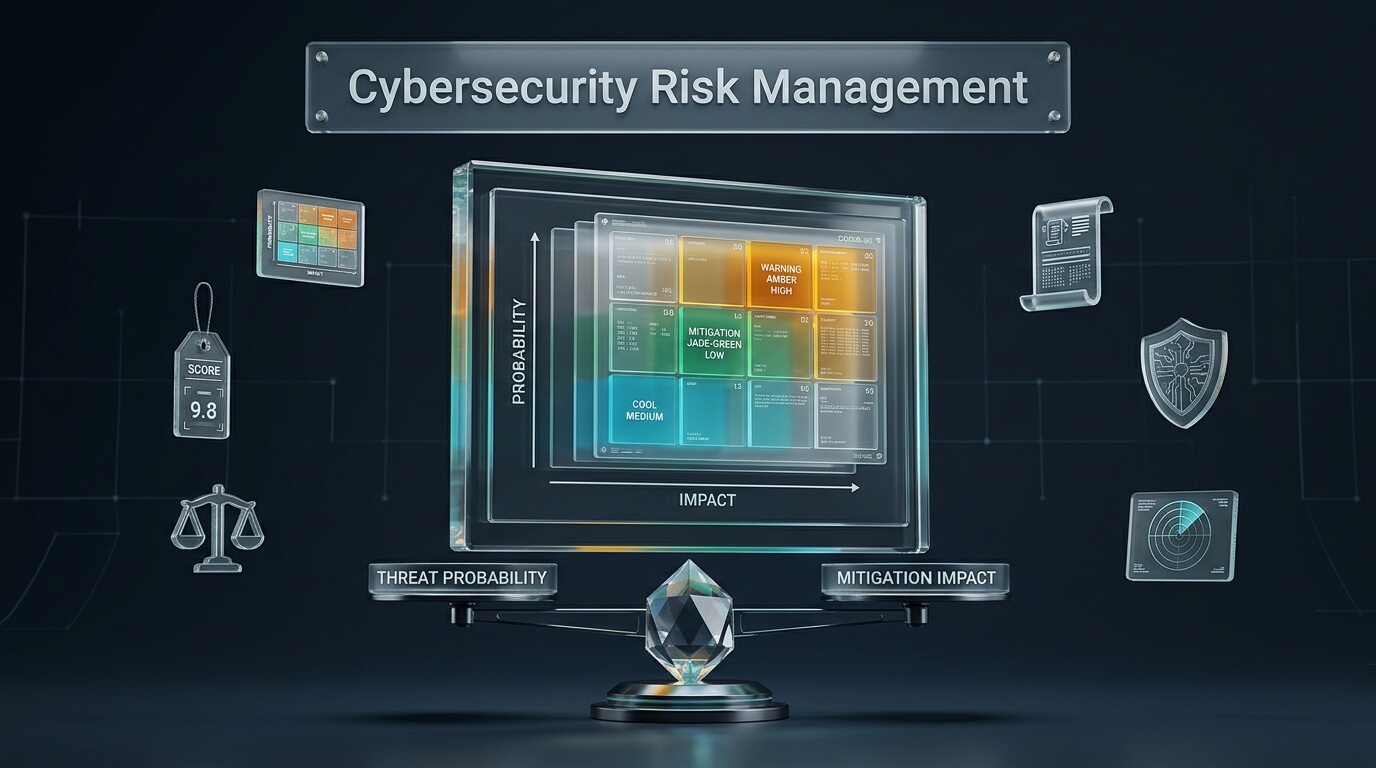
Modern enterprise security is no longer about eliminating every possible digital threat. In our hyper-connected world, achieving absolute mathematical security is impossible. Instead, corporate leadership must focus on continuous, measured prioritization. Implementing structured cybersecurity risk management transforms technical vulnerabilities into clear business decisions that corporate boards can understand and support.
Organizations face expanding attack surfaces across cloud workloads, remote employee endpoints, and third-party vendor connections. Every unpatched server, misconfigured cloud storage bucket, and compromised password represents a tangible cybersecurity risk. Left unmanaged, these exposures can lead to devastating ransomware outages, regulatory penalties, and reputational collapse.
Effectively managing cybersecurity risk requires shifting from reactive firefighting to proactive governance. Security leaders must quantify business exposure in financial terms rather than relying on abstract technical scores. Understanding the fundamental nature of risk in cybersecurity allows executives to allocate security budgets where they deliver the highest defensive return.
Modern corporate governance elevates risk management cybersecurity programs directly into boardrooms. Regulators and investors now demand transparent risk disclosures and verified mitigation controls. Adopting a structured cybersecurity risk management strategy ensures that an enterprise survives severe adversary attacks while sustaining continuous commercial operations.
Key Takeaways: Cybersecurity Risk Management in 2027
- Enterprise risk programs prioritize business operational continuity over chasing zero technical vulnerabilities.
- Quantitative risk modeling translates technical threats into measurable financial exposure for corporate board directors.
- The NIST Risk Management Framework and DoD CSRMC provide proven architectural structures for federal and enterprise systems.
- Automated risk management software replaces static spreadsheets, providing real-time visibility across third-party vendor ecosystems.
Foundations of Cybersecurity Risk Assessment: Qualitative vs. Quantitative
A defensible governance architecture begins with an objective assessment of organizational exposure. Conducting a formal cybersecurity risk assessment establishes a clear baseline of current technical posture and operational vulnerabilities.
1. The Core Assessment Lifecycle
Executing an effective assessment follows a systematic four-step lifecycle:
Step 1: Asset Inventory & Criticality Classification: Identify every server, database, mobile device, and software application across the enterprise. Rank assets based on their operational importance to revenue generation and statutory data protection.
Step 2: Threat Identification & Modeling: Enumerate potential adversaries capable of targeting enterprise systems. Analyze adversary motivations, capabilities, and historical attack patterns.
Step 3: Vulnerability Analysis: Scan assets for known software bugs, configuration errors, and weak administrative controls. Correlate identified weaknesses against active threat exploits.
Step 4: Impact & Likelihood Determination: Calculate the realistic probability of an attack succeeding and estimate the financial, legal, and operational damage.
Many organizations conduct their initial evaluations using a standardized cybersecurity risk assessment template. Adapting established templates ensures that internal teams evaluate assets methodically without overlooking critical operational dependencies.
2. Qualitative vs. Quantitative Risk Modeling
Security teams employ two distinct methodologies when conducting risk assessment cybersecurity reviews:
Qualitative Risk Assessment: Categorizes risks using descriptive ratings such as Low, Medium, High, and Critical. While qualitative methods are fast and intuitive, color-coded heat maps often produce subjective results that fail to persuade financial executives.
Quantitative Risk Assessment: Uses mathematical modeling—such as the Factor Analysis of Information Risk (FAIR) methodology—to calculate risk in specific monetary figures. Quantitative analysis calculates Annual Loss Expectancy (ALE) by multiplying Single Loss Expectancy (SLE) against Annualized Rate of Occurrence (ARO).
The FAIR Quantitative Architecture: The Factor Analysis of Information Risk standard breaks risk into two primary branches: Loss Event Frequency and Loss Magnitude. By running Monte Carlo simulations across thousands of scenarios, risk analysts generate 95 percent confidence intervals for annual monetary loss, providing CFOs with actionable financial forecasts.
Modern organizations deploy specialized cybersecurity risk assessment tools to automate data gathering. These tools ingest vulnerability telemetry, correlate threat feeds, and calculate financial exposure dynamically across hybrid cloud infrastructures.
Leading Frameworks: NIST RMF, ISO 27005 & DoD CSRMC
Rather than designing risk processes from scratch, organizations rely on established standards. Benchmarking against recognized cybersecurity risk management frameworks ensures regulatory defensibility and audit readiness.
1. NIST Risk Management Framework (RMF)
The National Institute of Standards and Technology published NIST SP 800-37 to provide a comprehensive, seven-step lifecycle for federal agencies and private enterprises. The NIST cybersecurity risk framework emphasizes continuous monitoring and near-real-time risk management:
Prepare: Establish organizational context, risk appetite, and assigned leadership roles.
Categorize: Classify systems and data based on potential impact from unauthorized access.
Select: Choose tailored security controls from NIST SP 800-53 baselines.
Implement: Deploy selected security controls across operational systems.
Assess: Test controls independently to verify correct implementation and effectiveness.
Authorize: Executive leadership makes a formal risk determination to authorize system operations.
Monitor: Continuously inspect control effectiveness, assess changes, and update risk scores.
2. ISO/IEC 27005 Standard
The International Organization for Standardization developed ISO/IEC 27005 to support organizations implementing information security management systems under ISO/IEC 27001. ISO 27005 provides systematic guidance for establishing risk context, conducting iterative risk assessments, and executing treatment plans.
3. COSO ERM & Corporate Governance Integration
Enterprise risk management aligns cyber risk with broader financial and operational objectives. Integrating the Committee of Sponsoring Organizations of the Treadway Commission (COSO) ERM framework ensures that cybersecurity risks are presented alongside traditional credit, market, and operational risks to executive boards.
In addition, organizations benchmark tactical defenses against the CIS Critical Security Controls. The 18 prioritized control categories establish practical defensive baselines, mapping technical configurations directly to enterprise risk tiers.
4. Department of Defense CSRMC Governance
Military commands operate under unique high-threat conditions. The cybersecurity risk management construct dod establishes strict cybersecurity criteria across weapons systems, tactical battlefield relays, and command databases.
Known formally as the cybersecurity risk management construct csrmc, this military governance model integrates mission assurance with technical risk management. It ensures that combatant commanders understand the cyber survivability of tactical platforms before deploying troops into contested operational theaters.
Actionable Risk Mitigation Strategies & Vulnerability Management
Once an organization identifies and quantifies its exposures, leadership must take decisive operational action. Developing comprehensive cybersecurity risk management strategies involves selecting the most cost-effective risk treatments.
The Four Classic Risk Treatment Options
Executive leadership addresses identified risks through four distinct paths:
1. Risk Mitigation (Reduction): Implementing technical controls—such as multi-factor authentication, network segmentation, and data encryption—to reduce likelihood or impact.
2. Risk Transfer (Sharing): Transferring financial consequences to third parties through commercial cybersecurity insurance policies or indemnification clauses in vendor contracts.
3. Risk Avoidance: Discontinuing risky business activities, shutting down vulnerable legacy software, or exiting high-risk foreign markets entirely.
4. Risk Acceptance: Acknowledging residual risk when the cost of mitigation exceeds the potential financial loss, supported by formal executive sign-off.
Executing successful cybersecurity risk mitigation requires prioritizing controls that remediate the widest range of vulnerabilities. Security teams focus first on high-likelihood threat paths that provide adversaries with easy lateral movement.
Integrating Vulnerability Management with Risk Governance
Effective risk mitigation relies heavily on robust vulnerability management cybersecurity workflows. Traditional vulnerability management treated patching as an unmanageable checklist, overwhelming IT teams with thousands of minor software bugs.
Modern risk-based vulnerability management correlates discovered weaknesses with real-world exploit activity. By utilizing the Common Vulnerability Scoring System (CVSS) alongside the Exploit Prediction Scoring System (EPSS), security engineers prioritize patching vulnerabilities that adversaries are actively weaponizing.
Supply Chain Risk Tiering & Vendor Management
Modern enterprises rely on hundreds of third-party software tools, cloud services, and outsourced contractors. However, not all external partners represent equal exposure. Mature risk programs categorize vendors into three distinct operational tiers based on data sensitivity and network access.
Tier-1 vendors with direct production database access undergo comprehensive annual technical audits and continuous monitoring. Tier-2 vendors handling internal business data submit independent SOC 2 Type 2 attestations. Tier-3 marketing vendors with zero confidential data access complete streamlined self-assessments. This structured tiering focuses defensive resources where third-party risk is most severe.
Pro-Tip: Transform Static Annual Registers into Continuous Telemetry
Never treat risk registers as static annual compliance documents. An annual audit represents only a fleeting snapshot in time. Connect your risk registers directly to automated vulnerability scanners, cloud configuration monitors, and threat intelligence feeds to maintain dynamic, real-time risk scores throughout the entire calendar year.
The Enterprise Toolkit: Software, Assessment Services & Analyst Roles
Executing modern risk governance requires combining powerful software platforms, specialized external expertise, and skilled in-house practitioners.
Automating Governance with Specialized Software
Tracking compliance and risk through manual spreadsheets is slow and error-prone. Modern enterprises deploy dedicated cybersecurity risk management software to centralize risk registers, automate evidence collection, and manage vendor assessments.
These platforms provide intuitive dashboards that track residual risk against defined corporate risk appetites. Automated workflows alert system owners when controls lapse or when newly discovered vulnerabilities exceed acceptable risk thresholds.
Engaging Third-Party Assessment Services
Many organizations lack the specialized staff required to conduct comprehensive technical evaluations. Engaging independent cybersecurity risk assessment services provides objective third-party audits that satisfy board oversight requirements and regulatory mandates.
Retaining a qualified cybersecurity risk assessment service helps organizations identify blind spots, evaluate supply chain risks, and prepare for formal SOC 2 or ISO 27001 certifications. External consultants provide valuable benchmark data comparing an organization’s security maturity against peer enterprises.
The Role of the Cybersecurity Risk Analyst
Demand for qualified risk professionals has grown rapidly. A dedicated cybersecurity risk analyst bridges the gap between technical engineering teams and corporate risk committees. Key responsibilities include:
Facilitating Threat Modeling Workshops: Assisting application developers in identifying security flaws during early software design phases.
Maintaining Enterprise Risk Registers: Documenting identified vulnerabilities, tracking remediation progress, and updating residual risk scores.
Evaluating Third-Party Vendor Risk: Reviewing security questionnaires and independent audit reports from external software vendors.
Risk analysts typically hold credentials such as Certified Information Systems Auditor (CISA) or Certified in Risk and Information Systems Control (CRISC), earning average annual salaries ranging from $95,000 to over $140,000.
In-Depth Reviews: Top 8 Cybersecurity Risk Management Platforms
Managing enterprise risk requires robust software capable of scaling across multi-cloud environments and complex supply chains. The following eight commercial solutions lead the global market in risk governance.
1. ServiceNow Risk Management
ServiceNow Risk Management transforms manual governance processes into automated digital workflows on the Now Platform. ServiceNow unifies enterprise risk, compliance, vendor risk, and business continuity into a centralized data architecture.
The platform correlates IT asset configurations directly with enterprise business services. When a vulnerability is identified on a database server, ServiceNow immediately calculates the operational impact on customer-facing banking or retail services.
ServiceNow is an exceptional choice for large global enterprises already utilizing ServiceNow for IT service management. Its automated workflow routing ensures remediation tasks are assigned directly to responsible engineering teams.
2. AuditBoard
AuditBoard is an integrated governance, risk, and compliance platform engineered for internal audit, SOX compliance, and enterprise risk management teams. It provides a centralized hub connecting risk assessments with compliance workflows.
Its specialized CrossComply module allows security teams to map internal controls across multiple compliance frameworks simultaneously, including NIST, ISO, and SOC standards. This structure eliminates duplicate audit efforts across separate regulatory domains.
AuditBoard features robust workflow collaboration tools, automated issue tracking, and executive reporting dashboards. Fortune 500 enterprises deploy AuditBoard to streamline internal audit operations and satisfy strict corporate governance requirements.
3. LogicGate Risk Cloud
LogicGate Risk Cloud is an agile, no-code governance, risk, and compliance platform designed to transform how organizations manage regulatory obligations. Its visual workflow builder allows teams to customize compliance processes without custom coding.
The platform features pre-built applications for regulatory tracking, third-party risk management, policy management, and internal audit controls. LogicGate correlates compliance evidence directly with enterprise risk registers, providing holistic visibility.
LogicGate is an exceptional choice for organizations with unique, complex regulatory requirements that outgrow rigid out-of-the-box compliance software. Its drag-and-drop customization allows compliance teams to adapt quickly to shifting legal standards.
4. Archer
Archer is a pioneer in enterprise integrated risk management, serving regulated financial institutions, healthcare networks, and government agencies worldwide. Archer provides specialized modules for operational risk, IT security risk, and third-party vendor governance.
The platform excels at aggregating massive volumes of telemetry into comprehensive risk registers. Archer allows organizations to model complex corporate hierarchies, assigning risk ownership across regional operating subsidiaries.
Archer is engineered for large enterprises with mature risk programs requiring deep customization and auditable controls. Its robust reporting engines generate executive-ready presentations for board oversight committees.
5. MetricStream
MetricStream is an industry-leading governance, risk, and compliance platform powered by artificial intelligence. MetricStream provides specialized suites for enterprise risk, cyber risk, vendor risk, and statutory compliance.
Its specialized CyberGRC software quantifies cyber risk in financial terms, enabling security leaders to calculate economic exposure accurately. The platform integrates threat intelligence feeds to predict emerging threat vectors before they impact operations.
MetricStream is widely deployed across global banking and energy conglomerates. Its automated compliance testing capabilities reduce manual audit preparation by up to 50 percent.
6. OneTrust
OneTrust is a market-leading enterprise platform for privacy, security, and third-party data governance. OneTrust helps organizations manage regulatory obligations, including GDPR, CCPA, and global privacy mandates.
The platform excels at automated vendor risk assessments, data mapping, and privacy impact evaluations. OneTrust integrates privacy workflows directly into business operations, ensuring defensible compliance across corporate databases.
OneTrust features a vast database of pre-completed vendor security questionnaires, accelerating third-party onboarding. Large enterprises deploy OneTrust to automate complex supply chain risk reviews.
7. UpGuard
UpGuard provides continuous third-party risk management and external attack surface monitoring. UpGuard combines non-intrusive external security ratings with automated security questionnaires to evaluate vendor risk.
The platform monitors the public internet for exposed data leaks, misconfigured cloud storage repositories, and leaked employee credentials. UpGuard generates transparent, letter-grade security scores for vendors, alerting teams when a partner’s security posture deteriorates.
UpGuard is praised for its fast deployment timelines and clean user interface. Fast-growing technology companies deploy UpGuard to secure their digital supply chains effortlessly.
8. SecurityScorecard
SecurityScorecard is a global leader in cybersecurity ratings, evaluating millions of organizations daily across ten distinct risk categories. SecurityScorecard provides outside-in visibility into an organization’s external security posture.
The platform grades organizations from A to F across domains including network security, DNS health, patching cadence, and endpoint security. Companies with an F grade are nearly eight times more likely to suffer a breach than those with an A grade.
SecurityScorecard enables organizations to benchmark their security posture against industry competitors and monitor vendor risks continuously. Its instant security ratings simplify cyber insurance underwriting and executive risk reporting.
Cybersecurity Risk Management Platforms Comparison Matrix
Selecting an appropriate risk platform depends on organization size, industry regulations, and technical maturity. The matrix below highlights key attributes among top solutions.
| Platform | Primary Specialty | Risk Quantification Capabilities | Supported Frameworks | Target Customer |
|---|---|---|---|---|
| ServiceNow Risk | Enterprise IT workflow & GRC | Automated business service impact mapping | NIST CSF, ISO 27001, SOX | Enterprises using ServiceNow |
| AuditBoard | Integrated internal audit & GRC | Cross-framework control mapping | SOX, NIST, ISO, SOC 2 | Public companies & audit teams |
| LogicGate Risk Cloud | No-code agile risk workflows | Dynamic scoring matrices & risk registers | NIST CSF, HIPAA, custom models | Mid-market to large enterprises |
| Archer | Enterprise integrated risk management | Hierarchical enterprise risk modeling | COSO, NIST RMF, ISO 27005 | Financial institutions & government |
| MetricStream | AI-powered CyberGRC & compliance | Monetary financial risk quantification | FAIR, NIST, ISO 27001 | Global multinationals & banks |
| OneTrust | Privacy, security & vendor risk | Third-party risk scoring & assessment | GDPR, CCPA, ISO 27701 | Regulated enterprise environments |
| UpGuard | Attack surface & vendor monitoring | Automated external security ratings | SOC 2, ISO 27001, vendor SIG | Fast-growing tech firms & SaaS |
| SecurityScorecard | Continuous cybersecurity ratings | A-to-F objective risk benchmarking | NIST CSF, PCI-DSS, custom scales | Insurers, boards & vendor managers |
Step-by-Step Implementation: 10-Step Enterprise Risk Blueprint
Constructing a durable risk management program requires disciplined execution. Security leaders follow this actionable roadmap to establish an audit-ready risk governance framework.
Checklist: 10-Step Enterprise Risk Management Blueprint
- Define Corporate Risk Appetite: Collaborate with executive leadership and the board to document acceptable thresholds for operational and financial risk.
- Catalogue All Digital Assets: Maintain a centralized configuration management database (CMDB) identifying hardware, software, and cloud repositories.
- Adopt a Recognized Framework: Select an established baseline such as the NIST Cybersecurity Framework or ISO/IEC 27005 to guide internal evaluations.
- Establish a Centralized Risk Register: Create a single repository to document identified risks, asset owners, and approved remediation timelines.
- Deploy Automated Risk Software: Implement platforms like ServiceNow or LogicGate to automate evidence collection and continuous risk scoring.
- Implement Risk-Based Vulnerability Prioritization: Combine CVSS severity scores with exploit probability data to patch critical vulnerabilities first.
- Conduct Third-Party Vendor Risk Reviews: Require all software and cloud vendors to submit security questionnaires and verified SOC 2 reports.
- Transfer Catastrophic Exposure: Purchase comprehensive cyber liability insurance policies to cover extortion demands and forensic investigation costs.
- Establish Formal Risk Exception Workflows: Require executive business unit owners to formally sign off when accepting residual risks that exceed baselines.
- Deliver Quarterly Board Risk Reports: Present risk metrics in clear financial terms, showing how security investments reduce operational exposure.
Executive Governance: The Board Risk Reporting Protocol
When presenting cybersecurity risk to corporate board directors, technical jargon confuses leadership. Risk leaders follow a structured four-phase reporting protocol:
Phase 1: Financial Exposure Summary: Open presentations with estimated financial risk ranges calculated through quantitative modeling. Focus on potential revenue interruption and shareholder impact.
Phase 2: Strategic Threat Landscape Review: Highlight active adversary campaigns targeting your specific industry peers. Provide context on emerging regulatory disclosure mandates.
Phase 3: Remediation Program Progress: Review the status of critical remediation initiatives funded in prior quarters. Show clear metrics demonstrating reduced attack surface exposure.
Phase 4: Resource Allocation & Decision Requests: Present prioritized resource requests tied directly to specific risk mitigation outcomes, enabling directors to make informed fiduciary decisions.
Third-Party Risk Evaluation: A 5-Stage Vendor Lifecycle
Because the majority of catastrophic enterprise security incidents originate across external supplier networks, risk managers follow a disciplined five-stage vendor governance workflow:
Stage 1: Inherent Risk Screening: Evaluate vendor software architecture and classify the partnership based on data volume, network integration, and business dependency.
Stage 2: Standardized Evidence Collection: Gather independent SOC 2 Type 2 audit reports, ISO certifications, and verified responses to Standardized Information Gathering (SIG) questionnaires.
Stage 3: Contractual Risk Allocation: Negotiate binding security service level agreements (SLAs), minimum encryption standards, prompt 24-hour breach notifications, and clear indemnification liability caps.
Stage 4: Continuous Attack Surface Monitoring: Deploy continuous external rating tools to track vendor domain health, leaked employee credentials, and exposed cloud storage buckets in real time.
Stage 5: Secure Offboarding & Revocation: Immediately terminate API keys, revoke federated identity tokens, and secure verified data destruction certificates upon vendor contract termination.
Frequently Asked Questions: Cybersecurity Risk Management
Here are comprehensive answers to the most common questions board directors, security executives, and risk analysts ask regarding risk management.
What is the difference between risk management and compliance?
Compliance means satisfying specific baseline rules or statutory checklists established by external regulatory bodies. Risk management is the continuous internal practice of identifying, analyzing, and mitigating threats specific to your organization’s unique operational environment.
How often should companies conduct a cybersecurity risk assessment?
Organizations should conduct formal, comprehensive risk assessments at least annually. In addition, security teams must perform targeted assessments whenever significant changes occur, such as cloud migrations, acquisitions, or major software releases.
What is the FAIR model in risk management?
Factor Analysis of Information Risk (FAIR) is an international standard quantitative model for understanding and measuring information risk. FAIR defines risk as the probable frequency and probable magnitude of future loss, translating technical vulnerabilities into monetary loss distributions.
What is the Cybersecurity Risk Management Construct (CSRMC) in the DoD?
The CSRMC is the Department of Defense framework for implementing risk management across military weapons systems, tactical communication networks, and defense IT environments. It balances technical compliance with mission assurance.
What is residual risk?
Residual risk is the exposure that remains after an organization implements all planned security controls and countermeasures. Corporate executive leadership must formally review and accept residual risk to establish legal defensibility.
How does cyber insurance fit into risk management?
Cyber insurance represents a risk transfer strategy. It reimburses businesses for financial losses resulting from data breaches, extortion payments, legal defense costs, and business interruption, but it does not replace the requirement for robust internal technical controls.
What are the primary job responsibilities of a cybersecurity risk analyst?
A cybersecurity risk analyst evaluates internal security controls, conducts third-party vendor risk reviews, maintains the corporate risk register, assists in threat modeling, and prepares risk metrics for executive leadership.
What is the difference between CVSS and EPSS?
The Common Vulnerability Scoring System (CVSS) measures the theoretical severity of a vulnerability based on its technical attributes. The Exploit Prediction Scoring System (EPSS) calculates the real-world probability that threat actors will actively exploit that vulnerability within the next 30 days.
What is a risk appetite statement?
A risk appetite statement is a formal document approved by corporate board directors that defines the amount and type of risk an organization is willing to pursue or retain in pursuit of its commercial objectives.
Why is third-party vendor risk management critical?
Most modern enterprise breaches originate through compromised supply chains and software vendors. Organizations must continuously assess the security posture of cloud providers and software vendors who process sensitive corporate records.
What certifications are best for careers in risk management?
Leading credentials for risk management professionals include Certified in Risk and Information Systems Control (CRISC), Certified Information Systems Auditor (CISA), Certified Information Security Manager (CISM), and FAIR Certification.
Final Verdict: Building an Agile Risk-Aware Enterprise
The pace of technological change requires organizations to embrace calculated risk to compete and innovate. Attempting to lock down every system completely stifles business growth, while ignoring digital threats invites catastrophe.
Successful enterprises cultivate an agile, risk-aware culture. By adopting standardized frameworks like the NIST RMF, automating asset discovery with modern GRC software, and translating vulnerabilities into financial metrics, security leaders become trusted business enablers. In our interconnected global economy, mastering cybersecurity risk management is the ultimate foundation for enduring corporate resilience.