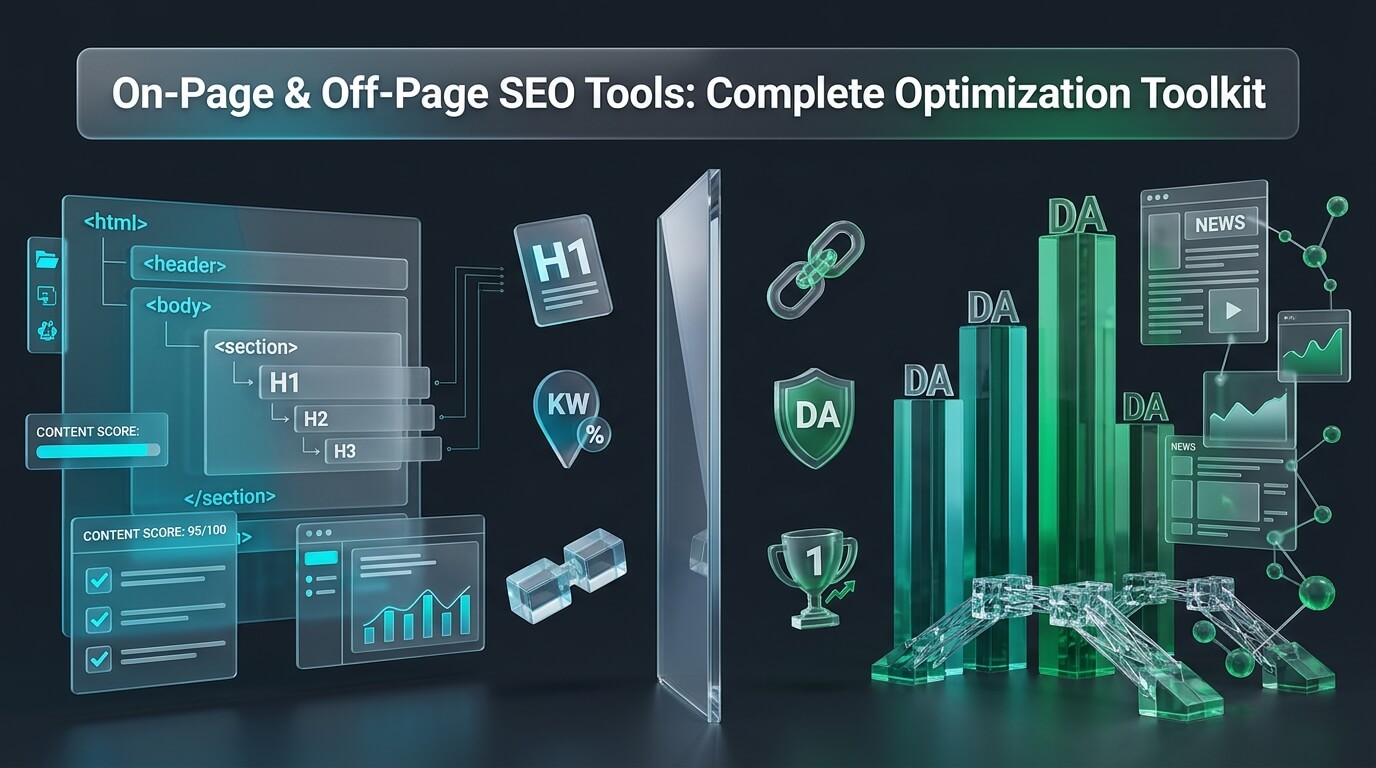
Achieving top positions in modern search results requires mastering two complementary disciplines. First, your website must feature impeccable technical structure, relevant topics, and helpful content. Second, your domain must build external trust, topical authority, and industry validation through reputable third-party endorsements. In the search marketing industry, these twin pillars are known as on-page and off-page optimization.
Managing both dimensions manually across dozens or hundreds of web pages is impractical. Content teams need real-time recommendations on keyword density and headings. Technical leads need alerts on broken links and canonical tags. Outreach specialists need reliable data on backlink opportunities and journalist contacts. That is why high-performing marketing teams invest in dedicated on page seo tools alongside specialized off page seo tools.
When combined thoughtfully, these site seo tools create a complete feedback loop. On-page software ensures your content satisfies user intent and search engine crawler requirements. Off-page platforms verify that your content earns the digital citations necessary to outrank aggressive competitors. In this guide, we break down the best software platforms, compare their capabilities, and show you how to build a unified optimization stack.
Key Takeaways for Total Search Optimization
- On-page tools analyze content structure, keyword semantics, meta tags, and internal link architecture.
- Off-page platforms track backlink profiles, unlinked brand citations, competitor link gaps, and outreach performance.
- The best on page seo tools provide live content grading against top-ranking competitors in search engine result pages.
- Using on-site seo tools to fix crawl errors and broken links creates a solid foundation before launching external outreach.
- While several on page seo tools free tiers handle basic checks, enterprise campaigns require paid suites with comprehensive SERP databases.
- Balancing on-site technical perfection with authoritative off-site seo tools delivers consistent, compounding organic search traffic.
Understanding the Two Pillars: On-Page vs. Off-Page SEO
Search algorithms evaluate hundreds of ranking signals to determine which URL deserves the top spot for a query. While these signals are constantly refined, they broadly divide into factors located directly on your website and signals generated across the wider web.
Understanding this distinction helps marketing teams allocate budget, time, and software resources effectively.
What Defines On-Page SEO?
On-page optimization refers to any measure taken directly within your website to improve its position in search rankings. You maintain complete direct control over these elements. Core on-page factors include:
- Content Relevance and Depth: Answering search queries thoroughly using natural language, related entities, and clear subheadings.
- Title Tags and Meta Descriptions: Writing compelling, keyword-rich snippets that earn clicks in search results.
- Header Structure: Organizing content logically with sequential H1, H2, and H3 tags.
- Internal Linking Architecture: Connecting related articles with descriptive anchor text to pass authority and help users navigate.
- URL Optimization: Creating short, descriptive, evergreen web addresses that indicate page topic.
- Image Optimization: Compressing image files, implementing modern WebP formats, and providing descriptive alt text.
- Core Web Vitals and Page Speed: Ensuring fast load times, minimal layout shifts, and rapid responsiveness across all devices.
- Structured Data Markup: Adding schema code so search engines understand organization details, articles, FAQs, and product reviews.
What Defines Off-Page SEO?
Off-page optimization encompasses all actions taken outside of your own website to impact rankings within search engine results pages. These signals demonstrate to search engines that your site is trustworthy, popular, and authoritative. Core off-page factors include:
- Editorial Backlinks: Inbound hyperlinks earned naturally from reputable industry publications, blogs, and news platforms.
- Unlinked Brand Mentions: References to your company name, product, or executives across high-authority websites.
- Digital PR and Media Coverage: Features, interviews, and press mentions driven by creative campaigns and industry commentary.
- Domain Authority and Trust Signals: Aggregate metrics that search algorithms use to evaluate your overall web footprint.
- Local Business Citations: Consistent Name, Address, and Phone number (NAP) listings across reputable business directories.
- Content Distribution and Social Signals: Broad amplification of your research reports and articles across professional networks.
Pro-Tip: Fix On-Page Foundations Before Off-Page Outreach
Never spend marketing budget building backlinks to poorly optimized pages. If a page suffers from slow loading speeds, confusing content, or broken internal links, search engines will hesitate to boost its rankings even with high-quality links. First, deploy dedicated on-site seo tools to audit and refine your content. Once your on-page score is high, activate your off-site seo tools to launch promotional campaigns.
Core Capabilities of Modern On-Page SEO Software
Modern on-page software goes far beyond basic keyword density checkers from a decade ago. Today, leading search engines use advanced natural language processing models to evaluate topical depth. Consequently, the best onpage seo tools employ machine learning to guide your content creation.
When selecting on-page platforms for your organization, verify that the software provides these core functions:
1. Semantic Content Optimization and SERP Analysis
Top-tier on-page tools crawl the current top-ranking pages for your target keyword in real time. They extract common terms, entity relationships, recommended word counts, and optimal heading counts. As writers draft content, the software updates a numerical optimization score, helping ensure that the article covers the topic as thoroughly as top competitors.
2. Technical Crawling and Site Architecture Audits
On-page optimization requires a sound technical foundation. Robust audit tools crawl your entire domain to flag duplicate content, thin pages, 404 broken links, redirect chains, and missing canonical tags. Catching these structural issues early prevents search engine crawl budget waste.
3. Schema Markup Generation and Validation
Structured data helps search engines parse your content and display eye-catching rich snippets in search results. Modern on-page platforms automatically generate JSON-LD schema for articles, products, FAQs, and breadcrumbs. They also test your markup against schema.org specifications to prevent syntax errors.
4. Internal Link Intelligence
Internal links distribute link equity across your domain and signal topical hierarchy to search engine bots. Dedicated on-page software audits your internal link network, identifies orphan pages that receive zero internal links, and recommends strategic contextual links between related articles.
Core Capabilities of Modern Off-Page SEO Software
Off-page optimization centers on building authority, credibility, and external relationships. Because you cannot alter external websites directly, dedicated off page seo tools focus on intelligence gathering, competitive analysis, and outreach management.
High-value off-page tools deliver these essential capabilities:
1. Comprehensive Backlink Auditing and Toxicity Monitoring
Search engines penalize websites that engage in manipulative or spammy link schemes. Off-page tools maintain massive web indexes that monitor every new and lost backlink pointing to your site. They categorize referring domains, analyze anchor text distribution, and alert you if spam networks suddenly target your domain.
2. Competitor Backlink Gap Analysis
One of the fastest ways to build authority is identifying websites that link to your competitors but not to you. Advanced off-page platforms compare multiple competitor domains simultaneously. They highlight intersection websites, giving outreach teams a prioritized list of publishers predisposed to covering your industry.
3. Digital PR and Media Prospecting
Modern link building relies on pitching genuine stories to editors and journalists. Specialized outreach platforms maintain searchable directories of media professionals, journalists, and industry bloggers. They find direct editorial email addresses and verify deliverability to protect your sender reputation.
4. Outreach Campaign and Relationship Tracking
Managing outreach across hundreds of websites in spreadsheets quickly leads to duplicated pitches and lost opportunities. Off-page CRM software tracks conversation histories, coordinates follow-up emails, and logs earned backlinks automatically when publishers go live with your link.
Reviews of the 8 Best On-Page & Off-Page SEO Tools
To help you choose the right platforms for your marketing goals, we evaluated the top software suites across both categories. Below are comprehensive reviews of the eight leading tools available today.
1. Surfer SEO
Surfer SEO is widely regarded as one of the best on page seo tools for content writers, editors, and SEO agencies. The platform analyzes over 500 on-page signals against the top-ranking search results to produce actionable content guidelines.
Its standout feature is the Content Editor. As writers compose articles in Surfer, Google Docs, or WordPress, the platform provides a live Content Score from 0 to 100. It suggests relevant semantic keywords, optimal word count ranges, paragraph structures, and image counts. Surfer also includes an internal link suggestion engine and an automated Audit tool that identifies quick on-page improvements for published articles.
- Core Focus: On-Page Content Optimization and Semantic Keyword Analysis.
- Best Features: Real-time Content Score, natural language processing entity recommendations, SERP analyzer, and Google Docs integration.
- Strengths: Highly intuitive interface, excellent guidance for copywriters, and reliable keyword clustering.
- Limitations: Lacks off-page backlink data; requires pairing with a dedicated backlink platform.
- Pricing: Paid plans start from $89 per month.
2. Ahrefs
Ahrefs is the gold standard for off-page search intelligence, powered by one of the largest commercial web crawlers in existence. While renowned as a backlink powerhouse, Ahrefs also provides enterprise-grade on-page auditing tools, making it an indispensable hybrid platform.
Site Explorer offers unmatched visibility into any domain backlink profile, referring domains, anchor text ratios, and historical link trends. Its Link Intersect tool allows marketers to find publishers linking to three competitors at once. On the on-page side, Ahrefs Site Audit crawls websites to detect technical errors, missing tags, slow pages, and internal linking opportunities.
- Core Focus: Off-Page Backlink Intelligence and Technical On-Page Site Auditing.
- Best Features: Comprehensive Site Explorer, Link Intersect, Content Explorer for PR pitching, and visual Site Audit.
- Strengths: Industry-leading backlink freshness, massive link database, and clear domain rating metrics.
- Limitations: Credit-based consumption model can get expensive for large teams; no real-time on-page content editor.
- Pricing: Lite plan starts at $99 per month; Standard plan starts at $199 per month.
3. Semrush
Semrush is a complete digital marketing suite that bridges the gap between on-page analysis and off-page campaign management. With dozens of specialized tools under one roof, it serves as the central command center for thousands of agencies worldwide.
For on-page optimization, the Semrush On Page SEO Checker generates a prioritized list of ideas to improve specific URLs, including semantic strategy, technical fixes, and readability. Its SEO Writing Assistant grades text inside Google Docs and WordPress in real time. For off-page needs, Semrush offers Backlink Analytics, a Backlink Audit tool to detect toxic links, and a built-in Link Building Tool with email outreach capabilities.
- Core Focus: Unified On-Page, Off-Page, and Technical SEO Suite.
- Best Features: On Page SEO Checker, SEO Writing Assistant, Backlink Audit, and Link Building Outreach Tool.
- Strengths: Complete feature set covering every aspect of search marketing; strong competitor intelligence.
- Limitations: Steep learning curve for beginners due to the vast array of menus and tools.
- Pricing: Pro plan starts at $139.95 per month; Guru plan starts at $249.95 per month.
4. Yoast SEO
Yoast SEO is the most recognized on-page WordPress plugin in the world, powering millions of websites across the globe. It provides creators with immediate on-page feedback directly inside the WordPress block editor.
The plugin evaluates text readability using the Flesch Reading Ease formula, checks keyword placement in titles and headings, and generates XML sitemaps automatically. It also provides automated schema structured data markup, helping search engines understand your organization and content structure without custom code. Yoast serves as one of the most popular on page seo tools free options available for basic website management.
- Core Focus: On-Page Content Structuring, Meta Management, and Schema Automation.
- Best Features: Traffic light content grading, snippet preview, XML sitemap generation, and schema graph builder.
- Strengths: Simple setup, smooth WordPress integration, and clean core code.
- Limitations: Limited to WordPress and Shopify; does not track backlinks or off-page authority metrics.
- Pricing: Generous free version available; Premium version costs $99 per year.
5. Moz Pro
Moz Pro is an all-in-one search software platform that created the widely referenced Domain Authority (DA) and Page Authority (PA) metrics. It offers a balanced mix of on-page page optimization scoring and off-page backlink research.
The Moz On-Page Grader analyzes individual URLs against target keywords, producing an overall score and actionable recommendations to fix technical errors. Link Explorer provides comprehensive backlink metrics, spam scores, and link equity tracking. Moz also offers the popular MozBar browser extension, allowing marketers to check on-page elements and domain authority instantly while browsing competitor pages.
- Core Focus: Balanced On-Page Content Grading and Off-Page Domain Authority Tracking.
- Best Features: On-Page Grader, Link Explorer, Domain Authority tracking, and MozBar Chrome extension.
- Strengths: Friendly user interface, reliable proprietary metrics, and strong educational community.
- Limitations: Backlink database index updates less frequently than Ahrefs or Semrush.
- Pricing: Standard plan starts at $99 per month; Medium plan starts at $179 per month.
6. Screaming Frog SEO Spider
Screaming Frog SEO Spider is an industry-standard desktop crawling program that excels at deep technical on-page audits. It crawls website URLs locally from your computer, acting just like a search engine spider.
The software audits titles, meta descriptions, duplicate URLs, response codes, redirect chains, canonical tags, and internal linking depth. It can also render JavaScript pages and integrate via API with Google Analytics and Google Search Console. For technical auditors, Screaming Frog represents one of the best on page seo tools for uncovering hidden structural bottlenecks across thousands of pages.
- Core Focus: Deep Technical On-Page Crawling and Site Architecture Auditing.
- Best Features: Complete site crawling, duplicate content detection, redirect chain mapping, and JavaScript rendering.
- Strengths: Unmatched depth for technical audits; highly customizable export options.
- Limitations: Desktop software that consumes computer RAM and CPU; no native off-page backlink database.
- Pricing: Free version crawls up to 500 URLs; Paid license costs $259 per year for unlimited crawls.
7. BuzzStream
BuzzStream is a dedicated off-page outreach CRM engineered specifically for digital PR, link building, and influencer relationship management. It replaces cumbersome spreadsheets with a collaborative, multi-user workspace.
As team members research prospective websites on the web, the BuzzStream BuzzMarker browser extension extracts contact details, social profiles, and domain metrics with one click. The software centralizes outreach communication, sends automated follow-ups, and alerts team members when a contact has already been pitched. This workflow keeps outreach organized and prevents embarrassing double-pitches.
- Core Focus: Off-Page Link Building Outreach and Relationship Management CRM.
- Best Features: BuzzMarker prospecting extension, email sequencing, team collaboration, and link placement tracking.
- Strengths: Built specifically for link acquisition workflows; excellent team coordination features.
- Limitations: Does not perform on-page audits; strictly focused on outreach and communication.
- Pricing: Starter plan starts at $24 per month; Growth plan starts at $124 per month.
8. Google Search Console
Google Search Console is the essential first-party diagnostic platform provided directly by Google. It is completely free and serves as the single source of truth for how search algorithms view your website.
On the on-page front, Search Console reports on indexation coverage, mobile usability, Core Web Vitals, and structured data errors. It also provides the Performance report, showing exact queries, impressions, clicks, and average ranking positions. On the off-page front, the Links report reveals your top linked pages, external linking domains, and top anchor text distributions directly from Google index.
- Core Focus: First-Party On-Page Performance Reporting and External Link Auditing.
- Best Features: Real search query performance data, index coverage reporting, Core Web Vitals diagnostics, and URL Inspection tool.
- Strengths: 100% free; direct data straight from Google; zero third-party guesswork.
- Limitations: Only shows data for your own verified domains; no competitor research or outreach tools.
- Pricing: 100% Free for all verified website owners.
Comparison of the Best On-Page & Off-Page SEO Tools
To help you compare capabilities at a glance, the table below summarizes the primary category, key capabilities, ideal audience, and pricing for each platform.
| Tool Name | Category | Primary Capability | Best Suited For | Starting Price |
|---|---|---|---|---|
| Surfer SEO | On-Page | Semantic Content Scoring & SERP Analysis | Copywriters & Content Teams | From $89.00/month |
| Ahrefs | Off-Page / Hybrid | Backlink Intelligence & Technical Audits | SEO Professionals & Link Builders | From $99.00/month |
| Semrush | Complete Suite | On-Page Checker & Backlink Outreach CRM | Agencies & Growth Marketers | From $139.95/month |
| Yoast SEO | On-Page Plugin | WordPress Content Grading & Schema Setup | Bloggers & Small Business Owners | Free or $99.00/year |
| Moz Pro | Hybrid Suite | Domain Authority & On-Page Grader | In-House SEOs & Marketing Generalists | From $99.00/month |
| Screaming Frog | Technical On-Page | Desktop Site Crawling & Architecture Audit | Technical SEOs & Web Developers | Free up to 500 URLs / $259/year |
| BuzzStream | Off-Page CRM | Link Outreach & Media Relationship Management | Digital PR Leads & Outreach Teams | From $24.00/month |
| Google Search Console | First-Party Hybrid | Index Coverage, Queries & External Link Data | All Webmasters & Website Owners | 100% Free |
Free vs. Paid Optimization Software: What Do You Really Need?
Budget constraints often force website owners to evaluate what can be accomplished using unpaid tools versus commercial platforms. Understanding the boundaries between free and premium software helps prevent wasted spend.
What Free SEO Tools Can Accomplish
Many new webmasters start by testing on page seo tools free of charge. In fact, a dedicated marketer can build a solid foundation using zero-cost tools:
- Google Search Console: Confirms indexation, flags mobile errors, and identifies keywords generating actual clicks.
- Google PageSpeed Insights: Diagnoses Core Web Vitals issues, script execution delays, and uncompressed media.
- Screaming Frog (Free Version): Crawls up to 500 URLs, which is sufficient for small business websites and local service providers.
- Yoast SEO or Rank Math (Free Tiers): Manages title tags, meta descriptions, and foundational schema markup.
- Ahrefs Webmaster Tools: Provides free technical audits and basic backlink reporting for domains you personally verify.
Where Paid SEO Tools Become Indispensable
While free tools handle basic diagnostics, scaling competitive campaigns requires commercial software. Investing in the best on page seo tools and premium off-page software delivers distinct advantages:
- Competitive SERP Models: Premium tools like Surfer SEO analyze competitor word counts, entity frequencies, and heading patterns in real time.
- Comprehensive Backlink Indexes: Paid platforms crawl billions of pages daily, providing instant notifications when you earn or lose authoritative backlinks.
- Outreach Automation: Dedicated tools like BuzzStream streamline email tracking, pitch templates, and follow-ups across multiple team members.
- Historical Trend Analysis: Paid tools retain years of organic ranking data, allowing you to track algorithm changes and competitor trajectory.
Strategic Recommendation: The Hybrid Tool Stack
For most growing businesses, the most cost-effective solution is a hybrid stack. Utilize Google Search Console and Screaming Frog for technical auditing. Pair them with a semantic on-page assistant like Surfer SEO for content writers, and an all-in-one platform like Semrush or Ahrefs for competitive backlink research. This setup provides complete optimization coverage without purchasing redundant subscriptions.
Step-by-Step Integrated Optimization Workflow
Having great software tools is only beneficial if your team follows a disciplined execution process. Follow this four-phase optimization workflow to systematically improve your organic rankings.
Phase 1: Conduct a Technical On-Page Audit
Before writing new articles or pitching publishers, audit your current website architecture using Screaming Frog or Ahrefs Site Audit. Look for technical blockers that prevent search engines from indexing your content efficiently:
- Fix 404 broken links and eliminate unnecessary redirect chains.
- Verify that every indexable page has a unique title tag, meta description, and canonical URL.
- Identify slow-loading template elements that hurt Core Web Vitals scores.
- Ensure your XML sitemap updates dynamically and submits cleanly to Google Search Console.
Phase 2: Optimize Existing Content with On-Page Software
Review your Google Search Console performance data to find pages ranking on page two (positions 11 through 20). These pages represent your fastest opportunities for traffic growth.
Import these URLs into Surfer SEO or Semrush On Page SEO Checker. Update outdated information, expand thin sections, incorporate missing semantic entities, and refine heading structure. Often, resolving semantic gaps elevates a page directly onto page one without building a single new backlink.
Phase 3: Identify High-Impact Competitor Link Gaps
Once your content is top-tier, turn to your off-page toolkit. Open the Link Intersect tool in Ahrefs or Semrush and enter your URL alongside three direct competitors who outrank you.
Export the list of referring domains that link to two or more rivals. These publishers have already demonstrated strong topical interest in your niche. Categorize these prospects into outreach buckets, such as resource page pitches, broken link replacements, or expert commentary contributions.
Phase 4: Execute Personalized Outreach and Track Results
Upload your prospect list into BuzzStream or Pitchbox. Craft concise, customized outreach pitches that emphasize the value your updated resource offers to the publisher audience.
Monitor your outreach metrics closely. Track open rates, response rates, and acquired links. Set up automated alerts in Ahrefs or Semrush to notify you the moment your new backlink is indexed by search crawlers.
Common Optimization Mistakes to Avoid
Even seasoned digital marketers occasionally make strategic errors when balancing on-page and off-page initiatives. Be vigilant against these five frequent pitfalls:
1. Obsessing Over Exact Keyword Density
Modern search engines understand semantic relationships and synonyms. Stuffing your exact target keyword into every paragraph or heading makes your text unreadable and triggers automated spam filters. Focus on writing clear, natural sentences that thoroughly address user search intent.
2. Neglecting Internal Linking Architecture
Many teams spend thousands of dollars on external link outreach while ignoring their internal link structure. Strategic internal links distribute link equity across your domain and tell search engines which URLs are your most important cornerstone assets. Always connect new posts to relevant parent categories and related articles.
3. Buying Low-Quality Directory and Network Backlinks
Purchasing cheap backlinks from automated networks or generic directories is dangerous. Search engines actively penalize manipulative link schemes. One high-quality editorial backlink from a relevant industry website carries far more ranking power than hundreds of spammy directory links.
4. Ignoring Mobile Page Experience
Search engines use mobile-first indexing for all websites. Testing your page appearance only on large desktop screens creates blind spots. Ensure your fonts remain readable, navigation elements are easy to tap, and layout shifts do not disrupt reading on smartphones.
5. Isolating On-Page Writers from Off-Page Marketers
When content writers work in isolation from digital PR specialists, marketing campaigns struggle. Writers must know which content assets generate links, and PR teams must pitch content built to satisfy search intent. Bring both teams together under unified search goals.
Frequently Asked Questions About SEO Tools
What is the primary difference between on-page and off-page SEO tools?
On-page software focuses on elements situated directly on your website, such as keyword optimization, heading tags, schema markup, and internal linking. Dedicated off page seo tools focus on external signals, including backlink profiles, brand mentions, competitor link gaps, and outreach management.
Can I improve my rankings using only on-page SEO tools?
For low-competition long-tail keywords, thorough on-page optimization is often sufficient to reach page one. However, for moderately or highly competitive terms, search algorithms require external authority signals. Earning high-quality backlinks through off-page efforts is essential to outrank established competitors.
Which tool is best for beginners starting out in search optimization?
Beginners should start with Google Search Console combined with a user-friendly WordPress plugin like Yoast SEO or Rank Math. These tools provide immediate guidance on titles, headings, and indexation without overwhelming new users with complex enterprise metrics.
How often should I run technical on-page site audits?
Growing websites should schedule automated technical audits at least once per month. If your team publishes content daily or frequently updates website code and plugins, running bi-weekly or weekly crawls with tools like Screaming Frog or Ahrefs helps catch redirect errors and broken links immediately.
Do off-page SEO tools automatically build backlinks for my website?
No, legitimate off-page software does not build backlinks automatically. Any service promising automated link creation typically uses spam techniques that trigger search penalties. Off-page tools provide data intelligence, identify high-probability prospects, and organize outreach campaigns, but your team must still earn links through valuable content and personal relationships.