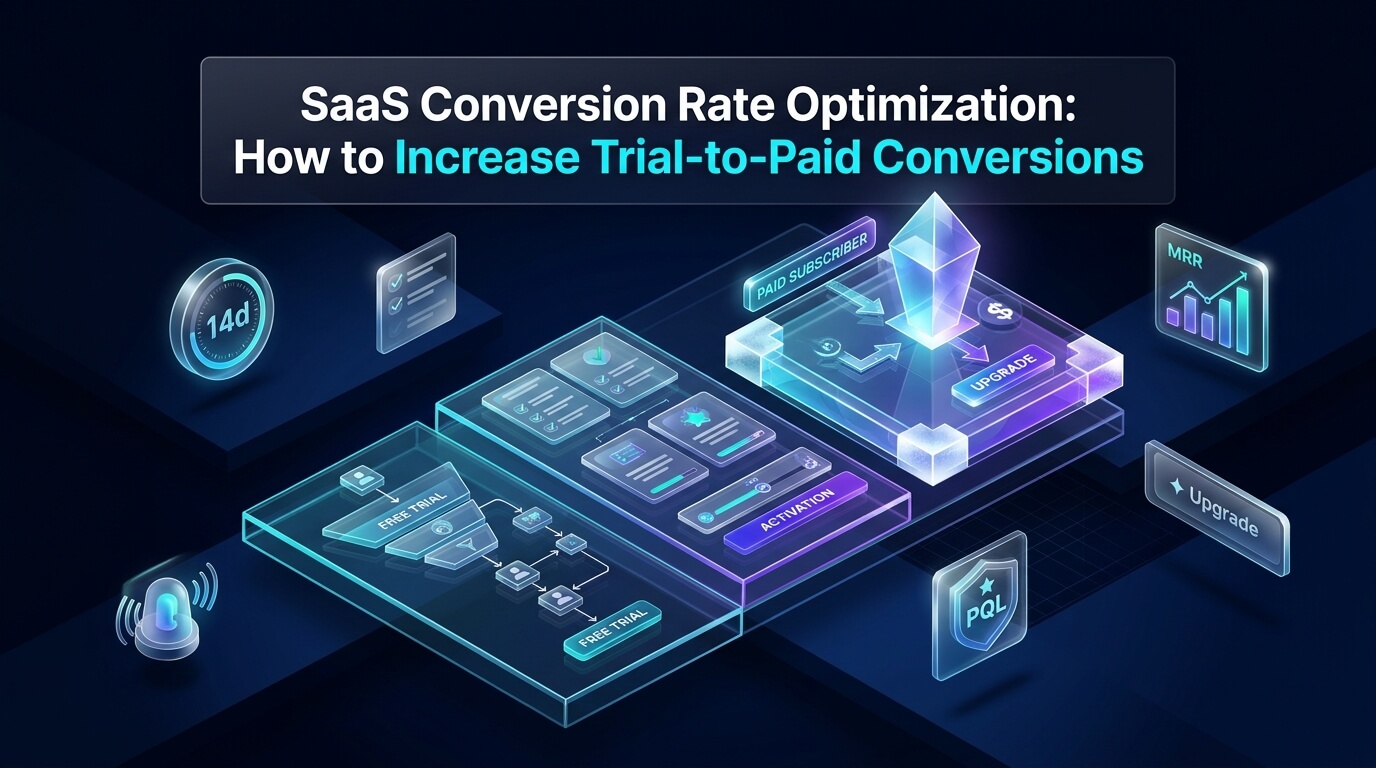
Software-as-a-service companies face unique economic hurdles. Acquiring web traffic and generating free trial signups is only the first step. If trial users abandon your application before experiencing core product value, customer acquisition costs outpace recurring revenue. Long-term software profitability requires turning casual trial users into paying subscribers.
Executing structured saas conversion rate optimization bridges the dangerous gap between user acquisition and paid activation. Rather than guessing why trial accounts go cold, high-growth software teams analyze in-app behavioral signals. They optimize every touchpoint from initial marketing landing pages to in-app onboarding workflows.
Whether you manage a self-serve product-led tool or an enterprise sales-assisted platform, mastering b2b saas conversion rate optimization protects marketing margins. This comprehensive guide details the full trial-to-paid optimization framework, essential product analytics platforms, and proven tactics to accelerate monthly recurring revenue.
Key Takeaways for SaaS Leaders:
- Trial-to-paid conversion rates depend heavily on rapid time-to-value during initial onboarding.
- Removing credit card requirements upfront increases trial volume but requires strict activation tracking.
- Interactive product tours and empty-state guidance keep new users focused on core workflows.
- Transparent pricing matrices with clear feature differentiation accelerate purchasing decisions.
- Aligning in-app user triggers with automated email sequences prevents account abandonment.
The Anatomy of the SaaS Conversion Funnel
Traditional ecommerce funnels terminate at the checkout confirmation screen. In contrast, software funnels involve multiple post-signup stages. Understanding these distinct milestones allows teams to deploy targeted saas cro strategies where user drop-offs occur.
Stage 1: Visitor to Trial Signup
The journey begins when prospective users land on your marketing website. Visitors evaluate your value proposition, inspect feature breakdowns, and review customer testimonials. The primary conversion objective is completing registration for a free trial or software demo.
Stage 2: Signup to Product Activation
Registration alone generates zero revenue. The critical milestone occurs when a user experiences their first “Aha!” moment. Product activation happens when a user completes the core action that delivers tangible value, such as connecting a data source or creating their first project dashboard.
Stage 3: Activation to Paid Subscription
Once a user experiences product value, the goal shifts toward paid conversion. In this phase, teams apply conversion rate optimization for saas trial to paid funnel mechanics. Users hit usage thresholds, utilize advanced features, or complete trial periods before selecting a paid subscription tier.
Stage 4: Expansion and Retention
Customer lifetime value compounds after the initial subscription. Optimization teams track account expansion triggers, such as seat additions, storage upgrades, and annual plan conversions. Minimizing churn and encouraging plan upgrades sustains long-term business valuation.
PLG vs SLG: Structuring Conversion Pathways by Business Model
The architecture of your software funnel depends heavily on your go-to-market motion. Trying to force an enterprise sales model onto a low-cost developer tool creates unnecessary friction. Conversely, relying purely on self-service for a complex six-figure platform results in confused buyers.
Product-Led Growth (PLG) prioritizes product self-service. The user interface acts as the primary vehicle for acquisition, retention, and expansion. In this model, conversion optimization focuses on lowering entry barriers, guiding users to instant value, and triggering contextual in-app upgrade prompts when usage limits approach.
Sales-Led Growth (SLG) centers on consultative relationship building. These platforms feature higher contract values, complex integrations, and multi-department evaluations. Here, website conversion goals center on qualifying prospect firmographics and scheduling comprehensive product demonstrations with experienced account executives.
Modern hybrid organizations unite both models under Product-Led Sales. In a hybrid motion, individual team members adopt the free or self-serve tier organically. As multiple team accounts emerge from the same corporate email domain, the system alerts sales representatives to initiate an enterprise licensing conversation.
SaaS Landing Page Conversion Optimization
Your marketing website serves as the primary gateway for prospective customers. Executing targeted saas landing page conversion optimization ensures paid and organic traffic converts into registered users efficiently.
High-converting SaaS landing pages avoid vague corporate buzzwords. Your hero headline must clearly explain what your software accomplishes within five seconds of landing. State who the tool serves and highlight the primary operational benefit in plain, direct language.
Replace static interface mockups with interactive product previews. Modern software buyers prefer clicking through interactive workflows over reading static feature bullet points. Allowing visitors to experience software utility directly on landing pages builds immediate buyer confidence.
Social proof placement also dictates registration rates. Display verified customer logos, review platform badges from G2 or Capterra, and quantifiable case study metrics. Seeing that peer organizations rely on your platform alleviates security and reliability concerns.
Interactive product tours offer a modern alternative to static screenshots. Embedding interactive walkthroughs allows prospective buyers to click through core software workflows before creating an account. Experiencing actual interface mechanics builds immediate confidence and filters out low-intent signups.
For technical and developer-focused products, providing live sandboxes or interactive code playgrounds accelerates evaluation. Developers prefer testing API endpoints and inspecting code libraries directly. Allowing technical evaluators to verify compatibility without booking sales presentations significantly lifts registration rates.
SaaS Free Trial Conversion Optimization
Deciding how to structure your trial experience is one of the most consequential decisions in software marketing. Effective saas free trial conversion optimization requires balancing signup volume against trial quality.
No Credit Card Required vs Credit Card Upfront
Offering a trial without requiring credit card details eliminates initial registration friction. Signup volumes typically increase by two to three times. However, trial-to-paid conversion rates for no-card trials often range between three and five percent. Teams must build exceptional in-app onboarding to activate these casual users.
Requiring credit card details upfront introduces significant friction, reducing initial signup volume by sixty percent or more. However, trial-to-paid conversion rates for upfront card trials often reach forty to fifty percent. Enterprise-oriented tools with consultative sales models frequently benefit from this qualified approach.
The Reverse Trial Model
The reverse trial has gained massive popularity across modern product-led growth companies. New users automatically receive full access to top-tier enterprise features for fourteen days without entering payment details. Once the trial expires, accounts downgrade to a perpetual free tier unless users upgrade.
This model allows users to experience premium automation and collaboration features without immediate payment barriers. Once premium features become ingrained in daily workflows, downgrading feels disruptive, driving organic upgrades.
Automated trial extension offers provide a powerful safety net for engaged users who need more evaluation time. If an account logs high usage but reaches day twelve of a fourteen-day trial without subscribing, trigger an automated extension offer. Offering an additional seven days in exchange for completing a brief setup milestone rescues deals that would otherwise stall.
Pro Tip for Product Leaders:
Track your Product Qualified Lead (PQL) metric closely. A PQL is a user who has completed specific meaningful actions inside your application indicating high purchase intent. Focusing sales outreach exclusively on PQLs yields three times higher closing rates than contacting every registered user.
In-App UX and SaaS Conversion Rate Optimization UI
The user interface inside your application dictates whether trial users convert or churn. Optimizing saas conversion rate optimization ui patterns removes cognitive friction during the critical first ten minutes.
Empty dashboard states represent a common point of abandonment. When a user logs in for the first time and encounters blank screens with zero data, they feel overwhelmed. Pre-populate initial workspaces with sample project templates or interactive dummy data to illustrate what a completed dashboard looks like.
Implement contextual onboarding checklists rather than lengthy forced modal tours. Progress bars that show completed setup steps tap into psychological completion drives. Allowing users to dismiss guides and learn at their own pace prevents user frustration.
Use subtle contextual tooltips rather than intrusive full-screen popups. Trigger helpful hints only when a user pauses or hovers over complex configuration menus. Providing guidance at the exact moment of need ensures a smooth learning curve.
Micro-celebrations and positive visual reinforcement amplify user momentum. Displaying subtle celebration animations or encouraging confirmation banners when a user completes their initial setup triggers positive psychological feedback loops. Recognizing early achievements motivates users to continue through advanced workflow configurations.
Optimizing the SaaS Pricing Page and Packaging
The pricing page represents the highest-intent conversion point on your entire web property. Poor pricing page architecture introduces doubt and stalls purchasing decisions.
Select value metrics that align with customer growth. Value metrics charge customers based on tangible usage dimensions, such as active contacts, processed transactions, or team seats. When customer costs increase only as their business grows, buyers perceive pricing as fair and equitable.
Employ price anchoring by highlighting your recommended plan. Placing a higher-priced enterprise package alongside your core tier makes the middle tier appear reasonably priced. Include clear comparison matrices beneath pricing cards to allow buyers to inspect feature differences quickly.
Interactive pricing sliders and cost calculators resolve pricing ambiguity for volume-based software. Allowing prospects to estimate annual costs based on their expected user count or data bandwidth builds financial trust. Transparent estimations qualify leads before they ever contact an account executive.
Avoid hiding all enterprise pricing behind opaque consultation walls. Even large corporate buyers who anticipate custom terms appreciate baseline parameters. Explaining what enterprise packages include, such as dedicated success managers and custom SLAs, helps procurement teams secure internal budget approvals.
SaaS Checkout Conversion Optimization
The transition from trial to paid subscriber culminates on your checkout and billing pages. Eliminating friction during saas checkout conversion optimization prevents last-minute payment abandonment.
Design your pricing matrix with clear tier differentiation. Highlight your most popular tier with a subtle visual badge to guide decision-making. Include an interactive toggle between monthly and annual billing, clearly displaying the annual discount percentage.
Streamline payment form inputs to absolute essentials. Avoid demanding corporate physical addresses or fax numbers unless required for tax calculation. Support modern payment methods, including credit cards, PayPal, Apple Pay, and automated invoicing for enterprise accounts.
Display security reassurance badges, refund guarantees, and data encryption seals directly beneath the purchase button. Transparent billing terms that explain trial rollover policies build trust and eliminate buyer hesitation.
Top 7 Software Platforms for SaaS Conversion Optimization
Building a world-class experimentation program requires specialized software. The following seven platforms represent the premier experimentation, product analytics, and user onboarding tools available today.
1. Appcues
Appcues is a leading product adoption and onboarding platform built specifically for software teams. Its intuitive visual builder allows product managers and marketers to publish in-app checklists, tooltips, and modal announcements without writing custom code. You can target specific user segments based on in-app behavior and lifecycle stage.
The platform provides detailed analytics that track how onboarding flows impact activation and trial conversion. Teams can run split tests on different tour variations to identify which guidance sequence produces the highest feature adoption. Appcues accelerates time-to-value for new trial subscribers.
2. VWO
VWO provides a comprehensive experimentation suite that bridges marketing website testing with in-app feature rollouts. Its robust visual editor allows non-technical marketers to test landing page layouts, pricing grids, and signup forms easily. Built-in Bayesian statistical models ensure accurate evaluation of test variations.
Beyond standard A/B testing, VWO includes integrated session recordings, heatmaps, and funnel drop-off analytics. You can observe exact user mouse movements and identify usability obstacles across checkout screens. VWO serves as an exceptional all-in-one testing suite for growing software brands.
3. Optimizely
Optimizely is the premier experimentation platform for enterprise software corporations and engineering teams. It offers client-side web testing alongside robust server-side feature flagging. Development teams use Optimizely to test new product features and backend algorithms with ultra-low latency.
The platform includes rigorous statistical engines that eliminate false positive test results. Its advanced audience segmentation enables precise targeting based on behavioral triggers and CRM data attributes. For enterprise platforms with complex compliance requirements, Optimizely offers unmatched security and scalability.
4. Mixpanel
Mixpanel is a specialized product analytics platform engineered to track user interactions across web and mobile applications. Instead of tracking simple page views, Mixpanel analyzes event-driven user actions. You can measure exactly how many users complete core activation milestones within their trial window.
Its cohort analysis and retention graphs reveal which product features correlate most strongly with long-term paid retention. By identifying the exact behaviors that drive subscription renewals, optimization teams can design in-app guides that nudge trial users toward those high-value actions.
5. Pendo
Pendo combines comprehensive product analytics with in-app user guidance and customer feedback collection. It provides visual path analytics that show every step users take through your software interface. Teams can spot navigational dead ends and user friction points instantly.
Marketers deploy targeted in-app guides and announcements directly from Pendo to guide struggling users. Built-in net promoter score surveys and qualitative feedback modules allow software teams to capture user sentiment at key lifecycle milestones. It is an indispensable platform for digital product teams.
6. Userflow
Userflow is a modern, ultra-fast user onboarding platform built for agile product-led teams. Its sophisticated flow builder allows non-technical team members to create interactive walkthroughs, resource centers, and checklist widgets. The lightweight script ensures zero noticeable impact on application performance.
The platform features built-in AI assistants that draft onboarding content and provide automated user support. Real-time event tracking and cohort branching allow you to create personalized onboarding paths based on user job roles. Userflow makes sophisticated onboarding accessible to growing software startups.
7. Chameleon
Chameleon is a highly customizable product adoption platform designed for modern web applications. It enables software teams to build contextual banners, modal announcements, and interactive walkthroughs that blend with their application styling. Its deep styling controls ensure in-app prompts feel completely native.
Chameleon includes robust microsurvey capabilities that capture user feedback directly inside the product interface. Teams can trigger satisfaction surveys immediately after a user completes a trial milestone. It connects smoothly with Segment, Mixpanel, and HubSpot to synchronize customer data across your tech stack.
| Platform Name | Primary Specialty | Key Strength | Best Suited For |
|---|---|---|---|
| Appcues | User Onboarding & Adoption | No-code interactive tours & checklists | Product-led SaaS & growth teams |
| VWO | Full-Funnel Testing Suite | Bayesian testing & session replays | Growing software brands & agencies |
| Optimizely | Enterprise Experimentation | Server-side feature testing & rollouts | Enterprise engineering & Fortune 500 |
| Mixpanel | Event-Based Product Analytics | Funnel drop-off & retention cohorts | Product managers & data analysts |
| Pendo | Product Guidance & Feedback | Visual path analytics & NPS surveys | Mid-market & enterprise product teams |
| Userflow | Fast No-Code Onboarding | Lightweight script & AI assistant | Startups & agile software companies |
| Chameleon | Native In-App Experiences | Custom CSS styling & in-app microsurveys | Design-conscious SaaS organizations |
In-House Optimization vs Hiring a SaaS CRO Agency
Executing continuous experimentation requires multidisciplinary expertise. An effective program requires product analytics tracking, UI design, front-end development, behavioral copywriting, and statistical rigor. Growing software teams must decide whether to build these skills internally or engage external specialists.
Building an internal team ensures deep product domain expertise. Internal team members participate in daily standups, interact with customer support representatives, and understand product roadmaps. However, hiring full-time specialists creates significant overhead expenses. Internal teams can also struggle with organizational bias, defending existing designs rather than challenging assumptions.
Partnering with a specialized saas conversion rate optimization agency brings immediate experience across dozens of previous software campaigns. External agencies possess battle-tested testing frameworks, proprietary benchmark data, and specialized tools. They can audit trial funnels quickly and deploy high-impact experiments with minimal engineering friction.
Many successful companies adopt a hybrid approach. Internal product managers establish core revenue goals and maintain product roadmaps. Meanwhile, an external agency conducts behavioral audits, formulates test hypotheses, and executes front-end experiments. This collaborative model accelerates testing cadence while keeping internal engineering focused on core product development.
Advanced Conversion Rate Optimization Strategies for B2B SaaS
Deploying advanced conversion rate optimization strategies b2b saas organizations rely upon requires aligning marketing triggers with customer lifecycle milestones. Standard website adjustments must connect directly with backend product engagement.
Personalize trial experiences by user job title during initial registration. Ask new users what specific objective they want to accomplish during step two of registration. Route marketers to campaign analytics dashboards while routing software developers directly to API credential settings. Role-based onboarding dramatically shortens time-to-value.
Deploy behavioral email sequences triggered by in-app inactivity. If a registered trial user fails to log in for seventy-two hours, send an automated helpful guide addressing their specific setup stage. Providing actionable tips rather than generic sales pitches encourages users to return and complete activation.
Optimize your website for organic evaluation by offering downloadable framework resources. Providing a practical conversion rate optimization for saas trial to paid funnel pdf template or audit checklist captures high-intent researchers. These educational assets generate qualified leads while establishing domain authority.
Retention, Churn Mitigation, and Account Expansion
Conversion optimization does not stop at initial checkout. In software economics, acquiring a subscriber who churns three months later results in negative customer acquisition return. Sustained profitability demands optimizing the full customer lifecycle.
Design intuitive cancellation flows that uncover the root causes of churn. When a customer initiates cancellation, present contextual alternatives before terminating service. Offer temporary account pauses, tier downgrades, or direct calendar booking with support specialists to resolve technical roadblocks.
Identify expansion opportunities through feature utilization metrics. When an account consistently approaches storage thresholds or adds active team collaborators, trigger automated upgrade recommendations. Framing upgrades around productivity gains rather than arbitrary penalties drives natural revenue expansion.
SaaS Conversion Rate Optimization Best Practices Checklist:
Work through this practical checklist to review your website conversion rate optimization for saas properties:
- Hero Value Proposition: Does your primary headline clearly explain the problem you solve within five seconds?
- Frictionless Registration: Have you removed all non-essential form fields and enabled single sign-on via Google or GitHub?
- Empty State Design: Do new user dashboards feature helpful sample data and intuitive starter templates?
- Activation Milestone: Can new users complete the primary value action in under ten minutes from initial signup?
- In-App Guidance: Are onboarding tooltips dismissible, contextual, and focused on high-value actions?
- Transparent Pricing: Does your pricing page clearly highlight feature differentiation and annual discount incentives?
- Trial Expiration Clarity: Do users receive clear countdown alerts and frictionless upgrade pathways before trials end?
- Behavioral Triggers: Are inactivity emails automated to re-engage struggling trial users with helpful solutions?
Measuring Success Beyond Standard Trial Signups
Focusing exclusively on raw trial registration volume gives software executives a false sense of security. Acquiring ten thousand low-intent trial users who never activate damages marketing efficiency and strains customer support resources.
Modern software organizations evaluate conversion health across four interconnected metrics: visitor-to-trial rate, trial-to-activation rate, activation-to-paid rate, and net revenue retention. Balancing these metrics ensures your optimization efforts drive sustainable recurring revenue.
Conducting comprehensive saas conversion rate optimization best practices audits ensures your product experience supports long-term customer satisfaction. When trial users reach activation quickly and experience consistent product utility, subscription renewals and account expansion follow naturally.
Frequently Asked Questions
What is a good trial-to-paid conversion rate for SaaS?
For opt-in free trials without credit cards required, average trial-to-paid conversion rates typically range between 3 percent and 5 percent. For trials requiring a credit card upfront, conversion rates average between 25 percent and 45 percent across standard industry benchmarks.
What is product activation in SaaS?
Product activation is the milestone where a new trial user completes the core set of actions required to experience your software’s primary value proposition. Reaching this “Aha!” moment is the single strongest predictor of long-term paid conversion.
Should SaaS companies gate their pricing page behind a demo form?
Self-serve and mid-market SaaS companies should always display transparent pricing tiers to satisfy buyer research. Enterprise platforms with complex implementation requirements can show baseline package tiers while directing custom deployment inquiries toward sales consultations.
How long should a SaaS free trial last?
Most modern SaaS products find that fourteen-day trials produce higher conversion rates than thirty-day trials. Shorter durations create a healthy sense of urgency, encouraging users to evaluate the software actively rather than postponing implementation.
What is the difference between a PQL and an MQL in SaaS?
A Marketing Qualified Lead (MQL) is someone who has engaged with marketing content like downloading an ebook. A Product Qualified Lead (PQL) is someone who has actively used your software and completed key activation actions, demonstrating genuine purchase readiness.
How does freemium compare to free trials in SaaS?
Freemium provides perpetual access to a limited feature set, maximizing user acquisition volume and long-term brand awareness. Free trials provide time-limited access to full product capabilities, creating urgency to evaluate and purchase quickly.
Why do trial users abandon software before activating?
Trial users abandon software primarily due to high cognitive onboarding friction, blank empty states, lack of clear guidance, and slow time-to-value. If users cannot achieve their primary objective within ten minutes, interest rapidly cools.
What is the fastest way to increase trial-to-paid conversions?
The fastest win is streamlining your in-app onboarding flow to reduce time-to-value. Guiding users to complete their primary setup action within the first ten minutes produces immediate, measurable lifts in paid subscription rates.
Conclusion: Build a Sustainable Growth Engine
SaaS conversion optimization is not a one-time marketing campaign. It represents a continuous operating discipline that connects website marketing with in-app product mechanics. When marketing and product teams collaborate on shared activation benchmarks, customer acquisition costs drop while customer lifetime value expands.
High-performing software companies view their product as their most persuasive sales representative. Every friction point removed from onboarding flows compounds recurring revenue across the life of the business. Consistent experimentation ensures your platform stays ahead of evolving user expectations.
Begin by auditing your current trial-to-paid funnel. Identify where new trial users stall, eliminate unnecessary registration fields, and refine in-app onboarding guides. Transforming your software into a high-converting growth engine starts with your next activation experiment.