Search is experiencing its greatest technological disruption in thirty years. For decades, digital discovery followed a straightforward routine. A user typed a keyword phrase into a search bar, and the search engine returned ten blue links. Webmasters competed to capture top organic rankings to drive visitors to their websites.
The sudden rise of large language models and conversational answer engines has rewritten this paradigm. Instead of browsing a list of external websites, millions of users now ask complex, conversational questions and receive synthesized, direct answers on the screen. The ongoing debate comparing seo vs ai highlights a massive shift in how information is indexed, synthesized, and cited.
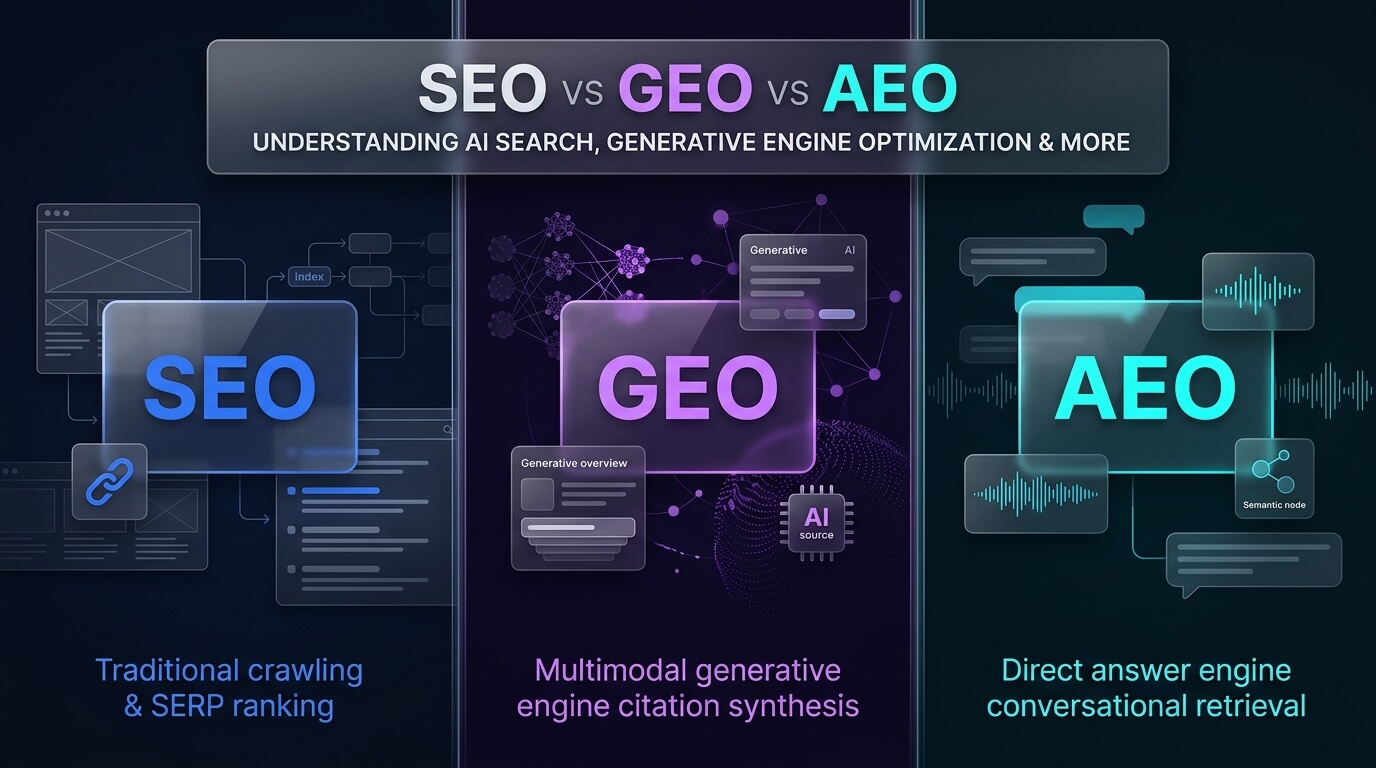
This technological evolution has introduced several new optimization disciplines. Marketing teams must now evaluate seo vs geo, determine how seo vs aeo operates, and master the complete spectrum of seo vs geo vs aeo. Rather than signaling the death of organic search, these emerging models create immense opportunities for brands that adapt early.
In this comprehensive guide, you will examine the exact definitions, ranking mechanisms, content frameworks, and tracking tools shaping the future of organic discovery. We analyze how traditional search engine optimization, answer engine optimization, generative engine optimization, and AI overviews work together to build enduring digital authority.
Key Takeaways: Modern Search Optimization Pillars
- Traditional SEO provides the foundational crawlability, technical health, and domain authority required by all search engines.
- Answer Engine Optimization (AEO) structures content into concise 40 to 60-word answers to capture featured snippets and voice search.
- Generative Engine Optimization (GEO) optimizes content to be ingested, synthesized, and cited as a source by LLMs like ChatGPT and Perplexity.
- Google AI Overviews (AIO) merge traditional web search indexing with generative multimodal synthesis directly on the SERP.
- Winning modern search requires publishing original research, proprietary data, and unambiguous entity schemas that algorithms trust.
Dissecting the Acronyms: Definitions, Meanings, and Taxonomy
The rapid expansion of artificial intelligence in search has introduced new industry terminology that often confuses marketing leaders. Establishing clear definitions is essential for strategic planning.
What is SEO? (Search Engine Optimization)
Search Engine Optimization is the practice of enhancing a website’s technical architecture, on-page content relevance, and backlink profile to earn organic rankings on traditional search engines like Google and Bing. Traditional SEO measures success through organic keyword positions, search impressions, and website click-through volume.
What is AEO? (Answer Engine Optimization)
To understand the seo vs aeo meaning, you must look at how search engines handle factual questions. Answer Engine Optimization focuses on formatting content so voice assistants (such as Siri and Alexa) and search engine featured snippets can extract direct, immediate answers. When analyzing seo aeo, the objective shifts from driving a website visit to becoming the single definitive answer quoted by the engine.
What is GEO? (Generative Engine Optimization)
To grasp the seo geo meaning, consider how large language models generate text. Generative engine optimization is the discipline of structuring web content so conversational AI engines (like Perplexity, ChatGPT Search, and Claude) cite your website as an authoritative source in their synthetic summaries. When evaluating seo geo and transitioning seo to geo, you optimize for semantic entities, factual density, and high information gain rather than keyword frequency.
What is AIO? (AI Overviews Optimization)
AI Overviews Optimization focuses specifically on Google’s native generative summaries that appear at the top of search result pages. Comparing seo vs aio highlights the transition from ranking among blue links to earning prominent citation cards inside Google’s AI-generated answer boxes.
The Complete Taxonomy: SEO vs. AIO vs. GEO vs. AEO
Marketers frequently ask how these four disciplines interact when evaluating seo vs aio vs geo and examining seo vs geo vs aeo vs aio:
SEO: Ranks web pages in organic search listings to drive direct website clicks.
AEO: Provides concise factual answers for smart snippets and voice search.
GEO: Earns brand citations inside conversational large language model responses.
AIO: Captures featured source links inside Google’s native AI Overviews.
These four disciplines do not operate as mutually exclusive rivals. They represent progressive layers of a modern digital marketing strategy.
Traditional SEO: The Foundational Architecture
Some commentators prematurely claim that artificial intelligence has made search engine optimization obsolete. This assumption misunderstands how AI models access web data.
Large language models do not generate facts out of thin air. When conversational engines like Perplexity or ChatGPT Search answer real-time queries, they deploy autonomous web crawlers to retrieve live web pages. These crawlers rely on the exact same infrastructure that powers traditional search engines: DNS resolution, XML sitemaps, clean HTML rendering, and robots.txt permissions.
If your website suffers from broken redirect chains, slow server response times, unindexed pages, or weak domain authority, AI crawlers will simply bypass your domain. Traditional SEO provides the technical highway that enables modern AI search engines to crawl, parse, and ingest your content.
In addition, traditional backlink authority remains a critical trust proxy for artificial intelligence. Language models evaluate web consensus. When authoritative industry publications, academic journals, and reputable media outlets frequently link to your website, AI models recognize your domain as an authoritative entity worth citing.
Answer Engine Optimization (AEO): Capturing Direct Answer Real Estate
Answer Engine Optimization emerged alongside the rise of voice search, mobile queries, and Google featured snippets. As smart devices proliferated, users demanded immediate answers without scrolling through multiple paragraphs.
The Mechanics of Answer Extraction
Answer engines parse web pages using natural language processing models that identify question-and-answer pairs. When a user asks “what is a canonical tag?”, the engine searches its index for the clearest, most concise definition available.
Capturing these placements requires disciplined formatting. Write direct, factual answer blocks of 40 to 60 words immediately beneath descriptive H2 or H3 subheadings. Avoid opening answers with throat-clearing fluff or transitional filler. State the core concept immediately in the opening sentence, followed by one or two supporting sentences that clarify key context.
Structuring Pages with Schema Markup
Coordinating seo and aeo requires robust structured data. Implementing JSON-LD Schema markup—such as FAQPage, HowTo, and QAPage schemas—provides search engines with explicit, machine-readable definitions.
Schema markup removes semantic ambiguity. It tells search crawlers exactly which text represents the question and which text represents the verified answer. This structured clarity dramatically increases your probability of capturing featured snippets and voice search results across mobile devices.
Voice Search and Conversational Query Formats
Voice-assisted searches on mobile devices and smart home speakers skew heavily toward natural spoken questions. Rather than typing “best CRM pricing”, users ask “what is the most affordable customer relationship management software for a team of five?”.
Anticipating these conversational structures allows content creators to draft natural, colloquial question headers. Answering the exact phrasing spoken by mobile users maximizes your selection rate across smart assistant devices.
Generative Engine Optimization (GEO): Influencing AI Citations
Generative Engine Optimization represents the frontier of modern search marketing. In the discipline of geo seo, your goal is not merely capturing a search click. Your goal is ensuring your brand, products, and insights are synthesized into the direct responses generated by conversational AI models.
How Large Language Models Synthesize Answers
Conversational AI platforms deploy Retrieval-Augmented Generation (RAG) architectures to answer user prompts. When a user asks for software recommendations, the engine executes three sequential steps:
1. Retrieval: The model queries its web index or performs a live web crawl to retrieve ten to twenty relevant text passages.
2. Re-Ranking: Neural re-ranking models score the retrieved passages based on factual authority, relevance, and information gain.
3. Synthesis: The language model compiles a cohesive, multi-source summary, appending hyperlinked citations to the websites that contributed unique facts.
Maximizing Information Gain for GEO Success
Google holds published patents regarding information gain scores. If an article merely rehashes existing web summaries without introducing new data, its information gain score is zero. Language models have no incentive to cite derivative content.
To win consistent citations in conversational engines, publish original primary research, proprietary survey findings, technical benchmark tests, and verified case studies. When generative models summarize an industry topic, they actively seek out primary sources that introduce unique statistics and first-hand operational lessons.
Entity Mapping and Knowledge Graph Grounding
Language models evaluate the web through entities—distinct people, companies, software platforms, and technical concepts. Successful seo and geo execution requires establishing unambiguous entity profiles.
Connect your brand across authoritative public knowledge graphs including Wikidata, Wikipedia, Crunchbase, and LinkedIn. Use Organization and SameAs Schema markup on your website to associate your executive leadership and corporate brand with specific industry topics. Clear entity grounding ensures AI engines understand who you are and recommend your brand during conversational product searches.
AI Overviews (AIO): Navigating Google’s Native Search Synthesis
Google AI Overviews (formerly Search Generative Experience) represent Google’s direct response to conversational chatbots. AI Overviews appear at the very top of Google’s search results for millions of informational and commercial queries.
The Anatomy of an AI Overview
AI Overviews do not replace traditional organic search. They synthesize organic content directly above the traditional blue links. An AI Overview typically features a generated summary paragraph alongside a carousel of source citation cards that link directly to external websites.
Executing seo aio and managing seo and aio requires understanding how Google selects citation sources. Google’s Gemini models prioritize pages that already hold strong organic rankings (typically on page one) and feature clear, modular content blocks that answer specific sub-questions.
Measuring the Click Impact of AI Overviews
AI Overviews change organic click-through distributions. For simple informational queries, AI Overviews satisfy search intent immediately, reducing organic click-through rates. However, for complex commercial comparisons and technical research, appearing as a primary source card inside an AI Overview drives highly qualified, ready-to-convert visitors.
To secure placement inside Google AI Overviews, format your articles with clear numbered lists, comparison tables, and descriptive subheadings. Modular, highly structured content allows Google’s synthesis models to extract your data points effortlessly.
Defending Brand Real Estate Against Overview Hallucinations
Generative AI summaries can occasionally misrepresent company pricing, confuse product features, or hallucinate inaccurate return policies. When your brand lacks clear, authoritative public documentation, generative engines guess based on incomplete web snippets.
Publishing unambiguous, crawlable pricing tables, detailed product specifications, and direct policy answers protects your company from algorithmic misinformation. Maintaining structured, factual clarity ensures Google AI Overviews cite accurate, verified company data.
The Hybrid Unified Framework: Blending SEO, GEO, and AEO
Treating organic discovery as a fragmented battle between competing acronyms leads to wasted effort. Forward-thinking marketing teams implement a unified hybrid framework that addresses every discovery surface simultaneously.
The Three-Tier Content Architecture
Structure every major content initiative using this integrated three-tier architecture:
Tier 1: Foundational Crawlability and Technical Health (SEO): Maintain lightning-fast load times, mobile responsiveness, clean URL hierarchies, and strong backlink authority to ensure continuous crawl accessibility.
Tier 2: Concise Definitions and Structured Schemas (AEO): Open every subtopic with a clear 40 to 60-word answer paragraph and apply comprehensive JSON-LD Schema markup to capture featured snippets and voice search.
Tier 3: Proprietary Data and Entity Depth (GEO): Inject original customer survey statistics, proprietary benchmarks, and author experience proof to maximize information gain and earn conversational AI citations.
Pro-Tip: Design Content for Semantic Chunking and Neural Re-Ranking
Modern retrieval-augmented generation systems split web pages into discrete text chunks before feeding them to language models. Avoid writing sprawling, 300-word paragraphs that mix multiple concepts together. Keep paragraphs focused on a single idea, and use clear subheadings to introduce each section. Clean semantic chunking makes it easy for AI re-rankers to extract your text and cite your domain as an authoritative source.
Comprehensive Reviews: Top 8 AI Search & Optimization Tools
Mastering modern search requires specialized platforms for tracking generative citations, modeling semantic entities, and auditing structured data. The following eight commercial platforms lead the market in AI search intelligence.
1. Perplexity AI
Perplexity AI is a conversational answer engine that pairs real-time web index scraping with advanced large language models. Perplexity represents the gold standard for conversational web research.
For search marketers, Perplexity serves as a vital diagnostic utility. By testing target queries inside Perplexity, analysts observe which websites the engine cites as authoritative sources and how it synthesizes competing viewpoints. Studying Perplexity’s citation patterns provides actionable insight into generative engine optimization criteria.
Perplexity is an essential diagnostic utility for content strategists and SEO professionals who want to understand how conversational AI models evaluate web authority.
2. ChatGPT Search
ChatGPT Search integrates real-time web search capabilities directly into OpenAI’s flagship conversational interface. It allows hundreds of millions of users to access up-to-date web information through natural dialogue.
ChatGPT Search displays clean inline citations and a dedicated source sidebar featuring thumbnail images and domain links. It partners with major media publishers while crawling the open web to retrieve authoritative answers. Monitoring whether your brand appears in ChatGPT Search responses provides direct feedback on your domain’s generative authority.
ChatGPT Search is a critical platform for brand marketers, digital PR professionals, and e-commerce stores seeking visibility across conversational search interfaces.
3. Google Gemini
Google Gemini is Google’s multimodal foundation model, powering both the standalone Gemini assistant and Google’s native AI Overviews on search result pages.
Gemini leverages Google’s massive web index and proprietary Knowledge Graph to deliver factual, cross-modal answers incorporating text, images, and video clips. Its “Double-Check” feature highlights which portions of generated responses are corroborated by organic Google search results, providing clear visibility into factual consensus modeling.
Google Gemini is mandatory testing software for digital marketers seeking to understand how Google’s core AI models evaluate brand entities and organic content.
4. Claude
Claude is an advanced large language model developed by Anthropic, celebrated for its high reasoning capabilities, nuanced prose generation, and adherence to safety guidelines.
While Claude focuses primarily on direct conversational synthesis and document analysis, its training datasets incorporate extensive web crawls. Marketers analyze how Claude articulates complex industry concepts, using its outputs to benchmark topical completeness and clarity when drafting authoritative long-form content.
Claude is an exceptional tool for content editors, research analysts, and copywriters who require deep conceptual analysis and sophisticated editorial drafting.
5. Microsoft Copilot
Microsoft Copilot combines OpenAI’s foundation models with Microsoft’s Bing search index to deliver real-time conversational search across Windows, Edge, and Office ecosystems.
Copilot provides detailed footnote citations linking directly to source web pages. It features deep integration with commercial shopping feeds, displaying product pricing cards and customer reviews directly inside conversational answers. Tracking Copilot citations is particularly valuable for B2B brands and software providers targeting enterprise desktop users.
Microsoft Copilot is an outstanding channel for B2B marketers, enterprise technology providers, and e-commerce brands targeting corporate desktop audiences.
6. Profound
Profound is a specialized analytics and monitoring platform built specifically to track brand visibility, sentiment, and citations across leading generative AI platforms.
The platform monitors prompts across ChatGPT, Perplexity, Claude, and Google Gemini, tracking how often your brand is recommended for specific commercial queries. Profound calculates your generative share of voice, alerts you to synthetic hallucinations, and identifies competitor displacement across AI answer engines.
Profound is the premier enterprise software solution for corporate brand managers and agency strategists who require automated tracking of AI search citations.
7. WordLift
WordLift is an AI-powered semantic SEO and automated structured data platform that converts unformatted web content into machine-readable knowledge graphs.
WordLift analyzes your web pages using natural language processing to identify entities, concepts, and relationships. It automatically generates custom JSON-LD Schema markup and builds a proprietary internal knowledge graph for your domain. This structured grounding makes it easy for answer engines and generative AI crawlers to ingest and cite your content accurately.
WordLift is an outstanding solution for e-commerce retailers, large publishers, and enterprise websites seeking automated semantic schema enrichment.
8. MarketMuse
MarketMuse is an enterprise content strategy and semantic modeling platform built upon sophisticated natural language processing algorithms.
Its patented Content Score evaluates the topical depth, completeness, and authority of your writing against the entire web consensus. Rather than focusing on superficial keyword counts, MarketMuse identifies critical semantic subtopics, related entities, and variant questions that your content must cover to be considered authoritative by both traditional search crawlers and generative AI models.
MarketMuse is an essential platform for enterprise content directors and digital strategists who prioritize building defensible, comprehensive topical authority.
Search Engine Optimization Frameworks Comparison Matrix
Understanding how SEO, AEO, GEO, and AIO differ across operational mechanisms, primary metrics, and content formats ensures proper resource allocation. The comparison table below highlights core differentiators across all four models.
| Framework | Primary Objective | Ranking Mechanism | Key Metric | Best For |
|---|---|---|---|---|
| Traditional SEO | Rank web pages in organic blue links | Crawl indexing, backlink graphs & on-page signals | Organic Clicks & Position 1-3 rankings | All commercial websites & publishers |
| AEO (Answer Engine) | Provide direct answers for voice & snippets | Concise definition blocks & Schema markup | Featured snippet ownership & zero-click reach | Informational queries & mobile users |
| GEO (Generative Engine) | Earn brand citations in LLM responses | Information gain, primary research & entity trust | Citation share & conversational recommendations | Thought leaders, B2B SaaS & data creators |
| AIO (Google AI Overviews) | Capture top citation cards on Google SERP | Page one organic ranking + modular content blocks | Overview inclusion rate & referral traffic | Commercial comparisons & tutorials |
Step-by-Step Implementation: 10-Step AI Search Blueprint
Adapting your digital marketing program to the generative search era requires structured execution. Follow this actionable ten-step blueprint to build comprehensive search visibility across traditional, answer, and generative engines.
Checklist: 10-Step AI Search Optimization Action Plan
- Audit Technical Crawl Infrastructure: Ensure server response times are fast, XML sitemaps are error-free, and robots.txt permits AI crawlers (like GPTBot and PerplexityBot).
- Map Conversational Search Intent: Research the natural language questions users ask conversational assistants regarding your core offerings.
- Draft Direct 50-Word Answer Blocks: Place concise, factual definition blocks immediately beneath H2 headings to capture AEO snippets.
- Inject Proprietary Primary Data: Publish original customer survey findings, benchmark tests, or case studies that introduce unique facts.
- Implement Comprehensive Schema Markup: Apply Organization, Article, FAQPage, and Author JSON-LD structured data to eliminate entity ambiguity.
- Connect Public Knowledge Graph Profiles: Verify and align your corporate profiles on Wikidata, Wikipedia, Crunchbase, and LinkedIn.
- Format for Modular Semantic Chunking: Use clean subheadings, bullet lists, and comparison tables that RAG systems can parse effortlessly.
- Audit for High Information Gain: Review content to ensure it offers contrarian perspectives and insights that generic AI cannot duplicate.
- Monitor AI Citation Share: Regularly test target commercial queries across Perplexity, ChatGPT, and Google Gemini to track brand citations.
- Execute Digital PR for Brand Search Velocity: Earn media coverage in respected trade journals to reinforce entity trust associations in AI training datasets.
Critical AI Search Optimization Mistakes to Avoid
Many organizations stumble during the transition to artificial intelligence because they repeat common strategic errors. Protect your organic reach by avoiding these traps:
Flooding Your Site with Unedited AI Text: Copying generic chatbot output and publishing it without human review results in thin, derivative articles that fail Google’s helpful content standards. Generative search engines cite primary sources, not derivative summaries.
Blocking AI Crawlers Prematurely: Blocking AI web scrapers in your robots.txt file prevents conversational search engines from indexing and citing your brand. Unless you are behind a hard paywall, blocking AI crawlers erases your visibility in modern answer engines.
Neglecting Traditional Backlinks: Assuming backlink authority no longer matters in the AI era is a fatal mistake. Language models rely heavily on external web consensus to determine which websites are credible sources of truth.
Omitting Author Proof and Real Experiences: Failing to showcase verified human author credentials, transparent testing methodologies, and real-world screenshots makes your content look indistinguishable from low-quality programmatic spam.
Frequently Asked Questions About SEO, GEO, and AEO
Below are clear, direct answers to common questions marketing directors, business founders, and search professionals ask regarding search optimization in the AI era.
Will generative search engines replace traditional SEO completely?
No, generative search engines will not eliminate SEO. Conversational answer engines rely on live web crawlers to retrieve real-time facts and index new content. Traditional technical crawlability, on-page relevance, and backlink authority remain mandatory prerequisites for earning AI citations.
How do large language models choose which websites to cite?
Large language models prioritize sources that demonstrate high information gain, original data, clear entity authority, and factual corroboration across authoritative web publications. Publishing primary research and verified case studies significantly increases citation probability.
Does Schema markup still help in generative engine optimization?
Yes. Schema markup provides machine-readable structured data that removes ambiguity for neural retrieval models. Clear Organization, Product, and Article schemas help AI engines understand exact relationships between entities, authors, and verified facts.
What is the difference between RAG and traditional search indexing?
Traditional search indexing matches user keywords against a static inverted index of web pages. Retrieval-Augmented Generation (RAG) retrieves relevant web passages dynamically and feeds them into a neural language model that synthesizes a cohesive, direct answer with citations.
Can small websites rank in Google AI Overviews and Perplexity?
Yes. Small and niche websites frequently earn citations in AI Overviews and Perplexity by publishing highly specialized, hands-on testing data that massive corporate aggregators overlook. Demonstrating authentic first-hand experience (E-E-A-T) is the most powerful competitive advantage for smaller publishers.
How do you track brand citations in conversational AI models?
You can track AI citations manually by prompting platforms like ChatGPT, Perplexity, and Gemini with target commercial queries, or use specialized AI tracking software like Profound. Monitor whether your brand is mentioned, which URLs are hyperlinked, and whether sentiment is positive.
Final Verdict: Thriving in the Synthetic Search Era
The rise of artificial intelligence does not represent the end of search marketing. It represents an elevation of quality standards across the web. Formulaic, low-effort summaries are now handled instantly by machines. In this environment, human expertise, original data, and distinct points of view are more valuable than ever before.
By building upon a solid technical SEO foundation, formatting answers for immediate AEO extraction, and engineering deep proprietary insights for generative engine optimization, your brand will dominate organic discovery across both traditional search engines and the conversational AI platforms of tomorrow.