Executive Summary
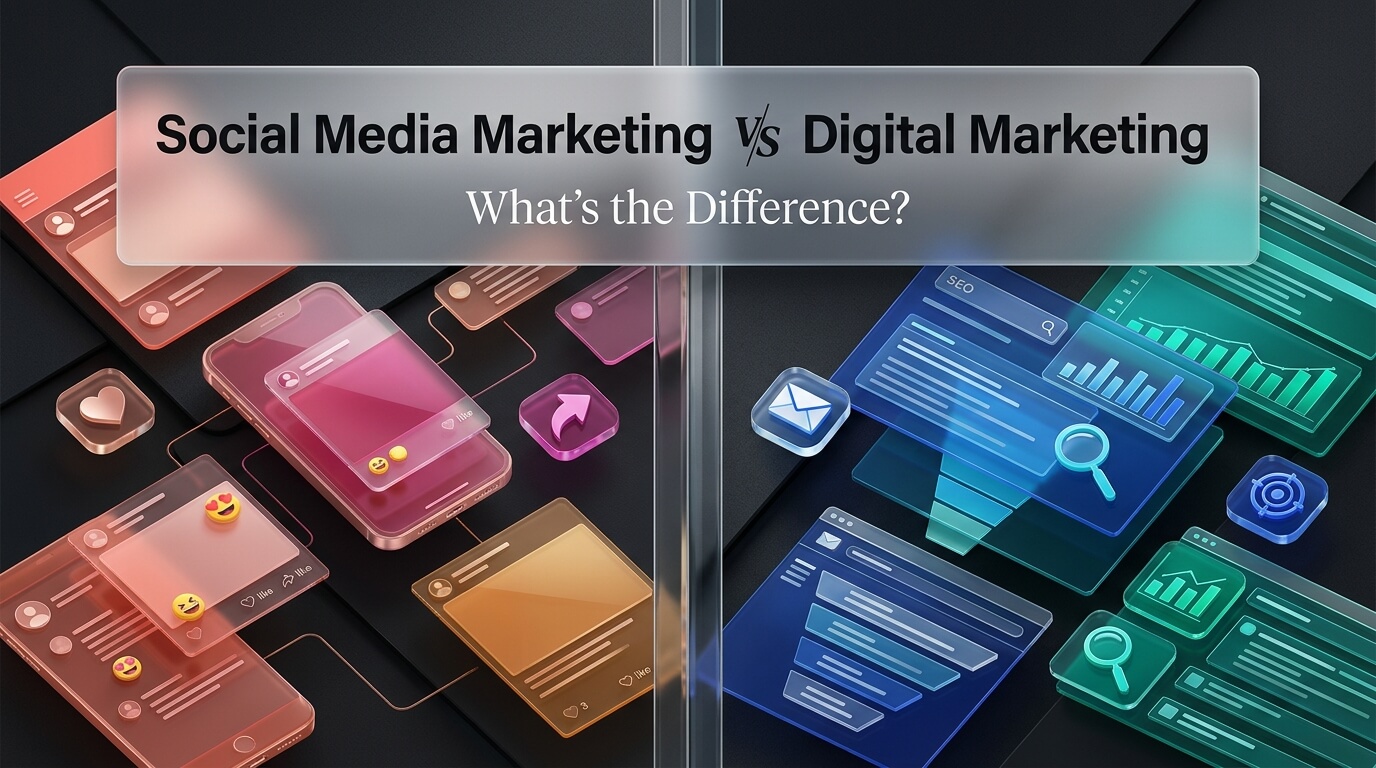
Modern businesses often struggle to separate online marketing terms. Many teams ask about the fundamental difference between digital and social media marketing when planning budgets. Digital marketing serves as the broad umbrella covering every digital touchpoint. Social media marketing operates as a focused channel within that umbrella.
Both disciplines share the ultimate goal of driving customer acquisition and revenue. Digital marketing encompasses search engine optimization, website conversion funnels, email automation, and paid search. Social media marketing centers on direct dialogue, community building, viral video formats, and brand awareness across interactive networks.
This comprehensive guide breaks down channels, cost metrics, conversion funnels, and real-world workflows. You will discover exactly how both strategies work together to produce sustainable business revenue.
Understanding the Core Difference Between Both Strategies
Marketing terms often cause confusion for business owners and new practitioners. Teams frequently discuss social media marketing and digital marketing as if they were competing forces. In reality, they work in harmony as part of a single customer journey.
Digital marketing covers all promotional activities executed through electronic devices or the internet. It includes search engines, websites, email funnels, mobile apps, and digital display ads. Social media marketing focuses exclusively on social networking platforms like LinkedIn, Instagram, TikTok, YouTube, and Facebook.
Thinking about digital vs social media marketing is similar to comparing transportation to automobiles. Transportation represents the total ecosystem of movement. Automobiles represent a specific, high-powered vehicle within that transportation network.
When you master both concepts, your marketing becomes far more cost-effective. You stop wasting money on disconnected campaigns that fail to deliver conversions. Instead, you create an integrated engine that captures attention and turns followers into loyal paying clients.
What is Digital Marketing? The Umbrella Ecosystem
Digital marketing represents the entire spectrum of online promotional tactics. Any communication channel that relies on internet connectivity or digital technology falls under this umbrella. Organizations use these channels to reach prospective buyers at every stage of their buying journey.
Unlike old broadcast media, digital marketing offers real-time measurement and precision targeting. Marketers track every click, page view, form submission, and completed purchase. This granular visibility helps businesses allocate their capital toward the highest-performing marketing assets.
The digital marketing umbrella includes several foundational pillars that work together:
- Search Engine Optimization (SEO): Optimizing web pages to rank high on Google and Bing for relevant organic search queries.
- Search Engine Marketing (PPC): Purchasing targeted keyword ads to capture high-intent buyers ready to complete an immediate transaction.
- Content Marketing: Producing high-value educational guides, case studies, videos, and articles that solve user problems.
- Email Marketing & Automation: Delivering segmented nurture campaigns, product updates, and automated behavioral messages directly to subscriber inboxes.
- Website & Conversion Rate Optimization (CRO): Designing fast, intuitive web pages that convert incoming web traffic into registered leads and sales.
- Affiliate & Influencer Partnerships: Collaborating with trusted creators and partner sites that promote products in exchange for performance commissions.
- Social Media Marketing: Engaging audiences on interactive social networks to build community and spark brand conversations.
Every pillar in this ecosystem plays a specific functional role. SEO captures intent when people actively look for answers. Email nurtures existing relationships. Paid search delivers fast pipeline growth. Social channels build brand personality and audience affinity.
What is Social Media Marketing? The Engagement Catalyst
Social media marketing is a specialized branch of digital marketing centered on social networks. It focuses on creating tailored content, starting two-way conversations, and building dedicated audience communities. Brands leverage these platforms to establish emotional connections with current and prospective customers.
Unlike traditional search engines where users seek specific solutions, social media users seek connection, news, and entertainment. Marketers must craft compelling narratives that fit seamlessly into user feeds. Winning campaigns stop the scroll with captivating hooks and helpful insights.
The core elements of effective social media marketing include several active practices:
- Organic Content Distribution: Publishing educational carousels, short-form reels, industry thoughts, and visual stories that showcase brand value.
- Community Management: Replying to direct messages, answering comments, hosting live audio rooms, and recognizing loyal community members.
- Paid Social Advertising: Running sponsored ad campaigns on Meta, LinkedIn, TikTok, and Pinterest with interest and lookalike audience targeting.
- Social Commerce: Enabling frictionless in-app shopping through storefronts like TikTok Shop and Instagram Shopping.
- Influencer & Creator Collaborations: Partnering with authentic niche creators who present your products to their dedicated follower bases.
- Social Listening: Monitoring brand mentions, industry hashtags, and competitor sentiment to guide overall marketing messaging.
Social platforms evolve quickly as user tastes shift toward authentic video and relatable creators. Modern social marketing requires agile creative production and real-time community engagement. Brands that treat social media as a two-way street generate intense customer loyalty.
Digital Marketing vs Social Media Marketing: Direct Comparison
Comparing these disciplines side by side clarifies how their scope, channels, and objectives differ. While social media focuses on social engagement, digital marketing encompasses the entire customer journey across the web. Both disciplines require distinct skill sets and analytical metrics.
Review this comprehensive comparison table to see how each discipline operates across critical business dimensions:
| Strategic Dimension | Digital Marketing | Social Media Marketing |
|---|---|---|
| Overall Scope | Comprehensive umbrella covering all online channels, web properties, and search ecosystems. | Specialized subset operating exclusively on social media platforms and networking apps. |
| Primary Channels | Websites, Google Search, Bing, Email, SMS, Affiliate networks, Display ads, and Social networks. | LinkedIn, Instagram, TikTok, YouTube, Facebook, X (Twitter), Pinterest, and Reddit. |
| Audience Mindset | High intent, solution-seeking, researching options, and ready to solve immediate business problems. | Browsing for entertainment, personal connection, industry news, and casual content consumption. |
| Primary Objectives | Customer acquisition, sales pipeline growth, lead capture, SEO rankings, and customer lifetime value. | Brand awareness, community trust, viral discovery, audience engagement, and social proof. |
| Key Performance Metrics | Cost per acquisition (CPA), conversion rate, return on ad spend (ROAS), organic rankings, and revenue. | Engagement rate, video watch time, comment sentiment, follower growth, shares, and virality. |
| Content Lifespan | Long-term and evergreen. SEO articles and landing pages generate leads for years. | Short-term and ephemeral. Posts typically peak within 24 to 72 hours before fading from feeds. |
| Communication Style | Direct, informational, transactional, structured, and focused on functional clarity. | Conversational, visual, emotional, authentic, culturally timely, and highly interactive. |
Recognizing these distinct traits helps marketing teams set realistic goals. You cannot judge a social media post with the same metrics used for a Google search ad. Each channel serves a distinct role in turning strangers into satisfied clients.
Key Channel Comparisons Across the Digital Landscape
To fully grasp how marketing disciplines interact, we must analyze specific channel pairings. Marketing leaders often ask how social media compares to search, email, content creation, and traditional advertising. Each pairing highlights unique strengths and trade-offs.
Social Media Marketing vs SEO: Discovery vs Search Intent
The contrast between social media marketing vs seo centers on user intent. When a person uses Google or Bing, they actively search for a solution to an urgent problem. They type specific search phrases and click on relevant organic results with clear commercial intent.
Social media operates on discovery rather than intent. Users do not log into Instagram or TikTok looking to purchase enterprise software. Instead, algorithms serve compelling content based on user interests. SEO captures existing demand, while social media generates brand awareness and creates new demand.
SEO provides long-lasting compound returns over several years. A well-ranked guide continues to generate qualified organic visits without recurring ad spend. Social media requires constant publishing activity to maintain feed presence, but it delivers immediate feedback and rapid viral reach.
Pro-Tip on SEO & Social Synergy
Repurpose your top-ranking SEO articles into bite-sized social carousels and short videos. Link your social audience back to deep-dive website resources to build domain authority and natural backlinks.
Social Media Marketing vs Content Marketing: Channel vs Core Asset
Examining social media marketing vs content marketing reveals an asset-versus-distribution relationship. Content marketing involves creating valuable, educational assets such as whitepapers, case studies, blog articles, and original research. These assets live on your owned media channels where you maintain total control.
Social media serves as a prime distribution channel for your content assets. Without social networks, great content often sits unseen on an empty blog. Without high-value content, social media channels quickly run out of meaningful ideas to share.
Content marketing establishes intellectual authority and solves deep customer pain points. Social media takes those core insights, breaks them into digestible formats, and sparks active public debate. Winning companies treat content creation as the fuel and social media as the distribution engine.
Social Media Marketing vs Email Marketing: Public Feeds vs Owned Inboxes
Analyzing social media marketing vs email marketing highlights the difference between rented and owned audiences. On social networks, an algorithm controls who sees your updates. Platform changes can slash organic reach overnight, leaving your brand dependent on paid boosts.
Email marketing represents owned media where you communicate directly with subscribers. When you send an email campaign, it lands straight into the recipient’s personal inbox without algorithmic filters. Email consistently delivers higher conversion rates and superior transactional ROI compared to open social feeds.
Smart marketers use social media as an acquisition funnel for their email newsletter. They offer helpful checklists, templates, and webinars on social channels to earn email signups. Once subscribers enter the email list, automated nurture sequences convert them into paying customers over time.
Social Media Marketing vs Advertising: Community vs Paid Promotion
The distinction between social media marketing vs advertising involves relationship building versus paid attention. Traditional digital advertising focuses on purchasing ad space across search engines, display networks, or video streams to deliver direct sales messages.
Social media marketing blends organic community interaction with paid amplification. It invites audience feedback, user comments, and shared experiences. While digital advertising pushes promotional offers outward, social media builds mutual trust through ongoing two-way conversations.
Paid social ads combine both approaches effectively. You can target specific job titles on LinkedIn or buyer interests on Instagram. Yet the creative itself must feel organic, entertaining, and authentic to win attention in crowded social feeds.
Social Media Marketing vs Social Media Management: Growth vs Operations
Professionals frequently confuse social media marketing vs social media management in job descriptions and scopes of work. Social media management focuses on day-to-day operational execution. It includes content scheduling, responding to customer comments, uploading assets, and maintaining brand profiles.
Social media marketing encompasses the broader strategic growth framework. It involves competitor research, campaign concepting, paid ad funnel design, influencer partnerships, and revenue attribution. Management keeps the channels running smoothly, while marketing drives measurable business growth.
High-performing teams integrate both functions tightly. Skilled managers ensure that customer feedback from comments informs future marketing campaigns. Strategic marketers provide clear creative guidelines so managers can represent the brand voice authentically every day.
Social Media Marketing vs Traditional Marketing
Comparing social media marketing vs traditional marketing illustrates the generational shift in how businesses communicate with buyers. Traditional marketing relies on offline channels such as television commercials, print magazines, radio broadcasts, billboards, and direct mail flyers.
While traditional media reaches broad general audiences, it suffers from high production costs and poor measurement. Advertisers cannot track how many viewers took action after seeing a highway billboard. In contrast, social media provides precise geographic, demographic, and behavioral targeting with real-time conversion tracking.
Examining social media marketing vs traditional marketing statistics highlights these economic advantages:
- Cost Per Thousand Impressions (CPM): Traditional TV and print ads average $18 to $35 per thousand impressions. Social media advertising averages $5 to $9 per thousand impressions, delivering over 60% cost savings.
- Audience Targeting Precision: Traditional marketing uses broad regional broadcasts. Social media lets advertisers target exact job titles, purchasing habits, verified interests, and lookalike customer audiences.
- Campaign Agility & Iteration: Traditional print materials take weeks to produce and cannot be modified once published. Social media campaigns can be tested, tweaked, or paused within seconds based on real-time data.
- Two-Way Dialogue: Billboards and radio ads deliver one-way monologues. Social media fosters direct two-way conversations, enabling instant customer feedback and public brand advocacy.
| Attribute | Traditional Marketing | Social Media Marketing |
|---|---|---|
| Average CPM | $18.00 – $35.00+ | $5.00 – $9.50 |
| Audience Targeting | Broad regional demographics | Laser-targeted behaviors & interests |
| Data Measurement | Estimated ratings & sample surveys | Real-time clicks, conversions & ROAS |
| Entry Cost | High ($5,000 to $50,000 minimum) | Low ($5 daily testing budget) |
For modern growing brands, digital social media marketing delivers unmatched flexibility and cost efficiency. You can start small, test creative messaging with modest ad spend, and scale budgets only when campaigns prove profitable.
Social Media Marketing vs Digital Marketing: Which is Better?
Executives often ask a simple question: social media marketing vs digital marketing which is better for business growth? The truthful answer depends on your company’s business model, sales cycle, and current growth goals.
Because social media is part of digital marketing, choosing between them is a false dilemma. A business cannot run effective digital marketing without some social footprint. Likewise, a brand cannot rely solely on social media without an optimized website and conversion mechanisms.
Use this practical decision matrix to determine where to concentrate your marketing resources first:
When to Prioritize Broader Digital Marketing (SEO, Email, PPC, Web):
- High-Intent Search Demand: Your target customers actively search for emergency solutions (e.g. plumbing, legal counsel, enterprise cybersecurity, local repairs).
- Long Sales Cycles: Complex B2B deals require multi-touch email nurture sequences, technical whitepapers, and formal proposals.
- High Transaction Values: High-ticket services need deep case studies, credible website proof, and conversion-optimized landing pages.
- Sustainable Organic Traffic: You want compounding search engine authority that delivers continuous leads without constant content creation.
When to Prioritize Social Media Marketing (Reels, TikTok, Community, Creator Ads):
- Visually Striking Products: Fashion, beauty, food, fitness, and consumer lifestyle goods that excel in video formats.
- Impulse Purchasing: Products priced under $100 that convert quickly through social storefronts and creator recommendations.
- Brand Personality & Advocacy: Companies building vocal consumer tribes, user-generated content movements, and community loyalty.
- Rapid Market Feedback: Startups testing product concepts, gathering audience opinions, and refining messaging through real-time comment feedback.
The strongest organizations never isolate these disciplines. They build an integrated strategy where social media sparks initial curiosity and broader digital marketing captures and closes the sale.
Top Platforms for Managing Digital and Social Media Marketing
Managing integrated marketing operations requires reliable software tools. Leading marketing suites combine search analytics, social distribution, email workflows, and attribution tracking under one roof. These vetted tools help marketing teams execute campaigns with speed and precision.
1. HubSpot
HubSpot provides an enterprise-grade marketing and customer relationship management suite. It connects your website pages, lead forms, email nurture automation, and social media scheduling into a unified database. Teams track full-funnel attribution from first social touch to signed contract.
The platform excels at content marketing, automated lead scoring, and customer lifecycle reporting. HubSpot offers free tier tools for startups, with professional marketing tiers starting at $800 monthly for growing enterprises.
2. Semrush
Semrush serves as the leading intelligence platform for search engine optimization and digital competitive research. Marketers analyze competitor keyword rankings, audit website technical health, and identify high-value backlink opportunities across global markets.
In addition to search data, Semrush includes social media scheduling and brand sentiment tracking features. Plans start at $139.95 monthly for marketing consultants and small growth teams.
3. Sprout Social
Sprout Social delivers powerful social media management, audience listening, and social customer care. Its unified Smart Inbox consolidates customer messages across Instagram, LinkedIn, Facebook, and TikTok into one central dashboard.
Marketing teams utilize Sprout Social for deep social listening, competitive benchmarking, and executive visual reporting. Standard pricing begins at $199 per user monthly.
4. Google Analytics 4
Google Analytics 4 provides essential measurement across all digital marketing and social media campaigns. It records user journeys across web pages and mobile apps using event-based tracking models and machine learning attribution.
GA4 helps marketers identify which social channels drive real web conversions, newsletter signups, and e-commerce revenue. Google Analytics 4 remains completely free for businesses of all sizes.
5. Mailchimp
Mailchimp enables businesses to turn social followers into engaged email subscribers. The platform provides intuitive drag-and-drop newsletter builders, automated customer journeys, and transactional messaging.
Users can publish social ads, manage landing pages, and track email click-through rates from a single interface. Mailchimp offers a free plan, with paid plans starting at $13 monthly.
6. Buffer
Buffer is an intuitive, creator-friendly social media scheduling and audience analytics platform. It allows small teams to draft, schedule, and cross-post updates to LinkedIn, Instagram, TikTok, Mastodon, and Threads.
The platform includes clean engagement reports and basic landing page creation tools. Buffer provides a generous free plan for up to three channels, with paid tiers starting at $6 per channel monthly.
7. ActiveCampaign
ActiveCampaign combines email marketing, marketing automation, and sales CRM pipelines. It tracks website visitor behavior and triggers personalized email campaigns based on pages viewed or links clicked.
This automated bridge connects initial social traffic to sophisticated lead nurture workflows. Starter plans begin at $15 monthly, making it popular with digital service agencies.
8. Hootsuite
Hootsuite is a veteran enterprise social media management platform used by global corporations. It supports multi-channel post publishing, team approval workflows, employee advocacy, and paid social ad analytics.
Its OwlyWriter AI helps social teams generate fresh post hooks and captions quickly. Professional plans start at $99 monthly with advanced analytics integrations.
| Platform / Tool | Primary Focus | Key Capabilities | Pricing / Free Tier |
|---|---|---|---|
| HubSpot | Full Digital & CRM | Inbound marketing, CRM, lead scoring & email nurture | Free tier / Paid from $800/mo |
| Semrush | SEO & Search Ads | Keyword research, site audits, backlinks & competitor data | From $139.95/mo / 7-day trial |
| Sprout Social | Social Media Management | Smart Inbox, social listening, sentiment analysis & reporting | From $199/user/mo |
| Google Analytics 4 | Web & App Measurement | Full journey attribution, conversion tracking & audience insights | 100% Free |
| Mailchimp | Email & Nurture | Automated emails, landing pages, segmentation & basic ads | Free tier / Paid from $13/mo |
| Buffer | Social Scheduling | Multi-channel publishing, analytics & simple bio links | Free up to 3 channels / $6/ch/mo |
| ActiveCampaign | Email & Marketing CRM | Behavioral triggers, CRM pipeline & complex lead scoring | From $15/mo / 14-day trial |
| Hootsuite | Enterprise Social | Enterprise scheduling, AI captioning & social ad management | From $99/mo / 30-day trial |
How to Integrate Both Disciplines for Maximum Business Growth
Top-performing businesses stop debating channels and focus on unifying digital marketing and social media marketing. When you link these strategies together, each channel magnifies the performance of the other. The resulting customer flywheel drives predictable, scalable revenue.
Here is how a modern omnichannel growth funnel operates across every customer stage:
Phase 1: Top-of-Funnel Discovery (Social Media & Video)
Short-form video clips on TikTok, Instagram Reels, and YouTube Shorts introduce your brand to new prospective buyers. These visual hooks spark interest and establish memorable brand positioning without asking for an immediate sale.
Phase 2: Middle-of-Funnel Education (Content Marketing & SEO)
Intrigued prospects search Google to verify your claims or read your website guides. Deep-dive blog articles, case studies, and comparison guides answer specific technical questions, building trust and domain authority.
Phase 3: Bottom-of-Funnel Conversion (Email Nurturing & Retargeting)
Visitors trade their email address for a valuable resource kit. Automated email sequences deliver social proof, client reviews, and direct calls-to-action. Retargeting ads remind hesitant prospects to complete their checkout or schedule a demo.
Phase 4: Post-Purchase Loyalty & Advocacy (Community & Referrals)
Delighted customers join private community groups on LinkedIn or Discord. They share product unboxing videos and tag your brand on social media. This organic advocacy generates genuine user-generated content that fuels the next cycle of discovery.
This closed loop prevents lead leakage. Social media attracts attention, website content earns trust, email secures the sale, and community drives referrals. That is the true power of integrated marketing.
Real-World Case Studies: Combining Social and Digital Channels
Examining real-world examples illustrates how winning organizations connect their channels. High-growth companies rarely isolate social media from broader digital infrastructure. Instead, they design connected customer pathways that convert curious viewers into lifetime buyers.
Review these two operational case studies demonstrating cross-channel integration in action:
Case Study 1: B2B Enterprise Software Growth
A cloud analytics software provider struggled with high customer acquisition costs. Their paid search ads cost over $18 per click for crowded industry keywords. Conversion rates remained sluggish because software buyers wanted social validation before scheduling product demonstrations.
The team shifted strategy to combine LinkedIn executive thought leadership with technical search engine optimization. Company founders published weekly technical breakdowns on LinkedIn analyzing real database architecture challenges. These insightful posts earned strong organic engagement from senior engineers and IT directors.
Each post invited readers to download a full benchmark report hosted on their website. Once engineers registered for the report, an automated HubSpot email workflow delivered three case studies over two weeks. This cross-channel approach dropped customer acquisition costs by 42% while tripling qualified sales pipeline.
Case Study 2: Direct-to-Consumer Fashion Brand
A direct-to-consumer apparel brand relied exclusively on Meta feed ads. Rising ad auction rates cut their profit margins in half. The brand needed a diversified marketing engine that protected customer acquisition costs during seasonal spikes.
They built a multi-channel framework connecting short-form video on TikTok with Google search and email retention. The brand partnered with fifty micro-creators who posted authentic styling videos. As these videos went viral, branded search volume on Google jumped by 180%.
The brand captured this high-intent search traffic with targeted Google Shopping ads. They offered a 15% discount for first-time email and SMS subscribers on their website. Post-purchase email flows generated 31% of total store revenue, insulating the brand against rising social ad rates.
Multi-Touch Attribution: Tracking True Channel Value
Measuring integrated marketing requires moving past simplistic last-click attribution models. If you only look at the final click, search ads will receive all credit while social discovery receives none. This mistake causes companies to prematurely cancel high-performing top-of-funnel social campaigns.
Google Analytics 4 uses data-driven attribution to assign credit across every customer interaction. A buyer might discover your brand through a TikTok clip, read two SEO guides on Google, and finally purchase after clicking a promotional email. Tracking the entire journey helps you fund the right touchpoints with confidence.
Budget Allocation Blueprint: How to Distribute Your Capital
Knowing how to split marketing capital between broad digital tactics and social media determines your return on investment. Misallocating budget early can drain reserves before campaigns have time to mature. Resource allocation should mirror your company’s stage of development.
Consider these proven budget models for different organizational stages:
1. Early-Stage Startups & Bootstrapped Brands (Budget Under $3,000 / Month)
- Social Media Organic & Creator Gifting (40%): Build founder presence on LinkedIn or TikTok. Send free product samples to micro-creators for honest reviews.
- High-Intent Search Ads (30%): Run tightly targeted Google Search campaigns for exact-match buyer keywords to capture immediate demand.
- Basic Website & Email Funnel (30%): Set up a fast Shopify or WordPress site with an automated 4-email welcome sequence on Mailchimp.
2. Scaling Growth Companies ($5,000 to $25,000 / Month)
- Paid Social Acquisition (35%): Run Meta and TikTok prospecting ads featuring high-converting creator video formats.
- SEO & Long-Form Content (25%): Publish weekly educational guides to capture organic search traffic and build durable search authority.
- Email Automation & Retention (20%): Build segmented behavioral nurture sequences, cart abandonment triggers, and VIP customer loyalty perks.
- Google Search & Retargeting (20%): Protect branded keywords and retarget web visitors across YouTube and Google Display networks.
3. Established Enterprises ($50,000+ / Month)
- Omnichannel Integrated Campaigns (40%): Coordinate unified seasonal brand narratives across connected TV, paid social, display networks, and influencer sponsorships.
- Advanced Attribution & Data Infrastructure (20%): Deploy multi-touch attribution software and CRM tracking to optimize customer acquisition costs.
- Organic Social & Community Management (20%): Maintain dedicated in-house social teams for rapid customer support and brand advocacy.
- Enterprise SEO & Thought Leadership (20%): Produce original industry research, podcast series, and executive keynotes.
Key Takeaway on Budget Allocation
Never allocate 100% of your budget to a single channel. Split your capital across quick-win conversion tactics (paid search and retargeting) and long-term compounding assets (SEO and brand community).
Career Paths: Digital Marketing vs Social Media Specialist
Professionals planning their career path frequently evaluate the job market for digital vs social media marketing roles. Both career paths offer lucrative advancement opportunities, remote flexibility, and high industry demand. Yet each specialization prioritizes distinct daily skills.
A digital marketing specialist focuses heavily on numbers, data analysis, and technical systems. Their daily responsibilities include managing Google Ads accounts, troubleshooting Google Tag Manager scripts, conducting keyword research, and setting up complex email flows in Klaviyo or HubSpot. Career progression often leads to Growth Marketing Director, Head of Performance, or Chief Marketing Officer.
A social media marketing specialist focuses on creative storytelling, visual editing, community engagement, and cultural trends. Their daily tasks involve filming smartphone video hooks, writing punchy social captions, coordinating with content creators, and monitoring community sentiment. Career advancement paths lead to Social Media Director, Head of Brand, or VP of Communications.
| Job Title / Role | Specialization | Average US Salary | Primary Daily Focus |
|---|---|---|---|
| Social Media Coordinator | Social Media | $48,000 – $62,000 | Scheduling posts, responding to comments & basic video editing |
| Digital Marketing Specialist | Digital Marketing | $65,000 – $84,000 | SEO audits, Google Ads management, email flows & GA4 tracking |
| Social Media Marketing Manager | Social Media | $78,000 – $105,000 | Influencer strategies, paid social budgets & cross-platform campaigns |
| Performance Marketing Manager | Digital Marketing | $95,000 – $135,000 | Multi-channel paid media, ROAS optimization & customer acquisition |
| VP or Director of Marketing | Integrated Marketing | $145,000 – $210,000+ | Company growth strategy, team leadership & annual budget planning |
Professionals who master both fields command the highest compensation. When you pair creative storytelling with rigorous analytical conversion tracking, you become an indispensable asset to any growth organization.
Step-by-Step Implementation Checklist
Unifying your marketing operations requires structured execution. Use this step-by-step checklist to align your channels, tools, and campaigns for consistent growth.
Master Marketing Alignment Checklist:
- Audit Existing Marketing Touchpoints: Review all active web pages, email sequences, social handles, and ad accounts to ensure unified brand messaging.
- Establish Unified Tracking Infrastructure: Install Google Analytics 4 and Meta Pixel across your website with verified conversion event tracking.
- Map Your Customer Journey: Clearly define which channels generate initial awareness, which nurture trust, and which secure the final purchase.
- Create a Core Content Repurposing System: Produce one comprehensive educational resource each month and slice it into 15 social posts, 4 newsletters, and 2 video scripts.
- Build a High-Converting Email Lead Magnet: Offer a free template or checklist on social channels to convert temporary followers into permanent email subscribers.
- Launch Retargeting Ad Campaigns: Run targeted display and social ads showing reviews and customer success stories to recent web visitors.
- Conduct Weekly Metric Reviews: Evaluate customer acquisition cost, conversion rates, and channel ROI to reallocate budget toward top performers.
Frequently Asked Questions
What is the main difference between digital and social media marketing?
Digital marketing is the comprehensive umbrella covering all internet-based promotional tactics, including SEO, websites, email funnels, and search ads. Social media marketing is a specialized channel within digital marketing that focuses on building community, engagement, and viral discovery on social platforms.
Social media marketing vs digital marketing which is better for a small business?
Neither is better on its own because they serve complementary roles in customer acquisition. Social media marketing is great for building immediate brand awareness and gathering customer feedback. Broader digital marketing ensures you have a professional website, search rankings, and email sequences to convert those followers into paying clients.
Can a business succeed with only social media marketing and no website?
Relying solely on social media is risky because platform algorithms can slash organic reach without warning. A dedicated website and email list represent owned media where you retain complete control over customer relationships and sales funnels. Successful brands use social media to attract attention and direct traffic to their owned web properties.
How do social media marketing and digital marketing work together?
Both disciplines work together to guide prospective buyers through the sales funnel. Social media captures top-of-funnel attention through short-form video and community dialogue. Digital marketing channels like SEO, email workflows, and retargeting ads nurture that attention and convert interested visitors into repeat customers.
Conclusion: Building a Unified Marketing Engine
Understanding social media marketing vs digital marketing allows business leaders to stop viewing channels as competitors. Digital marketing provides the solid structural foundation of websites, search visibility, and automated email funnels. Social media marketing supplies the interactive spark that breathes life, community, and human personality into your brand.
When you align both disciplines, your business gains a massive competitive advantage. You reach prospective buyers during passive entertainment hours and capture them when they actively search for solutions. Start by building a trustworthy website, producing authentic social content, and connecting your channels through clear conversion funnels.
Embrace the synergy between social media and broader digital tactics. With consistent execution and real-time data tracking, your integrated marketing engine will deliver sustainable revenue growth for years to come.