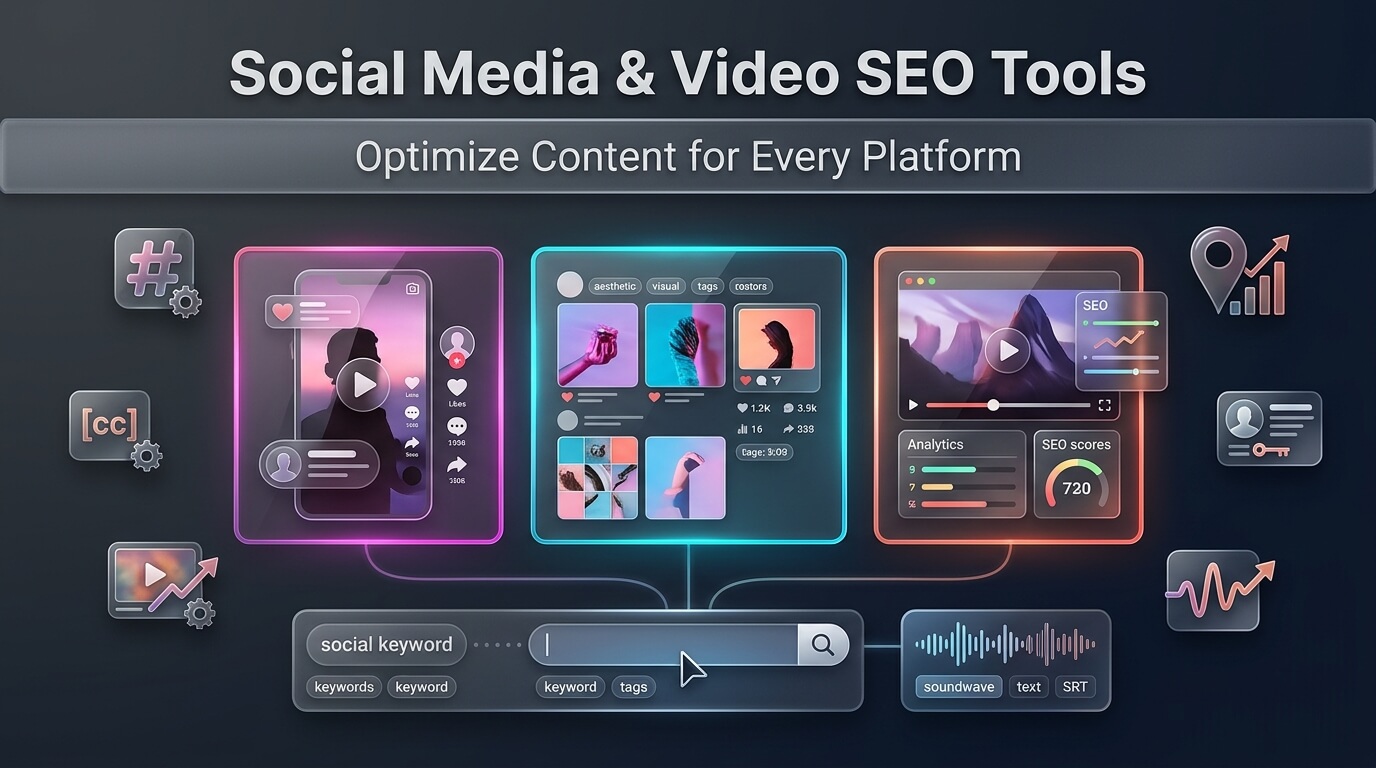
Social media feeds are no longer just chronological timelines. Today, platforms like TikTok, Instagram, YouTube, Pinterest, and LinkedIn operate as powerful search engines. Millions of consumers search directly inside social apps for product reviews, how-to guides, and local recommendations. If your brand relies solely on hashtags and luck, your posts miss massive organic traffic.
Implementing targeted social media seo tools allows creators and brands to optimize captions, subtitles, audio tracks, and metadata. These platforms analyze search query volumes across social networks. They reveal exactly what phrases your target audience types into search bars. In addition, dedicated video seo tools help video producers rank long-form guides and short-form video clips on Google and YouTube.
Key Takeaways for Social Media & Video Optimization
- Social platforms now prioritize keyword relevance in captions, transcripts, and on-screen text over generic hashtag spam.
- Using dedicated seo tools for social media helps creators find high-intent search terms across TikTok, Instagram, and Pinterest.
- Optimizing video content with specialized youtube video seo tools captures valuable real estate in Google universal search results.
- Free tools like free social media seo tools dashboards provide immediate search term data without upfront costs.
- Cross-platform keyword research ensures your messaging remains consistent across feeds, video channels, and search engines.
The Evolution of Social Media into Visual Search Engines
Consumer search behavior has changed dramatically over recent years. Younger audiences frequently turn to TikTok or Instagram instead of traditional web search engines when looking for dining spots, fashion advice, or software tutorials. These visual platforms deliver immediate, authentic user experiences that text-heavy web pages struggle to match.
Social network algorithms have adapted to this shift. They now index spoken audio, closed captions, bio descriptions, and on-screen graphic overlays. When you include natural search phrases in your video speech and caption copy, your content surfaces directly in search results. This shift creates a massive opportunity for brands that master social optimization.
Modern marketing teams treat social channels as organic search assets. Rather than posting one-off viral clips, they build lasting content libraries. By pairing traditional search tactics with modern social analytics, you capture high-intent buyers across every stage of the digital customer journey.
Search algorithms index closed captions and spoken dialogue automatically. Always speak your primary target keywords clearly within the first five seconds of your video. In addition, ensure your auto-generated captions match the spoken words accurately to maximize social search rankings.
How Social Algorithms Evaluate Video and Visual Content
Search engines inside social apps use multi-layered artificial intelligence models to understand video files. They do not rely solely on what you write in the description box. Instead, they scan the entire audio-visual presentation.
1. Optical Character Recognition on Screen Text
Modern video platforms scan video frames for readable text. When you add title cards, bullet points, or subtitle stickers, computer vision models extract those words. If your on-screen graphics match the user search query, your video receives a higher ranking score.
2. Natural Language Processing on Spoken Audio
Speech-to-text models transcribe spoken words in real time. Algorithms analyze the transcript to determine topical relevance and semantic depth. If a creator repeatedly explains technical steps with accurate terminology, the system categorizes the clip as an educational authority.
3. Visual Scene and Object Categorization
Neural networks classify the physical objects shown in your camera footage. A video showing baking pans, flour, and ovens is automatically indexed under culinary arts, even if the creator omits cooking hashtags. Visual accuracy prevents creators from gaming algorithms with misleading titles.
4. Viewer Engagement and Completion Velocity
Search rankings on social platforms weigh user satisfaction heavily. Algorithms evaluate how long viewers watch, whether they re-watch specific segments, and how frequently they share the clip. Videos with high completion rates rank above clips with clickbait titles that cause quick viewer drop-offs.
Platform-by-Platform Optimization: How Social Search Algorithms Work
Every major social channel operates a distinct indexing algorithm. Understanding how each platform ranks content enables you to tailor your optimization strategy for maximum organic reach.
1. TikTok Search Optimization
TikTok search engine evaluates multiple technical elements to categorize clips. Using dedicated tiktok seo tools, creators identify trending search phrases that appear in the TikTok auto-suggest search bar. The algorithm evaluates your spoken audio, on-screen text banners, video descriptions, and up to five relevant hashtags. Applying specialized seo tools for tiktok ensures that your educational clips rank at the top of query results for months after publication.
2. Instagram Search & Feed Optimization
Instagram uses text relevance across profile bios, usernames, post captions, and alt text. Leading instagram seo tools help marketers research semantic keyword clusters rather than relying on bloated hashtag blocks. For budget-conscious creators, testing instagram seo tools free options reveals niche search terms with low competition. By using capable seo tools for instagram, your posts rank in both the recommendation feed and the internal search tab.
3. YouTube & Video Search (Long-Form and Shorts)
YouTube represents the second-largest search engine on the planet. Producing video content requires thorough keyword research across titles, descriptions, chapters, and tags. Creators use seo tools for youtube shorts to optimize vertical video clips for the Shorts feed. Meanwhile, comprehensive youtube seo tools for videos ensure long-form tutorials earn prime positions on both YouTube search and Google universal video carousels.
4. Pinterest Visual Search
Pinterest functions almost entirely as a visual search engine and shopping catalog. Pin titles, board descriptions, and image overlay text directly dictate search placement. Implementing dedicated pinterest seo tools helps e-commerce stores identify seasonal buying queries months in advance. Using strategic seo tools for pinterest drives continuous, compounding referral traffic back to your product catalog.
5. Facebook Search & Community Feeds
Facebook indexes public page content, group discussions, and video descriptions. Utilizing modern facebook seo tools allows community managers to structure page bios and post updates around frequent user queries. Testing facebook seo tools free utilities helps non-profit organizations and small businesses identify community topics. Applying seo tools for facebook helps business pages maintain high visibility across local recommendations.
6. LinkedIn Professional Search
LinkedIn search algorithm evaluates professional headlines, article titles, newsletter topics, and post hashtags. Implementing linkedin seo tools allows B2B consultants and enterprise software brands to optimize corporate profiles for high-value executive queries. Using tailored seo tools for linkedin positions your executive team as authoritative industry thought leaders.
7. Twitter / X Real-Time Search
Real-time breaking discussions require immediate semantic relevance. Utilizing modern twitter seo tools helps media brands identify emerging conversation spikes before they hit mainstream news cycles. Deploying targeted seo tools for twitter ensures that your analytical commentary surfaces during trending industry debates.
Essential Features to Look for in Social and Video SEO Tools
Choosing software to manage cross-platform search requires evaluating several operational capabilities. The best platforms combine search listening, tag management, and performance tracking into one unified workflow:
- Social Auto-Suggest Scraping: The platform should pull real-time search recommendations directly from TikTok, Instagram, YouTube, and Pinterest search bars.
- Closed Caption and Transcript Optimization: Look for software that transcribes video audio and highlights keyword density across spoken words.
- Competitor Video Auditing: The tool must inspect competitor video tags, description structures, and viewer engagement ratios side by side.
- Hashtag and Keyword Grouping: Organizing keywords into reusable thematic buckets saves time during content production sprints.
- Cross-Platform Scheduling Integration: Connecting keyword optimization directly to post publishing calendars streamlines team productivity.
- Free and Freemium Accessibility: Beginners benefit from social media seo tools free tiers to validate strategies before upgrading to enterprise plans.
Review of the 8 Best Social Media & Video SEO Tools
We tested leading market software across search intelligence, video metadata auditing, multi-platform compatibility, and pricing value. Below is an exhaustive breakdown of the top eight tools for content creators and social marketers.
1. vidIQ
vidIQ is widely recognized as one of the premier seo tools for video content available today. Designed specifically for video producers and channel managers, vidIQ provides a suite of analytics that hooks directly into YouTube and web browser interfaces.
The platform features a powerful Keyword Research tool that scores queries based on search volume and competition difficulty. It provides daily video topic ideas based on predictive artificial intelligence, helping creators produce content that matches current viewer appetite. The tool includes an in-depth Competitors tool that tracks competitor views per hour, showing which topics gain momentum in real time.
For creators managing short-form vertical clips, vidIQ provides specialized analytics for the YouTube Shorts shelf. You can audit video tags, examine description keyword placement, and compare thumbnail CTR performance. vidIQ offers a capable free tier alongside affordable Pro subscriptions, making it an indispensable asset for video growth.
Channel owners benefit from the SEO Scorecard module. When viewing any video on YouTube, vidIQ displays an instant audit showing tag volume, keyword rank in search, social shares, and end-screen usage. This transparent breakdown reveals exactly why competitor videos rank at the top of query results.
2. TubeBuddy
TubeBuddy is a premier browser extension and channel management toolkit officially certified by YouTube. It streamlines daily channel operations, tag research, and metadata optimization across large video archives.
TubeBuddy standout capability is its Keyword Explorer. The tool evaluates search volume, competition, and overall optimization scores tailored specifically to your channel size. It reveals related search terms, trending queries, and common questions asked by real viewers. In addition, TubeBuddy offers automated A/B testing for video thumbnails and titles, allowing creators to let live data determine the highest-converting assets.
The platform also includes bulk processing tools. Channel owners can update cards, end screens, and video description links across hundreds of published videos in a single click. For video teams seeking dependable seo tools for video distribution, TubeBuddy remains a gold-standard choice.
The Search Rank Tracking feature monitors keyword positions over time across YouTube search and Google search results. You can receive automated notifications when a video drops out of top three rankings, allowing you to refresh video descriptions or adjust title tags to regain organic traction.
3. Sprout Social
Sprout Social is an enterprise-grade social media management and social listening platform. While widely known for scheduling and customer care, its advanced listening features make it an exceptional tool for cross-network social SEO.
Sprout Social Listening module monitors millions of public conversations across Twitter, Facebook, Instagram, Reddit, and YouTube. Marketers can track brand mentions, industry keywords, and emerging audience queries. This deep listening intelligence reveals the exact language consumers use when discussing product categories.
The platform features comprehensive sentiment analysis and competitive benchmarking reports. Agencies can package social trend data into beautiful client presentations. While Sprout Social requires an enterprise investment, its comprehensive data depth makes it the preferred tool for global brands.
Sprout Social also integrates customer sentiment tagging. By analyzing user comments on product announcements, teams identify customer pain points and natural phrasing. Writers then weave these exact customer queries into upcoming blog posts and social captions to match search intent.
4. Hootsuite
Hootsuite is a pioneer in social media management, offering scheduling, analytics, and social search monitoring across all major social networks. It provides a centralized dashboard where teams manage feeds across Facebook, Instagram, TikTok, LinkedIn, Pinterest, and Twitter.
Hootsuite features built-in search streams that track specific keywords, hashtags, and location-based mentions in real time. Content teams can identify trending conversational topics and participate in relevant discussions instantly. The platform also integrates OwlyWriter AI, which generates search-optimized captions and keyword-rich hooks tailored to specific social networks.
Hootsuite unified analytics dashboard measures engagement, reach, and click-through rates across all connected profiles. This unified reporting proves how social search optimization contributes to overall brand growth and website traffic.
Marketing teams utilize Hootsuite custom approval workflows to maintain brand quality. Before any post goes live, senior editors check that proper keywords, audio tags, and alt descriptions are present. This quality control prevents publishing incomplete or un-optimized social updates.
5. Tailwind
Tailwind is the ultimate visual marketing and search automation platform built specifically for Pinterest and Instagram. E-commerce businesses, food bloggers, and lifestyle publishers consider Tailwind essential for organic visual search dominance.
Tailwind SmartLoop and Pin Scheduler automate publishing at optimal engagement times. More importantly, its Ghostwriter AI generates keyword-rich pin titles, board descriptions, and image alt text based on current Pinterest search demand. It identifies seasonal keyword trends, allowing brands to publish holiday pins weeks before consumer search volume peaks.
For Instagram creators, Tailwind provides an intelligent Hashtag Finder that categorizes tags into Good, Best, and Competitive tiers. This balanced mix ensures your posts reach both niche audiences and broader recommendation feeds without triggering spam flags. Tailwind offers a free plan to help beginners establish their visual search presence.
Tailwind Communities enable creators in similar niches to collaborate and share each other visual pins. When authoritative group members pin your content, Pinterest search algorithms view your domain as highly trusted, accelerating organic pin placement across search feeds.
6. Keyhole
Keyhole is a dedicated real-time social listening, hashtag analytics, and social search monitoring platform. It provides high-accuracy tracking across TikTok, Instagram, Twitter, YouTube, and LinkedIn.
Keyhole specializes in tracking hashtag reach, sentiment, and viral velocity. For TikTok and Instagram creators, Keyhole reveals which hashtags generate actual impressions versus empty bot engagement. The platform identifies top-performing influencers and keywords driving conversations around specific industry topics.
The software features an intuitive social search tracker that alerts teams to emerging industry phrases before they peak in popularity. Agencies use Keyhole automated reporting dashboards to demonstrate social campaign reach and audience growth to commercial clients.
The platform provides sentiment tracking charts that show whether public reactions to a keyword are positive, neutral, or negative. This context helps social media teams avoid jumping on controversial search trends that could alienate target buyers.
7. Flick
Flick is a modern social marketing platform designed to help creators, agencies, and small businesses grow on Instagram and TikTok through intelligent search optimization.
Flick Hashtag Search tool allows marketers to research, manage, and analyze hashtags in seconds. It suggests relevant, low-competition tags that improve ranking chances on the Instagram search page. The platform also offers an AI Social Media Assistant that crafts engaging, keyword-rich captions tailored to your brand voice.
Flick includes advanced post analytics that measure which specific hashtags and search terms delivered impressions. This feedback loop allows marketing teams to refine their keyword buckets continuously for improved organic visibility.
Flick Banned Hashtag Checker protects your account health. Instagram occasionally restricts hashtags associated with spam or policy violations. Flick alerts you if any of your saved tags become flagged, preventing your posts from being hidden from search feeds.
8. BuzzSumo
BuzzSumo is the premier content research and viral trend tracking platform on the web. It analyzes billions of articles and social posts across Facebook, Twitter, Pinterest, and Reddit to reveal what content resonates with online audiences.
BuzzSumo Question Analyzer scans thousands of forum threads, Quora inquiries, and Amazon product reviews to find the exact questions consumers ask about any topic. This search listening data allows video producers and social creators to design content that answers urgent customer problems directly.
The platform also tracks viral Facebook engagement, showing which video formats, headline styles, and topics generate maximum shares. For content marketers who want to validate video and social ideas with concrete historical data before shooting footage, BuzzSumo provides unmatched market intelligence.
BuzzSumo Journalist and Influencer directory connects creators with authoritative social voices. Pitching your optimized video tutorials to relevant industry journalists helps earn powerful social shares and editorial backlinks, amplifying your overall organic search visibility.
Social Media and Video SEO Software Comparison Table
Evaluating available tools side by side helps you match software capabilities with your specific platform focus. The table below outlines primary strengths, key supported networks, best user audiences, and pricing models across all eight platforms.
| Tool Name | Primary Focus | Supported Platforms | Best Suited For | Pricing Structure |
|---|---|---|---|---|
| vidIQ | YouTube & Shorts keyword optimization | YouTube, YouTube Shorts | YouTubers & Video Creators | Free or from $7.50/mo |
| TubeBuddy | A/B testing & bulk video tag updates | YouTube | Channel Managers & Video Editors | Free or from $4.99/mo |
| Sprout Social | Enterprise social listening & topic audits | All major social networks | Enterprise Brands & Agencies | Starts at $249.00/mo |
| Hootsuite | Multi-channel streams & AI caption writing | Facebook, IG, TikTok, LinkedIn, X | Marketing Teams & Social Pros | Starts at $99.00/mo |
| Tailwind | Visual search & Pinterest pin keywords | Pinterest, Instagram, Facebook | E-commerce & Bloggers | Free or from $14.99/mo |
| Keyhole | Real-time hashtag tracking & viral reach | TikTok, IG, Twitter, YouTube | Influencer Agencies & PR Brands | Starts at $89.00/mo |
| Flick | Hashtag tier analysis & caption generation | Instagram, TikTok | Content Creators & Boutiques | Starts at £11.00/mo |
| BuzzSumo | Viral topic research & question finding | Facebook, Twitter, Pinterest, Web | Content Strategists & Writers | Starts at $199.00/mo |
Free vs Paid Social SEO Tools: Choosing the Right Setup
Budget constraints often force creators to choose between free online options and premium subscriptions. Fortunately, deploying seo video tools free utilities can kickstart your channel without financial risk. Built-in search bars on TikTok, YouTube, and Pinterest cost nothing and offer direct insight into real user query habits.
Google Trends provides another exceptional free resource for social marketers. It shows whether search volume for a topic is growing or declining over time. Pairing Google Trends with free browser extensions gives creators a strong competitive edge during initial channel launches.
However, professional agencies managing multiple brand accounts quickly outgrow free tools. Enterprise software provides automated cross-posting, competitor alerting, historical performance tracking, and white-label client reporting. If you publish dozens of posts weekly across multiple client channels, paid software pays for itself in saved labor hours.
Step-by-Step Playbook for Cross-Platform Social SEO
Achieving consistent organic search visibility across feeds requires a disciplined editorial workflow. Follow this practical five-step routine before publishing content on any social or video network.
The Standard Operating Procedure for Multi-Platform Optimization
- Perform Platform-Specific Query Research: Type your core concept into the native search bar of your target network. Note the auto-complete suggestions to identify exact phrasing.
- Script and Speak Your Target Keywords Naturally: State your primary target keyword within the opening five seconds of your video footage. This ensures auto-caption engines index your core topic immediately.
- Draft a Keyword-Rich Caption and Hook: Write a descriptive caption containing two to three natural variations of your target keyword. Avoid stuffing raw keywords without context.
- Apply Structured Category Tags and Hashtags: Add three to five specific, highly relevant hashtags. Mix broad topic tags with focused niche tags to balance search reach.
- Verify Closed Captions and Image Alt Text: Review automated transcripts for spelling accuracy. Add descriptive alt text to still images to assist visually impaired users and search crawlers.
Common Mistakes to Avoid in Social and Video SEO
Many creators apply outdated SEO techniques to modern social platforms, hurting their organic reach. Avoiding these common mistakes keeps your content eligible for top search rankings:
1. Stuffing Bloated Blocks of Irrelevant Hashtags
Pasting thirty generic hashtags like #viral, #fyp, or #foryou into post captions looks spammy and confuses modern indexing algorithms. Algorithms categorize content based on contextual language, not generic hashtag walls. Stick to three to five focused tags that accurately describe your post.
2. Neglecting On-Screen Text and Graphic Overlays
Modern video algorithms read on-screen text banners using optical character recognition. If your video lacks clear on-screen titles, search bots miss vital contextual signals. Always place clean headline text within the top third of your video frames.
3. Forgetting Video Chapters and Timestamps
Long-form video tutorials benefit greatly from structured timestamps in the video description. Search engines display these timestamps as clickable key moments directly in Google search results. Adding chapters dramatically increases organic click-through rates.
4. Ignoring Sound Track Relevance and Voice Audio
TikTok and Instagram index trending background audio tracks alongside spoken dialogue. Using trending audio tracks relevant to your niche increases the likelihood of your video being recommended in audio search feeds.
Frequently Asked Questions About Social Media and Video SEO Tools
How does social media SEO differ from traditional website SEO?
Traditional SEO focuses on optimizing website code, backlinks, and long-form written articles for search engines like Google and Bing. Social media SEO optimizes video transcripts, spoken dialogue, profile bios, and post captions for internal search algorithms on apps like TikTok, YouTube, and Instagram.
Can social media posts rank directly on Google search results?
Yes. Google frequently indexes YouTube videos, TikTok clips, Pinterest boards, and LinkedIn articles directly in its universal search results. Optimizing social content increases your brand chances of capturing multiple search results on page one.
Are hashtags still important for social media search rankings?
Hashtags remain useful for topical categorization, but their relative importance has decreased. Modern search algorithms rely far more heavily on spoken dialogue, closed captions, profile bio keywords, and natural language in post captions than on raw hashtags.
How do video chapters help YouTube and Google search visibility?
Video chapters break long recordings into discrete topical segments. Google surfaces these timestamps as Key Moments in search results, allowing users to jump directly to the specific answer they need. This feature boosts viewer satisfaction and click-through rates.
What is the most effective free tool for social media keyword research?
The native auto-suggest search bar on platforms like TikTok, YouTube, and Pinterest is the most accurate free research tool available. It shows the exact real-time phrases users type, giving creators direct insight into audience demand without software costs.
Final Thoughts: Dominating Search Across Every Digital Feed
The boundary between traditional search engines and social media networks has dissolved. Consumers expect fast, visual, and engaging answers wherever they spend their digital time. By implementing dedicated social media seo tools and disciplined optimization workflows, you protect your brand from invisibility.
Pairing keyword-optimized video production with multi-channel search listening ensures that your content meets your target audience at their moment of curiosity. Invest in dependable tools, focus on audience intent, and watch your social and video channels drive sustainable organic growth.