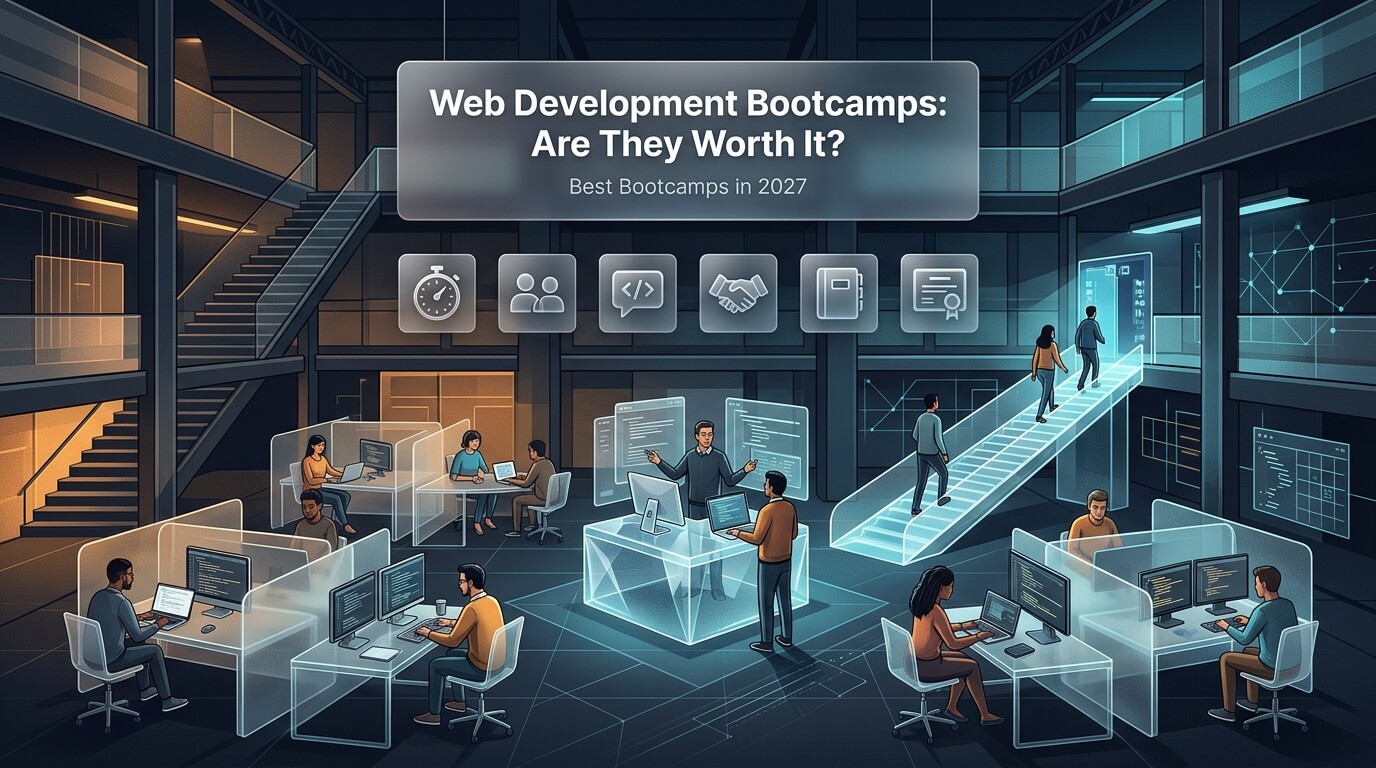
Web development bootcamps have reshaped software education over the last decade. They condense multi-year computer science degrees into intensive, hands-on learning sprints, preparing career changers for high-paying software engineering positions across global tech hubs.
What Is a Web Development Bootcamp?
Breaking into the software technology industry traditionally required a four-year university degree in computer science. However, the accelerating demand for digital applications created a massive engineering talent deficit.
A web development bootcamp is an intensive, accelerated training program designed to teach practical, job-ready programming skills in a fraction of traditional academic timelines. Instead of theoretical calculus and compiler design, bootcamps focus strictly on technologies utilized in commercial workplaces.
Students spend hundreds of hours writing code, building production-grade web applications, and participating in agile team sprints. They master version control with Git, construct modern user interfaces, and deploy secure backend APIs to cloud hosting platforms.
Beyond technical instruction, reputable bootcamps provide dedicated career coaching, resume workshops, and technical interview simulations. This comprehensive career acceleration makes bootcamps a popular alternative for motivated career switchers worldwide.
A coding bootcamp does not promise effortless overnight success. It provides an immersive, structured environment with experienced mentorship, peer accountability, and an industry-vetted curriculum designed to fast-track your path to a professional engineering salary.
Types of Web Development Bootcamp Formats
Every student balances unique financial, professional, and family obligations when planning a career transition. Modern coding academies offer several instructional delivery models to accommodate diverse lifestyles.
Understanding these distinct learning structures helps prospective students choose a program that aligns with their personal availability and financial circumstances.
1. Full-Time Immersive Programs
Full-time immersive bootcamps require forty to sixty hours of active study per week, typically spanning twelve to sixteen weeks. Students attend daily live lectures, complete collaborative pair programming exercises, and participate in daily agile standup meetings.
This rigorous format mimics real-world software engineering environments. Because of the demanding daily schedule, students cannot maintain outside employment during the program. However, it delivers the fastest route to market for motivated individuals seeking an immediate career transition.
2. Part-Time and Evening Programs
For individuals who cannot afford to leave their current jobs, a web development bootcamp part-time schedule provides a sustainable alternative. These programs distribute the curriculum across six to nine months with evening lectures and weekend lab sessions.
Part-time students commit fifteen to twenty hours weekly to coursework and independent programming assignments. This flexible pacing allows career changers to protect their existing income while methodically building the technical portfolio needed to transition into tech.
3. Online Remote vs In-Person Campus Cohorts
Aspiring developers frequently debate whether to attend an in-person cohort or enroll in a web development bootcamp online. Online programs eliminate relocation expenses and commute times, offering access to elite Silicon Valley instructors from any geographical location.
Meanwhile, searching for a web development bootcamp near me appeals to students who thrive in physical classroom settings. In-person campuses foster face-to-face peer networking, quiet study halls, and immediate access to on-site teaching assistants.
4. Self-Paced Mentored Tracks
Self-paced tracks allow students to progress through curriculum modules as fast or as methodically as their personal schedule permits. Students meet weekly with an assigned industry mentor for code reviews, portfolio feedback, and technical interview preparation.
This model requires exceptional personal discipline and self-motivation. Students who manage their time effectively can complete the curriculum rapidly, reducing overall living expenses during their career pivot.
Comparison of Bootcamp Learning Models
- Full-Time Immersive: 12–16 weeks, 50+ hours/week, zero outside work, fastest job readiness.
- Part-Time Flexible: 24–36 weeks, 18–22 hours/week, maintain existing employment.
- Live Online: High flexibility, access to top instructors nationwide, zero commute.
- In-Person Campus: Dedicated physical environment, face-to-face peer accountability.
What Do You Learn in a Modern Web Development Bootcamp Full Stack Curriculum?
The tech industry expects developers to understand how modern applications operate from client viewports to cloud databases. Leading academies structure their programs around a comprehensive web development bootcamp full stack curriculum.
Students progress through sequential technical milestones designed to build confidence and real-world problem-solving abilities.
Phase 1: Web Fundamentals and Modern JavaScript
Students begin by learning semantic HTML5 for accessible page structure and CSS3 Grid and Flexbox for responsive visual layouts. They dive deep into ECMAScript (JavaScript), mastering DOM events, asynchronous promises, array methods, and object destructuring.
Phase 2: Frontend Engineering with React and TypeScript
Next, students adopt modern frontend libraries. They construct interactive user interfaces using React, manage component state with hooks, and style components with Tailwind CSS. Adding TypeScript teaches students static type safety, eliminating bugs during team development sprints.
Phase 3: Backend APIs and Relational Databases
The curriculum shifts to server environments using Node.js and Express. Students learn RESTful API architecture, JSON payload parsing, and secure user authentication using JSON Web Tokens (JWTs) and bcrypt password hashing. They design normalized relational database schemas in PostgreSQL and execute complex queries using Prisma ORM.
Phase 4: Capstone Architecture, Testing, and Deployment
In the final phase, students collaborate in small agile teams to architect a custom, full-stack capstone application from scratch. They write automated unit and integration tests, containerize their code with Docker, and deploy live applications to platforms like Vercel and Render. This working software serves as the centerpiece of their professional hiring portfolio.
Evaluating Web Development Bootcamp Cost and Financing Models
Tuition is a critical consideration for anyone evaluating an educational career transition. The total web development bootcamp cost varies widely depending on program format, institutional prestige, and career support services.
In the United States, tuition ranges from $10,000 for self-paced online programs to $22,000 for elite full-time immersive cohorts. Academies offer several financing structures to make tuition accessible to diverse economic backgrounds.
- Upfront Tuition Payment: Most bootcamps offer a $1,000 to $2,500 discount for paying upfront.
- Monthly Installment Plans: Spreading payments evenly across the program duration with zero interest.
- Income Share Agreements (ISAs): Students pay zero upfront tuition, paying a fixed percentage of their salary after landing a qualifying tech job.
- Private Student Loans: Specialized educational lenders like Ascent Funding and Climb Credit offer deferred payment loans.
- Tuition Money-Back Guarantees: Full tuition refunds if graduates fail to secure a software job within six to nine months of graduation.
What Does Web Development Bootcamp Reddit Say? Real Student Perspectives
When investigating prospective programs, smart career changers read verified web development bootcamp reviews and turn to online peer forums for unfiltered feedback. Discussions on web development bootcamp reddit offer valuable grounded perspectives beyond polished marketing brochures.
Community members frequently emphasize that bootcamps are not magic tickets to effortless employment. Successful graduates note that ninety percent of your outcome depends on the hours of deliberate practice you invest outside scheduled lectures.
Reddit reviewers advise prospective students to learn basic programming fundamentals before enrolling. Completing introductory HTML, CSS, and JavaScript tutorials beforehand prevents students from falling behind during fast-paced early curriculum weeks.
Furthermore, Reddit alumni praise programs that provide transparent, third-party audited job placement data through the Council on Integrity in Results Reporting (CIRR). CIRR-verified reports prove authentic graduate employment percentages and median starting salaries.
Top 8 Web Development Bootcamps and Learning Platforms Reviewed
Selecting the best web development bootcamp requires evaluating curriculum quality, mentor access, graduate employment outcomes, and tuition value. Below is an exhaustive technical review of the eight most prominent bootcamps and platforms in the modern education landscape.
1. Flatiron School
Flatiron School is a premier coding academy offering full-time and part-time software engineering bootcamps both online and at physical campuses. It maintains an outstanding reputation for rigorous software engineering education.
Its curriculum covers modern JavaScript, React, Python, Flask, and SQL databases, giving graduates full-stack flexibility. Students collaborate on agile team projects that mirror real commercial development environments. Flatiron School provides dedicated 1-on-1 career coaching, portfolio reviews, and a vast employer network of hiring partners.
With transparent outcomes reporting and flexible financing options, Flatiron School remains a top recommendation for students seeking comprehensive immersion and high-accountability career transition support.
2. Springboard
Springboard is an innovative online learning platform specializing in mentored career tracks with job guarantees. It is engineered specifically for working professionals who require flexibility.
The Software Engineering Career Track features a curriculum designed in partnership with Colt Steele, covering frontend React, backend Node.js and Python, and data structures. Students are paired with an experienced senior software engineer who conducts weekly 1-on-1 mentorship video calls. Springboard also provides dedicated career advisors who guide salary negotiation strategies.
Springboard offers a tuition-back guarantee if eligible graduates do not secure a qualifying software engineering job within six months of completion, making it a low-risk option for disciplined online learners.
3. General Assembly
General Assembly is a global pioneer in technology education with physical campuses across North America, Europe, Asia, and Australia, alongside robust online cohorts. It boasts an alumni network of over 100,000 graduates worldwide.
Its Software Engineering Immersive teaches full-stack JavaScript, React, Python, Django, and database engineering. Students benefit from frequent guest lectures by industry leaders, hackathons, and exclusive hiring showcase events. General Assembly maintains partnerships with Fortune 500 corporations actively recruiting entry-level tech talent.
For career changers who value global brand recognition, vast alumni networking circles, and established corporate hiring pipelines, General Assembly is an exceptional choice.
4. App Academy
App Academy is celebrated for having one of the most intellectually rigorous and selective software engineering bootcamps in the world. It popularized the deferred tuition and Income Share Agreement model in tech education.
The curriculum emphasizes deep computer science foundations, algorithm efficiency, dynamic programming, and full-stack development using Python, JavaScript, React, and Flask. Students undergo rigorous weekly technical assessments to verify total mastery of concepts before advancing. Its alumni work at leading technology titans including Google, Meta, and Apple.
App Academy is best suited for highly driven individuals ready to commit full-time to an intense, demanding academic boot camp experience.
5. Thinkful
Thinkful, a Chegg service, offers flexible online software engineering bootcamps with individualized 1-on-1 mentorship. It focuses on practical project-based learning tailored to individual student schedules.
The curriculum emphasizes modern JavaScript, Node.js, React, and automated testing frameworks. Students receive multiple weekly mentorship sessions with senior developers who provide granular pull request reviews. Thinkful’s dedicated career services team assists with resume crafting, LinkedIn optimization, and mock technical whiteboarding interviews.
Its combination of flexible pacing, direct mentorship access, and diverse financing options makes Thinkful a strong contender for career changers balancing busy life schedules.
6. CareerFoundry
CareerFoundry is a leading European-based online academy delivering fully remote, flexible tech career tracks with verified job guarantees. It pairs every student with both a personal tutor and an expert industry mentor.
The Full-Stack Web Development Program guides students from absolute beginner fundamentals through advanced React, serverless functions, Progressive Web Apps (PWAs), and MongoDB persistence. Tutors review and approve every assignment within twenty-four hours, while senior mentors provide strategic architectural guidance. CareerFoundry guarantees a full tuition refund if graduates do not land a tech role within 180 days of graduation.
Its dual-mentor support system and self-paced scheduling make CareerFoundry one of the most supportive environments for independent remote learners.
7. freeCodeCamp
freeCodeCamp is a world-renowned non-profit educational platform providing a 100% free, comprehensive software engineering curriculum. It represents the premier web development bootcamp free alternative globally.
Its structured curriculum includes verified certifications in Responsive Web Design, JavaScript Algorithms and Data Structures, Front End Development Libraries, and Back End Development and APIs. To earn each certification, students must build five complex capstone projects that pass automated unit test suites. Thousands of graduates have landed engineering jobs at companies like Microsoft, Spotify, and Amazon without spending a single dollar on tuition.
For self-disciplined learners seeking a zero-cost path to software engineering, freeCodeCamp stands as an extraordinary educational resource.
8. The Odin Project
The Odin Project is an open-source, community-driven full-stack curriculum that teaches real-world software engineering from the ground up. It guides students through configuring a real local development environment on their own computer.
Rather than relying on browser-based code sandboxes, students use real command-line terminals, Git version control, and VS Code. The curriculum offers two distinct full-stack tracks: Full Stack Ruby on Rails and Full Stack JavaScript (Node.js & React). Students build extensive portfolio applications and receive code feedback from a vibrant community of over 500,000 active Discord developers.
The Odin Project is universally praised across developer forums as one of the most authentic, practical, and effective free coding bootcamps available on the web.
Comprehensive Bootcamp Comparison: Top Programs Compared
Selecting your educational path requires analyzing tuition costs, delivery formats, duration, and career outcomes. The table below provides an objective side-by-side comparison of top web development bootcamps and learning platforms.
| Bootcamp / Platform | Format & Pacing | Approximate Cost | Job Guarantee? | Primary Strength |
|---|---|---|---|---|
| Flatiron School | Full-Time / Part-Time (Online & Campus) | $16,900 | No (Career Coaching) | High accountability and strong employer network. |
| Springboard | Self-Paced Mentored (Online) | $9,900 – $11,500 | Yes (Money-Back) | Weekly 1-on-1 industry mentor video calls. |
| General Assembly | Full-Time / Part-Time (Global Campuses) | $16,450 | No (Career Placement) | Massive global corporate alumni network. |
| App Academy | Full-Time Immersive (Online) | $17,000 – $22,000 (ISA) | Deferred / ISA Available | Rigorous algorithmic and computer science focus. |
| Thinkful | Flexible / Full-Time (Online) | $9,500 – $16,000 | Tuition Refund Guarantee | Individualized tutoring and flexible pacing. |
| CareerFoundry | Self-Paced Flexible (Online) | $8,500 | Yes (Money-Back) | Dual-mentor model with 24-hour task reviews. |
| freeCodeCamp | Self-Paced Independent (Online) | 100% Free | No (Self-Driven) | Zero financial barrier and verified certificates. |
| The Odin Project | Self-Paced Open Source (Online) | 100% Free | No (Community Driven) | Realistic local tooling and active Discord support. |
How to Choose the Right Web Development Bootcamp for Beginners
Choosing an academy is a significant financial and emotional commitment. Prospective students should conduct thorough due diligence before signing enrollment agreements.
Following a structured evaluation framework ensures you select an academy that aligns with your career goals and learning preferences.
Checklist: Evaluating Coding Bootcamps
- Audited Outcomes: Does the school publish CIRR-verified graduation and employment statistics?
- Curriculum Currency: Does the program teach modern TypeScript and React, or outdated jQuery and PHP?
- Instructor Qualifications: Are lectures taught by experienced senior engineers or recent bootcamp grads?
- Career Support Duration: Does career coaching continue until you secure a job, or end at graduation?
- Financial Terms: What are the exact terms, interest rates, and minimum salary thresholds for ISAs?
Taking the time to attend admissions information sessions and speaking with recent alumni on LinkedIn will give you candid insights into daily student life and graduate hiring support.
Are Web Development Bootcamps Worth It in 2027?
The modern software engineering job market has matured. Tech employers no longer hire candidates simply for knowing basic syntax. Companies seek engineers who can build resilient applications, understand data structures, and solve complex business problems.
Web development bootcamps remain highly worthwhile investments for disciplined students who treat the experience as a full-time professional commitment. When compared to the $120,000 cost and four-year duration of a university degree, a $12,000 to $16,000 bootcamp that leads to an $85,000 engineering salary delivers extraordinary financial return on investment.
However, bootcamps are not suitable for passive learners expecting effortless outcomes. Success requires hundred of hours of independent coding, continuous project building, and relentless technical interview preparation.
Strategic Summary for Career Changers
A web development bootcamp is an accelerated bridge into the technology economy. Build programming fundamentals before day one, embrace difficult debugging challenges, and craft a distinct capstone portfolio that showcases your problem-solving abilities to hiring managers.
Career Acceleration
Verified ROI
The Reality of the Tech Job Search After Bootcamp Graduation
Completing your coding bootcamp is only the first major milestone of your career transition. The subsequent job search is an intensive, multi-month campaign that demands resilience and strategic networking.
According to CIRR employment reports, the average bootcamp graduate requires between three to six months to secure their first engineering offer. The job search is not a passive numbers game of blindly submitting hundreds of generic applications on automated job boards.
Successful graduates treat their job search like a full-time engineering sprint. They spend twenty hours per week building new feature enhancements for their capstone projects, contributing to open-source software repositories, and solving algorithmic coding challenges on LeetCode. They dedicate another twenty hours to targeted networking, reaching out directly to engineering managers on LinkedIn, attending local tech meetups, and scheduling informational coffee chats.
Landing your first software engineering role requires proving that you can learn quickly, communicate clearly under pressure, and collaborate effectively inside a distributed engineering organization.
How to Avoid Coding Bootcamp Scams and Predatory ISAs
The rapid expansion of the bootcamp industry attracted unscrupulous operators focused more on predatory tuition financing than educational outcomes. Career changers must recognize red flags before signing legally binding contracts.
Be cautious of academies that promise guaranteed $100,000 starting salaries with zero prior experience. In reality, salary outcomes vary based on geographic location, prior professional background, and local market demand. A reputable school provides transparent, unedited salary ranges supported by independent audit reports.
Examine Income Share Agreements (ISAs) with extreme care. In a predatory ISA, the payment cap can reach up to two times the cash tuition price, forcing graduates to pay over $40,000 back to the school over four years. Verify the minimum salary threshold required before payments trigger. A student-friendly ISA sets the threshold at $50,000 or higher and features a payment cap of no more than 1.5 times the upfront tuition.
Furthermore, avoid academies that do not require any technical admissions screening. Programs that accept everyone without assessing aptitude often suffer from high student dropout rates and diluted classroom instruction quality.
The Essential Capstone Project Playbook: Standing Out to Hiring Managers
In a competitive hiring market, generic tutorial clones like basic todo lists, weather widgets, and simple clones of Netflix will not impress senior engineering hiring managers. Your portfolio capstone project must demonstrate authentic engineering creativity.
The most compelling student capstone projects solve a real business or community problem. Instead of a generic e-commerce storefront, build an inventory optimization dashboard for a local non-profit. Instead of a simple chat room, construct an automated real-time translation tool using WebSockets and machine learning APIs.
Ensure your project documentation is pristine. Write an exhaustive README file on GitHub complete with architectural diagrams, animated GIF demonstrations, and step-by-step instructions for running the application locally using Docker. Include a dedicated section detailing the technical tradeoffs you evaluated when choosing your database and framework.
Finally, deploy your application to a live, custom domain with HTTPS encryption. A live, bug-free web application that prospective employers can click and test immediately is worth more than a dozen theoretical certificates.
Technical Interview Preparation: Mastering Algorithms and System Design
Bootcamp graduates often find the technical interview process to be the most intimidating phase of hiring. Tech interviews evaluate both practical coding competence and computer science problem-solving agility.
Whiteboard and live coding sessions test your understanding of foundational data structures including arrays, hash tables, linked lists, stacks, and binary trees. Practice solving common two-pointer techniques, sliding window patterns, and depth-first search traversals while verbalizing your thought process out loud to a peer.
Senior interviewers also evaluate behavioral alignment and cultural fit. Prepare structured responses using the STAR method (Situation, Task, Action, Result) detailing how you resolved technical disagreements during group projects, debugged critical production outages, and incorporated critical code review feedback.
Approaching technical interviews with humility, curiosity, and structured problem-solving discipline will earn the confidence of engineering hiring committees.
Building a Lasting Professional Engineering Brand After Graduation
Entering the software engineering marketplace without a traditional computer science credential requires proactive personal branding. Prospective employers need clear, visible evidence of your technical curiosity, problem-solving stamina, and collaborative communication style.
Documenting your learning journey publicly is one of the most effective ways to establish credibility. Publish technical articles on platforms like Dev.to, Medium, or your own personal engineering blog. Writing tutorials explaining difficult concepts you recently mastered, such as implementing authentication with JWTs or optimizing database queries with indexes, demonstrates genuine mastery.
Contribute actively to open-source software repositories on GitHub. Start by fixing small documentation typos, answering beginner questions in issue trackers, and writing missing unit tests for popular libraries. Open-source contributions demonstrate that you can navigate unfamiliar enterprise codebases, adhere to established team coding standards, and accept constructive code review feedback gracefully.
Engage with local technology communities by attending developer meetups, hackathons, and regional conferences. Volunteering to help organize tech events connects you with senior engineering leaders in informal, low-pressure environments. Many of the best engineering opportunities never appear on public job boards; they are filled through personal recommendations and authentic professional relationships.
\n
Frequently Asked Questions
Can you really get a software engineering job after a bootcamp?
Yes, thousands of bootcamp graduates work as software engineers at leading tech companies and startups. Employers prioritize candidates who demonstrate strong problem-solving skills, clean code habits, and a working portfolio of full-stack web applications.
Do tech employers respect bootcamp certificates?
Employers respect the practical skills demonstrated by bootcamp graduates rather than the certificate itself. Tech hiring managers evaluate your GitHub code repositories, capstone projects, and performance during live technical coding interviews.
Is a free bootcamp as good as a paid bootcamp?
Platforms like freeCodeCamp and The Odin Project provide world-class curriculums that rival paid programs in technical depth. However, paid bootcamps provide live daily lectures, 1-on-1 mentorship, strict peer accountability, and dedicated career placement coaching that free platforms leave up to the individual.
What should I learn before starting a coding bootcamp?
Prospective students should complete free introductory tutorials covering HTML, CSS, and fundamental JavaScript before their bootcamp starts. Mastering basic loops, conditionals, functions, and Git terminal commands ensures you hit the ground running on day one.