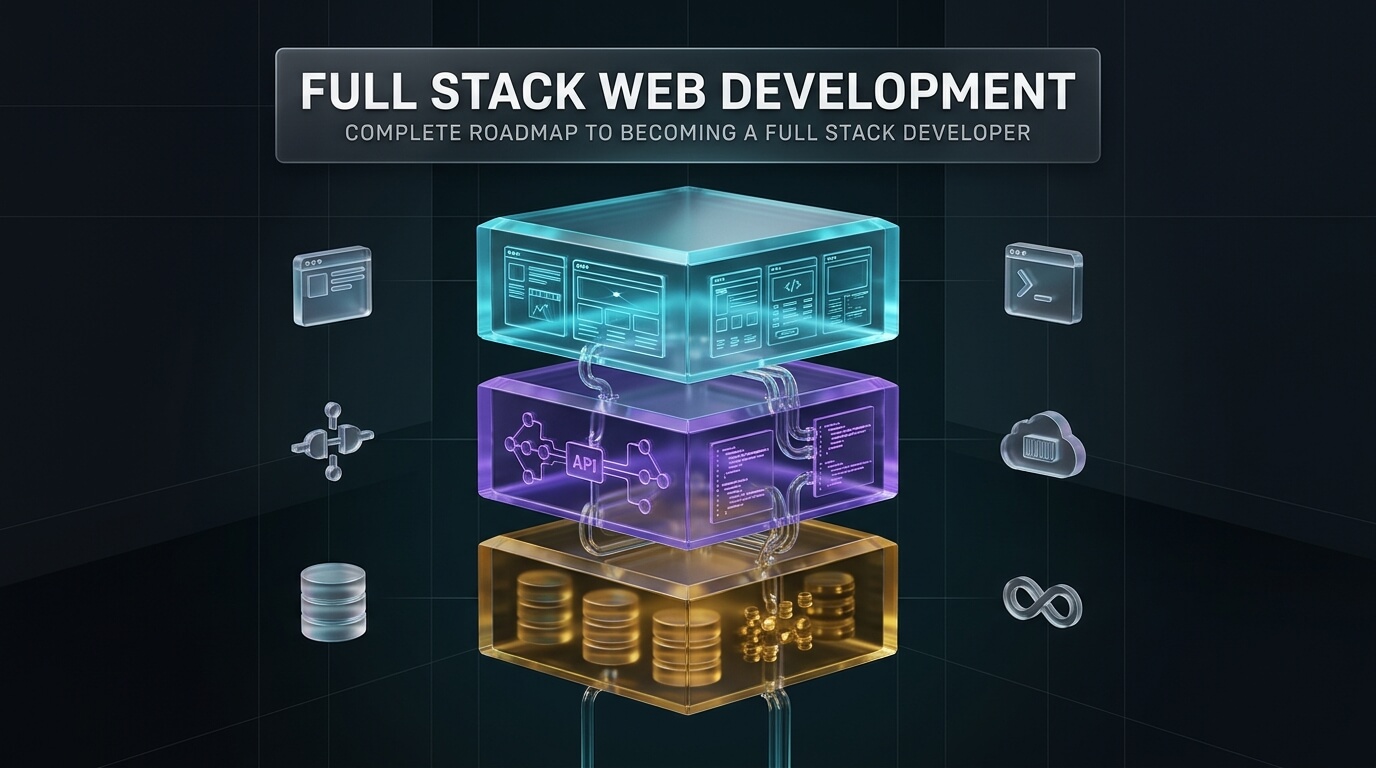
Full stack web development represents the complete mastery of modern web architecture. Full stack engineers bridge user interface design with scalable server infrastructure, constructing resilient digital products from client viewports down to database clusters and cloud deployments.
What Is Full Stack Web Development?
Every commercial digital application operates as a cohesive two-sided machine. The client side captures user input through engaging visual interfaces. The server side processes records, verifies business rules, and stores data in secure databases.
Full stack web development encompasses both ends of this digital spectrum. A full stack developer possesses the versatile expertise required to build interactive user interfaces, construct resilient backend APIs, design normalized databases, and deploy applications to global cloud networks.
Rather than working solely in an isolated domain, full stack engineers understand how changes in one layer impact the entire system. When adding an input field to a checkout form, they update client validation rules, modify backend API endpoints, adjust database schemas, and verify automated deployment scripts.
This comprehensive holistic perspective makes full stack developers exceptionally valuable assets for technology startups and enterprise corporations alike. They facilitate rapid prototyping, eliminate cross-department communication bottlenecks, and deliver complete software features autonomously.
Full stack engineers do not merely write code across two environments. They optimize systemic performance, eliminate duplicate business logic, and construct clean end-to-end type safety that prevents bugs before software reaches production users.
The Modern Full Stack Web Development Roadmap
Embarking on a career in full stack engineering requires a structured learning path. Navigating this vast landscape is straightforward when following an established full stack web development roadmap.
The roadmap progresses sequentially from foundational web markup to advanced cloud deployment architectures. Mastering each stage ensures deep comprehension before advancing to complex frameworks.
Stage 1: Frontend Foundations (HTML5, CSS3, JavaScript)
Every developer starts by mastering the core languages of the browser. Semantic HTML5 structures document trees, while modern CSS Flexbox and Grid engines arrange responsive layouts. Modern ECMAScript (JavaScript) introduces DOM manipulation, event handling, and asynchronous network requests via the fetch API.
Stage 2: Frontend Component Frameworks and TypeScript
Once comfortable with core JavaScript, developers adopt a component-driven framework such as React, Vue, or Angular. They learn state management paradigms, reusable component patterns, and responsive UI design systems. Adding TypeScript introduces static typing, preventing runtime bugs across client applications.
Stage 3: Server Runtimes, APIs, and Business Logic
The journey transitions to server environments using Node.js, Python, or Go. Developers learn to scaffold application servers, construct RESTful endpoints, parse JSON payloads, and implement secure JWT authentication flows. They handle error logging, input sanitization, and CORS headers.
Stage 4: Databases and Data Persistence (SQL & NoSQL)
Developers master data modeling, relational schema normalization, and ACID transaction rules using PostgreSQL or MySQL. They explore NoSQL document stores like MongoDB for unstructured data. Learning modern Object-Relational Mappers (ORMs) like Prisma streamlines database migrations and query execution.
Stage 5: DevOps, Containerization, and Cloud Deployment
The final phase covers deploying software to modern cloud infrastructure. Developers package applications inside Docker containers, manage environment variables, and configure continuous integration and continuous deployment (CI/CD) pipelines. They deploy scalable full-stack applications to platforms like Vercel, AWS, or Railway.
The Five-Stage Progression Matrix
- Client Layer: Semantic HTML5, CSS Grid, Modern JavaScript, and TypeScript.
- UI Framework Layer: React, Vue, or Next.js with Tailwind CSS styling systems.
- API & Logic Layer: Node.js, Express, Python FastAPI, and REST/GraphQL APIs.
- Persistence Layer: PostgreSQL, Redis caching, and Prisma ORM schemas.
- Cloud Operations: Docker, Git version control, CI/CD actions, and cloud hosting.
Essential Full Stack Web Development Skills
Becoming an accomplished full stack engineer requires a balance of client-side visual design craft and backend systems engineering. Employers prioritize candidates possessing well-rounded technical capabilities.
Mastering these foundational full stack web development skills guarantees long-term professional adaptability as tools evolve.
End-to-End Type Safety
Modern applications eliminate integration bugs by sharing TypeScript data schemas across both client and server layers. Modifying a database schema column automatically generates matching TypeScript interfaces for backend API responses and frontend component props. This compile-time verification catches breaking changes across multi-developer teams instantly.
Database Modeling and Performance Tuning
Full stack developers must design clean relational data models that prevent data anomalies. They understand foreign key constraints, table normalization, and indexing strategies. Knowing how to analyze query execution plans with EXPLAIN ANALYZE prevents database bottlenecks as user traffic scales.
API Design and Architecture
Engineers must decide when to implement RESTful conventions, flexible GraphQL schemas, or high-speed binary RPC protocols. They design predictable status codes, implement idempotent operations, and enforce strict rate limiting to protect backend servers from traffic overload.
DevOps and Infrastructure as Code
Modern software teams expect full stack developers to deploy and monitor their own applications. Engineers write Dockerfiles, configure reverse proxies like Nginx, set up SSL certificates, and monitor application performance metrics. Understanding cloud infrastructure ensures applications remain online around the clock.
Choosing a Full Stack Web Development Framework
Constructing decoupled applications with separate repositories for frontend and backend can introduce significant maintenance overhead. Modern software teams increasingly adopt an integrated full stack web development framework to unify their development workflow.
These unified meta-frameworks blend client-side component rendering with server-side API execution within a single codebase. They handle routing, data mutations, server-side streaming, and asset optimization out of the box.
Select Next.js for dominant React ecosystem support and frictionless Vercel cloud deployment. Choose Remix for exceptional web standards adherence and resilient form handling. Opt for Django or Ruby on Rails when building rapid database-driven prototypes with built-in administrative dashboards.
Top 8 Full Stack Web Development Tools and Platforms Reviewed
Professional full stack engineers rely on modern toolchains to build, test, and scale applications efficiently. Below is an exhaustive technical review of the eight most vital tools powering modern full stack engineering.
1. Next.js
Next.js is the leading full-stack React framework developed by Vercel. It bridges client-side user interfaces with scalable server-side execution within a unified developer workflow.
Its App Router introduces React Server Components, allowing developers to execute database queries directly inside UI components without creating intermediate API endpoints. Server Actions simplify form mutations by handling client submissions seamlessly on the server. Next.js also includes automated image optimization, font bundling, and incremental static regeneration (ISR) for blisteringly fast page load speeds.
Enterprises and startups alike deploy Next.js for high-performance e-commerce platforms, SaaS dashboards, and content portals. Its cohesive architecture drastically reduces developer context switching between frontend and backend codebases.
2. Remix
Remix is an innovative full-stack web framework built on modern Web Fetch standards and maintained by Shopify. It prioritizes browser fundamentals and resilient progressive enhancement.
Remix eliminates client-side state management overhead by leveraging native HTML form submissions and server loaders. When a user submits data, Remix processes the mutation on the server and revalidates all dependent on-screen data automatically. Its nested routing architecture allows distinct parts of a page to load and handle errors independently without breaking the entire layout.
Developers praise Remix for its blazing performance and near-zero client JavaScript requirements. It is an exceptional framework for building reliable, dynamic web applications that perform flawlessly even on low-bandwidth mobile networks.
3. Supabase
Supabase is an open-source Firebase alternative that provides a complete backend suite built entirely on PostgreSQL. It equips full stack developers with enterprise-grade server infrastructure in minutes.
Every Supabase project includes a dedicated PostgreSQL database, built-in user authentication with social logins, real-time WebSocket subscriptions, and scalable file storage. It automatically generates instant REST and GraphQL APIs directly from database schemas. Developers write database logic using standard SQL and Postgres Row Level Security (RLS) policies.
Full stack developers use Supabase to eliminate tedious backend boilerplate when launching new digital products. Its commitment to open-source PostgreSQL ensures zero vendor lock-in as platforms grow.
4. Prisma
Prisma is a next-generation Object-Relational Mapper (ORM) for Node.js and TypeScript that fundamentally redefines database access. It makes working with databases intuitive and completely type-safe.
Developers define their data models in a clean, human-readable schema file. Prisma CLI generates an automated TypeScript client with autocomplete specifically tailored to the project schema. Whenever a query executes, TypeScript verifies that all field names, relation joins, and data types match the database exactly.
Prisma also provides Prisma Migrate for declarative schema migrations and Prisma Studio for visually browsing and editing live records. It eliminates entire classes of runtime SQL syntax errors across full-stack codebases.
5. MongoDB
MongoDB is the world’s most widely adopted NoSQL document database. It provides flexible, schema-less data persistence that maps naturally to JSON-like objects in modern programming languages.
MongoDB stores records as dynamic BSON documents, allowing developers to evolve data models without running costly database migrations. Its distributed architecture supports horizontal scaling and automated data sharding across global server clusters. When paired with Express, React, and Node.js, it forms the popular MERN full-stack development stack.
Organizations handling high-velocity content catalogs, real-time logging streams, and mobile app backends rely heavily on MongoDB. Its intuitive document model accelerates agile prototyping cycles.
6. GraphQL
GraphQL is an open-source query language and server-side runtime for APIs created by Meta. It revolutionizes client-server data communication by giving clients complete control over data payloads.
Instead of hitting dozens of discrete REST endpoints, client applications send a single GraphQL query specifying the exact fields required. The server aggregates the data from multiple databases or microservices and returns a single, predictable JSON response. This eliminates network over-fetching and under-fetching, conserving valuable mobile cellular bandwidth.
GraphQL features strong typing through an explicit schema definition language (SDL). Frontend and backend teams can develop features in parallel based on a shared, mutually agreed API contract.
7. Vercel
Vercel is a modern cloud deployment and serverless hosting platform engineered specifically for frontend frameworks and full-stack applications. It provides the gold standard for developer deployment velocity.
Vercel integrates directly with GitHub, GitLab, and Bitbucket repositories. Every git push triggers an automated build that generates an isolated preview deployment URL for stakeholder review. When code merges to the main branch, Vercel deploys the application across a global edge network with automated SSL certificates and CDN asset caching.
Its Edge Middleware and serverless execution runtimes execute full-stack code with single-digit millisecond latency worldwide. Vercel removes infrastructure maintenance headaches, allowing engineering teams to focus purely on product development.
8. Git
Git is the distributed version control system that serves as the universal foundation for all modern software engineering collaboration. It tracks code modifications and coordinates work across distributed developer teams.
Git allows developers to create isolated feature branches to experiment with new full-stack features safely. Pull requests facilitate rigorous code reviews, automated CI/CD test runs, and architectural discussions before merging changes into production. Its distributed design ensures that every developer maintains a complete local clone of project history.
Platforms like GitHub and GitLab build on Git to provide project tracking, issue boards, and automated workflows. Mastering Git branching and merge conflict resolution is an indispensable prerequisite for every professional full stack developer.
Side-by-Side Comparison: Modern Full Stack Technologies
Evaluating your full-stack toolchain requires analyzing architectural roles, primary capabilities, and ideal application deployment contexts. The table below presents an objective side-by-side comparison of top full-stack tools.
| Tool / Platform | Stack Category | Primary Technical Benefit | Type Safety | Best Application Context |
|---|---|---|---|---|
| Next.js | Full-Stack Meta-Framework | Server Actions and Server Components. | Full TypeScript | High-scale SaaS platforms and modern web portals. |
| Remix | Full-Stack Web Framework | Web standards and nested route data loaders. | Full TypeScript | Dynamic web apps requiring fast mobile UX. |
| Supabase | Backend-as-a-Service (PostgreSQL) | Instant REST/GraphQL APIs and built-in auth. | Database Generated | Rapid prototyping and relational MVP development. |
| Prisma | Type-Safe Database ORM | Auto-generated TypeScript client and migrations. | End-to-End Strict | Node.js and Next.js database operations. |
| MongoDB | NoSQL Document Database | Flexible BSON document schemas and sharding. | Schema-less / Mongoose | High-volume unstructured data and mobile backends. |
| GraphQL | API Query Language | Declarative data fetching without over-fetching. | Schema Definition | Complex multi-client web and mobile apps. |
| Vercel | Global Serverless Cloud Host | Instant git deployments and preview staging URLs. | Platform Level | Production hosting for modern web applications. |
| Git | Distributed Version Control | Branching, code reviews, and distributed history. | Source Tracking | Universal team development and code versioning. |
Full Stack Web Development Career Outlook and Compensation
Demand for full stack engineering talent continues to grow across the global software industry. Companies recognize that hiring versatile engineers reduces communication overhead and accelerates feature delivery.
Consequently, full stack positions offer excellent career longevity and competitive compensation. Developers work across early-stage startups, high-growth scale-ups, and established multinational enterprises.
Market Compensation and Full Stack Web Development Salary
Salaries for full stack developers reflect their ability to deliver working software across multiple disciplines. In the United States, an entry-level full stack developer earns between $78,000 and $96,000 annually.
Mid-level engineers proficient in TypeScript, React, and cloud databases command between $115,000 and $155,000. Furthermore, senior full-stack architects leading cloud migrations and system design frequently earn upwards of $185,000 to $225,000, accompanied by meaningful equity grants. The average full stack web development salary ranks among the highest in software engineering.
Representative Annual Compensation Ranges
- Junior Full Stack Developer (0–2 Years): $75,000 – $96,000 base compensation.
- Mid-Level Full Stack Engineer (3–5 Years): $110,000 – $155,000 base compensation.
- Senior Full Stack Architect (5+ Years): $155,000 – $195,000 base compensation.
- Lead Staff Engineer / Principal: $200,000 – $250,000+ base compensation plus equity.
Educational Pathways: Bootcamp, Course, or Certification?
Aspiring developers have multiple educational routes available to launch their professional careers. Choosing between an intensive bootcamp, self-paced courses, or formal certifications depends on your learning style, budget, and timeline.
Attending a Full Stack Web Development Bootcamp
A full stack web development bootcamp provides an intensive, immersive learning experience lasting between twelve and twenty-four weeks. Students study forty to sixty hours per week under the direct mentorship of senior industry engineers.
Bootcamps prioritize hands-on project creation, pair programming, and mock technical interviews. Graduates finish with a robust GitHub portfolio showcasing complete full-stack web applications. However, bootcamps require significant financial investment and dedicated full-time commitment.
Enrolling in a Full Stack Web Development Course
For individuals balancing current employment or academic commitments, a self-paced full stack web development course offers superior flexibility. Platforms like freeCodeCamp, Udemy, and Coursera offer comprehensive curriculums at accessible price points.
Success in a self-paced course requires exceptional self-discipline and consistency. The best courses guide students through constructing real database-driven web applications rather than simply following along with basic code snippets.
Earning an Industry-Recognized Full Stack Web Development Certification
Achieving a verified full stack web development certification demonstrates structured competency and commitment to prospective employers. Cloud certifications from AWS (such as AWS Certified Developer) or Google Cloud prove your ability to deploy and manage production software.
While certifications alone rarely guarantee employment, pairing formal certifications with a compelling portfolio of working web applications significantly strengthens candidate resumes during initial recruiter screenings.
Commercial Full Stack Web Development Services and Agency Partnerships
Non-technical founders and established enterprises often require rapid software deployment without the lengthy delays of hiring an in-house engineering team. In these circumstances, partnering with a professional full stack web development company offers strategic agility.
These specialized software agencies deliver turnkey digital products, handling user interface design, server infrastructure, payment processing, and ongoing cloud maintenance.
Core Full Stack Web Development Services Offered by Agencies
Commercial agencies deliver comprehensive end-to-end solutions tailored to client business objectives:
- Turnkey MVP Engineering: Rapidly building and launching functional software products to validate market hypotheses.
- Enterprise SaaS Modernization: Upgrading dated monolithic applications into modern decoupled cloud architectures.
- Full Stack Web Development Services: Providing end-to-end engineering from Figma prototypes to production cloud deployment.
- Custom API & Integration Architecture: Connecting disparate third-party enterprise CRMs, ERPs, and payment gateways.
- Cloud Migration & Cost Optimization: Transitioning on-premises infrastructure to automated serverless environments.
Partnering with an experienced development firm ensures software launches on schedule with defensible cybersecurity and scalable performance foundations.
Hands-On Full Stack Web Development Tutorial: Building an End-to-End App
Theoretical knowledge becomes permanently solidified through hands-on coding practice. This practical full stack web development tutorial guides you through building a complete full-stack application connecting a React frontend with an Express API and PostgreSQL database.
Step 1: Scaffold the Monorepo Project Structure
Create a root project directory named fullstack-app and initialize git version control. Within the root directory, create two separate folders named client and server:
mkdir fullstack-app && cd fullstack-app
git init
mkdir client server
Step 2: Construct the Express Server API
Navigate into the server folder and initialize a Node.js project. Install Express, CORS, and dotenv to configure environment variables. Create an index.js file to serve customer data:
const express = require('express');
const cors = require('cors');
const app = express();
const PORT = process.env.PORT || 5000;

app.use(cors());
app.use(express.json());

// Mock customer database
const customers = [
  { id: 1, name: 'Acme Corp', tier: 'Enterprise' },
  { id: 2, name: 'Starlight Labs', tier: 'Startup' }
];

app.get('/api/customers', (req, res) => {
  res.json({ success: true, data: customers });
});

app.listen(PORT, () => console.log(`API running on port ${PORT}`));
Step 3: Scaffold the React Frontend Client
Navigate into the client directory and initialize a modern Vite React application using npm create vite@latest . — –template react-ts. Open src/App.tsx and fetch data from your backend API server:
import { useState, useEffect } from 'react';
interface Customer {
id: number;
name: string;
tier: string;
}
export function App() {
const [customers, setCustomers] = useState([]);
useEffect(() => {
fetch('http://localhost:5000/api/customers')
.then(res => res.json())
.then(result => setCustomers(result.data))
.catch(err => console.error(err));
}, []);
return (
Customer Directory
{customers.map(c => (
- {c.name} — {c.tier}
))}
);
}
Step 4: Launch and Verify Full Stack Integration
Start your backend server by running node index.js inside the server directory. In a separate terminal tab, navigate to the client folder and execute npm run dev to launch the Vite local server.
Open the provided local URL in your web browser. You will observe your React client successfully requesting records from your Express API and rendering the live customer directory. You have constructed a functional full-stack web application.
Future Trends Shaping Full Stack Engineering
The full stack engineering paradigm continues to evolve rapidly. The boundary separating frontend user interfaces from backend cloud infrastructure is becoming increasingly fluid.
Full-stack serverless architectures allow developers to deploy code without managing physical operating systems. Cloud functions spin up in milliseconds on demand and scale to zero when idle, drastically reducing operating overhead for technology businesses.
Furthermore, artificial intelligence agents integrated into developer workflows are accelerating coding velocity. AI models generate boilerplate SQL queries, scaffold component layouts, and write automated integration test suites. Full stack engineers who master these AI tools build feature-rich digital products faster than ever before.
Strategic Summary for Developers and Leaders
Full stack web development is one of the most rewarding and impactful disciplines in technology. Focus on mastering core web fundamentals, database normalization, and type-safe architectures. Maintaining curiosity across the entire software stack ensures your skills remain indispensable throughout your engineering career.
End-to-End Type Safety
Cloud DevOps
Monorepo Architecture vs Decoupled Polyrepo Setups
Organizing a full-stack codebase is a pivotal architectural decision for software engineering departments. Teams evaluate whether to maintain client and server code inside a unified monorepo or separate polyrepo repositories.
A monorepo stores frontend applications, backend services, shared TypeScript types, and UI component libraries inside a single version-controlled repository. Modern monorepo build tools like Turborepo and Nx orchestrate multi-package builds with intelligent caching. When an engineer updates a shared data interface, the monorepo verifies that both client and server packages build cleanly without breaking contracts.
Conversely, a polyrepo setup isolates frontend and backend code into separate Git repositories. This isolation allows independent versioning, isolated deployment permissions, and smaller individual repository sizes. However, coordinating breaking API changes across decoupled repositories requires disciplined semantic versioning and published client SDKs.
For modern startups and agile engineering teams, monorepos utilizing TypeScript have become the preferred standard. They drastically simplify local development workflows and ensure atomic commits across full-stack features.
Full-Stack Authentication and Session Architectures
Securing full-stack web applications requires careful coordination between client storage and server verification. Developers must defend against credential theft and unauthorized access.
Traditional server-rendered applications utilized stateful sessions stored in Redis or memory databases, transmitting session identifiers via HTTP-only cookies. While secure, stateful sessions can introduce scalability bottlenecks across distributed multi-region server clusters.
Stateless JSON Web Tokens (JWTs) resolve this scaling hurdle by encoding verified user identity claims directly inside cryptographic signatures. Modern full-stack architectures store refresh tokens in secure, HTTP-only, SameSite cookies to protect against Cross-Site Scripting (XSS) attacks. Meanwhile, short-lived access tokens reside in memory to authorize incoming API requests.
OAuth2 and OpenID Connect (OIDC) protocols allow full-stack applications to delegate authentication to trusted identity providers like Google, GitHub, and Apple. Implementing standard identity protocols ensures robust security while reducing user friction during account registration.
Data Synchronization and Real-Time Event Pipelines
Modern web users expect dynamic applications to update instantaneously without manual page refreshes. Real-time collaboration features like live document editing and chat messaging require persistent communication conduits.
WebSockets establish bidirectional, full-duplex communication channels between client browsers and application servers. Unlike standard HTTP requests that close immediately after response delivery, WebSocket connections remain continuously open. Servers push instant updates to connected clients with sub-ten-millisecond latency.
Server-Sent Events (SSE) provide an efficient alternative when data flow is predominantly unidirectional, such as streaming live stock prices or real-time AI generation responses. SSE utilizes standard HTTP connections to stream incoming records continuously to browser EventSource clients.
Full stack engineers implement optimistic UI updates on the client side to make interactions feel instantaneous. The client interface updates immediately upon user interaction, rolling back gracefully only if the background server mutation returns an error.
Automated Full-Stack Testing and Continuous Deployment
Maintaining high software quality across a multi-tier application requires comprehensive automated testing pipelines. Relying on manual testing invites devastating regressions into live user environments.
Full-stack developers implement unit tests to verify pure utility functions and business logic algorithms using Vitest or Jest. They write API contract tests to verify that endpoint status codes and JSON payloads conform to expected schemas.
End-to-End (E2E) testing frameworks like Playwright launch headless browser instances to execute realistic user scenarios across the entire technology stack. An automated E2E test logs into a test account, completes a shopping checkout flow, and verifies that the database records the cleared payment accurately.
These automated test suites run automatically inside GitHub Actions workflows on every pull request. Automated continuous deployment pipelines promote tested code to production servers seamlessly, enabling high-velocity software delivery.
Full-Stack Performance Auditing and Core Web Vitals
Building full-stack applications requires constant vigilance over runtime performance. A sluggish user experience directly damages customer retention, conversion rates, and organic search engine rankings.
Full stack engineers monitor Google Core Web Vitals metrics including Largest Contentful Paint (LCP), Interaction to Next Paint (INP), and Cumulative Layout Shift (CLS). They analyze database query bottlenecks, optimize API payload sizes, and implement aggressive caching headers.
Content Delivery Networks (CDNs) distribute static assets and cached API responses to edge server nodes across the globe. By serving assets physically close to visitors, full-stack applications achieve instant initial page loads regardless of geographical distance.
Pairing frontend asset optimization with efficient server-side database pooling ensures that full-stack platforms deliver sub-second response times even under heavy concurrent user traffic.
Frequently Asked Questions
How long does it take to become a full stack developer?
Most individuals require between nine to eighteen months of dedicated study to achieve entry-level full stack competency. Intensive bootcamp graduates often reach job readiness in four to six months of full-time, forty-hour weekly training.
Do full stack developers need to be experts in everything?
No, full stack developers typically follow a T-shaped skill profile. They maintain broad foundational competence across the entire software stack, while cultivating deep, specialized mastery in one or two domains like frontend React development or backend database engineering.
Which tech stack is best for beginners in 2027?
The PERN stack (PostgreSQL, Express, React, Node.js) and the Next.js full-stack framework with TypeScript are the most recommended paths. They teach transferable relational database fundamentals and utilize JavaScript across both client and server layers.
Can full stack developers work 100% remotely?
Yes, full stack web development is one of the most remote-friendly professions globally. Because full stack engineers can build and test complete features independently, distributed technology firms actively seek full stack developers for remote positions.