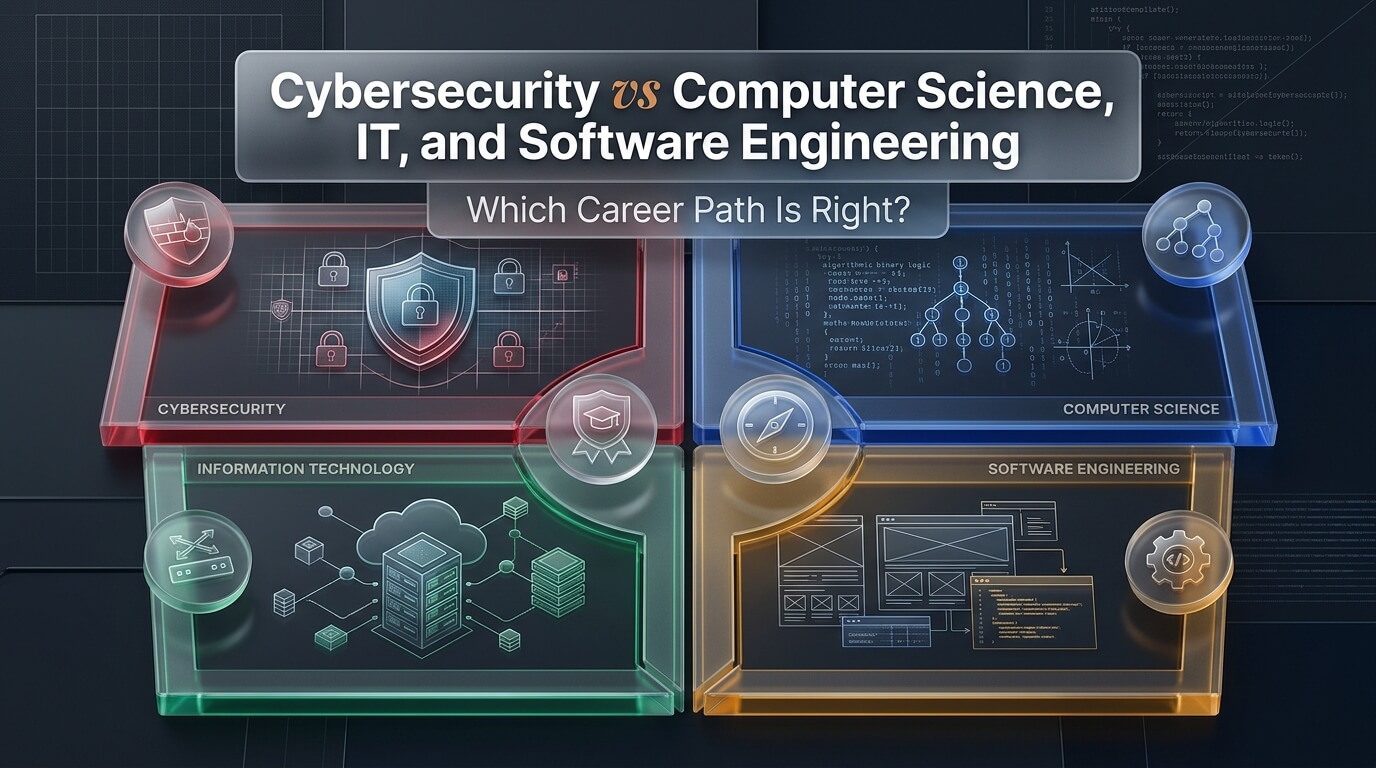
Entering the modern technology industry presents aspiring professionals with exciting yet challenging career decisions. The digital sector has matured into diverse, specialized disciplines, each offering unique daily challenges, intellectual rewards, and compensation trajectories. Understanding which technological pathway aligns with your natural strengths, work style, and long-term career aspirations is essential before investing thousands of dollars in university tuition or professional bootcamps.
Prospective students frequently evaluate the core trade-offs of cybersecurity vs computer science when selecting an undergraduate major. While computer science emphasizes theoretical computing principles, programming language architecture, and mathematical algorithms, cybersecurity concentrates on defending digital infrastructure against active human adversaries. Evaluating computer science vs cybersecurity reveals that both pathways deliver exceptional job security and rapid career growth.
Another common dilemma involves comparing cybersecurity vs it operations. Information technology specialists deploy, configure, and maintain the daily computing systems that power modern businesses. In contrast, security defenders evaluate those same systems to identify software flaws, misconfigured access rules, and potential attack paths. Understanding the nuances of cybersecurity vs information technology and information technology vs cybersecurity helps newcomers determine whether they prefer systems administration or threat analysis.
Software development represents another compelling career alternative. Analyzing cybersecurity vs software engineering demonstrates the fundamental difference between building applications and protecting them from exploitation. Deciding whether to pursue cybersecurity or computer science, or choosing between cybersecurity or software engineer roles, depends heavily on whether you enjoy authoring creative feature code or hunting elusive adversary indicators.
Terminology often confuses aspiring defenders. Many newcomers question whether to use the single word cybersecurity or cyber security. The linguistic comparison of cybersecurity vs cyber security and cybersecurity versus cyber security is purely a stylistic convention; both terms describe the exact same technical discipline, though formal industry frameworks standardize on the compound single word. Navigating these distinctions empowers you to build an intentional, fulfilling technology career.
Key Takeaways: Technology Career Comparison
- Computer science provides the broadest theoretical foundation, opening doors to software development, machine learning, and security engineering.
- Cybersecurity is an adversarial, mission-driven discipline focused on threat hunting, incident response, and risk governance.
- Information technology focuses on system availability, network uptime, and employee enablement, while security enforces protective boundaries.
- Software engineering prioritizes building functional features at scale, whereas application security specialists audit code for exploitable flaws.
Cybersecurity vs. Computer Science: Theory vs. Defensive Application
The relationship between computer science and cybersecurity is foundational. Computer science is the parent academic discipline that birthed modern computing, while cybersecurity emerged as a critical specialization dedicated to safeguarding digital systems from malicious compromise.
When evaluating a cybersecurity vs computer science degree, academic curricula differ substantially. Computer science degree programs require rigorous coursework in discrete mathematics, calculus, compiler design, data structures, and algorithmic complexity. Students spend hundreds of hours programming in languages like C++, Java, and Python. In contrast, dedicated cybersecurity degree programs emphasize network protocols, digital forensics, defensive architecture, ethical hacking, and regulatory compliance.
Career versatility represents a primary advantage of computer science. A computer science graduate possesses the technical versatility to work as a backend software developer, cloud systems architect, mobile application engineer, or machine learning specialist. Transitioning from computer science into security engineering is relatively straightforward because understanding how software is built makes identifying security flaws intuitive. Conversely, cybersecurity graduates enter the workforce with specialized defensive skills, qualifying immediately for frontline security analyst and threat detection roles.
Analyzing cybersecurity vs computer science salary outcomes demonstrates strong earning power across both fields. Entry-level software engineers and security analysts earn comparable starting wages, typically ranging from $75,000 to $95,000 annually. Mid-career professionals in both tracks routinely achieve six-figure compensation. Specialized roles, such as principal security architects and senior software engineering managers, frequently command compensation packages exceeding two hundred thousand dollars in major technology corridors.
Choosing between these two academic majors depends on your core intellectual interests. If you enjoy solving abstract mathematical equations, optimizing algorithm execution speeds, and building software systems from the ground up, computer science is the superior choice. If you are fascinated by adversary psychology, investigative threat analysis, and mission-driven network defense, a dedicated cybersecurity degree offers immediate vocational relevance.
Cybersecurity vs. Information Technology: Operations vs. Protection
Information technology and cybersecurity work closely together in every modern enterprise. However, their primary operational mandates, daily performance metrics, and professional mindsets differ significantly.
Information technology professionals are builders and enablers. IT specialists manage corporate hardware inventories, deploy cloud productivity suites, configure local area networks, and provide technical helpdesk support to employees. Their primary operational objective is maximizing system availability, network speed, and user convenience. When an employee cannot access an application, IT engineers work quickly to eliminate friction and restore access.
In contrast, cybersecurity professionals operate as guardians and auditors. Security teams view systems through an adversarial lens, analyzing how authorized features could be manipulated by hostile threat actors. While IT seeks to make system access effortless, security enforces necessary friction through multi-factor authentication, least-privilege permissions, and network segmentation. Understanding this natural dynamic between cybersecurity vs it security helps organizations balance operational productivity with robust protection.
Terminology distinctions also exist within enterprise governance. When analyzing cybersecurity vs information security and cybersecurity versus information security, subtle scope boundaries emerge. Information security is a broad umbrella discipline that protects data in all formats, including physical paper files, intellectual property binders, and building access controls. Cybersecurity represents the digital domain within information security, focusing strictly on protecting digital assets, networks, and cloud infrastructure from electronic attack.
Similarly, examining cybersecurity vs network security reveals another structural relationship. Network security is a focused technical specialization within the broader cyber defense discipline. Network security engineers configure hardware firewalls, monitor packet routing protocols, and design virtual private networks. Cybersecurity encompasses network security while extending protection to endpoints, cloud identity directories, application code, and employee behavioral training.
Career transitions between IT and security are exceptionally common. Many elite penetration testers and incident responders started their technology careers on IT help desks or as junior network administrators. Working in general IT builds deep practical familiarity with Windows Active Directory, Linux terminal administration, and networking switches, providing an invaluable technical foundation for subsequent security specializations.
Cybersecurity vs. Software Engineering: Building vs. Securing
Software engineering and cybersecurity represent two sides of the modern digital architecture coin. Software engineers write the functional code that drives the modern economy, while application security professionals ensure that code cannot be weaponized against users.
A career in cybersecurity or software development offers distinctly different daily experiences. Software engineers spend their working days authoring new application features, refactoring database schemas, integrating third-party APIs, and fixing user interface bugs. Their productivity is measured by development velocity, feature release cycles, and code reliability. They collaborate closely with product managers and visual designers to create intuitive digital experiences.
Conversely, application security professionals analyze code through an adversarial perspective. Known as AppSec engineers or DevSecOps specialists, these professionals conduct static code analysis, execute dynamic vulnerability scans, and perform manual code reviews to identify structural security flaws. They hunt for input validation oversights, SQL injection vulnerabilities, cross-site scripting bugs, and insecure cryptographic libraries before code deploys into live production.
Deciding between cybersecurity or software engineer pathways depends heavily on your creative preferences. If you derive immense satisfaction from designing user-facing applications, watching clean code compile, and seeing customers interact with features you built, software engineering is exceptionally rewarding. If you prefer deconstructing applications, identifying obscure edge-case vulnerabilities, and outthinking malicious threat actors, cybersecurity offers thrilling intellectual stimulation.
The rise of DevSecOps has bridged the gap between these disciplines. Forward-thinking enterprises now embed security testing directly into continuous integration and continuous deployment pipelines. Software engineers who cultivate security awareness, often called security champions, are among the most sought-after and highly compensated professionals in modern technology.
Specialized Intersections: Data Science, Cloud, and AI
As technological ecosystems expand, the boundaries between traditional disciplines continue to blur. Modern cybersecurity operations increasingly rely on sophisticated data analytics, elastic cloud infrastructure, and artificial intelligence to monitor global attack surfaces.
Evaluating cybersecurity vs data analytics reveals powerful operational synergies. Data analysts collect, clean, and visualize large datasets to identify commercial trends and optimize business operations. In the security operations center, security analysts apply these identical statistical techniques to massive SIEM log repositories, identifying abnormal authentication patterns and suspicious data exfiltration spikes. Deciding between cybersecurity or data analytics depends on whether you prefer business intelligence reporting or digital threat forensics.
Analyzing cybersecurity vs data science highlights the growing role of advanced predictive modeling. Data scientists author complex machine learning algorithms that parse unstructured data. In modern cybersecurity, data science powers behavioral anomaly engines, automated spam classifiers, and predictive threat scoring systems that detect zero-day attacks before traditional signatures are authored.
Cloud infrastructure represents another critical technological intersection. Comparing cybersecurity vs cloud computing demonstrates that cloud engineers design, deploy, and scale virtual servers, serverless functions, and container clusters. Cloud security architects ensure that these elastic environments enforce robust identity governance, encrypted storage, and automated posture compliance. Deciding between cybersecurity or cloud computing comes down to whether you prefer managing scalable cloud infrastructure or auditing its defensive integrity.
The intersection of cybersecurity vs ai has emerged as the most transformative technological frontier. Cyber adversaries leverage generative AI to automate vulnerability reconnaissance and synthesize convincing phishing lures. In response, defensive platforms utilize artificial intelligence to correlate threat telemetry across millions of endpoints in milliseconds, executing autonomous remediation workflows at machine speed. Professionals who master both artificial intelligence fundamentals and defensive security principles will command premier industry value throughout the coming decade.
Pro-Tip: Choosing the Optimal Educational Pathway for Long-Term Career Mobility
If you are undecided between fields, consider pursuing a foundational computer science degree while earning specialized cybersecurity credentials like CompTIA Security+ or Certified Ethical Hacker independently. A computer science degree provides broad market credibility and flexible career mobility across all technology sectors, while industry certifications validate hands-on defensive capabilities to hiring managers.
In-Depth Reviews: Top 8 Technology Disciplines & Career Pathways
Choosing an optimal career path requires evaluating core technical focuses, daily work activities, entry prerequisites, and professional growth opportunities. Below are comprehensive reviews of eight premier technological career pathways shaping the modern digital economy.
1. Computer Science
Computer science is the foundational study of computation, algorithmic theory, and information architecture. Governed globally by academic authorities like the Association for Computing Machinery, computer science examines how software and hardware interact to solve complex computational challenges.
Practitioners in computer science design efficient data structures, author operating system kernels, optimize database query engines, and study theoretical computing limits. The discipline emphasizes rigorous mathematics, logical problem-solving, and abstract thinking, providing a universal foundation applicable to every computing subfield.
Computer science offers unmatched career versatility. Graduates qualify for diverse roles across software engineering, quantitative finance, cloud architecture, and artificial intelligence research. Its broad market recognition ensures strong employment demand across every major industry sector.
The academic curriculum is notoriously demanding, requiring extensive dedication to higher mathematics, calculus, and theoretical proofs. Students seeking immediate hands-on technical configuration skills may find the heavy theoretical focus initially abstract.
2. Information Technology
Information technology focuses on the practical application, deployment, and management of computer systems, networks, and business software. Championed by industry organizations like CompTIA, IT professionals ensure that organizational technology functions reliably and securely.
Daily responsibilities include configuring enterprise workstations, administering cloud productivity suites like Microsoft 365, managing local area networks, troubleshooting hardware failures, and supporting non-technical staff. IT professionals serve as the operational backbone that keeps modern businesses productive.
Information technology provides accessible entry pathways into the technology industry. Aspiring professionals can enter the workforce quickly by earning foundational vendor-neutral certifications like CompTIA A+ and Network+, gaining valuable hands-on experience without requiring four-year university degrees.
Entry-level helpdesk positions often feature repetitive troubleshooting tasks and modest starting wages. Career advancement requires ongoing self-study and continuous credential advancement into specialized systems engineering or cloud administration tracks.
3. Software Engineering
Software engineering is the systematic, disciplined application of engineering principles to the design, development, testing, and maintenance of software applications. Guided by institutions like the IEEE Computer Society, it transforms conceptual user requirements into scalable software products.
Software engineers write clean, maintainable code across diverse programming languages, design relational and NoSQL database schemas, construct web microservices, and collaborate within agile development sprints. They focus on delivering high-performance features that delight end users while maintaining system scalability.
The profession offers exceptional creative fulfillment and strong market compensation. Software engineers enjoy the satisfaction of building tangible applications used by millions of people, accompanied by lucrative stock compensation packages at leading technology enterprises.
The field moves at breakneck speed, requiring continuous learning as programming frameworks, frontend libraries, and cloud deployment pipelines evolve rapidly. In addition, debugging complex distributed systems under tight release deadlines can introduce significant workplace stress.
4. Cybersecurity
Cybersecurity is the specialized practice of defending computer systems, networks, cloud environments, and sensitive data from digital attacks, unauthorized access, and malicious destruction. Guided by national authorities like the Cybersecurity and Infrastructure Security Agency, it protects digital infrastructure.
Defenders monitor security telemetry inside security operations centers, analyze malware binaries, configure next-generation firewalls, conduct penetration tests, and coordinate emergency incident response containment. Cybersecurity is an inherently adversarial discipline that pits defenders directly against human threat actors.
The discipline delivers high purpose, strong job security, and recession-resistant stability. A global shortage of skilled cybersecurity professionals guarantees robust hiring demand, excellent compensation, and rapid promotion avenues for motivated defenders.
Security operations can be intensely stressful, particularly during active ransomware emergencies and weekend incident containment shifts. Frontline defenders must manage potential alert fatigue while maintaining constant vigilance against novel threat vectors.
5. Information Security
Information security is the overarching governance discipline dedicated to protecting the confidentiality, integrity, and availability of organizational information across all media formats. Guided by professional associations like ISACA, it aligns security safeguards with enterprise risk management.
Information security professionals author corporate security policies, manage regulatory compliance audits (such as ISO 27001, SOC 2, and HIPAA), evaluate third-party vendor risks, and conduct executive risk assessments. They serve as the vital bridge connecting technical IT controls with corporate boardroom governance.
The field provides exceptional executive visibility, regular interaction with senior corporate leadership, and clear promotion avenues to Director of Risk and Chief Information Security Officer positions. It offers an ideal career path for professionals who enjoy policy, risk strategy, and compliance management.
The role involves substantial documentation, audit evidence gathering, and administrative reporting. Practitioners seeking deep hands-on code reverse engineering or manual penetration testing may find the heavy governance focus less technically satisfying.
6. Data Science
Data science combines mathematics, statistics, computer science, and domain expertise to extract meaningful insights and predictive models from large, complex datasets. Supported by professional bodies like the American Statistical Association, it powers modern algorithmic decision-making.
Data scientists clean raw data streams, construct machine learning pipelines, author predictive algorithms, and present visual business intelligence dashboards to corporate stakeholders. In security contexts, data scientists build behavioral models that detect insider threats and automated botnet traffic.
Data science offers tremendous intellectual prestige, excellent compensation, and direct strategic influence on corporate business models. The versatility of data science skills allows practitioners to transition smoothly across tech, healthcare, finance, and marketing sectors.
Entering data science typically requires advanced educational credentials, often including a master’s degree or doctorate in statistics, mathematics, or computer science. In addition, practitioners frequently spend significant time on tedious data cleaning and pipeline formatting tasks.
7. Cloud Computing
Cloud computing encompasses the design, architecture, deployment, and operational management of scalable computing resources delivered on demand over the internet. Guided by organizations like the Cloud Security Alliance, it represents the foundational infrastructure of modern computing.
Cloud engineers and architects manage multi-cloud infrastructure on Amazon Web Services, Microsoft Azure, and Google Cloud Platform. They configure virtual networks, deploy Kubernetes container clusters, automate infrastructure provisioning using Terraform, and optimize cloud consumption costs.
The global corporate migration to public and hybrid cloud infrastructure ensures massive ongoing hiring demand. Skilled cloud architects command top-tier enterprise salaries and enjoy high operational autonomy across modern remote-first technology organizations.
Managing elastic cloud infrastructure requires constant vigilance to prevent accidental configuration errors that expose cloud storage buckets to public internet scraping. Rapid feature releases from cloud providers demand continuous learning and ongoing certification renewal.
8. Artificial Intelligence
Artificial intelligence is the advanced computational science dedicated to building machines and algorithms capable of performing tasks that traditionally require human intelligence. Guided by academic bodies like the Association for the Advancement of Artificial Intelligence, it represents computing’s frontier.
AI engineers design deep neural networks, fine-tune large language models, build computer vision systems, and deploy autonomous decision agents. In cybersecurity, AI engineers author automated threat correlation systems and synthesize adaptive defensive algorithms that neutralize attacks at machine speed.
Artificial intelligence is the most rapidly expanding sector of the global technology economy, commanding extraordinary venture capital investment, unprecedented media visibility, and industry-leading compensation packages for top research talent.
The field demands elite mathematical proficiency, extensive linear algebra comprehension, and advanced programming skills. In addition, rapid technological shifts mean that models and frameworks can become obsolete within months, requiring relentless technical adaptation.
Comprehensive Career Path Comparison Matrix
Comparing technology disciplines requires evaluating primary technical focuses, daily operational activities, core skill prerequisites, median compensation benchmarks, and ideal personality characteristics. The matrix below highlights key attributes across the eight reviewed technological pathways.
| Discipline / Pathway | Core Focus | Primary Daily Activities | Key Skills Required | Median US Salary | Ideal Personality Fit |
|---|---|---|---|---|---|
| Computer Science | Theoretical Computation & Algorithms | Algorithm Design & System Architecture | Mathematics, Logic & C++/Java | $115,000 – $145,000 | Analytical, Abstract Problem Solver |
| Information Technology | Systems Administration & User Enablement | Network Setup, Cloud Tools & Support | Hardware, Networking & Customer Service | $75,000 – $105,000 | Helpful, Practical Systems Builder |
| Software Engineering | Application Development & Architecture | Writing Code, Unit Testing & Sprints | Python, JavaScript, Git & Databases | $120,000 – $160,000 | Creative Builder & Product Focused |
| Cybersecurity | Digital Defense & Adversary Neutralization | Threat Hunting, SIEM Triage & Forensics | Linux, Networking, Pen-Testing & SIEM | $110,000 – $145,000 | Investigative, Resilient & Inquisitive |
| Information Security | Enterprise Risk Governance & Compliance | Policy Drafting, Auditing & Vendor Reviews | Risk Frameworks, ISO 27001 & Communication | $115,000 – $150,000 | Diplomatic, Methodical & Strategic |
| Data Science | Predictive Modeling & Statistical Analysis | Data Wrangling, Machine Learning & Dashboards | Statistics, Python/R & SQL/Pandas | $118,000 – $155,000 | Curious, Quantitative & Data Driven |
| Cloud Computing | Elastic Cloud Infrastructure & DevOps | Provisioning AWS/Azure & Container Pipelines | Terraform, Docker, Kubernetes & CI/CD | $125,000 – $165,000 | Architectural, Systems Thinker & Scaler |
| Artificial Intelligence | Neural Networks & Autonomous Systems | Model Training, Fine-Tuning & Evaluation | Deep Learning, PyTorch & Linear Algebra | $135,000 – $185,000+ | Visionary, Mathematically Elite & Agile |
Each reviewed pathway delivers exceptional long-term career viability. Selecting the right direction depends on aligning your innate personality strengths and intellectual curiosities with the day-to-day realities of each discipline.
Decision Framework: Which Path Matches Your Career Goals?
Choosing an optimal career path requires structured self-reflection. Instead of selecting a discipline solely based on entry-level salary rankings or marketing hype, evaluate the exact type of daily problems you genuinely enjoy solving.
Ask yourself fundamental questions regarding your personal work style. Do you thrive in high-pressure, unpredictable environments where you investigate active emergencies and outthink hostile adversaries? If so, cybersecurity offers an exhilarating calling. If you prefer quiet, deep concentration where you spend uninterrupted hours designing elegant software architectures, software engineering or computer science will provide greater daily satisfaction.
Consider your preferred educational timeline and financial resources. If you need to enter the workforce quickly with minimal tuition debt, earning foundational information technology certifications provides an accessible springboard into corporate environments. If you possess a strong mathematical background and are willing to complete an intensive four-year university program, computer science or data science provides universal long-term career flexibility.
Remember that technology career pathways are not irreversible dead-end choices. The modern technology industry celebrates cross-functional mobility. A professional who starts as a software engineer can easily transition into application security. Similarly, an IT systems administrator can transition into cloud architecture or threat operations. Focus on building solid computing fundamentals, and your career will evolve naturally alongside your interests.
Checklist: Choosing Your Ideal Technology Career Pathway
- Evaluate whether you prefer building creative software features (engineering) or defending infrastructure (cybersecurity).
- Assess your mathematical comfort level: computer science, data science, and AI require heavy calculus and statistics.
- Determine your desired entry speed: IT certifications offer rapid entry, while academic degrees offer broader versatility.
- Experiment with free online introductory tutorials in Python programming, Linux terminal commands, and networking fundamentals.
- Engage with working professionals across each discipline via local meetups or LinkedIn informational interviews.
- Select a foundational pathway that aligns with your innate strengths, knowing that cross-discipline transitions remain accessible throughout your career.
Frequently Asked Questions: Cybersecurity vs. Related Fields
Is cybersecurity harder to learn than computer science?
Cybersecurity is not necessarily harder, but it requires broader operational knowledge across operating systems, networking protocols, hardware configurations, and human social engineering. Computer science is more mathematically intensive, demanding deep mastery of abstract algorithmic proofs and computational theory.
Can you get into cybersecurity with a computer science degree?
Yes, a computer science degree is highly respected in the cybersecurity industry. Understanding programming fundamentals, data structures, and operating system mechanics makes learning offensive penetration testing and defensive engineering intuitive and straightforward.
Does software engineering pay more than cybersecurity?
Software engineering and cybersecurity offer comparable compensation bands across most corporate tiers. While senior software engineers at major Silicon Valley tech giants often receive higher equity stock grants, specialized cybersecurity architects and ethical hackers command equivalent top-tier compensation.
Can I transition from IT helpdesk into cybersecurity?
Yes, transitioning from IT helpdesk into cybersecurity is one of the most common career trajectories. Working in IT provides hands-on familiarity with user access permissions, networking switches, Windows Active Directory, and endpoint troubleshooting, creating an ideal foundation for security operations.
Is a dedicated cybersecurity degree better than a general IT degree?
A dedicated cybersecurity degree provides immediate vocational relevance for specialized roles in security operations centers, digital forensics, and penetration testing. A general IT degree offers broader administrative versatility across cloud administration, systems engineering, and database management.
Final Verdict: Finding Your Perfect Technology Niche
The technology industry is not a winner-take-all contest between competing disciplines. Computer science, information technology, software engineering, cybersecurity, data science, and cloud computing are interdependent pillars of a connected digital world. Without software engineers, there would be no applications to use; without IT professionals, there would be no networks to connect them; and without cybersecurity defenders, those systems would crumble under adversary attack.
Choosing the right path requires matching your personal passions with professional realities. Embrace computer science for foundational theory and engineering versatility, pursue software engineering to build creative user applications, select information technology for practical systems enablement, and dedicate yourself to cybersecurity if you crave the mission-driven thrill of defending society against malicious adversaries.
Whichever direction you choose, continuous curiosity, disciplined problem-solving, and a commitment to lifelong learning will serve as your ultimate competitive advantages. With dedicated study and proactive hands-on experimentation, you can build a fulfilling, resilient, and highly rewarding career in the digital economy.