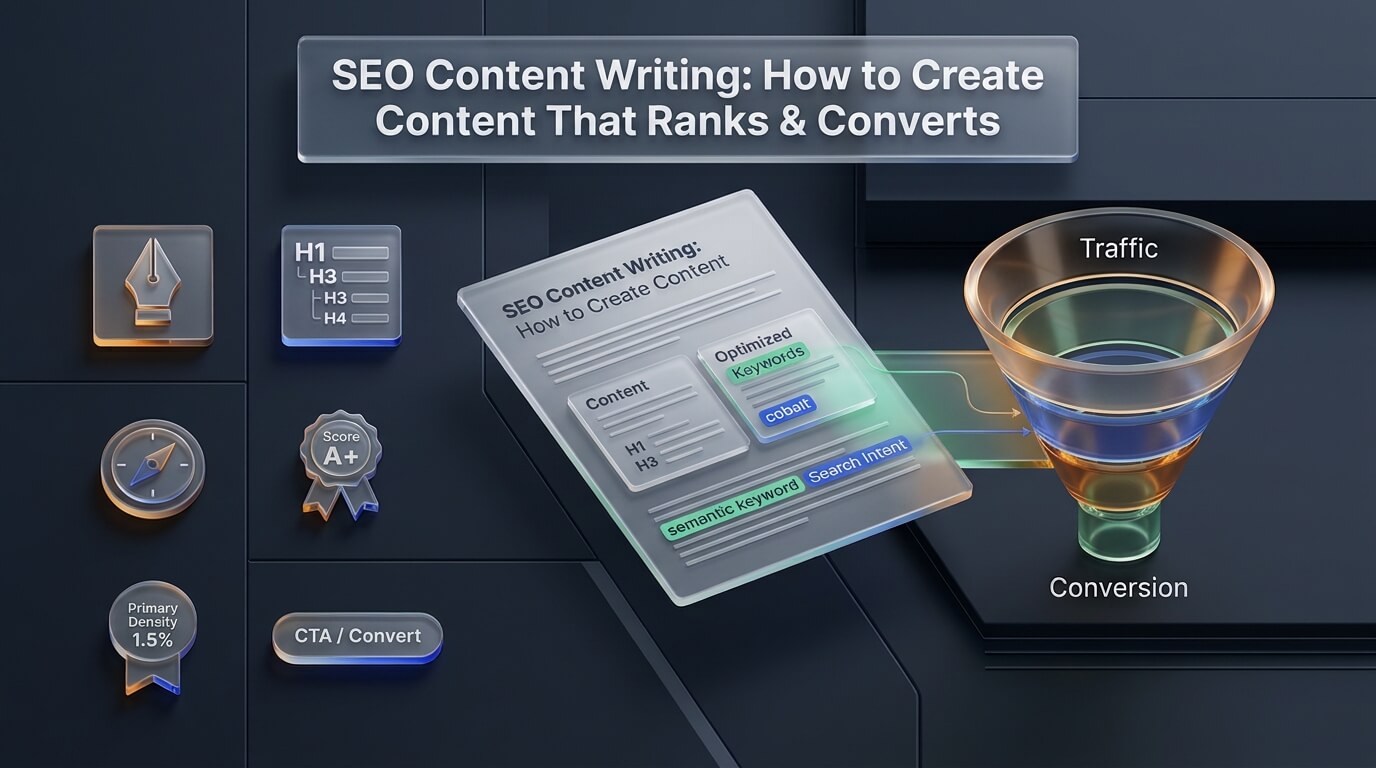
Introduction: The Dual Art of SEO Content Writing and Copywriting
Many digital marketers believe they must choose between two opposing goals. They think they must either write for search engine algorithms or write for human readers. This belief is completely wrong. Today, the most successful online content accomplishes both goals at the same time.
This powerful combination is known as seo content writing. High-quality seo content writing attracts steady organic search traffic from search engines while engaging and converting visitors. At the same time, skilled seo copywriting guides readers toward meaningful business action, such as buying a product, booking a call, or joining an email list.
Search engines like Google have evolved to reward clear, helpful writing. Modern ranking algorithms prioritize content that answers user questions quickly and accurately. If your articles are full of keyword stuffing or dull corporate jargon, readers leave within seconds. High bounce rates signal to search engines that your content failed to satisfy the reader.
Whether you work as an in-house seo content writer or run your own business, mastering seo writing is an essential skill. Understanding how to structure articles, research search intent, and craft persuasive calls to action gives you a major advantage online.
This comprehensive guide explains how to build a winning seo content strategy. We cover practical keyword research, on-page content optimization, persuasive copywriting frameworks, and the best software tools. Follow these proven methods to create articles that rank at the top of search results and turn casual visitors into loyal customers.
Key Takeaways: SEO Content Writing Essentials
- Balance Search and Conversion: Great content attracts organic search visitors and motivates them to take concrete business actions.
- Satisfy User Search Intent: Identify whether readers want quick facts, detailed tutorials, or product comparisons before writing a single word.
- Structure for Fast Reading: Short sentences, two-sentence paragraphs, bold headers, and comparison tables keep mobile readers engaged.
- Answer Questions Immediately: State the core answer in the opening paragraph to satisfy search algorithms and reduce bounce rates.
- Refresh Content Regularly: Updating existing articles with fresh data often generates faster traffic gains than publishing new posts.
Search Intent and Keyword Research: The Foundation of Content That Ranks
Every successful piece of content starts with deep keyword research. However, looking at search volume alone is not enough. A skilled seo writer must understand the exact intent behind the search query. Search intent describes what the user actually hopes to accomplish when typing a phrase into Google.
Search queries generally fall into four distinct intent categories. Informational queries seek quick knowledge, such as how to bake sourdough bread. Navigational queries seek a specific website, such as Twitter login. Commercial queries compare options, such as best running shoes for marathon training. Transactional queries signal ready-to-buy intent, such as buy espresso machine online.
Matching your content format to user search intent is essential. If a user searches for a comparison between two software platforms, an informational history of software will fail to rank. Instead, you must deliver a structured review with a clear pros and cons table. Studying the top five ranking pages on Google reveals the exact format searchers prefer.
Modern search engines also evaluate topical authority. Rather than publishing isolated blog posts, build organized topic clusters. A topic cluster consists of a broad pillar page supported by detailed subtopic articles. Connecting these related articles with internal links signals to search engines that your website possesses deep subject expertise.
An experienced seo copywriter searches for long-tail keywords that competitors overlook. Long-tail search phrases often have lower search volume but much higher conversion intent. Capturing these targeted queries allows new websites to win profitable traffic quickly.
Anatomy of a High-Ranking Article: On-Page Architecture and Readability
The structure of your article matters just as much as your research. Modern web users scan pages quickly on mobile devices rather than reading every word. If your article looks like a solid wall of tiny text, visitors hit the back button immediately.
Start with a compelling title tag and main H1 heading. Your H1 should include your primary target keyword near the beginning. It should also promise a clear, specific benefit that motivates users to click from search results.
Hook the reader in the opening sentence. Avoid long philosophical introductions that waste the reader’s time. State the main answer or core insight within the first two paragraphs. Providing immediate value satisfies the user’s curiosity and prevents them from returning to search results.
Organize your body text using clear H2 and H3 subheadings. Each subheading should clearly describe the section that follows. Including secondary keywords and question phrases in your subheadings helps search crawlers understand your page structure.
Keep your sentences short and your vocabulary simple. Aim for an average sentence length of eight to fourteen words. Use two to three sentences per paragraph. This clean layout creates plenty of white space and keeps mobile reading effortless.
Break up dense information using bullet points, comparison tables, and highlighted callout boxes. Visual elements provide visual variety and make key takeaways easy to remember. Search engines often extract these formatted lists directly into featured snippets at the top of search pages.
Finally, incorporate strategic internal and external links. Link out to authoritative research studies and official resources to support your claims. Link internally to related guides on your own website to guide readers deeper into your content ecosystem.
SEO Copywriting Tactics That Drive High-Value Conversions
Ranking on page one of Google is only half the battle. If visitors read your article and leave without taking action, your organic traffic produces no business value. This is where professional seo copywriting makes all the difference.
While traditional content writing focuses on educating the audience, copywriting focuses on persuasion. Combining both disciplines allows you to educate readers while guiding them toward your products or services. You can achieve this by addressing real customer pain points throughout your article.
Use proven copywriting frameworks to structure your arguments. The Problem, Agitate, Solve framework works exceptionally well inside educational articles. First, identify the frustrating problem your reader faces. Next, explain why ignoring the problem leads to lost time or money. Finally, present your solution as the most effective path forward.
Weave contextual calls to action naturally into your paragraphs. Rather than relying solely on generic banners at the bottom of the page, place text links directly inside relevant discussions. For example, if you mention email automation, link directly to your email template guide or software trial.
Address common buyer objections openly within your text. Explain why your approach works better than alternatives and back up your claims with specific case study numbers. Transparent, honest advice builds deep credibility and makes readers eager to work with you.
SEO Content Optimization: Auditing and Refreshing Existing Content
Creating new content is exciting, but updating existing articles often yields faster traffic gains. Search algorithms favor fresh, accurate information. Over time, published articles suffer from content decay as statistics change and competitors publish newer guides.
The discipline of seo content optimization involves reviewing underperforming articles and improving their search relevance. Start by checking your analytics to identify articles that rank on page two of Google. These pages already have search traction and can often jump to page one with minor updates.
Begin your refresh by updating outdated statistics, broken links, and old product screenshots. Look for thin sections that fail to answer common user questions and expand them with clear, practical steps. Adding fresh examples and updated screenshots signals to search engines that your guide is maintained actively.
Use modern content optimization software to identify missing semantic keywords. These tools analyze the top-ranking competitors for your target query and suggest related concepts you should address. Incorporating these natural terms strengthens your topical depth without keyword stuffing.
Review the search intent of your target query once a year. If search engines have shifted from showing broad overviews to showing step-by-step checklists, update your article layout to match. Adapting to evolving user preferences protects your search rankings over the long term.
The Business of SEO Writing: Careers, Agencies, and Freelancing
Demand for skilled writers who understand search engine marketing has never been higher. Businesses across every industry need high-performing content to build their brands and generate sales. This demand has created thriving career paths in seo content creation and seo content marketing.
Many writers work in-house as a full-time seo content writer or content marketing manager. In these roles, writers collaborate with product teams, design marketing campaigns, and oversee publishing calendars. In-house positions offer stable compensation and deep familiarity with a single brand.
Other professionals operate as an independent seo freelance writer or consultant. Freelance writers enjoy the freedom to choose their clients, work from anywhere, and set their own project rates. Top freelance writers who demonstrate strong organic traffic results command premium fees for their work.
Digital marketing agencies also hire specialized writers to deliver professional seo content services to corporate clients. Agency writers handle diverse topics ranging from legal software to boutique travel. This fast-paced environment provides rapid skill development and broad industry exposure.
To succeed as an seo freelance writer, focus on proving business results rather than just counting words. Track how your articles rank on Google and calculate the leads they generate for clients. Presenting concrete case studies allows you to charge premium project rates rather than low hourly fees.
Pro-Tip: Write for Skimmers, Scanners, and Deep Readers
Different visitors consume content in different ways. Skimmers read only headings and callout boxes. Scanners read bullet lists and bold text. Deep readers read every word. Formatting your article with clear visual breaks satisfies all three reading styles and keeps overall time-on-page high.
Essential SEO Writing Tips for Writers and Marketers
Applying consistent writing habits ensures every article you publish performs at its best. Follow these seven core seo writing tips to sharpen your craft and improve your organic search results.
First, craft magnetic title tags that balance target keywords with curiosity. Your title should include your exact primary keyword while promising a clear benefit. Testing different headline variations helps you find titles that earn the highest click-through rates from search results.
Second, write clear and conversational sentences. Avoid complex academic language and convoluted sentence clauses. Read your drafts out loud to catch awkward phrasing. If a sentence feels clumsy when spoken, rewrite it using simple, everyday words.
Third, make your subheadings informative and engaging. Instead of generic headers like Overview or Details, use benefit-driven subheadings like Five Proven Tactics to Cut Customer Acquisition Costs. Informative subheadings help readers find the exact answers they need quickly.
Fourth, optimize your images with descriptive file names and alt text. Name your image files with clear, hyphenated keywords before uploading them. Add natural alt text that describes the image accurately for visually impaired readers and search crawlers.
Fifth, practice intentional internal linking. When publishing a new article, link back to two or three related guides already on your site. Then, edit those older articles to add links pointing forward to your new post. This two-way linking distributes search authority evenly across your website.
Sixth, conclude your articles with a clear and actionable next step. Invite readers to download a free template, read a related tutorial, or contact your team for a consultation. Giving readers a clear path forward keeps them engaged with your brand.
Seventh, use professional editing tools to catch grammatical errors and passive voice. Polished, error-free writing builds trust with readers and enhances your professional reputation.
Top 8 Platforms & Tools for SEO Content Writing & Copywriting
Producing high-ranking content consistently requires a reliable toolkit. Below are eight top platforms that help writers research keywords, analyze competitors, and polish prose.
1. Surfer SEO
Surfer SEO is a leading content intelligence and on-page optimization platform. It analyzes hundreds of on-page signals across top-ranking Google competitors to generate real-time writing guidelines.
The platform provides a content editor that scores your article as you write. It suggests ideal word counts, heading structures, image counts, and relevant semantic keywords. Surfer also offers a powerful topical audit tool that identifies content gaps across your website.
Its clean integration with Google Docs and WordPress makes collaborative writing and client reviews fast and organized.
Surfer SEO is standard software for content marketing teams and agencies focused on search rankings.
2. Clearscope
Clearscope is an enterprise-grade content optimization platform trusted by major media brands and high-growth technology companies. It helps writers produce comprehensive, highly relevant content.
The tool uses advanced natural language processing to evaluate search intent and topical relevance. It provides a letter grade for your draft based on how thoroughly you cover essential subject concepts. Clearscope also tracks search intent shifts and content performance over time.
Its minimalist interface keeps writers focused on quality prose without distracting clutter or artificial scoring rules.
Clearscope is the gold standard for enterprise marketing teams prioritizing editorial depth and search authority.
3. Grammarly
Grammarly is an indispensable digital writing assistant used by millions of professionals worldwide. It checks grammar, spelling, punctuation, and sentence clarity in real time.
The software highlights wordy sentences, passive voice, and repetitive vocabulary. It offers one-click rewrites that make complex thoughts concise and easy to read. Grammarly also includes an integrated tone detector that ensures your writing matches your brand voice.
Its browser extensions and desktop apps work across email, web content management systems, and word processors.
Grammarly is essential software for any writer committed to delivering clean, error-free prose.
4. Hemingway Editor
Hemingway Editor is a beloved readability tool designed to make writing bold, clear, and punchy. It evaluates drafts and assigns a clear reading grade level.
The app highlights hard-to-read sentences in yellow and very hard-to-read sentences in red. It also flags passive voice, unnecessary adverbs, and overly complex words. By removing these editorial weaknesses, writers can easily achieve an accessible reading score.
The tool is available as a free browser application and a paid desktop program that works offline.
Hemingway Editor is the perfect tool for writers striving to meet strict readability and clarity standards.
5. Semrush Writing Assistant
Semrush Writing Assistant is a specialized writing addon provided by the renowned Semrush search intelligence platform. It connects directly into Google Docs, Microsoft Word, and WordPress.
The tool evaluates your draft against top-ranking rivals for your target keyword. It scores your content on four key dimensions: SEO quality, readability, originality, and tone of voice consistency. It also checks for accidental plagiarism and suggests semantic keywords to include.
Its real-time suggestions help writers optimize articles without toggling between separate browser windows.
This addon is ideal for marketing teams that already utilize the Semrush software ecosystem.
6. Frase
Frase is an intuitive AI-powered research and content optimization platform designed to speed up the writing process. It helps teams create comprehensive content briefs in minutes.
The software scrapes and summarizes top-ranking Google search results for any query. It highlights common questions people ask on Reddit, Quora, and Google People Also Ask boxes. Frase also provides a content editor with real-time topic scoring and heading suggestions.
Its automated outline builder saves hours of preliminary research and ensures no critical subtopics are missed.
Frase is a fantastic, cost-effective choice for solo writers and boutique digital marketing agencies.
7. MarketMuse
MarketMuse is an advanced AI content strategy and planning platform that uses patented topic modeling technology. It helps publishers build unmatched topical authority.
The platform audits your entire website to identify content strengths, weaknesses, and keyword gaps. It predicts the difficulty of ranking for specific topics based on your existing site authority. Its content briefs provide detailed subtopic outlines, target word counts, and internal linking recommendations.
The software helps content leaders make data-backed editorial decisions and avoid publishing low-impact articles.
MarketMuse is ideal for enterprise publishers managing large content libraries across competitive industries.
8. Copy.ai
Copy.ai is a versatile marketing copywriting platform powered by modern artificial intelligence. It helps writers overcome writer’s block and brainstorm creative angles.
The platform generates engaging article outlines, persuasive email subject lines, social media blurbs, and product descriptions. Writers can train the tool on custom brand voices to ensure consistent messaging across all marketing channels. Its automated workflows streamline repetitive content repurposing tasks.
Its clean dashboard allows team members to collaborate on drafts and share custom prompt templates.
Copy.ai is an excellent companion for marketers who need to produce high volumes of creative copy quickly.
Platform Comparison: SEO Content Writing & Copywriting Tools
The table below summarizes the primary strengths, target users, and pricing models for each leading platform.
Strategic Roadmap: 5-Step SEO Content Creation Checklist
Executing an organized content workflow guarantees dependable search performance. Follow this five-step checklist every time you write a new article.
Checklist: Step-by-Step SEO Writing Plan
- Map Search Intent and Keywords: Identify the primary keyword, search intent, and supporting semantic queries before outlining.
- Analyze Top-Ranking Competitors: Review the top five search results to determine ideal word count, heading structures, and media formats.
- Draft with Human Cadence: Write short sentences and two-sentence paragraphs using simple, everyday words.
- Optimize Formatting and Headings: Use clear H2 and H3 tags, comparison tables, and bullet lists to make key takeaways easy to scan.
- Integrate Internal Links and CTAs: Link to related guides on your site and provide a clear, helpful call to action for the reader.
Frequently Asked Questions About SEO Content Writing & Copywriting
Here are clear answers to common questions writers, marketers, and business owners ask about creating high-ranking content.
What is the difference between SEO content writing and SEO copywriting?
SEO content writing focuses on educating readers and ranking for informational search queries through articles and guides. SEO copywriting focuses on persuading readers to take specific business actions, such as purchasing a product or booking a consultation.
How long should an SEO article be to rank well on Google?
Article length should match the depth required to answer the search query completely. Simple questions might need eight hundred words, while complex technical guides require three thousand words. Analyze the average length of the top three ranking competitors to determine the best target.
Does keyword density still matter for modern search algorithms?
No. Modern search engines use natural language processing to understand topical concepts rather than counting keyword percentages. Repeating a keyword unnaturally harms readability and can trigger ranking penalties. Use your primary keyword naturally and focus on thorough topic coverage.
Can artificial intelligence replace human SEO content writers?
AI tools can help with research, outline generation, and rough drafting. However, human writers are essential for providing firsthand experience, empathetic storytelling, factual verification, and unique editorial perspectives. Search engines reward genuine personal expertise over generic automated text.
What is search intent and why is it more important than search volume?
Search intent describes what a user actually wants when searching online. Even if a keyword has ten thousand monthly searches, your article will not rank if its format does not match what users want. Satisfying search intent is the single most critical ranking factor in modern search.
How many internal links should an SEO article include?
Most articles benefit from three to five relevant internal links per thousand words. Ensure that every link adds genuine context and points to a related resource that helps the reader continue their research.
What is the best way to improve the readability score of an article?
Improve readability by breaking long compound sentences into two shorter sentences. Replace multisyllabic academic words with simple everyday alternatives. Keep paragraphs limited to two or three sentences to create plenty of white space on mobile screens.
How do comparison tables and callout boxes help search rankings?
Comparison tables and callout boxes organize information into clean, readable formats. They increase time on page and reduce bounce rates. In addition, search engines frequently pull structured tables directly into featured snippets at the top of search results.
How often should existing blog posts be updated for SEO?
Audit and update high-priority articles once every six to twelve months. Refresh outdated statistics, replace broken links, and expand sections to address new industry developments. Regular updates protect your rankings against newer competitor articles.
How can a freelance writer prove the return on investment of SEO writing?
Freelance writers can prove value by tracking organic keyword rankings, monthly page views, and conversion events for the articles they write. Sharing before-and-after traffic screenshots in client case studies justifies premium project pricing.
What is the biggest mistake beginners make in SEO blog writing?
The most common mistake is writing long, fluffy introductions that fail to answer the user’s question quickly. Beginners often bury the key answer halfway down the page. Always deliver the main answer in the opening paragraph to hook the reader immediately.
How does voice search impact SEO article writing?
Voice search queries tend to be longer and sound like natural spoken questions. Writers can optimize for voice search by including conversational questions in H2 headings and providing concise, direct answers right below each heading.
What tools are most important for a beginner SEO copywriter?
Beginners should start with Google Docs or WordPress paired with a free readability checker like Hemingway Editor. Adding Google Search Console and a keyword research tool provides all the insights needed to create high-ranking content.
How do topical clusters improve search rankings?
Topical clusters connect related articles through organized internal links. When search engines crawl a cluster, they recognize comprehensive subject coverage. This collective authority helps every article in the cluster rank higher than isolated posts.
Final Verdict: The Enduring Power of High-Quality Writing
Search algorithms will continue to evolve, but the core foundation of search marketing remains unchanged. People search the internet to solve real problems, learn new skills, and make informed purchase decisions. Businesses that invest in thoughtful, user-focused seo content writing consistently win top search positions.
By blending deep keyword research with persuasive copywriting frameworks and clean formatting, you create content that serves both search engines and human readers. Start applying these clear writing principles today to build lasting digital authority and grow a loyal, engaged audience.